

A Glimpse of Japanese Ideals
A Glimpse of Japanese Ideals
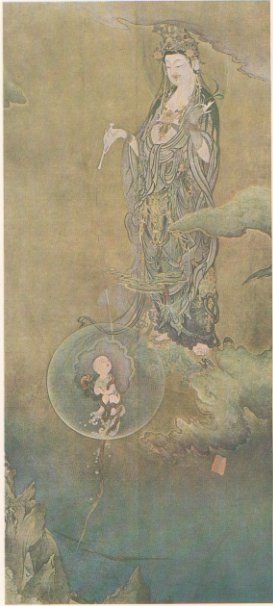
"Merciful Mother Kwannon." Painted on silk by Kano Hogai. In the possession of the Tokyo School of Arts.
A Glimpse of Japanese Ideals
Lectures on Japanese Art and Culture
By
JIRO HARADA, Lit.D.
KOKUSAI BUNKA SHINKOKAI
[The Society for International Cultural Relations]
TOKYO, JAPAN
1937
FIRST PUBLISHED IN DECEMBER 1937
BY KOKUSAI BUNKA SHINKOKAI
PRINTED IN JAPAN
ALL RIGHTS RESERVED
DEDICATED
TO
THE FRIENDS OF JAPAN
IN AMERICA
By the Same Author (in English)
Examples of Japanese Art in the Imperial Household Museum, Tokyo, 1934
English Catalogue of Treasures in the Imperial Repository, Shoso-in, Tokyo, 1932
Gardens of Japan, London, 1928
The Lesson of Japanese Architecture, London, 1936
Hiroshige, London, 1929
Dr. Jiro Harada was born in 1878 in the westernmost end of the mainland of Japan. Still in his early teens he left for the United States of America where, after a regular high school education, he studied at the University of California. Returning to Japan in 1905, he taught in two government colleges until 1916. l He was sent by the government to London as an attache of His Imperial Majesty's Commission to the Japan-British Exhibition, 1909-1911; to San Francisco, California, as one of His Majesty's Commissioners to the Panama-Pacific International Exposition, 1914-1916; to Genoa, Italy, in 1920, to Geneva, Switzerland, in 1921, 1925, 1928, as an attache of the Government Delegates to the International Labour Conferences. He lectured on Japanese art and culture at universities in U. S. A., 1935-1936. Since 1911 he has been corresponding editor for "The Studio," London, and since 1925 a member of the staff of the Imperial Household Museum, Tokyo. His works are as listed above. The Fourteenth Edition of the ENCYCLOPAEDIA BRITANlCA includes contributions from his pen, such as, "Japanese Architecture," "Japanese Sculpture," "Japanese Interior Decoration," "Japanese Ivory Carving," "Japanese Gardens," "Tea Ceremony," and "Noh Drama."
FOREWORD
ONE of our eminent scholars has said that as we increase our knowledge of other peoples we realize more and more that all the higher interests of a nation are in harmony with the welfare of the whole human race, and that those interests are best served by cooperation among the nations of the earth. This statement is true, and we are firmly convinced that only through the mutual exchange among nations of their respective cultural ideas is to be found the secret of sympathetic understanding indispensable for mutual Re specs and good-will. Especially at this time do we feel called upon to make our utmost endeavours to cultivate a sense of interdependence and unity among the nations of the world, and to avail ourselves of every opportunity to develop mutual understanding in the higher realms of thought and spirit. We must strive to establish among the peoples of the world a common mental attitude of mutual help, without which we shall never be able to enjoy lasting happiness and prosperity.
Many have been led to think that the civilizations of the East and of the West are opposed, being independent entities incapable of harmonization. This is untrue. We tend to forget that the differences of the two cultures are not absolute but relative, that they are often complementary, and that they contribute to the enrichment of human relationships. We realize increasingly that the world has so shrunk, in point of communication time, thereby reducing our concepts of space, that it has become impossible for most of us to think of the world as composed of geographical fragments. Economic interdependence has become so real that it is impossible for any nation to live in isolation. Indeed, it is high time now to extend this growing sense of interdependence from the economic to the cultural field, so that our interdependence may be realized more thoroughly and our cultural affinity may be established more firmly. We believe that the diffusion of the products both of the earth and of the mind, the sharing of the good things of life by the whole world, should be the foremost aim of that new and better civilize tion for which we all strive. To realize this aim, we should endeavour to correlate the large body of Eastern and Western ideas which reveal themselves in all the phases of our varied national activities, for the enrichment of that body of common knowledge which all of us need, and in which we may find a solid basis of mutual understanding, interdependence and unity.
As one means towards such an end, in 1935 a visiting lectureship in Japanese art and culture was arranged bet ween the University of Oregon and the Kokusai Bunka Shinkokai. Mr. Jiro Harada of the Imperial Household Museum of Tokyo was sent to the University of Oregon in September of that year to give a regular course of lectures during the fall and winter quarters. During the spring of 1936 he gave several brief series of lectures at many leading universities and colleges on the Pacific Coast. Following a return to the University of Oregon for the summer session, he went to Boston to give a series of lectures at the Museum of Fine Arts in association with the Special Loan Exhibition of Art Treasures from Japan held in conjunction with the Harvard Tercentenary Celebration.
At the Fifty-eighth Commencement Exercises of the University of Oregon, on June 1, 1936, the honorary degree of Doctor of Letters was conferred upon Mr. Harada in recognition of his profound scholarship and the consummate skill and understanding with which he had interpreted the culture of the East to the people of America.
We are now much pleased to be able to present in this volume a few of the numerous lectures delivered by Dr. Harada during his twelve months in America. It is our hope that this volume will go far towards giving not merely a glimpse, as the title of the book modestly claims, but a real insight into Japanese ideals.
Chairman, Board of Directors, Kokusai Bunka Shinkokai
PREFACE
AT the invitation of the University of Oregon and by the courtesy of the Kokusai Bunka Shinkokai, to which the present volume owes its appearance, I went to America in the autumn of 1935 and returned to Japan about a year ago, thirteen months later. For two academic terms covering six months I gave a course of lectures on Japanese Art and Culture at the University of Oregon. During the remainder of my stay in America, I was privileged to give a course at the Summer Session of that University, and to lecture at different Universities, Art Museums, and other public and private institutions, terminating my visit by delivering a series of lectures at the Museum of Fine Arts in Boston, where a special loan exhibition of art treasures from Japan was most successfully held in connection with the Tercentenary Celebration of Harvard University. I feel extremely grateful for the splendid opportunities afforded me and the sincere encouragement given at these lectures, enabling me to render with pleasure my services, however meagre, towards the establishment of a better understanding of Japan in America.
The present volume contains only a few of the lectures given in America, and no one can feel more keenly than I their shortcomings, their inadequacy for publication, though I have been reluctantly prevailed upon to send them out in the present form. The lectures presented in this volume are designated as having been given at particular institutions, and most of them bear a touch of local colour, yet not one of them appears here exactly as it was delivered at the given institution; they are all somewhat revised and much greater in length than was possible for presentation on a single occasion. Usually the speaker improves his lecture on his way home immediately after delivering it, and his best lectures generally remain undelivered. So I feel now, as I send the copy to press, as if I were still riding home from the lecture hall.
Perhaps it is not out of place here to acknowledge the profound debt of gratitude I owe in connection with this publication to the Kokusai Bunka Shinkokai, especially to Count Ayske Kabayama, Chairman of the Board of Directors, who greatly encouraged me and even went so far as to write a kind foreword, and to Mr. Setsuichi Aoki, General Secretary, who spared no pains in bringing out this work in the best form possible. For their kindness in allowing the insertion of so many collotype and colour reproductions and otherwise beautifying this volume more than my humble text deserves and far beyond my original expectations, I am deeply indebted to the Society. Thanks are extended also to the Imperial Household Department for allowing the use of photographs of the Imperial Gardens in Kyoto, to the Imperial Household Museum in Tokyo for permitting the reproduction of a number of rare objects including those of the Shoso-in and to the temples, public institutions and private individuals whose treasures and gardens have been included in the illustrations of this book.
Full of shortcomings as it is, I cannot help hoping that this volume may afford a glimpse, if no more than that, of the ideals and accomplishments of the Japanese people.
TOKYO, October, 1937
Imperial Household Museum
Contents
-
Some Characteristics of the Japanese Which Have Influenced their Art
Delivered at the University of California, Berkeley, Cal. -
Certain Ideals and Characteristics of Japanese Art
Delivered at the Museum of Fine Arts, Boston, Mass. -
A Survey of Japanese Archaeology
Delivered at the University of Oregon, Eugene, Ore. -
Japanese Architecture
Delivered at the Seattle Art Museum, Seattle, Wash. -
The Shoso-in, or Imperial Repository at Nara
Delivered at the Art Institute of Chicago, Chicago, Ill. -
Ancient Lacquer in Japan
Delivered at Mills College, Oakland, Cal. -
Japanese Gardens
Delivered at Oregon State Agricultural College, Corvallis, Ore. -
Noh Drama
Delivered at the University of Washington, Seattle, Wash. -
Japanese Appreciation of and Attitudes Toward Art
Delivered at the University of Washington, Seattle, Wash. -
Cha-no-yu as a Cultural Institution
Delivered at the Fogg Art Museum, Harvard University, Cambridge, Mass. -
Fallen Leaves
Delivered before the Rotary Club, Eugene, Ore.