

IX. JAPANESE APPRECIATION OF AND ATTITUDES TOWARD ART
Delivered at the University of Washington
ART objects may be appreciated from many angles, though a certain definite attitude towards them may be considered desirable in our study. The study of the art history of Japan requires, broadly speaking, an investigation into the culture and politics, manners and customs, and geographical and physical conditions of the country. This will afford us a useful background, but it will be more directly profitable for us to know something of the lives of the artists and the development of the schools which they have constituted. And finally it becomes imperative for us in actual investigation to come in direct contact with the works of art themselves. In dealing with artifacts it will be well to bear in mind that each object may be approached from several viewpoints. The following four points may be taken as showing a classification of the values we commonly attach to an art object:
1. Archaeological or curiological value. The older the object is the more precious it is considered by some, especially when the product belongs to the realm of archaeology. An object is valued by some people simply because it is old, odd, or rare, regardless of its scientific or artistic importance. This cannot be the most important phase of the art object.
2. Historical value. There seem to be two meanings involved here: (a) the historical value that comes from the importance the object occupies in the history of the people in general and art in particular, and (b) that which comes from the history of the object itself. In the former case the rarer the object the more highly it is prized, or when it is the unique example of an important link in the history of art or of the people. Again, greater importance may be attached to one particular object, though it may be inferior to others, simply because it has pioneered the way for others. The importance of another may be based on its own interesting history: by whom, how, and in what circumstances it was made, and to whose collection it has belonged, etc. This particular phase of the art value has been given undue emphasis by many of our experts, especially those of the tea cult, or men devoted to cha-no-yu, who are intimately acquainted with art objects. They value very highly the testimonials given by predecessors in the form of certificates accompanying the object or written on the box containing it, be it a painting, utensil, or ornament.
3. Practical value. This is one of the pitfalls into which many of our tea devotees fall. They value an object only when they can use it in some manner or form in cha-no-yu, be it as an ornament on the tokonoma or as a utensil in the preparation of tea or in serving the meal in connection with ceremonial tea, as the case may be. If an object can be fitted into the scheme of things in ceremonial tea, its value, artistic or otherwise, is greatly multiplied, but if it can not, its value dwindles almost to nothing.
4. Aesthetic value, or the intrinsic value. An art object may be of the greatest artistic importance regardless of whether it is old or new, rare or abundant, useful or not, with or without historical background. While these other different values mentioned above may be taken into consideration more or less as a background, the aesthetic value of each object will concern us more vitally than other values when we come in direct contact with the art object itself. It is important for us to know whether it is beautiful or not, by what medium the beauty was expressed (whether in wood, bronze, clay or other material), and what mode or style of expression was employed (whether divine or human figures in sculpture, or flowers or birds or animals in painting).
When we look at an art object we should appreciate its beauty pure and simple, giving due regard to its age or history as a background, and to whether it is unique or one of many duplicates. Giving its aesthetic value the greatest importance, we bring in as the background other values, such as archaeological, curiological, historical and practical, in due measure, to make a true estimation of its art in our study. We have to be rather careful so that we may not be misguided or prejudiced by less important phases of art. In dealing with art objects in the study of art we must first judge of the beauty of the object and then elucidate therefrom how and to what degree the aesthetic sense of the people is expressed therein.
What, then, is beauty? What is the Japanese criterion of beauty? I am unable to deal with this phase of the subject this evening, for I wish to tell you on this occasion, the last opportunity I have on my present trip, something of the extent of our people's appreciation of art, some stories illustrating how much art has entered into the life of the people.
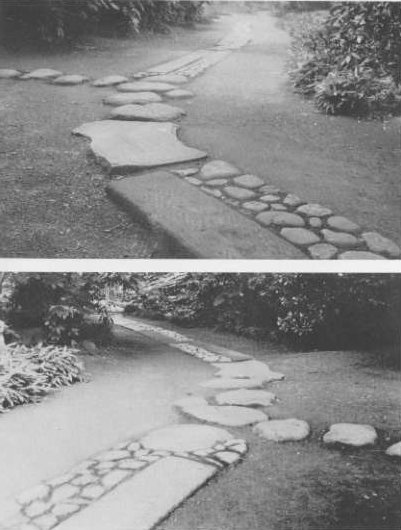
Rikyu, one of the greatest Japanese connoisseurs, who lived three and a half centuries ago, gave definite instructions to his pupils on how to lay stepping stones in the garden. In those instructions he insisted on giving 60% to utilitarian considerations as against 40% to artistic. In other words, according to this great master, the stepping stones should be so laid that they may give the assurance of safety to the person walking over them and that they may be useful in getting us from one place in the garden to another. But this was not enough. They should be artistic as well in their layout; they should contribute some artistic value to the garden in which they are laid. Instead of laying these stones in a straight line, we should give certain turns and changes of direction to the path to avoid a rigid appearance. Instead of arranging all the stones lengthwise in order to get the maximum value of each stone from the utility standpoint, we should employ differently shaped stones in various ways and especially in such a way as to correlate them in an artistic sequence and give variation to the whole. He insisted that there should be an artistic effect, but at the same time that still greater emphasis should be placed on the useful element in the laying of these stepping stones. (Plate 104.)
Oribe, another great connoisseur who lived shortly after Rikyu, reversed the ratio and insisted on 60% of artistic against 40% of the useful element, thus giving greater importance to art than to use.
There is thus seen to be a difference in the ratio of importance given by different masters to the artistic and useful sides of the stepping stones in the garden, but in both cases considerable importance is given to art.
I have referred to the opinion of these two great tea-masters because consideration has often been accorded to common utensils similar to that we give to a phase of landscape architecture. For centuries, especially during the last four hundred years or so, our people have been taught to appreciate the beauty in objects we have around us in the house. They have been taught to appreciate the beauty, not only in art objects which are enjoyed merely as such, but also in objects that we use in the daily routine of life. Much of such delicate taste has been developed by our cha-no-yu, which is commonly known as ceremonial tea, though in reality it is a cult or institution founded upon the adoration of beauty in the ordinary acts of everyday life, such as making the fire, sweeping the floor, serving a meal, drinking tea, and so forth. I have no time now to go into the details of this institution, but let me impress upon you the fact that cha-no-yu is mainly responsible for the aesthetic culture of our people during the last few centuries.
The tea-masters were persons of very high aesthetic taste and they insistently demanded artistic utensils for the entertainment of guests at tea, which usually included a meal. Let me enumerate some of the things required for the cha-no-yu. They used a hanging scroll showing a painting or a calligraph in order to give food for meditation, and a vase or basket for flowers - these for decoration of the alcove in the room. They also used a basket or box of some kind to carry charcoal into the room where the tea was made; a brazier, except in winter when the hearth was used, to build a fire in; a pair of tiny iron or bronze tongs to arrange the charcoal and live coals with; an iron kettle to boil the water in; a feather brush to tidy up around the brazier or hearth with after the fire was properly made. They needed a ceramic jar or wooden vessel to hold the fresh water; a bamboo dipper with which to take hot water from the kettle and refill the same with fresh water from the jar, and a small stand of metal, pottery, or bamboo, to rest the kettle lid on when hot water was being used. They also employed a small ceramic or lacquer box to hold incense, which was burnt when the charcoal fire was in order; a ceramic or wooden caddy to contain the pulverized tea; a ceramic bowl for preparing and drinking the tea in; a scoop made of a bent piece of bamboo or of ivory for scooping out the pulverized tea from the caddy; a bamboo whisk for whipping or stirring the pulverized tea in a bowl of hot water, and a metal or ceramic vessel for holding the waste water used for rinsing the tea bowl. In order that the aesthetic sense of the guests might be satisfied, each of these objects must be not only artistic and pleasing in itself, but also harmonious and agreeable the one to the other in texture, shape, colour and design. These things must be carefully considered and the choice of articles made accordingly. (Plates 105, 106, 107, 108 109 110 111 112 113 114 115 116 117 118 119 120 .)
Not only must the objects used in the alcove and in connection with the making of tea be carefully thought of, but also the dishes in which the meal is served. This meal is generally served on an individual tray or small stand of plain lacquer, which holds the lacquer bowls for rice and soup and three or four pottery dishes of artistic shape and varying decoration for other kinds of food. The boiled white rice comes in a covered bowl of black lacquer and the meal is eaten with chopsticks. The food as served should be a feast to the eyes as well as to the palate. The dishes, their shape and decoration, should be beautiful and harmonious in their relation to the food they contain and pleasing also when empty, for all the dishes are left on the tray until the end. They should be in keeping with the occasion for which the entertainment is arranged. That is, if a happy occasion, the ware used should indicate long life and happiness, and if a farewell reception for a friend, there should be some objects to suggest the joy of an anticipated reunion, or something of the sort.
The objects mentioned include almost all the articles that we generally require in a home. The list embraces articles made of metal, pottery, wood, bamboo, ivory, and lacquer.
Of course we should all realize, more than we generally do, the great importance in our lives of the beautiful dishes and plates used at our daily meals. They are important, because, on account of our frequent and intimate contact with them, they exert a great influence upon our aesthetic culture, affecting our very lives. Our people have evidently borne this in mind and because the great importance they place upon these utensils may appear almost ridiculous to strangers, I wish to tell you some facts in order to give you an idea of the value our people attach to these articles of everyday use.
Before proceeding to recount a few incidents illustrating the great esteem with which people have regarded works of art, permit me merely to touch upon the religious attitude in which a number of artists have produced their work. The serious attitude of mind assumed by artists and artisans in their work is often very touching. Not long ago I had occasion to visit Kichibei's workshop for making raku-yaki in Kyoto. The present potter is of the thirteenth generation, producing mainly tea-bowls both red and black, as did his predecessors. The workshop was made sacred by stretching a straw rope with festoons across the entrance, this indicating the presence of the gods. No women are allowed to enter it, and no one with shoes on. Not only of potters is this true, but in a number of other professions as well. Artists in various branches still continue to follow the time-honoured custom of beginning each year's work, at the New Year season, in a religious spirit by cleansing themselves with cold water at dawn, and invoking the aid of the gods in their work. The artists are prone to rely upon the help of the gods, and this has been especially marked in swordmaking. Many great swordsmiths have consecrated themselves when engaged in forging swords by purifying themselves with cold water, living on a simple diet cooked with fire freshly started by striking flint against steel, and dressing themselves in sacred Shinto robes.
Now let us turn our attention to the products themselves. The degree of appreciation of artistic values of objects may not be determined absolutely by the prices the people pay for them. Yet the enormous prices paid may rightly be taken as an indication of the existence of great appreciation. And the exact value of the figures quoted below may be better realized when I tell you that in Tokyo to-day an expert gardener or a skilled carpenter may be hired for less than 3 Yen a day, and that a ceramic rice-bowl or a tea-cup for common house hold use may be had for ten or twenty sen each.
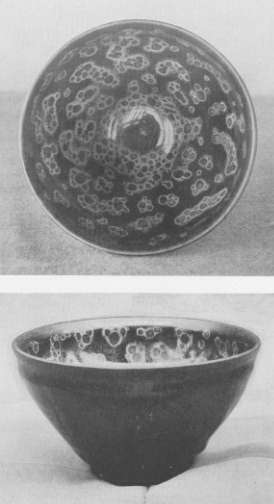
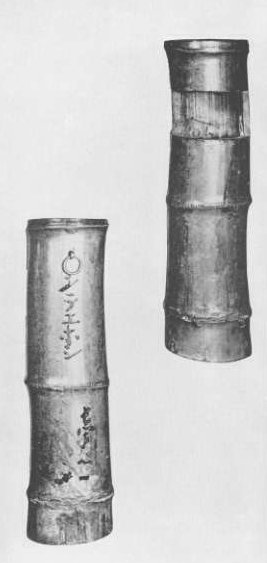
Some years ago a single tea bowl at a sale in Tokyo fetched the enormous sum of 167,000 Yen (one yen at the normal exchange rate equals about 50 cents of American money, but in purchasing power it may be said to be almost equal to one dollar). Think of paying $167,000 for a pottery bowl used in drinking tea! A temple in Kyoto possesses a similar bowl, for which an offer of 100,000 Yen was refused some years ago, on the ground that the bowl could always bring enough money to rebuild the temple should occasion require. That was the tradition handed down in that temple. I know of several tea bowls which were sold during the past decade or so for more than 100,000 Yen each. Not long ago the fabulous sum of 77,000 Yen was paid for a stoneware flower vase with whitish and bluish glazes. Another flower vase, of celadon ware about a foot high, changed hands for 135,000 Yen. What puzzled many of my Western friends was that, not long ago, 20,300 Yen was paid at Prince Shimazu's sale for a tea scoop cut out of a small piece of bamboo by a teamaster named Katagiri Sekishu, who died some 300 years ago. Think of paying $20,000 for a simple piece of bamboo! A flower vase named "Shakuhachi" (a vertically blown flute), made of a section of bamboo by Rikyu, was sold some years ago for 83,000 Yen. Another piece of bamboo for holding flowers and named "Sairai" (second coming), made by Enshyu, fetched 68,900 Yen not long afterwards. Just a section of bamboo, devoid of any ornament, except what Nature has given, its beauty consisting mainly of the natural curves and proportion of length in relation to the size of the bamboo and to the bamboo joint. The highest price for a tea-caddy in modern times was paid at the Sakai sale which took place in Tokyo not long ago. The enormous price of 200,000 Yen was paid for a small egg-plant shaped stoneware tea caddy not much more than three inches in height covered with a brownish glaze of varying intensity. (Plates 105, 106.)
The prices paid for these utensils are by no means universal. They are local and peculiar to our people, principally to the wealthy men of the tea cult. To be sure, in many instances the extravagance of the price is due to the history of the object and the personal elements that have gone into its making. Nevertheless, each has artistic value to a surpassing degree, and without that value its history would not be possible. If I trace back the history of some of these objects it may be easier for you to understand why such enormous sums of money are being paid for them, and also how great is our love of the beautiful in these utensils.
Let me tell you the story of a tea-caddy. There was once a wealthy merchant at Hakata named Sotan who was intimate with Hideyoshi, often called the Napoleon of Japan, who lived at the close of the sixteenth century. Hideyoshi was one day entertained at tea by Sotan as a guest, with his trusted vassal Mitsunari. The host was fully aware of the fact that Hideyoshi was extremely fond of one of his tea-caddies called "Hakata Bunrin." So out of respect to the distinguished guest, he used that caddy on this occasion. Hideyoshi knew that the host greatly prized his tea-caddy and that no amount of persuasion would induce him to part with it for any consideration whatever. Nevertheless, he wanted to possess it. So the general planned to take it in secret, Mitsunari assisting him. The host, however, was not long in suspecting the plot. So as soon as he had finished using the caddy he placed it in his bosom and kept it there. The tea being over, Hideyoshi took leave and the host followed him through the garden. Mitsunari then slipped back to the rear of the tea-room, but could not find the caddy. Hideyoshi lingered awhile on the garden-path. Thereupon the host pulled out the caddy from his bosom saying, "Is it not this for which you are waiting?" and immediately hid it again. Hideyoshi burst out laughing; he must have appreciated the fact that this was a good joke on him. Then the great general told the host to take good care of the caddy and to enjoy the possession of it without taking heed of covetous eyes. Of course it was not Hideyoshi's idea simply to steal it. He knew that the host would not give it up, so he planned to take it by strategy and give him something of equal worth in its place. Sotan, on his part knew very well that if he were to present it to Hideyoshi he would be highly rewarded for it, but the truth of the matter was that he could not bear to part with it. Each knowing what was in the heart of the other, a dramatic scene centering about the tea-caddy was played then and there. The great general was defeated but the unconquerable despot would not leave it that way. So he laughed and in a tone of command said, "Henceforth you may enjoy the possession of it and need not consider others." If he had really wanted to take the caddy from Sotan, no doubt he could have done so by force, but that was not his idea.
This caddy came into the possession of Sotan in a strange way: His business manager had lost heavily in trading in the South Seas and as an atonement for his blunder and in order to seek forgiveness of his master, was about to commit seppuku or hara-kiri. When about to kill himself, his wife said to him that at her parents' home there was a beautiful old pottery jar that might give joy to the master and lead him to forgive the offense. So the small jar was brought, and at the sight of it, the master was thrilled with joy. He was overpowered by the beauty of it, and so forgave the man, and this jar became the cherished "Hakata Bunrin," the caddy which even Hideyoshi coveted.
Subsequently Hideyoshi died and Sotan became old and was uneasy about the preservation of this caddy. Acting upon his best judgment, he presented it to Marquis Kuroda, his feudal lord, whose descendants still guard it very carefully. When a publication dealing with celebrated tea utensils was being compiled not long ago, Takahashi Soan, the editor, wished to see this caddy, but Marquis Kuroda refused on the ground that he did not wish to break the long-established custom of his family which prohibited the taking it out of the box except when the heir succeeded to the family estate. The present Marquis had seen it only once, viz., when he succeeded his father. So the publication in question was not able to contain a photographic reproduction of that caddy. I understand that it is kept in a nest of boxes together with the accessories such as brocade bags, and with five exact reproductions of it made some years ago to keep the bags in shape and for any emergency.
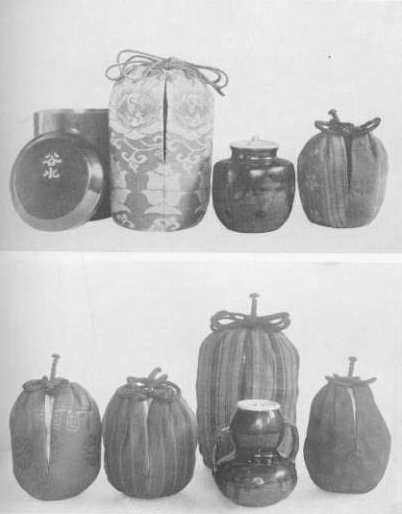
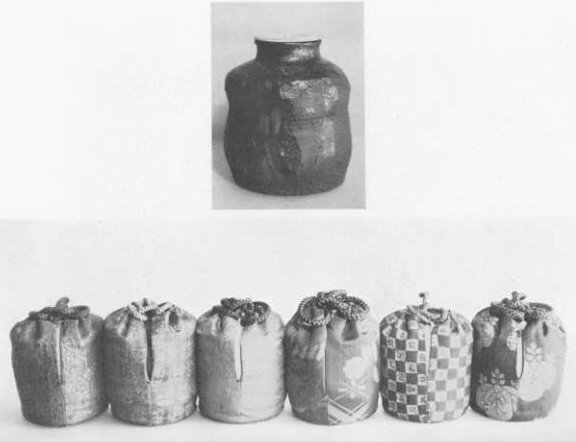
This reminds me of the extreme caution exercised by our tea-devotees in the preservation of these utensils. The caddy itself may not be more than three or four inches in height and about two inches in diameter. It is kept in a small box by itself, carefully wrapped in wadded silk or cushioned. The caddy should have also bags of brocade or some other rare fabric suitable to the shape of the jar and the colour of the glaze. It is not at all uncommon for a famous caddy to have four or five bags, so that it may appear in suitable attire on special occasions or in different seasons of the year. In order to keep these bags in perfect shape, they are fitted on replicas or dummies of the caddy made for that purpose. These should be kept in a box by themselves. Again, certain great men may have seen the caddy, passed judgment upon it, or written an appreciation. Some of these writings may be carefully folded and kept in a box, while others may be mounted in kakemono (hanging scroll) form. These will he kept in boxes also, so that the box which contains all these accessories may be fairly large. I recall seeing at Mr. Nezu's home in Tokyo a large box about two feet high, almost as wide, and fully three feet long which contained a famous tea-bowl only a few inches in diameter and its accessories, the tea-bowl being kept as the core of that large box. It is only due to the meticulous care taken of these utensils that so great a number of them have been preserved to this day. On account of such care many of them have been saved, even from the great earthquake and fire of 1923. Not even a drop from a shelf was able to harm many of these. Even fire failed to penetrate to the core in many cases. For this cha-no-yu is largely responsible, and we owe a debt of gratitude to tea-devotees for the preservation of many superb objects of art and use.
In spite of the great care taken of art objects, it is but natural that some made in fragile material, such as ceramics, should break in the course of centuries. But people have not discarded them even when broken, if they happen to be worthy: they have repaired them and continued using them, for they have acquired skill in mending them in an artistic manner by means of plain or gold lacquer. Often the repair seems to add artistic value to the object mended. There are in Japan certain "celebrated pieces" which are mended, and I remember seeing a tea-bowl made up of three pieces from different bowls joined together. Of course, ordinarily a broken tea-bowl or tea-caddy cannot command nearly as great a price as a perfect one. Until a few years ago art dealers used to ask for a broken ceramic tea-bowl only about one- or two-tenths of the price of a whole one, but nowadays they have come to demand nearly half, or more in some special wares, for a breakage in the wares of certain kilns is not considered to depreciate their artistic and market value materially.
Because our people were so appreciative of beauty, they were able to pick up beautiful things produced in China, Korea, and other countries of Asia. A large number of the so-called "celebrated pieces," famous utensils used in connection with tea, are from these countries. The existence of a large number of other great Chinese masterpieces in Japan is also due to the fact that our people have loved and respected works of art. Not only did these eminent masters make use of these beautiful objects in their daily life, but they designed utensils or made them themselves, or insisted upon having them made in beautiful forms. Whatever objects were designed or made by the masters were carefully preserved by their descendants or followers. With the aid of these beautifully preserved utensils we have been able to develop good art in our modern industries, notwithstanding the fact that shiploads of trash are being sent abroad annually.
Our people are fortunate in having many beautiful examples of old art preserved for their guidance. The greatest collection of these ancient objects may be found in the eighth century Imperial Treasure-House, widely known as the Shoso-in. The treasures in this collection have always been a source of great inspiration to our artists and artisans. We still turn toward them for new thoughts and new designs in our modern manufacture. This unique treasure-house, which to this day has preserved intact thousands of articles of great artistic value, well illustrates the appreciation and reverence of the arts shown by the Emperors as well as the people of Japan during the last twelve centuries.
Let me give you another illustration of the great care given to some of our utensils. Soan tells how he came upon the celebrated tea bowl named "Tokabo" (suggesting peach blossoms), made by the potter Chojiro. While engaged in the publication of several volumes containing prints and accounts of famous tea utensils, Soan, the compiler, succeeded in tracing this well-known tea-bowl to an old family in Osaka named Morii. The present-day family, however, apparently was not aware of its possession. But after receiving repeated inquiries the present Mr. Morii now in possession opened a sacred altar in his home which was dedicated to his great grandfather Ryoson and which had not been opened in this generation. There he found a small wooden statue, a little over a foot high, of his great grandfather and a locked box. The statue held a priest's sceptre, to which was tied the key to a padlocked box which contained the famous tea-bowl, "Tokabo," and a piece of paper inscribed to the effect that this tea-bowl was not to be sold by any of the descendants until forced to sell his ancestor's statue. You may imagine what that would mean - to sell one's ancestor's statue in Japan where the spirits of the dead are worshipped! The bowl was found to be of the class of pottery known as raku, covered with black glaze, and beautiful beyond words, in a cylindrical form, with exquisite marks of the potter's workmanship.
I may add here that sometimes these utensils, such as the tea caddy, tea-bowl, and iron kettle, were presented, some three or four centuries ago, as rewards for valorous exploits in wars. Often great warriors preferred a caddy or a censer to an extension of his dominions, and exchanged a tea-bowl for a castle.
We are told that many warriors carried beautiful tea-bowls and tea-caddies with them when they went to war and used them in preparing and drinking bowls of tea at their leisure on the battlefield. We know that Hideyoshi, a great general, hastily built a cha-seki (tea-room) at Yamazaki and enjoyed cha-no-yu while he was engaged in an important campaign against Mitsuhide, who overthrew his master. That cha-seki is named "Myoki-an" and it still remains intact. Hosokawa Yusai, a warrior and tea-devotee, was so fond of a certain stone lantern in his garden, that he had it carried by his men back and forth between his home in his fief and Tokyo (then called Edo), hundreds of miles apart, when the terms of his service required his presence in one place or the other. This stone lantern is to be found used as his tombstone today at the Koto in, one of the tributary temples of Daitokuji in the suburbs of Kyoto.
I may refer here to one or two similar instances: It is recorded that in the fifth year of Tensho (1577) Nobunaga rewarded Hideyoshi for his exploit of restoring peace in the provinces of Harima and Tajima by giving him a sword forged by Fudo Kuniyuki and an iron kettle of otokoze type for boiling water in cha-no-yu. Four years later, in 1581, Nobunaga served Shibata Katsuiye, one of his generals, with tea with his own hand in appreciation of the latter's exploit in vanquishing the enemy in the north. On that occasion Katsuiye asked Nobunaga to present him with an iron kettle of ubaguchi type - a kettle with sunken mouth suggesting that of an elderly toothless woman - which had been bequeathed to Nobunaga by his father, Nobuhide, and which Katsuiye had long wished to possess. This was not the first time he had asked for it, and on the previous occasion Nobunaga had promised that he would consider the re quest when Katsuiye should show proof of great loyalty. Nobunaga evidently thought this was an opportune moment to present it. So he handed the kettle to Katsuiye, murmuring the following extemporary thirty-one syllabled poem as he gave it:
"Nare narete akanu najimi no ubaguchi wo Hito ni suwasen koto oshizo omou."
This may be roughly translated -
It is with reluctance that I allow others to kiss The mouth of the aged dame, my old sweetheart, Whose friendship never staled.
Such importance was attached to tea utensils that sometimes tragedies involving the sacrifice of human lives were caused, or romances of unusual human interest created on their account.
It should be observed in this connection that cha-no-yu was utilized to great advantage for political purposes by such great generals as Nobunaga, Hideyoshi and Iyeyasu. However, the fact remains that many of the warriors in those times were genuine tea devotees and thoroughly appreciated the value of beautiful tea utensils.
Such an appreciation was shown by Akechi Mitsuharu at the Sakamoto castle in 1582 just before that stronghold was set on fire. Knowing that his fate was sealed, Akechi Mitsuharu appeared on the watch-tower and shouted. When the clamour of the enemy had subsided, Mitsuharu spoke thus at the top of his voice:
"I have a word to say to you, besiegers. My master, the Lord of Hyuga, has fallen in the ill fated battle of Yamazaki and his wife and children are about to end their lives here, and I, Akechi Mitsuharu, am about to die with the castle as my pillow. We ourselves may perish as the fortunes of war decree, but I can hardly bear to destroy the treasures that are here which in truth belong to the world at large. I will now hand over to you these treasures with the list of them. Pray, take them to your master for safe keeping."
Having said this, he slowly lowered, by means of sashes, bundles wrapped in silk brocade bedding. Seeing that the treasures were safely in the hands of the enemy, he retired to the keep and later set it on fire and so ended his life and that of others in his charge. The bundles contained, among other treasures, such cha-no-yu utensils as a tea-caddy named "Nara-shiba," a celadon water-jar, a pottery incense box named "Chidori" (plover), a tenmoku tea-bowl, scrolls of paintings and calligraphs, and also swords by Niji Kunitoshi and Yaken Toshiro. Thus these works of art, which numbered more than sixty, were saved even in the midst of the carnage.
Though I have no time to recount it here, there is an interesting story connected with a precious tea-caddy named "Ariake" (dawn), which was once sold at an enormous price in order to save the people in his fief from starvation. This act was interpreted by Hosokawa Sansai, a warrior and tea-devotee, as showing a real understanding of the spirit of cha-no-yu by his son, Tadatoshi.
Perhaps the most tragic story we have in connection with the appreciation and preservation of art objects is the one which is sometimes presented on the stage. I have seen it played on two or three occasions. It deals with a samurai who hastened to his lord's house one night when fire had broken out. Upon his arrival he found that the warehouse was already ablaze, but knowing that his master greatly prized a kakemono of painting kept in that warehouse, he plunged into the burning building, searched for the scroll, and finally found it. But when he came out of the building, he found himself completely surround- by fire. Buildings fell around him in masses of flames, and one building was threatening to fall upon him; there was no way of escape. Thereupon he took the scroll out of the box, tore off his sleeve and wrapped the scroll up in it; he then sat on the ground in the attitude becoming the samurai that he was. With his sword he cut open his belly, and inserted the scroll in it, and then prostrated himself to protect the treasure. The following morning the scroll was recovered from the smoldering remains of that samurai. Historically it is claimed that it was not a scroll of painting, but a valuable document, but in the play a scroll of painting is used. I remember even seeing many years ago in a temple a kakemono of a painting of Daruma, called "Chi-Daruma" (bloodstained Daruma), which purported to tell the same story.
When I finished typing as far as this this afternoon in my room in the Edmond Meany Hotel and paused for a moment, wondering to myself whether it was better to end my lecture with this gruesome story, or with something else, I caught sight of a noble object. It was quite a revelation to me when I first saw the majestic form of your Mt. Ranier as I looked up from my typewriter and turned toward the window about 6 o'clock this afternoon. Ever since my arrival in this city about a fortnight ago, I have been on the lookout for that mountain. Atmospheric conditions, however, have not been favourable, at least whenever I tried to see her, and I was almost on the verge of giving up hope. But I saw her this afternoon, though only for a short time and somewhat faintly. She looked ethereal, yet full of power. You will think it natural that my mind should turn towards Mt. Fuji in Japan as it did. So I wish to engage your attention for a few moments now to tell you, as my concluding remarks, why we think so much of Mt. Fuji. I do so thinking that you may like to compare your reactions with ours to a similarly shaped mountain, and hoping also that the observations I am about to make may help you to understand the sort of comparison we are more or less accustomed to make of the art of the Far East and that of the West.
We think Mt. Fuji is beautiful, primarily because she has a well balanced form, a cone - though slightly truncated near the vertex - and appears almost like an isosceles triangle without its rigid lines. That form is restful to look upon, soothing to the soul. The mountain gives us the impression of being well balanced, rising as she does gradually from the plain to an imaginary vertex. She is emblematic of our nation, for everything converges from the bottom to the top, even as the multitude, the people, look up to the Emperor as their head, as some one has pointed out.
The simplicity of her form captivates us; the exquisite sweep of the lines with their majestic curves, all converging to a single point, inspires us. She symbolizes, we think, the principles of our government, the ideal of our nation, and also the ultimate aim of all rationalization movements that are going on in different parts of the world, Japan not being excepted. Mt. Fuji visualizes this principle of simplification; she stands as the very essence of simplicity; and we think this is one of the reasons why we consider Mt. Fuji beautiful - the noble form being coincident with our high principles.
To us Mt. Fuji seems to make visual the spirit of the Far East, and that may need a word of explanation. Oriental art embodies the ideal of trying to find the self in the universe, while Occidental art tries to expand the self through the universe. Oriental art is, in a way, centripetal, developing the self from outside towards the centre, while Occidental art is constructive and may be described as being centrifugal, always working away from the centre, from the self, for its greater expansion. Oriental art does not seek to develop the form, hut remains submissive to it and endeavours to bring out the spirit of the thing, while Occidental art investigates an object in order to grasp and develop its form, upon which the individual tries to construct his own view of the universe. So it is natural that we should seldom find that individuality in Oriental art, which constitutes the chief feature of Occidental art. The East tries to depict the spirit of the thing, while the West lays great stress on the outward form. Ours is more idealistic, while yours is built more on the foundation of realism, or intellect. Symbolically a triangle, or pyramid, represents one of our five elements known as "gorin" and it symbolizes fire, and stands more for emotion than for intellect. In this respect, too, Mt. Fuji makes visual the spirit of the Far East. By the way, in this respect the Western ideals may be represented by another of the five elements of "gorin" - a circle or sphere symbolizing water, which seeks to find its own centre of gravity, and stands for intellect, rather than for emotion.
As some one has pointed out, a similar observation may be made regarding our calligraphy. In your writing vertical lines are drawn first and horizontal ones afterwards (that is if you do not forget to cross your t's), while with us the reverse is true, horizontal lines being drawn first and vertical ones afterwards. The vertical line indicates the centre, and the horizontal line an expanse; the West, upon the one hand, establishes the self as the centre and then reaches out towards others; the East, on the other hand, lays the foundation of thoughts in the multitude, and proceeds to find the centre, the self. The vertical line expresses the finite and the horizontal line infinity. In the West the finite (or vertical line) precedes the infinite (or horizontal line) and formulates its own desires; and it is therefore egoistic or individualistic. In the East, infinity (a horizontal line, or the multitude) precedes the finite (a vertical line, or the self) and tries to formulate the centre according to the spirit of the multitude; it is therefore less individualistic, less self-asserting. The East is more for generalization, while the West is more for specialization. The East tries to have the desires of the multitude converge to a point, even as Mt. Fuji suggests the idea of starting from the base, the multitude, and working up to the vertex. On this account, too, Mt. Fuji may be said to visualize the spirit of the East. These I think may be taken as some of the elements of the forces that lie at the back of our heads and make us feel the beauty of Fuji mountain, either consciously or unconsciously.
With this observation I wish to close this series of lectures at the university.
NOTES ON PLATES
Plate 104. Upper and Lower: Stepping Stones in the Korakuyen, a garden constructed for the feudal lords of Mito at their official residence in Edo (present Tokyo), and recently given to the City. Small stones are often combined, as in this case, with larger ones in forming the path in the garden in order to give variation. Stepping stones constitute a very important part in Japanese gardens, and they are laid, on the one hand, to facilitate movement from one place to another and afford safety, and on the other, to give beauty to the whole garden.
Plate 105. Yohen Temmoku Tea-Bowl. Interior and side views. Sold about a decade ago for \ 167,000. Strange iridescent marks on the inside of the bowl against the purplish black background give a mystic depth to the bowl; and when this is partly filled with green liquid tea the profundity of feeling is intensified.
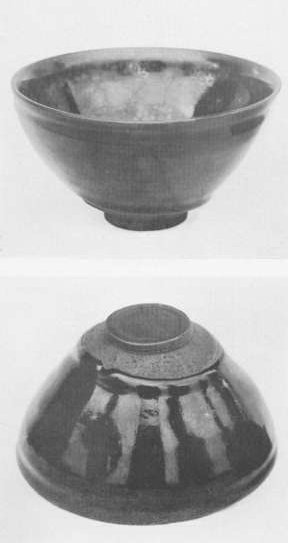
Plate 106. Yohen Temmoku Tea Bowl. Upright and inverted views. Across the mouth, 121 mm.; height, 65 mm. In the possession of the Ryukoin temple in Kyoto. The iridescent marks in various groups shine like constellations in the dark heavens. The marks are visible only on the inside, and the bowl is covered with a black glaze, except the bottom-rim and a narrow zone around it. The bare bottom seems to give a glimpse into the real character of the bowl, and of the potter who made it.
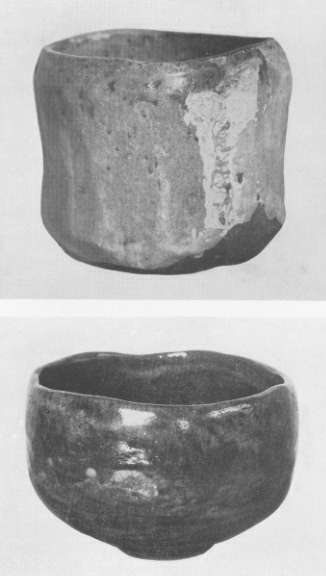
Plate 107. Upper: Raku Tea-Bowl. Made by Kawakami Fuhaku and named "Jurojin" (god of longevity), being one of a set of seven named after the Hichi-fuku-jin" (seven gods of good luck). Covered with a soft reddish glaze, except the bottom-rim, by which the fascinating character of the master is suggested. Owned by the head-house of the Edo Senke school of cha-no-yu, Tokyo.
Lower: Raku Tea-Bowl named "Egawo" (smiling face), made by Ryo-nyu, ninth generation from the original raku potter in Kyoto, the present potter being the thirteenth. Covered with a soft red glaze slightly mottled with white. Author's collection.
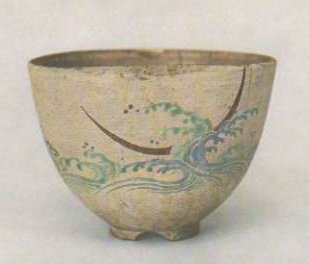
Plate 108. Tea-Bowl by Ninsei. With a design of waves and a crescent. Few bowls reveal the refined delicate feeling of Japanese taste more than this example. Imperial Household Museum in Tokyo.
Reproduced in colour.
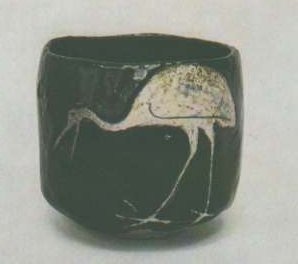
Plate 109. Tea-Bowl by Dohachi With a design of n crane on the outside and a tortoise on the bottom, inside the bowl, against the background of black glaze. In Japan the crane is said to live for one thousand years and the tortoise for ten thousand years; both stand for longevity and are widely used as symbols. Imperial Houschold Museum in Tokyo.
Reproduced in colour.
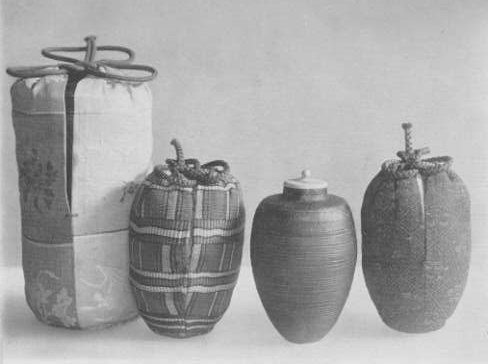
Plate 110. Upper: Tea-Caddy named "Tani-mizu." Accompanied by the following accessories: a silk brocade bag for the caddy, a wooden case for the caddy in its bag, and a brocade bag for the wooden case. All of these are kept in a paulownia-wood box, upon the lid of which is written the following poem:
"Yama fukami Hito mo kumi enu tani mizu wa Tsurara nomi koso Musubare nikeri."
It may be roughly rendered thus:
The trickling spring in the ravine, Deep among the mountains, Which no man can scoop to drink, Forms nothing but icicles.
Lower: Gourd-shaped Tea-Caddy with Accessories. Covered with glaze like the colour of the quail; with handles shaped like bamboo leaves; accompanied by three bags and a wooden case with a bag. Upper and lower in the author's collection.
Plate 111. Upper: Tea-Caddy named "Goro-maru." By the vigorous shape of the caddy, Goro-maru is suggested, a person well-known for his great physical strength and soldierly sympathy towards the Soga brothers, who are famous in story for having revenged their father's death. This caddy was accepted by Kawakami Fuhaku as a parting gift from a wealthy man of Osaka in preference to one thousand pieces of gold when he left Kyoto for Edo (present Tokyo) to establish a school of his own.
Lower: Silk brocade bags for "Goro-Maru" tea caddy. Fuhaku and his successors have made bags for the caddy, the present master being the eighth generation. Both the caddy and bags are in the possession of the head-house of the Edo Senke school of cha-no-yu in Tokyo.
Plate 112. Sobokai Tea-Caddy with Accessories. With two bags and a wooden case with its bag. Author's collection.
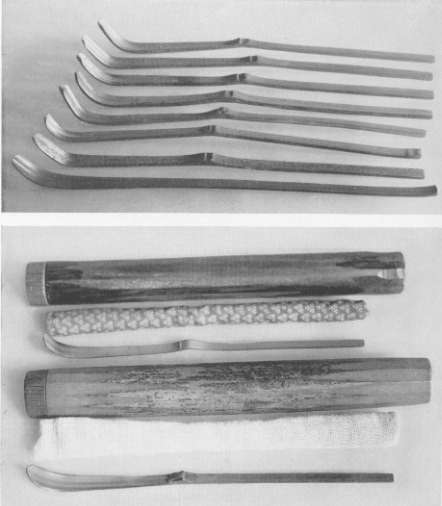
Plate 113. Upper: Bamboo Tea-Scoops named "Hakkei" (eight scenes of Shosho). Made by Kawakami Fuhaku, the founder of the Edo Senke school of ceremonial tea. Each scoop is associated with a poem written on the bamboo tube in which it is kept. Owned by Kawakami Kansetsu, Tokyo.
Lower: Bamboo Tea-Scoops. The upper one was made by Shimizu Dokan (ob. 1783), accamponied by a bag and a bamboo tube to kocp it in. The lower one was made by a Buddhist priest named Taiko Osho who lived to be eighty years of age. The scoop is named to mean "like the sun rising." A close examination of the scoop shows clean and forcible slashes on the bamboo joint and at the end, revealing the determined character of the aged priest who made it. The angular cuts on the joint suggest a jagged cliff, and the forward half of the scoop bears a striking resemblance to a graceful orchid leaf. The combination, or the contrast, of the two - the jagged cliff and the graceful leaf, the tip of which is slightly curled up as if to greet the first rays of the sun while it is still wet with dew - seems to afford a glimpse into the heart of Nature. The scoop is kept in a coarse linen bag suggestive of a simple priest's robe. Owned by Mr. Etsusaku Nagai of Tokyo.
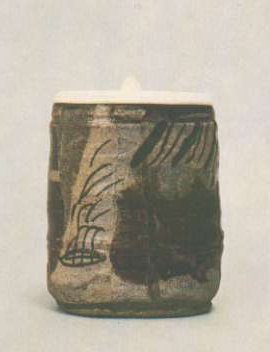
Plate 114. Stoneware Tea-Caddy. Old Seto kiln. With ivory lid, as is usual with tea-caddies. About actual size. Imperial Household Museum in Tokyo.
Reproduced in colour.
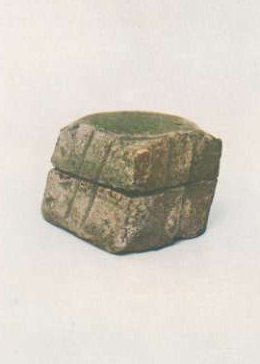
Plate 115. Stoneware Incense-Box. Iga kiln. About actual size. It suggests a tremendous precipice, perhaps of basalt formation, covered with moss, freshened after a rain. Imagine the sensation one feels when holding it in one's palm! Imperial Household Museum in Tokyo.
Reproduced in colour.
Plate 116. Bamboo Flower Vase. Obverse and reverse. Named "Tate-Eboshi," suggesting the head-gear of that name. The small ring attached to the reverse is used for hanging it on the wall or a post. At a recent sale, it brought 8,000 Yen.
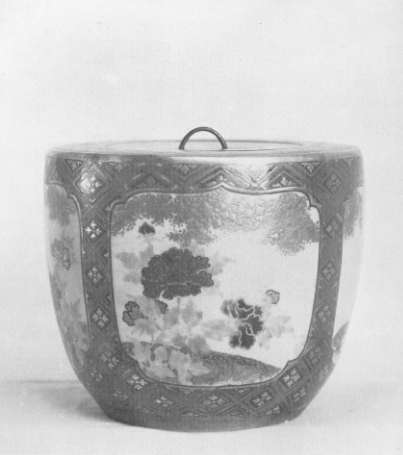
Plate 117. Polychrome Water-Jar. By Ninsei. Decorated with a floral design in four plaques formed by frames of a lattice design in gold. Imperial Household Museum in Tokyo.
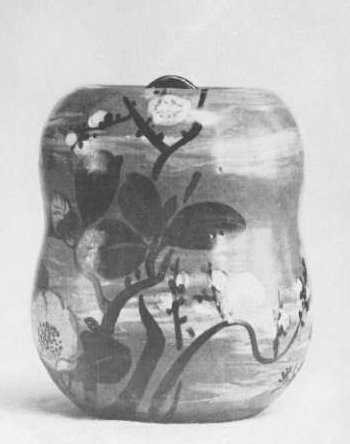
Plate 118. 118. Water-Jar. By Kenya. Decorated with a conventional design of plum blossoms and camellia in bloom. Owned by Viscount Okouchi.
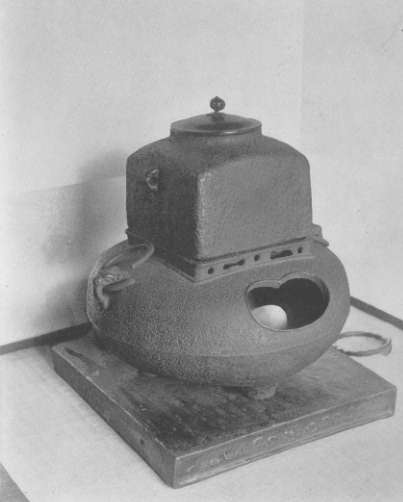
Plate 119. Iron Kettle on Iron Brazier. A square kettle fitted to the square top of a round brazier placed on a green-glazed flat tile. Water is usually boiled in this manner in cha-no-yu during the summer months. Not only the shape of iron but the texture also is highly appreciated, and in order to preserve its beautiful "complexion" the kettle and brazier are handled very carefully, efforts being made not to touch them with bare hands, lest the oil affect the iron. Ring-handles seen on the floor are used, whenver the kettle is to be moved, by thrusting them through the pierced knobs on the kettle. Author's collection.
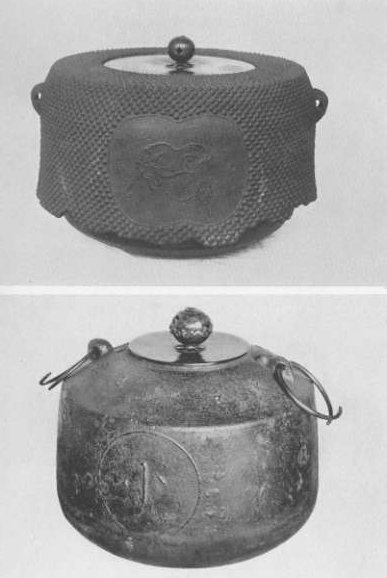
Plate 120. Upper: Iron Kettle with "Hail" Surface. With a design of a cow being led by a boy.
Lower: Iron Kettle. With the character for "small" surrounded by a circle in relief. These kettles are used in cha-no-yu for boiling hot water for tea, each having extra pieces of iron at the bottom, inside, so that they may produce the pleasant music of the pine by the sea when the water boils.