

III. A SURVEY OF JAPANESE ARCHAEOLOGY
Delivered at the University of Oregon
JAPANESE archaeology is a new field of study, scientific researches having been started only about a generation ago. I think I am right in giving credit to Professor Edward Morse from one of the New England states, who taught for some time in Japan, for having inspired our scholars and shown them how scientific archaeological excavations should be carried on. The pre-historic kitchen midden which he excavated at Omori, now included in the city of Tokyo, is marked by a stone monument visible from the train as one enters Tokyo from Yokohama.
Our archaeologists have been doing some good work in recent years. There are not very many excavations being carried on in Japan proper now, but these few are being conducted by competent scholars. Some of these excavations are in charge of the archaeological seminar headed by Professor Kosaku Hamada of the Imperial University of Kyoto and certain others are in charge of the archaeological research room headed by Professor Yoshito Harada of the Imperial University of Tokyo, while there are still others conducted by the historical department of the Imperial Household Museum in Tokyo. Nearly all the archaeological excavations are being carried on by one or other of these three institutions; very careful studies have been made and the results of the investigations published. The Imperial burial mounds are being taken in charge by a special bureau established in the Imperial Household Department. I believe that this bureau has marked out and provided protection for the tombs of each of the 123 Emperors who have reigned over Japan with unbroken lineage through nearly 2600 years.
The excavations in Korea are carried on with greater enthusiasm perhaps than in Japan proper and these excavations are conducted mainly by competent scholars from the government museums in Korea. Interesting archaeological discoveries have been made of late years in Keishu, a province in the southeastern part of Korea, but the wealth of the tombs at the ancient site of Lo-lang near the present Heijo in the northwestern part of Korea is inestimable. Lo-lang was a Chinese colony which existed from 108 B.C. to 313 A.D., having had at one time a population of about 400,000. Quite a number of these tombs - some 40 or 50 of them - have already been excavated, but there are more than two thousand in this rather limited region. Actually 1,360 have already been charted and numbered. Many valuable discoveries have been made in these tombs. Among such may be mentioned lacquer cups bearing dates of their manufacture, one corresponding to 86 B.C., another to 33 B.C., others to 22 B.C., 14 B.C., 8 B.C., 3 A.D., 6 A.D., 9 A.D., 45 A. D., and 69 A.D. All of these dated pieces also give the names of the government factories where they were made. A bronze weapon bearing a date corresponding to the year 222 B.C. as weld as another metal piece bearing a date equivalent to 41 B.C. have already been recovered from the Lo-lang tombs. The older piece was evidently brought there from China by immigrants.
A number of archaeological excavations have been made in South Manchuria by the Far Eastern Archaeological Society and the Ryojun Museum. These excavations include the ruins of the pre-historic ages at Pi-Tzu-Wo, a site of the stone age, a castle of the Han dynasty called Mu-Yang-Ch'eng, the Han tombs at Nan-Shan-Li and another tomb of the first century B. C. at Yin-Cheng-Tzu. Some scientific archaeological researches have also been made in China, but on account of the scarcity of material so far furnished by China, these excavations made by Japanese scholars are of inestimable value not only in showing the relations which existed among the early cultures in China, Korea, and Japan, but also in throwing a flood of light upon the life and culture of the early Chinese people themselves. Our scholars are going still further with their studies. They have excavated the site of the capital of Bokkai in northern Manchoukuo where they found an eighth century Japanese copper coin, thus establishing the fact of its direct or indirect intercourse with Japan. They have recently discovered further north an ancient tomb purported to belong to the Koguryo before they expanded into Korea at the beginning of the fourth century, the tomb containing an interesting wall painting of flowers and birds, and of nude human figures wrestling in the Japanese style. The activities of our scholars in Korea and Manchoukuo are certain to result in valuable contributions to Oriental archaeology.
When does the history of Japan actually begin ? Well, the beginning of the authentic history of Japan is rather obscure. We say that it began with the reign of the Emperor Jimmu, the first in the line of Emperors of Japan of which the present incumbent is the 124th in an unbroken line. The accession to the throne of the Emperor Jimmu is given in the historical records as 660 B.C., this date based upon the Nihon Shoki, a history of Japan written in the year 720. Certain historians, however, place it in the first century B.C. instead of the seventh, though the people on the whole support the Nihon Shoki. While not disproving the existence of earlier history, archaeological and documentary evidence support our knowledge of the history of Japan only from the end of the third century A.D. in the reign of the Emperor Ojin. It is believed by many of our archaeologists that the stone age in the western part of Japan extended to about the third century B.C., while in the eastern part it lasted a few centuries longer, and that the aeneolithic age, when the metal and stone cultures were co-existent, extended from the end of the second century B.C. till toward the end of the third century A.D. when authentic history based on documentary evidence is believed to begin. It is interesting to observe, however, that archaeological discoveries are tending to substantiate some of the points which have been questioned, thus inducing us to give greater credit for accuracy to our ancient records than we have been accustomed to give them. In spite of diverse views held by some historians, the belief of the people at large, and the national life and activity as well, is based upon orthodox history, as you may readily understand from the fact that Japan is to hold a World's Fair in 1940 with a fund of twenty million yen and with the long official title "Japan International Exposition for the Commemoration of the Twenty-Six Hundredth Anniversary of the Foundation of the Empire."
It is usually alleged by archaeologists that in general the progress of human civilization advanced from the stone to the metal age and that the latter began with the copper period and proceeded to that of the bronze, ending with the exclusive use of iron. In Japan also the stone age gave way to that of metal, but the periods of copper, bronze and iron did not follow the established European sequence. It is quite generally believed by our scholars that with us there is hardly any copper period and that the age of bronze and that of iron probably began simultaneously. However, as a result of recent investigation we are in possession of some remarkable artifacts which force us to acknowledge the existence of an aeneolithic period when stone and metal implements were coexistent, thus connecting the end of the stone age with the beginning of the metal age.
The most important unwritten document concerning early Japanese culture is to be found in the burial mounds, around which Japanese archaeology is centred. And I shall confine my talk this evening more or less to these burial mounds. Generally speaking a burial mound consists of one or more coffins with or without chamber or chambers and the mound which covers them. These mounds are classified according to their shape. There are four types: (a) round; (b) square-front and round-back; (c) square; and (d) round top on a square base. The first two are very common, but the last two are very rare.
These mounds are built with or without terraces, and with or without moats. Some have two or three terraces, and one, two, or even three moats one outside the other. Of course, comparatively few of these moats contain water, because in many instances the land has been converted into rice fields. Some of these burial mounds must have looked magnificent with water all around them. It is but natural that people in ancient times should have associated them with fairy lands. The burial mound of the Emperor Sui-nin, who died in 70 A.D., is in Yamato province, and has been popularly known as Horaizan, or Elysian Isle. The burial mound of the Emperor Ojin, who died in 310 A.D., situated in Kawachi province, is surrounded by three moats, one outside the other.
It is extremely rare for one to come across a mound surrounded by a mud wall.
Although these burial mounds are now covered with thick growths of shrubs and big trees, originally they were so constructed as to prevent such growths. They were often covered entirely with cobblestones, most of which were gathered at the seashore. In rare instances these cobblestones are of different colours, an example of which may be seen in Harima province. In other rare cases they are white, an instance of which is to be found in Kawachi province. The eighth century record mentions that the burial mound of the Emperor Kimmei, who died in 571 A.D., was covered with cobblestones; and today the actual condition of the mound in Yamato province verifies this ancient record. According to tradition, the stones used in the burial mound were gathered from far off places. When the "square-front and round-back" mound was built in Yamato province for a prince in the reign of the Emperor Sujin, in the first century B.C., stones were brought from the Osaka mountains. In this case according to tradition the people lined up across the plain a distance of some fifteen or twenty miles and transported the stones to the burial ground by passing them one by one from hand to hand along the line. We know for certainty that the cobblestones used to cover the "round-top on a square-base" type of burial mound erected for the Emperor Meiji, who died in 1912, were taken from the shores of Shodo-jima, an island many miles away in the Inland Sea of Japan.
The burial mounds were covered with small stones. These were used both for utility and decoration - utility, since they protected the mound against erosion; decoration, since they made the mound neat and beautiful, patterns made with stones of different colours and sizes sometimes adorning it.
The mounds are generally made of earth or earth mixed with stones, but occasionally they are formed merely by piling up stones. This type of mound is called tsumiishizuka (cairns). This type is very rare in Japan, and dolmens almost non-existent, though both are commonly found in Korea, the Kwantung peninsula, China, and even in Europe.
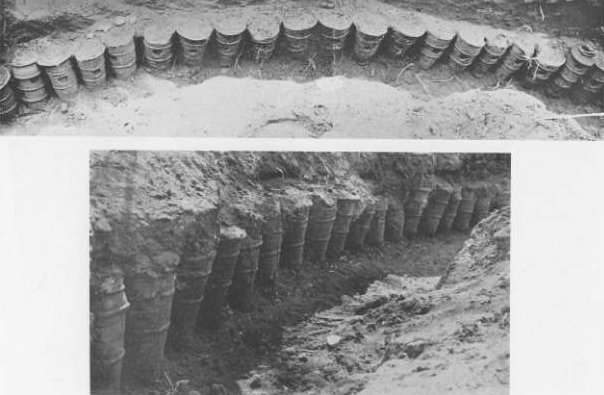
Many of the mounds have haniwa, or terra-cotta cylinders and figures. They are found on the mound, encircling it, often along the base, sometimes repeated twice or three times at different altitudes, sometimes on the top, and sometimes, though rarely, on the outer side of the moat.
One of the ancient records narrates a tradition concerning the origin of haniwa. According to that account, when Prince Yamato-hiko was buried, in the reign of the Emperor Sui-nin (29 B.C. - 70 A.D.), his servants were buried alive with him. But their moaning and groaning were so pitiful that when the Empress Hihasu-hime died, the Emperor, acting on the advice of Nomi-no-Sukune, forbade any one to be buried alive, but calling one hundred potters from the Province of Izumo had figures of men and animals made, and standing them up around the burial mound used them as substitutes for men and animals. This in substance is the account given in the Nihon Shoki as to the origin of the use of haniwa figures of men and animals, though the Kojiki (Record of Ancient Matters), which preceded the Nihon Shoki by several years, merely states that a "man-fence" was put up for the first time on Prince Yamato-hiko's burial mound, and that a bureau of potters (hani-shibe) to make clay figures and utensils was established when the Empress Hihasu-hime died.
This account of creating figures as substitutes for the sacrificial burial, interesting though it is, is now often discredited by our scholars, even though they do not deny the existence in ancient times of the custom of burying people alive with the dead, for they know that such practice was prohibited by the Taika Reform Edict of 645, and that it was referred to in the Chinese History of Wei (220-265 A.D.). At any rate, there has been a growing tendency among our scholars not to consider the haniwa figures in connection with inhumation as immolation, though now the original theory is being revived by some.
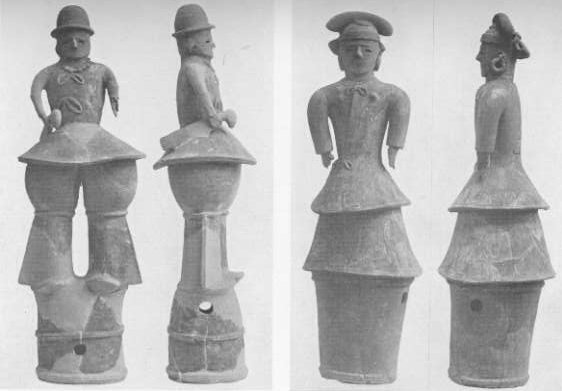
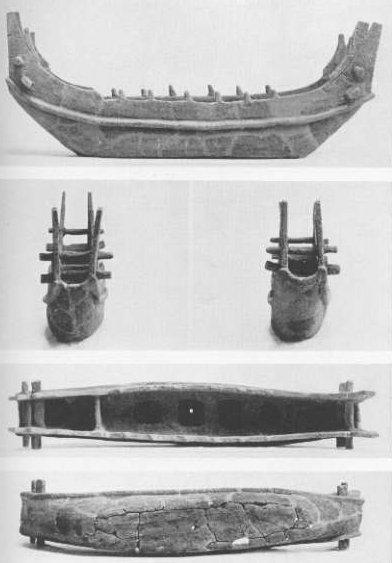
The purpose of the haniwa was like that of the cobblestones on the mound, for use and decoration. Haniwa were originally cylinders which, filled with earth, were planted in the ground around the base of the mound, one almost touching the other, to prevent the earth from being washed away. In the course of time these cylinders came to be more decorative, figures of men and women, animals and birds, and even of boats and instruments such as quivers and archers' wrist-guards being used. (Plates 19, 20, 21, 23.)
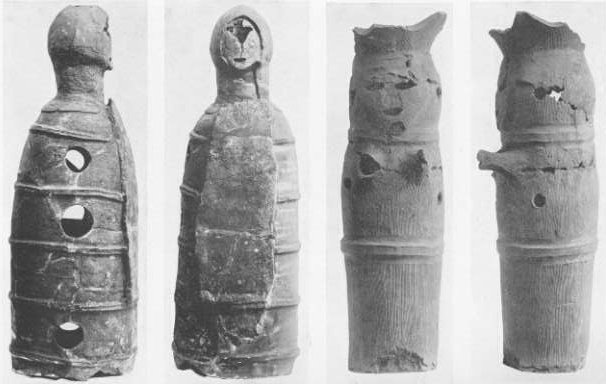
Many scholars believe that the haniwa figures were evolved from cylinders. To substantiate this belief, we note that some cylinders were marked with human features, showing the first step in evolution. They seem to have developed gradually into human forms, into animals and birds, and to have been placed among the original cylinders at regular intervals. Finally they became more decorative than utilitarian, though the lower portion continued to be cylindrical in form and to be thrust into the ground.
This theory, however, is refuted by some scholars, who maintain that the crude figures which seemingly suggest an evolution from cylinders belong to a later date than that of more complete human figures of haniwa.
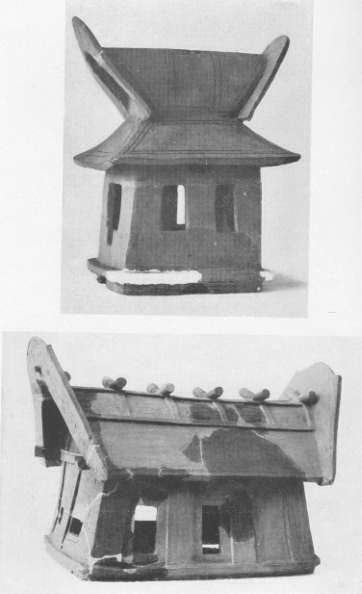
Some of you may have seen certain Chinese mortuary figures in pottery, glazed or unglazed. These models of men and women, houses and cattle, furniture and utensils, for they are made in these forms, are like our haniwa inasmuch as both are grave figures. Yet they are entirely different in this respect; the Chinese mortuary figures were buried with the dead, being deposited in the same chamber with the coffin, while ours were placed not inside but outside the mound. Those of China were made and placed there for the use of the dead, but ours, with the exception of the modeled houses. which were made to rest on a flat surface on the top of the mound, were employed for the purpose of use and decoration about the burial mound. The real purpose of our haniwa houses has not yet been ascertained. Some suspect that they were placed there as necessary utensils -for the worship of and the offerings to the dead and others believe that they supplied dwelling-places for the spirits of the dead. Many of us are inclined to favour the latter view. That would make the purpose for which these haniwa houses were made the same as the modeled houses found in Chinese tombs. But ours are placed outside, while the Chinese mortuary figures were buried inside the grave; and ours are much larger in size compared with theirs. In the case of human, animal and other figures, ours are fundamentally different from the Chinese. The relation of ours to the tombs may be said to be somewhat similar to that of the stone figures of men, horses and lions which Chinese used along the approach in front of their burial mounds in ancient times. But theirs were treated differently: they were lined up in pairs on either side of the approach to the tomb, while ours stand along the base of the mound. (Plate 22.)
To be sure, we, too, have had human figures and horses in stone as decoration for our tombs, but these were far from being in general use. Furthermore, they were placed around the mound in addition to terra-cotta haniwa.
Now, when did the burial mound come into existence in Japan? Well, human bones have been found in our stone age sites, and we are led to conclude that in the pre-historic period our people did not have any large mounds over their graves.
We believe that the burial mound came into existence sometime in the aeneolithic period, that is between the second or third century B.C. and the third century A.D., the period in which the people used stone implements together with bronze spear-heads and daggers, and which connects the end of the stone age and the beginning of the metal age.
Now let us consider the different types of mounds separately The round burial mounds, the first in our list, found in the northern part of Kyushu, are known to contain bronze spear-heads and daggers together with stone implements, thus showing their date to be in the aeneolithic period. The bronze spear-heads and daggers came originally from the continent. So the round type of burial mound may be considered, on the one hand, as showing Chinese influence, but on the other, not necessarily so, for it was the type most commonly used all over the world. This type continued in use for a long time in Japan; at least until the Nara period in the eighth century.
As far as we can ascertain with our present knowledge the second type of burial mound, namely, the "square-front and round-back" type, originated in Japan. It is found neither in China, nor in Korea; it may be considered peculiar to our people. This type is generally believed to have been adopted by the Imperial family with the burial of the Emperor Kogen (214 158 B.C.). We know that the regulations concerning burial were well established by the time the Emperor Sujin (ob. 30 B.C.) and Sui-nin (ob. 70 A.D.) were buried, and that there were haniwa and stone coffins already in use. We have reason to believe that this particular type of burial mound in all its grandeur must have been well developed by this time, having grown from a small scale in previous generations.
This theory is supported by a small ancient tomb of this type situated at the foot of Mt. Unebi in Yamato Province. When the "square-front" part of it was cut through in the construction of a new road, some stone spear-heads, stone arrow heads and earthenware fragments - remnants of the stone age - were brought to light. Archaeologists are inclined to believe that the "round back" part of this tomb (which was undisturbed) was used for the burial of the master of the family, and most likely contains metal implements of an advanced age. This would serve to prove that this type of burial mound originated when the cultures of the stone and metal ages were co-existent.
This interesting type of burial mound reached the height of development when the Emperor Ojin died in 310 A.D. and later the Emperor Nintoku in 399 A.D. The tombs of these two sovereigns have been authenticated beyond the shadow of a doubt. A part of the "square front" of the Emperor Nintoku's tomb collapsed in 1872 and accidentally brought to light a stone coffin and a suit of iron armour and a helmet and other objects that had a historical bearing on this Emperor's life. The coffin is not that of the Emperor himself; his is to be found in the "round-back" part of the tomb. This tomb, which is in the province of Izumi, is the largest of its type, measuring about 1,620 ft. in length, the diameter of the "round-back" being no less than 816 ft., and the entire mound being encircled by three moats, one outside the other.
The second largest of this type is that of the Emperor Ojin, surrounded by two moats, the mound measuring some 1,350 ft. in its entire length, and the circular mound at the back measuring nearly 800 ft. in diameter. In the former case, the length of the "square-front" is about the same as the diameter of the "round-back," while in the latter the front part is much shorter.
The third largest of this type is the burial mound of the Emperor Richu, who died in 405 A.D. His mound measures 1,212 ft. in its entire length, the diameter of the "round-back" being about 654 ft.
The last of the burial mounds of this type to be made was the tomb of the Emperor Bidatsu, who died in 585. The type came into existence in 158 B.C. and remained until 585 A.D.
Different interpretations are given as to the meaning of the "square-front " of this type. According to one theory it is a sort of altar for the "round-back," but many scholars maintain that this explanation is not sufficient since the "square-front" has been used for burying people who were subordinate to the person buried in the "round-back." The most reasonable explanation seems to be that it was first built in order to give greater dignity to the "round-back," and later came to be used for the burial of persons who were sub' ordinate to the one interred in the "round-back."
Now we come to the third type, the square. Not many of the Imperial tombs are of this type, in fact only two or three. One is that of the Emperor Yomei, buried in 587, and another that of the Empress Suiko who died in 628. Among the tombs of the people, examples are scattered all over the country, though their number is small compared with the other two types we have already referred to. This square type seems to have come into existence when the "square-front and round-back" type went out of fashion in the latter part of the sixth century, especially around the seat of the Imperial government, though in the Izumo region it seems to have developed earlier. This type of tomb had been adopted for the burial of Chinese Emperors as early as the Ch'in and Han dynasties, that is in the second and third centuries B.C. The influence of it may have come to Izumo province early in history but it did not reach Kinai, where the Emperor resided, until later.
The square type must have been commonly used by the middle of the seventh century, for the Taika Reform Edict of 645 sets forth restrictions as to the size of the square burial mounds. For the princes of the blood the burial chamber was to be nine feet deep and five feet wide and the mound was to be nine fathoms square and five fathoms high, to be constructed by one thousand men in seven days; high officials were to have burial chambers proportionate in size to those of the princes, the mound to be no more than seven fathoms square and three fathoms high, and to be completed in five days by five hundred men; lower officials were to have their burial mounds proportionately less than those of the higher officials, and the mound was to be no more than five fathoms square and two and a half fathoms high, to be made in three days by 250 men; certain other persons were to have a chamber nine feet deep, four feet wide and four feet high, and not to be covered with a mound, and the tomb was to be completed in a day by one hundred men; while certain others were to have their tombs finished in a day by fifty men. "Use small stones for the building of the tombs. When common people die, bury the dead in the ground." (Though not clear, the number of men mentioned in the above-mentioned passage seems to indicate the total number of man-days required for the completion of the tomb.) Such in substance were the regulations issued in 645 A.D. concerning burial mounds.
The fourth type of burial mound - round-top on square-bottom- is extremely rare. So far the only examples of this type that we know of are the tomb of the Emperor Jomei, who died in 671 A.D. and another in Kawachi province for a prince. There is no example of this type among the tombs of the people. The type existed in China and Korea, and it seems to have been imported into Japan and used for only a short time. But just recently it was adopted for the Emperor Meiji's tomb constructed some twenty-five years ago.
Now let us continue and consider the chambers contained in these mounds. Each mound contains one or more chambers with one or more coffins; and these chambers are constructed of stone. Doubtless there must have been some chambers constructed of lumber, but the wood having decayed no trace of them remains. There are two kinds of stone chambers: one vertically and the other horizontally constructed. The former were constructed by raising stone walls on four sides and covering these with stone slabs for the ceiling. The latter were constructed by making three walls and a ceiling, and leaving one side of the chamber to serve as an entrance, which invariably was closed.
As an example of a vertically constructed stone chamber, mention may be made of that in the "square-front" burial mound of the Emperor Nintoku dating from the end of the fourth century. It was revealed in 1872, as I have already mentioned, by a landslide, and found to be about twenty feet long and eight feet wide. Others of about equal size have been found elsewhere, but generally speaking they are much narrower. On the average they are about three feet wide, three feet deep and seven feet long.
Generally speaking these chambers are formed by piling up broken stones to form the walls, and by covering the ceiling with slabs. But there are cases where only slabs have been used to form the chamber.
These vertically made chambers, as well as the horizontally made ones, are generally built higher than the ground level, though there are cases where they are made below the ground level.
The horizontally made chambers are generally connected by a sort of passageway, the shortest of which has been found to be no more than two feet, while the longest was found to measure about seventy feet. Usually the passageway is about ten or twelve feet long and six feet high. There is generally one chamber but occasionally there are two or three en suite. They vary in size: there is one in Ise province which measures about thirty-two feet long, ten feet wide, and thirteen feet high in the middle. The passageway in Prince Shotoku's tomb in Kawachi province measures twenty-four feet long, six feet wide, and about six and a half feet high, and the chamber with which it is connected measures eighteen feet long, ten feet wide, and ten feet high. But ordinarily they are about ten feet long and six feet wide.
In the horizontally constructed chambers we often find stone shelves on the wall, evidently for corpses or wooden coffins. Sometimes the floor of the chamber is partitioned with stone slabs, as if to screen one corpse from another.
The limitation placed on the size of the stone burial chamber in the Taika Reform Edict of 645 mentions also, as we have noted, that small stones should be used in the construction of these chambers. Doubtless there existed an extravagant tendency to use big stones in the construction of tombs. People must have been in the habit of spending fortunes on tombs as suggested by the passage in the edict which states that the people were being impoverished by the custom. And the Emperor Tenchi during his reign between 661 to 670 tried to abolish the stone burial chamber altogether in order to do away with unnecessary expense.
These horizontally constructed chambers with passageways are found mostly in the round and square types of burial mounds, and also frequently in the "square-front and round-back" type. The entrance to the passageway ordinarily faces south and generally looks out on open country.
Now let us consider the decorations in these chambers. The vertically constructed chambers show hardly any attempt at decoration. The horizontally constructed ones, however, reveal traces of decoration, which consists of colouring and engraving. Often both methods are combined. The slabs used for partitioning the floor of the chamber are often engraved with designs showing wadded archers' wrist-guards, shields, daggers, bows, mirrors and boats, as well as such geometrical designs as circles, triangles, squares and spirals. Concerning the number of coffins and chambers in these burial mounds, it may be said that generally a burial mound contains one chamber, but often two and sometimes three are found. This shows that a mound was not monopolized by one dead person, but was shared by his parents, brothers and sisters and other members of the family. Sometimes more than two bodies were found interred in a single chamber. Years ago, say twenty years or so, scholars thought that one mound was intended for one person only and the others buried with him were those who immolated themselves at the death of their lord. But such a theory is no longer supported to-day. Different persons were buried at different times in the same tomb, which served for the whole family.
It may be noted that our ancients had another method of burial: they bored holes into the hillside for the purpose. These holes are often found in groups. Some years ago they were believed to be the dwelling places of the ancients, but scholars today generally accept these holes as ancient tombs. Some of these holes contain one or two chambers, led to by passageways, which are generally several feet in length, though some are much longer. These chambers are often decorated with engraved or scratched pictorial and geometric designs.
There are two other forms of tombs: one consisting of a horizontal passageway leading to a well-like pit; the other consisting of a deep pit. Some have mounds and some do not. Some of these pits contain coffins, and others merely the objects that had been buried with the dead, the wooden coffins having entirely vanished. It may be stated that the custom of burying the dead in the ground was already in existence among our people in the stone age.
Let us say a few words concerning the kinds of coffins used. There are a few instances where boat or canoe shapes formed of clay have been found containing a coffin. Only a few wooden coffins have been preserved but there are a uumber of stone coffins, some of which are carved out of a large piece of stone with the lid of another piece. Some of these coffins are shaped like boats, or a split bamboo section, and others like chests or houses. Some coffins are constructed with slabs in the shape of a box, chest or house. There are also terra-cotta coffins with lids. These are generally made in two half sections, evidently from the necessity of baking them.
Jar coffins constitute another type. They consist of two big jars with their mouths put together. These are generally known to have been used in the period when stone and metal cultures were co-existent, but their use was continued into the later period.
Now for a few words concerning objects buried with the dead. Generally no artifacts have been found in the tombs of our stone age. The tombs of the aeneolithic age often contain various objects, though some are without any. The people started burying different objects when they began building mounds over the tombs.
In China the custom of burying certain objects with the dead was already existent before the Chou dynasty, or more than 1,000 years before Christ, and the custom of burying treasures with the dead came into vogue after the Ch'in and Han dynasties, that is from about the 3rd century B.C.
In the metal age which followed the aeneolithic age, our people were accustomed to place many treasures with the dead. To mention some of them: utensils of pottery and bronze; arms and weapons, such as daggers, bows and arrows, armour and helmets; horse trappings, such as bits and saddles; bronze mirrors which are more suggestive of their being treasures than for actual use; such personal ornaments as magatama (curved jewels), kuda-dama (tube jewels), kiriko (cut crystals) beads, gold and silver rings, gilt bronze and stone armless; farming utensils, such as ploughs and hoes, iron hammers and tongs. Though objects made of easily perishable material are not to be found, there are means of ascertaining their existence indirectly, as we often find remnants of hemp or silk cloth on some of these objects or enclosed in some of the vessels. These artifacts of our early culture, it is needless to state, discredit many of the old theories advanced by scholars of former times when they had to rely on myths and traditions. On the other hand some artifacts have been brought to light which seem to refute certain of the advanced theories of modern scholars labouring with scanty evidence. Our archaeologists have a great duty, viz., to furnish us with further facts concerning our ancient culture before the third and fourth centuries of the Christian era. (Plates 26, 27, 29)
It is interesting to consider in this light the original gift made by the Empress Dowager Komyo to the Vairocana Buddha of the Todaiji, the gift which forms the nucleus of the famous Shoso-in treasures. Instead of being buried with him when he died, the treasures and utensils that belonged to the Emperor Shomu may be considered to have been dedicated to the Great Buddha, on the forty-ninth day after the Emperor's death.
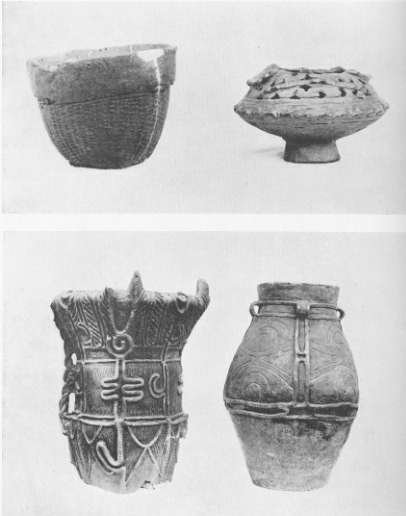
Two kinds of pottery are found in our ancient tombs: (a) a dark-grey kind, hard and usually with a design known as the "rope" motif, and more generally known as the jomon type, and (b) terra cotta, a reddish absorbent kind, not so hard as the other and more readily breakable, generally plain and known as the yayoi type. Though some of the former show great skill in details, yet technically from the potter's point-of-view they are more primitive than the other. The latter was developed in the stone age, and continued to be made in the proto-historic period by a class of specialists known as hani-shibe. Most of the haniwa were made by them. Generally speaking, the burial mounds which yield the pottery of the first kind are older than those yielding the pottery of the second kind, though the evidence is not conclusive, as they are often found together. (Plates 19, 20, 21, 22, 23, 24)
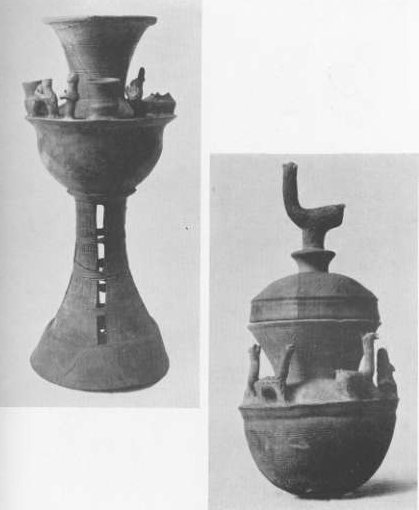
There is still another kind of pottery known as suye-ki which came into existence in the proto-historic age, later than the above-mentioned two. It consists of dark hard pottery resembling the Shiragi ware of Korea, and appearing in sacrificial vessels of elaborate form. (Plate 25)
The art of these potters in the yayoi type was so advanced in the first and second centuries in the Christian era that they were able to make large jars which were used for burial purposes. Some of these jars, two put together, measure no less than six feet, and evidently a large number of them was made as shown by our recent excavations in Kyushu. Such a method of burial must have quickened the development of the potter's art, but the method seems to have existed only for a short time in a limited area in northern Kyushu. In place of jars, coffins came to be made of stones, and the potters seem to have turned their attention to the making of haniwa cylinders and figures, and still later to terra cotta coffins in the form of chests and houses.
Potters played a very important part in our ancient burials. I am greatly interested in the enormous number of haniwa that were required for the burial mound. Take for instance the Emperor Nintoku's tomb, which is encircled three times by haniwa. The number of haniwa used on this single Imperial tomb has been computed to be about 6,480 on the mound itself and about 4,800 outside the moat, making a total of 11,280. If a potter were capable of turning out say twenty haniwa a day, the number of the haniwa on this single tomb represents about 600 man days.
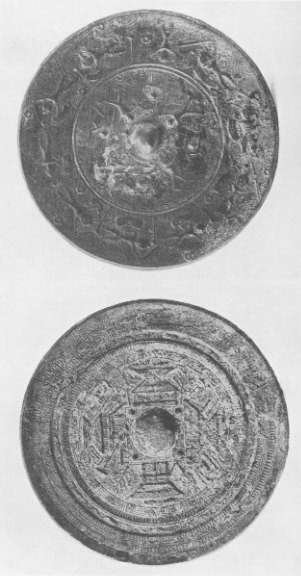
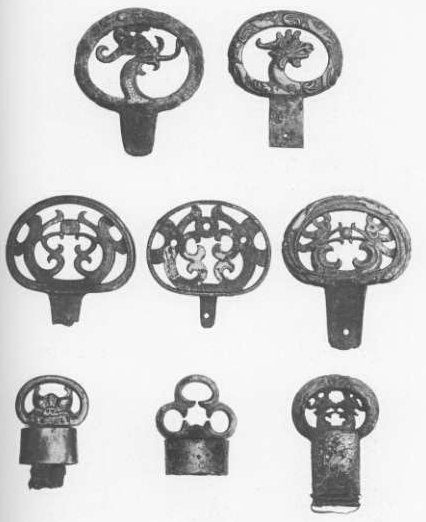
Artifacts recovered from these ancient tombs evidence a high degree of skill attained in metal work as shown by daggers and swords and their mountings, especially in pommels decorating the end of the hilt, sword-guards and pierced work in scroll design on the scabbard and hilt. Also on armour, mirrors, dotaku, and personal ornaments. Some suits of iron armour were found with a simple incised decoration. Some of the bronze mirrors are decorated on the back with a design of human and animal figures as well as floral subjects, while others have small bells stuck around the edge; some of the dotaku, or bell-shaped bronzes, which are not found in tombs, bear interesting designs, such as the tortoise, dragon-flies, primitive houses and hunting scenes, executed with lines in relief. (Plates 27, 28, 29)
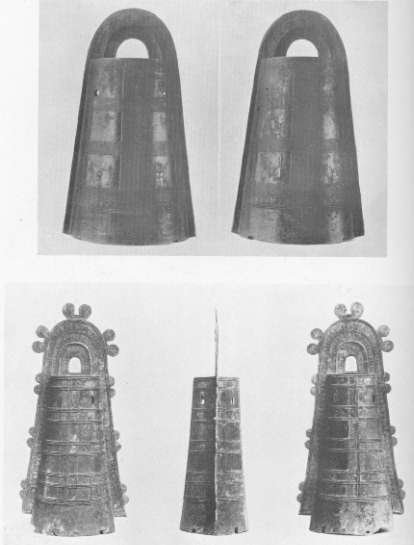
The dotaku by the way, is an interesting relic of an ancient cult of Japan. It is shaped dike a deep bell, somewhat flattened and decorated usually with a fin-like projection on either side, and generally has an elaborate knob at the top with a hole which could be used for hanging it, but with no trace of a hook inside for the tongue. The purpose for which it was created is not clear. However, it is believed by some to be a bronze reproduction of a musical instrument made by stretching a skin over a frame made with strips of bamboo which was sounded by being struck from the outside. At the time it was reproduced in bronze it had already ceased to be a musical instrument; it came into existence merely as a bronze ornament, or treasure. They are found in all sizes, the smallest being only a few inches and the largest over four feet in height. They are distributed quite extensively throughout Japan. A small specimen, which is believed to be merely a horse-bell instead of a dotaku, and which is similarly shaped but with a hook for the tongue inside, was recently found in an excavation in Lo-lang, a Han colony in Korea which throve there during the first three or four centuries of the Christian era. A stone mould, apparently for an object shaped like the dotaku, was also found there. The dotaku has long been considered exclusively Japanese, and some people have come to associate them with an unknown ancient religion. But it is extremely interesting as showing the progress made by our people in the art of casting metal in this primitive art period. It is interesting also for the designs which reveal the manners and customs of the ancients and the style of architecture they used.
We have recovered from these burial mounds some bronze daggers and their replica in stone. Later in history swords and daggers were generally made of iron by the blacksmith, a specialist known in ancient history as a "kanuchi." Some of the pommels of the sword-hilts were made by them in a rounded design peculiarly Japanese. Though the swords they forged at that time may have been inferior to the best swords produced by the Korean and Chinese swordsmiths, the art of forging swords - the art which reached such a state of perfection later as to astonish the Chinese in the tenth and eleventh centuries in the Sung dynasty - was then being gradually mastered.
Neither bows nor arrows now remain, but archaeological investigation shows that it was not the ancient Chinese and Korean short bows, but long bows of the South Seas and buzzing arrows like those of the Huns who were China's great enemies on the north, that were used by our people.
Some armour and helmets seem to have been made of leather and hemp cloth, but only examples in iron and in gilt bronze have been excavated. Some of the haniwa figures are represented in armour and helmet, some showing the short cuirass of the type prevalent in the south, and others the long armour which covered the thighs as well, the type prevalent among the people in the north.
Horse trappings possibly came from the continent when horses were imported. A large number of metal fittings, as well as saddled haniwa horses showing details of the harness, have been excavated. And today, when the archaeology of China is still very much in the dark, the recent Japanese find' ings are indispensable in the study of the horse-trappings of the Six Dynasties of China. It is interesting to note also the similarity of those found to what are still in use in Korea. Many bronze mirrors must have come from China in ancient times, but we know that there were bronze mirror-casting specialists in Japan also, who produced a large number of Japanese mirrors.
Numerous tombs have yielded an interesting variety of unglazed ceramics, which fall into the following classification: daily utensils, sacrificial vessels, coffins and haniwa. The utensils are generally crudely made with simple decorations, but some of the sacrificial vessels are wonderfully moulded and artistically decorated. Very little decoration is given to ceramic coffins, but there is a wide range of subjects treated in the haniwa, there being male and female figures differently dressed, houses of various types, quivers and archers' wrist-guards, and horses and cylinders.
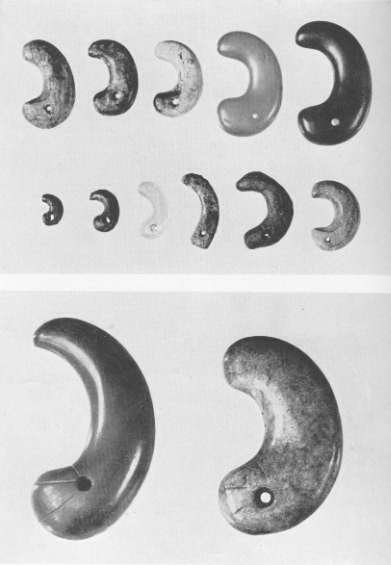
Some wonderful workmanship is shown on such personal ornaments as diadems, necklaces, armless, ear-pendants, etc. Among personal ornaments mention may be made of the magatama (curved jewel), a striking object. This is an interesting design which our ancients were fond of using together with the kuda-tama (tube jewel) and kiriko (cut crystal); it is perforated at the head to be strung for a necklace. The shape of the magatama is generally believed to have been derived from the tusk of a boar or some other wild animal, such tusks having been found actually in use by some tribes as personal ornaments. For a long time the magatama was considered exclusively Japanese, to be found nowhere else but in Japan, but recent excavations have revealed a large number of them in the tombs of Keishu in the southern part of Korea. The most surprising find was in the so called "Tomb of the Gold Crown," a Shiragi tomb of the fourth century A.D. in Keishu; more than fifty magatarna of different sizes having been discovered there on the magnificent crown of pure gold now kept in the museum at Keishu. These magatama are similar in shape and material to those found in Japan proper. They are commonly made of Weiss, quartz, agate, and rock crystal, all of which are found in different parts of Japan, but also of jade and jadeite, which are found today only in the country south of China and among the Ural mountains. There is no trace of jade ever having been found in Japan or Korea. It is still an open question whether or not these precious materials were brought over from south of China and the Ural mountain region to Japan and Southern Korea to be worked into magatama as early as our stone age (for they were already in use then). There is a stone at the museum at Keishu and one or two others in Japan which are believed by some to have been used for grinding and shaping magatama. So far, magatama have been found all over Japan and in South Korea, but we know of none having ever been found in China. Such being the case, in spite of the fact that they have been discovered in Keishu, which was in close touch with Japan in ancient times, we may still continue to consider magatama as peculiar to the Japanese race.
It is interesting to observe in this connection one of the national traits of our people, namely, the love and devotion shown by them for what is old and dear in spite of their eagerness to adopt what is new and advanced. They appreciated the beauty of the simple curvature in the boar's tusk. They used it as a personal ornament, but evidently came to dislike the animal element in the object with the touch of cruelty which the tusk suggested, though the artistic appeal of the simple beauty was very great. So they copied the tusk in stone and continued to use it as an ornament, and the magatama still makes a strong appeal to our people. It is amazing to find that there are a number of people in Japan today who will gladly pay thousands of dollars for one of these old jade magatama an inch or so long. Perhaps this may be taken as showing the love and devotion held by our people for what is old and dear to them, and the fact that they have copied the beauty of the tusk of an animal in stone may also be taken as a proof of the depth of artistic feeling in the Japanese people.
The origin of the Japanese race is still obscure. Further archaeological and ethnological investigation may enable us to trace our history to its source. Certain authorities claim that the Japanese have a strain of the peaceful art-loving natives of the south, mixed with a dash of the impetuous and valorous races of the north, resulting in the peculiar combination of art and war. A further study into the primitive life arid culture of our people may give us a better insight into the fundamental characters of the Japanese people than has been hitherto obtained.
NOTES ON PLATES
Plate 19. Haniwa Cylinders, showing how they were used in ancient burial mounds. Yawata-zuka, Gumma-gun, Gumma Prefecture.
Plate 20. Haniwa Figures. Terra-cotta mortuary figurines suggesting their possible evolution from the cylindrical haniwa used on the burial mound around the base to preserve the mound against erosion. Some scholars maintain, however, that these crude figures are of a later date than that of more finished figures such as shown on Plate 21. Left: Found at Nozu-mura, Kumamoto, Kyushu. Right: Found at Ryugasaki-machi, Ibaragi Prefecture.
Plate 21. Haniwa Figures, showing a type more developed than others. Some of these are valuable in suggesting the manners and customs of our ancestors. Left: A Male Figure; obverse and reverse. Found at Minami Inugai-mura, Tochigi Prefecture. Right: A Female Figure; obserse and reverse. Found at Uyehasu-mura, Gumma Prefecture. Both are shown with the necklace; the woman wearing earings, the man holding a sword.
Plate 22. Haniwa Houses. Found on top of a burial mound. Upper: irimoya type of roof. Found at Kishima-mura, Nara Prefecture. Lower: Gabled, with a sort of katsuogi (weight-blocks) on the ridge. Found at Akahori-mura, Gumma Prefecture.
Plate 23. Earthen Boat excavated from a burial mound in Koyugun, Hyuga province. A model; not coffin. Imperial Household Museum.
Plate 24. Jomon Type of Pottery. Jars and bowls. Imperial Household Museum.
Plate 25. Decorated Earthen Jars. Sacrificial vessels. Suye-ki type of pottery. Imperial Household Museum.
Plate 26. Magatama. Curved jewels peculiarly Japanese, though some have been found in Southern Korea. Imperial Household Museum.
Plate 27. Bronze Mirrors. Right: With design of houses. Imperial Mausolea Bureau. Left: With hunting and dancing scenes. Imperial Household Museum.
Plate 28. Dotaku, bell-shaped bronze object, the original use of which is still in doubt. Some scholars are inclined to associate dotaku with an ancient religion of some sort. Upper: Decorated with design of primitive houses, human figures, animals, etc., in relief. Obverse and reverse. Imperial Household Museum. Lower: With fin-like decoration. Obverse, reverse and side views. Imperial Household Museum.
Plate 29. Pommels of Sword-Hilts. With conventional designs of dragons, phoenixes, etc. Imperial Household Museum.