

VIII. NOH DRAMA
Delivered at the University of Washington
I have been informed that a study of noh drama has already been made at this university and that most of you are well acquainted with the subject. Under the circumstances I thought it best to deal with this subject more or less from special angles, but I am afraid I cannot contribute much to your knowledge.
Some one has described the noh as a "a classic heroic drama in which the fundamental emotions are portrayed in a spirit of high seriousness and impersonal grandeur." To understand those fundamental emotions, and to understand noh, it is necessary to know the Buddhistic attitude toward life and death, for the themes of noh plays have been greatly influenced by Buddhistic trends of thought, since it was Zen priests who were mainly responsible for the assembling and writing of noh dramas in early days. It is necessary to realize that the first noh plays were written during a time when complete self-annihilation in death was considered absolutely necessary in order to reach Nirvana. Thus many noh plays are concerned with ghosts or spirits of people who are detained upon earth by their memories, unfulfilled passions or jealousies. Only by giving up self completely might they reach eternal peace, and Buddhism has the power of rescuing these wandering spirits. Sutra read or prayers offered by priests were thought to help send straying ghosts to Nirvana. It was also believed that thought was creative; that is, a person could be what he thought himself to be.
Noh drama is said to be "the perfection of brevity in dramatic art." A garment spread on the floor of the stage in the play called "Aoi-no-Uye" represents a ladylying on a sick bed. It suggests the extent of simplification in noh. There are usually only three characters in a play, although sometimes minor parts may bring the total to five or six but very rarely. The chief actor of the play is called the shite and the subordinate character is referred to as the waki (side or secondary). Both may have tsure or adjuncts. The waki is always the priest or traveler, while the shite is the main character who is represented by the old man or woman in the first scene and in the second by the spirit in all its glory. Thus in a formal play, which has two scenes - the fore-scene (mae) and the after scene (nochi) - the shite is a man in the fore-scene and a god in the after scene. They all help to concentrate on one point, viz., to produce the single impression of human emotion, usually a tragic one. This emotion is axed on the idea, not personality; and characters portray types of human beings, not individuals. The play is so planned and worked out as to create an image which is selfless, though personal. The writers, many of whom were Buddhist priests, show a complete grasp of man's spiritual being by giving detailed accounts of great characters after they have entered the spiritual life.
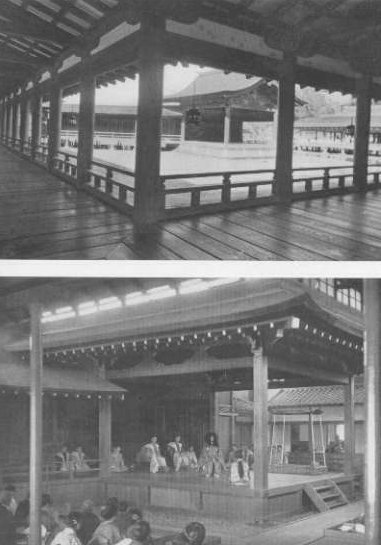
The noh in its early days was performed on the grass in the open. By a gradual development it came to be performed on a wooden stage built about two and a half feet above the ground, the regular size of which is now eighteen feet square with a post at each corner, and open on three sides: both sides and front. This stage has a narrow extension, about a quarter of its size, on the right hand side facing the stage for the chorus, and another extension, about one-half its size, on the back for the musicians and attendants. To that rear extension is attached aslant a passage (hashigakari or bridge) varying in length from 20 to 72 feet. By means of that bridge the stage is connected with the mirror room which is located between the green room and the bridge. The players appear from under the curtain at the end of the bridge, towards which the bridge slopes slightly down. The stage too is very slightly tilted to the front. Three pine sapplings are planted a little apart along the front of the bridge, suggesting on the one hand the close approximation to Nature, and marking on the other the actor's progress between heaven, earth, and man. There is a narrow space on the ground along the side and front of the stage covered with sand and gravel. (Plate 103 upper and lower.)
The wooden wall called kagami-ita (mirror board) at the back of the rear extension, forming a background to the stage, is always decorated with the painting of an aged pine tree and the narrow panel on the side with one of bamboo. These paintings are explained by some authorities as reflecting a similar painting on the screen used for the background of the Shogun's seats, which faced the stage. But I am inclined to believe that they indicate a reflection of Nature in front. These paintings, together with the pine sapplings and gravelled strips of ground between the stage and the spectators' seats, may be taken to indicate that originally the noh was performed in woods. Further more, they may be taken to indicate an ideal which the noh players should have, the ideal being to keep themselves in the mood of performing not for the enjoyment of human spectators, but for the pleasure of the invisible gods in the woods, of which a pine is reflected on the "mirror-board" back of the stage.
The noh pieces now performed by the six main schools of noh (four origi- nal and two additional) - Kanse Komparu, Hosho, Kongo, Kita, and Umewaka - number about 250, but there are many others not included in that list. About 1,750 pieces are known to have existed, though of many of them we know nothing beyond their names. However, excluding those written after the Restoration of 1868, about 800 texts survive. No less than 300 of these were written before the end of the sixteenth century and are decidedly superior to those written afterwards. No less than 93 of these plays are credit ed to one man, Seami Motokiyo, who, together with his father, is considered the founder of modern noh. Out of the large number extant about 250 were chosen to be used, and these noh pieces are generally classified in the following five divisions for convenience:
(1) Waki-noh, pieces in which the waki, the secondary character, assumes preponderance in the play, generally dealing with Shinto or Buddhist deities;
(2) Shura-noh, which commonly deals with the ghosts of warriors;
(3) Kazura-mono, or pieces using wigs, with noble female characters for the main parts;
(4) Genzai-mono, or present-day pieces, dealing with love, insanity and other manifestations of human nature;
(5) Goban-mono, or pieces dealing with demons or goblins as subjects, or those of a felicitous nature with gay and joyous elements.
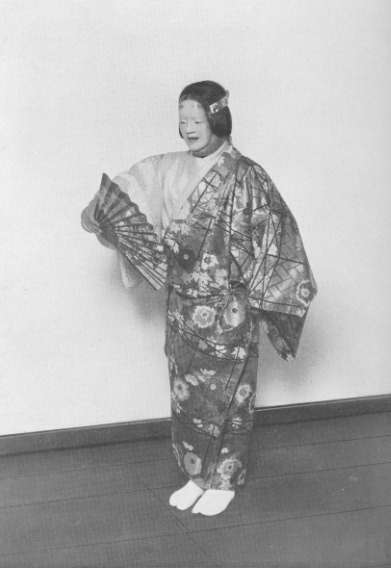
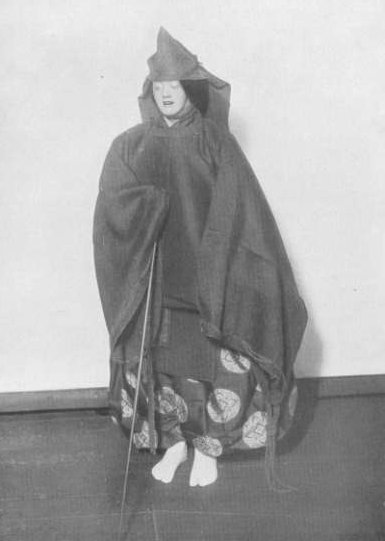
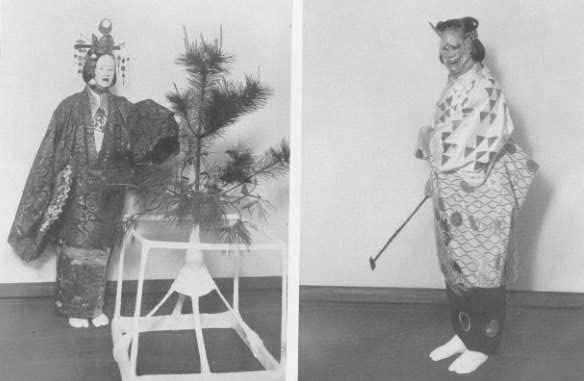
Each program of noh performances, which generally consumes the better part of the day, contains an example from each of the above-mentioned mentioned five classes in the order given with kyogen (comic farces) between. The rules for the organization of this program were laid down by Seami on a very strict basis, and have remained unchanged since then. The theory of the jo, ha and kyu has been insisted on in the arrangement of the noh program. The jo is the initial part and must be slow, solemn and powerful. The ha, or middle part, must have a variation, the movement being in medium tempo. The kyu, or last part, must be brief and rapid. This is the theory which obtains also in every movement and gesture on the stage. Even in taking a step forward, this theory of three variations is observed in the movement of the foot. If the actor is to move in a circle on the stage, the first third will be done in a slow and solemn manner, the second third in a slightly quicker tempo, while the last third should be finished rapidly. Not only in single movements, but in the performance of a dance the principle of jo, ha, and kyu is upheld. And further more, masters also insist on a contrast: riki-do and sai-do, strong and vigorous contrasted with light and weak. These qualities are shown in the steps, and in the gestures, as well as in the movements of the body. The harmonious combination of these variations and contrasts creates a pleasing rhythmic flow of movement in the performance of the noh drama. (Plates 98, 99, 100, 101, 102.)
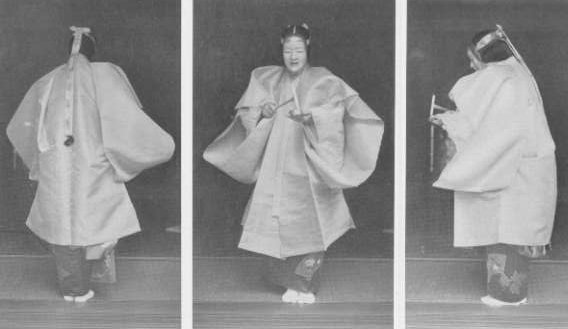
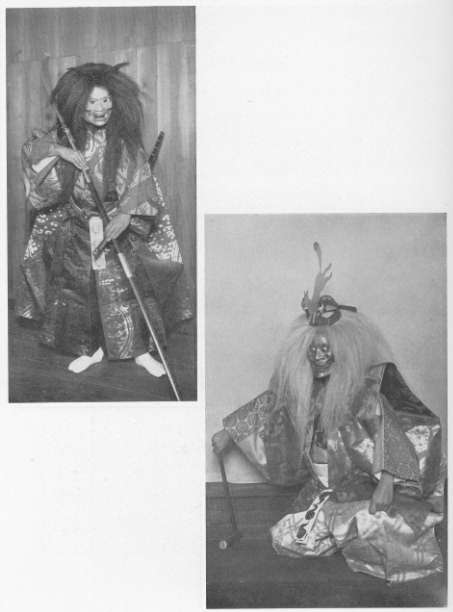
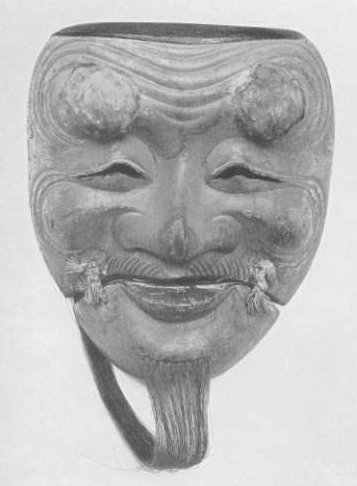
The whole program, if it is a formal one, is preceded by a play called "Okina," which is held in special reverence, and the person acting as its chief character, Okina, representing the radiant sun-goddess, has always been required to purify himself with a diet specially cooked and by pouring over himself cold water freshly drawn from the well each morning for seven days preceding the performance. (Plate 92.)
The construction of the noh piece, though by no means uniformly so, is generally as follows:
A waki (secondary character), generally a travelling monk or a minister of: state, first appears and tells who he is and where he is bound. He walks a little, singing, to show that he is travelling. Coming to a standstill, he announces his arrival at the destination, some shrine or historic spot, and takes his place at the foot of the front right-hand corner, facing the stage. The shite (principal character) in the fore-scene comes in the form of a farmer, fisherman, priest, or some other character, usually describes the scenery of the place, and speaks to the waki resting at the post. This person in reality is either a god or the spirit of the warrior chained here or a Shinto or Buddhist deity, usually disguised as an old man or woman. Answering the questions put to him by the waki, the shite gives an historical account of the heroes connected with the place, or relates the origin of the temple or shrine as the case may require, thus furnishing the audience with the necessary background to the play. The principal actor in the fore-scene then retires, and there comes on the stage a common farmer, wood-chopper or some such person and gives in plain language, spoken in an ordinary way, the information in detail concerning the place, generally reiterating what has been already given, though in literary language not easily understood, by the spirit in disguise, and then retires. This allows the necessary time for the principal character to change for reappearance. The night comes on, and the priest, feeling the atmosphere of the place, decides to spend the night in the open. While waiting, the waki sings, indicating the lapse of some time. Then appears the principal character in the after-scene, in proper form and attire as a Shinto or Buddhist deity, or the spirit of the hero. The climax comes when the god or spirit dances, revealing spiritual attributes, and in words and action, recounts his bravery, his death struggle, or his suffering in the underworld. If the spirit is seeking release, he asks for the prayers of the priest for freedom to speed to the place of peaceful repose. The main character tells his story as he performs, or dances without any song, but the dance itself is the climax of the play. This being the case, one often fails to get the force of the play by merely reading it; one must see the performance as well. The sutra chanted or prayers offered by the priest enable the spirit to free itself from earthly torment and go to Nirvana. In some present-day pieces, the waki assumes an important role in the play. In certain others, the shite and his assistant (shite-zure) often take an active part throughout, and in others the waki entirely disappears.
Generally several persons, attired in the kami-shimo dress, sit on the side extension and sing or intone either in chorus by themselves or with the per' former. Each holds a closed fan while singing, and often they alternate with the performer as if carrying on a conversation. Thus the actor speaks or sings as he performs. The musicians on the rear extension consist ordinarily of one player each on the fuye (transverse flute), the tsuzumi (small hour-glass shaped drum struck with the tips of the fingers over the shoulder), the okawa (a slightly larger drum struck, on the knee, also with the tips of the fingers), and the flat drum beaten with two sticks. The first and the last musicians play kneeling on the floor, while the second and third play sitting on collapsible stools. The movement of their hands and their solemn attitude are interesting and impressive. The music is emphatic or explosive, each stroke on the small drums being preceded by a peculiar utterance of the musician. (Plate 103 lower.)
For acoustic purposes, big ceramic jars are placed about, generally five or seven under the stage and two or more under the bridge according to its length. The jar when hung upright produces a low resonance, higher notes being obtained by tilting the jar. The stage generally is so constructed as to produce five different notes by stamping the floor with the foot. These five notes are taken to suggest symbolically different seasons of the year as follows. spring near the left back, winter near the -front on the left, summer in front on the right, autumn about the middle, and midsummer in the back slightly to the right. In regard to the stamping, note that there are three kinds: one is to represent the actual sound as in describing the sound caused by a plunge in water; the second is to express joyous emotion in the course of narration, and the third is mainly to signal the musicians, or to keep time with them.
The text of the play when read seems incomplete because the climax of the play comes in the dance performed in the second scene, as we have already observed. But the exchange of dialogue between the actors and the chorus is effective, as is the change from prose(kotoba) to verse (utai) in parts where in' tensity of feeling is desired. There is hardly any realism on the stage, a very limited number of simple accessories being used. Usually the story is first recited by the ghost of one of the characters and then portrayed in a symbolic dance. The result to the audience is a "vision of life painted with colours of memory, longing, or regret."
It is interesting to note the fact that among a large number of people, in the upper and middle classes, especially among the intelligentsia, the practice of noh singing is widespread, and not a few of them go so far as to perform on the stage, or try to learn one of the drums. I know of many college and university professors, as well as eminent business men and their wives taking part in the production of noh performances. In feudal Japan many of the lords did likewise.
Nobunaga did not have much time to encourage noh. Still he was able to perform it, for it is recorded that he once danced before his men, singing, "Man's life is but fifty years. When you compare it to things in this universe, it is but a dream. There is not a single living thing that does not die." At the end of that dance he shouted, "Blow the horns; get yourselves armed." Thus they rushed to the battle of Okehazama.
We know that Hideyoshi, the Napoleon of Japan, was extremely fond of noh, and that he learned to perform it. There are about ten noh plays which were composed by him. Naturally there were many among his subordinates who also were keenly interested in noh drama. When he was appointed the regent, he performed noh himself. It is recorded that he had a noh performance given in the midst of his campaign at Odawara. Again, when he was stationed in Nagoya Castle, he built a large boat with a stage on it, where he often had noh performances carried on. He also used noh in Buddhistic ceremonies. The third anniversary of his mother's death he commemorated with an elaborate noh program. Once when he was performing noh in Nagoya, he stopped in the midst of his performance, raised his mask from his face and said to the chorus, "I forgot to give orders to send sacks of rice to my soldiers in Korea. Will some one make haste and have some rice sent to the front immediately?" At the end of the remark, he adjusted his mask and finished the performance.
Noh was used in connection with various functions. Sometimes common people were invited to view a performance, on such happy occasions as when one was given to celebrate a marriage in the Shogun's family, the birth of a boy to the Shogun, the coming of age of his young heir, etc. As many as 5,111 common people were invited annually to the noh drama given at the Shogun's castle in Edo (present Tokyo), these people being representatives of 385 old streets and 18 new streets of Edo. They were divided into two groups: morning and afternoon, the former being called the "morning glory" and the latter the "evening-glory" or moon flower. The Otemon gates were opened at 6 o'clock in the morning to admit the guests on the day of the performance. Each guest was presented with an umbrella, because on one occasion it had rained and umbrellas had been given out, and thereafter the custom was followed whatever the weather might be. The people, however, were not allowed to use the umbrella while viewing performances on the matting in the open. Once when it began raining hard, they were told to feel free to leave if they wished, but were not allowed to open the umbrellas and use them while watching the performance. They just sat on the umbrellas and enjoyed the play, and at the end of the program packages of sweets and often other presents were given to them.
After the Restoration of 1868, many time-honoured institutions suffered seriously and noh was also in grave danger. But we owe a debt of gratitude to your General U. S. Grant, who was once stationed, I understand, in your state on the banks of the Columbia River, for his interest in noh, which really started the modern revival. When, during his visit in Japan, he was entertained with noh performances in Tokyo, he spoke very highly of the significance of the drama, and expressed his sincere hope that it would be preserved unchanged against foreign influence. He foresaw the danger ahead of it, for that was the time when our people were doing their utmost to import all sorts of foreign ideas, regardless of the precious inheritance of their own race. General Grant's advice gave an impetus to Prince Iwakura to construct a noh stage at Shiba, Tokyo, for the preservation of this classic drama. He organized a group of sixty noblemen for the purpose and raised enough money to build the stage. This had a great deal to do with the starting of the modern revival of noh in Japan.
The noh drama constituted the principal form of entertainment among aristocrats and warriors in feudal Japan, while the music known as gagaku found favour with the Court, and the kabuki, or theatrical plays, furnished amusement for the common people. Until comparatively recently the kabuki players were looked down upon with contempt, something in the nature of beggars who originally played on the dry river bed and looked for coins to be thrown to them. But noh performers have always been treated with great respect, often great generals and feudal lords themselves having participated in the plays, as we have already mentioned. Today the actors of the kabuki are no longer looked down upon, and the noh is very popular among the upper and middle classes of our people, especially among the intelligentsia, while the shibai appeals strongly to all classes. The shibai, the modern theatre, consists of kabuki, which has come to be considered the classic style of acting, shimpa-geki, the new school of acting, and the ningyo-shibai, puppet shows or puppet drama. Of these forms of entertainment, the noh is the oldest and most unusual, and it also claims the honour of being the only existing form of drama in the world which has come down unchanged through the centuries.
Of course all music, dancing and drama in Japan, including noh, is traced back to a mythical origin. This is the kagura (sacred dance) which is still performed at different shrines in Japan. This kagura dance, as the story goes, was devised by the gods in front of a cave of heaven. Amaterasu, the sungoddess, had become offended and withdrawn into a dark cave, taking the light of the world with her. The assembled gods and goddesses tried every way of bringing her out of the cave without success. Finally, one of them, Uzume, the goddess of mirth, "lifted up her skirts, laughed and danced upon an inverted tub." The laughter of the other gods and the peculiar stamping sound aroused the curiosity of the sun-goddess. When she had partly opened her portals to discover the cause of all the merriment, strong gods pushed the doors fully open, restoring light to the world. The dance then performed by the goddess of mirth has thus been perpetuated in a serious way in the Shinto shrines as kagura, which is one of the sacred rites performed by maidens dressed in white with red skirts.
Noh drama, as we know it now, came into existence at the end of the fourteenth century or the beginning of the fifteenth. While gigaki, bugaku (which is also known as gagaku) and gyodo were imported from China, noh and kyogen originated in Japan. Kyogen literally means "wild words" and is a comic farce which is invariably presented with noh; so inextricably indeed that a noh performance is generally spoken of as noh-kyogen.
Saru-gaku (literally " monkey-music," consisting of juggling feats and comic remarks with actions to suit) of Yamato province was revolutionized by Kan-nami Kiyotsugu and his son Seami Motokiyo, and what is now known as noh-gaku, noh music or drama, was born as the result. The main part of another class of native music known as den-gaku became the secondary element of noh, while the secondary part of saru-gaku became the main clement of noh. Not only did these two geniuses, under the encouraging patronage of the Shogun Yoshimasa, build on what was best in their own saru-gaku, but they drew freely from den-gaku ( literally "rice field music"), which throve throughout the twelfth, thirteenth and part of the fourteenth centuries, and had much in common with the saru-gaku. What was graceful in them was ennobled to profundity in the noh, while their comic elements developed into kyogen.
The saru-gaku and den-gaku were native music and drama that were developed among the common people. The origin of the former is very much disputed, as the derivation of the character for "saw" is often traced to the character representing a god instead of a monkey, bringing its origin back to the sacred dance performed in front of the cave of heaven when the sungoddess went into hiding. The latter seems to have originated with the entertainment gotten up to cheer the farmers at the time of the transplanting of rice, the most important and arduous task in the farmer's life. Both saru-gaku and den-gaku had many things in common, and constituted the main forms of entertainment for the common people. The actors had their shows at different festivals, and they had their regular troupes which travelled throughout the country giving performances. They used masks which were very precious to them. So much so that one of the greatest punishments that could be inflicted upon them was to confiscate their masks.
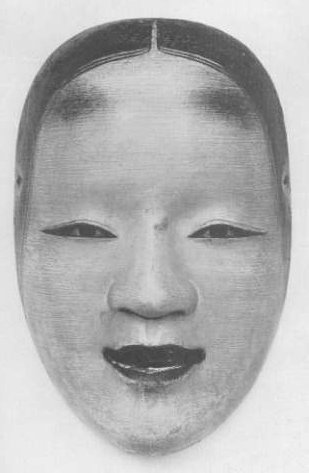
The masks used in noh and kyogen were by no means imitations; they were created by the Japanese themselves. Of course, the best points of the earlier masks were taken and combined in the production of masks best suited for the new drama. Therein is the peculiarity of the noh masks, and the circumstances leading up to their birth may be very briefly noted here.
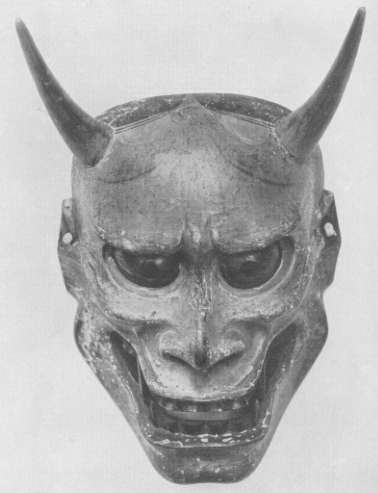
In the twelfth century, gigaku was already almost nil, continuing its feeble existence in Nara alone. Bugaku was then in vogue, but only among aristocrats, and quite beyond the reach of the common people. Gyodo was too solemnly religious and unsuited for the entertainment of the masses. It was just at this juncture that the musicians and performers of gigaku, who still maintained a precarious existence in some of the temples, originated a popular mask-using comedy to be performed for the entertainment of the common people right after the religious services in temples. The new comedy was well received, and the temples and shrines made good use of this popular entertainment for the purpose of gathering people together. This new comedy was called saru-gaku, and such is one version of its origin. Den-gaku was also in vogue and both were born among the people and continued to exist for the people. They were vulgar, but rich in vital interest. By the middle of the fourteenth century, saru-gaku began to attract the aristocrats and the warrior class. It was then that the great genius, Kan-nami, appeared from among the saru-gaku people, and that his art was recognized by the ruling Shogun, whose patronage he came to enjoy. Seami, Kan-nami's son, was also a genius, and the combined efforts of the gifted father and son succeeded in bringing the popular drama to completion, elevating it to a plane where it became suitable for the enjoyment of higher class people as well. They increased its dramatic elements, even enriching it with many tragedies. Its plots became more and more complicated, requiring a greater length of time for the performance. Consequently it became necessary to express joy as well as sorrow by one mask, and this resulted in the creation of a mask with an expression that may be sad as well as glad - a sort of a half way expression - which may be turned either way according to the acting. The masks used for momentary expressions of joy, sorrow, anger, etc., are from the past type which still retains the influence of gigaku. The true characteristic of the noh mask is to be found in the half-way expression, or in the composite expression which contains all the traits of a character, so that any particular trait required may be momentarily awakened in the mask, so to speak, by suggestion in acting. The success achieved in giving such expression to the masks enabled noh to include complicated plots, and become the mother of the Japanese theatrical performance. (Plates 93, 94, 95.)
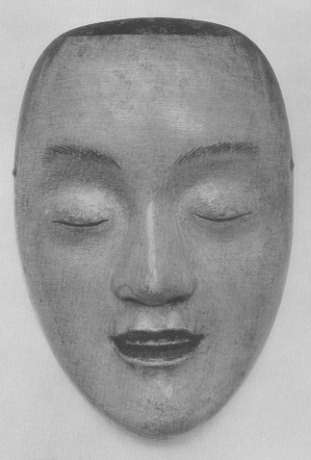
Kyogen, which is presented after each noh piece to relieve the audience, is said to show the beginning of that style in literature which carries itself on merely by conversation. As an example of subtle drolly, of refined comic literature, kyogen is said to occupy the highest position in Japanese literature.
In kyogen characters are made fun of. Take for instance a priest, who in the noh is always saintly and learned, but in kyogen is always degraded and like such as we often come across in our daily lives. In classifying the kinds of kyogen, the following ten forms may be noted.
(1) Those that are peaceful and end happily.
(2) Those which are concerned with demons and spirits.
(3) Those that deal with the crippled and the mischievous.
(4) Those that deal with priests, who, unlike those portrayed in noh, are unable to read even a single line of a sutra.
(5) Those that deal with yamabushi, priestly warriors.
(6) Those which are concerned with marriage, seeking husbands, etc.
(7) Those which are concerned with amusements such as were in vogue then - renka (series of poems), cha-no-yu (ceremonial tea), picnics and wrestling.
(8) Those dealing with thieves, bad men, and blackmailers.
(9) Those dealing with daimyo (feudal lords) of inferior character, such as (a) cowards, (b) the ignorant and those lacking in good taste, (c) the weak, easily overcome by women, (d) the selfish and oppressive, (e) the powerless, or incompetent, (f) those being made fools of by others.
(10) Those imitating and making fun of the noh.
Kyogen consists of the comedy element only, or the principal part of dengaku and saru-gaku. The masks used for both noh and kyogen are carved by the same artists, but differ in style. While many of the noh masks are threatening or grave, those of the kyogen are comically constructed with the intent of making people laugh. This aim is attained by a successful revelation in the masks of such principles of humour as a hitch in tension or seriousness, a sudden break in equilibrium, or extreme exaggeration. The reason for making the noh and kyogen masks small - just sufficient to cover merely the face - is to minimize their weight, on account of the long hours required for the performance. Noh and kyogen are still popular in Japan to-day. It cannot be denied that the present day kabuki theatre owes much to noh and kyogen in its manner of performance, and to their masks for the make ups used by the actors.
It was Okuni who started kabuki run exclusively by women. She seems to have been a sacred dancer of the Izumo shrine, and later her art was developed into kabuki, which took for its backbone the kyogen of the saru-gaku. Later the women kabuki was forbidden and young men's kabuki came into existence, and took much from noh.
Independent dances were developed from the noh shimai. The Fujima school of dancing in Tokyo, the Nishikawa school of dancing in Nagoya and the Inouye school of dancing in Kyoto, as well as the Yamamura school of dancing in Osaka, all received an influence from the noh dance. The leaders of these schools of dancing have always tried to infuse into their art the elements of popular dancing, and at the same time have endeavoured to conserve the dignity and refinement of the noh dancing.
The secret of success in the noh performance, the fundamental principles governing it, was pointed out by Mr. Kongo of Kyoto to be in the use of the little fingers of the hands and the attention given to the soles of the feet. These principles have been adopted by successful dancers other than the noh. It is explained that ordinarily we do not use the little finger, which is left to hang apart. In that condition the hand looks graceful and effeminate. But if strength is put into the little finger, it sticks close to the other fingers and the hand looks strong. Not only in dancing, but also in the art of fencing these two fundamental principles are considered vitally essential. The fencer holds the bamboo stick in the same way as the skilled noh performer holds a fan. The grip seems loose, but the stick or fan is held tight because of the strength placed in the little finger gripping it. Not only the manner of holding the fan, but the whole performance should be free from suki, or unguarded moments. We are told that a fencer once watched a noh player performing a dance as if he were facing his enemy; he tried to find unguarded moments when he might strike. But the player danced in such a way that there was no chance for the fencer to strike, except once when the dancer was supposed to look into a well in the course of the performance. After the performance was over, the fencer had an interview with the actor and sought an explanation of the unguarded moment. It was found that when he had looked into an enclosure representing the well he had caught sight of a piece of string and thought of the carelessness of his serving man. It was then that he lost the concentration of his mind for a moment.
In connection with the use of the little fingers I was interested the other day in reading the interview in which a well known Japanese woman magician named Tenkatsu was reported to have spoken of how important her little fingers were in her profession, comparing them to the throat of singers. I know that in the traditional style of Japanese dancing, too, the secret of using :he little fingers has been taken advantage of in the manipulation of the fan, that almost indispensable article in these performances.
I have no time to dwell upon the noh masks this evening, but I wish to make one observation before closing. A great variety of masks is used, more than one hundred and twenty different names of masks being enumerated in the list of apparel used by the main schools. You all know that the art of carving these masks reached such a height of perfection in Japan that even the masks alone were able to perpetuate the essence of noh drama and that they were used in order to assist in the realization of the ideals of noh.
What, then, is the ideal of noh? It is explained by Seami, the founder. According to him the highest form of noh consists in the art of reproduction, reproduction not of the outward form of life, but of the spirit of the thing, by means of songs and dances. When we speak of the art of reproduction we are likely to associate it with realistic mimicry, but since the noh is founded on songs and dances, it is not meant to be a mere realistic copy of human life or Nature, but to be an artistic reproduction. It is not to be a raw and bleak reproduction of a human being, but an artistic or refined reproduction. This reproduction, according to Seami, must be in yugen. Yugen means that it should have something more in it than what appears on the surface, that it should possess a deeper quality than that revealed. That is the quality which gives shibumi to the noh drama. In order to attain the ideal, only the essential and vital points should be reproduced in a polished or refined and yugen manner. Thus noh should be an idealistic or symbolic representation of the life which it seeks to represent.
It is for the purpose of attaining this end - to reproduce the essential objectives only in an idealistic and symbolic manner, thus creating yugen - that masks are used in noh. In order to achieve the end, the mask is not used by every participant, but is confined to the shite, the principal character, and shite-zure, the character supplementary to shite, only when considered absolutely necessary as in representing a demon or deity, etc. The principal characters only use the masks in order that they may cover the minor realistic individual expressions on the naked face, and may present to the spectators only the representative and symbolic expressions. In order to attain this end efforts were made in carving the noh mask not to reveal any momentary, realistic or individualistic expression true to life, but to do away with all this, and reveal on it the fundamental features of the character, each of which may be accentuated by the force of the play at the required moment.
Mr. Kongo once told me that the true significance of a real noh mask will remain beyond the comprehension of those who are interested merely in the realistic or physical expression on the mask. According to him those who are interested merely in the expression or suggestion of laughter or weeping in the corner of the mouth or in the eyes cannot truly appreciate the real taste, the real value, of the noh mask. The real significance of the mask-covered face is in the quality apart from the physical expression of the man therein suggested. The real value of the mask is communicated only to one who can feel the personality of a living man whose face the quiet and peaceful mask is. Thus a mask is no longer a copy of a human face; nor is it any actual human face. It is detached from the flesh and is an image of a person's face or character as we retain it in our memory. The mask is not a human face; it is the face of the character which lives in a world of its own. Such in substance is the ideal cherished by the talented and capable head of the Kongo school of noh. And I believe that that has been the ideal held by the great masters who taught the art of noh drama and by those great carvers and priests who carved noh masks.
In Japan noh masks are known as noh-men or omote. In both cases the term signifies that the mask is the face. It is interesting to compare it with the English term "mask," which signifies that it is used to cover or hide the face. One is the face, and the other is something to cover the face.
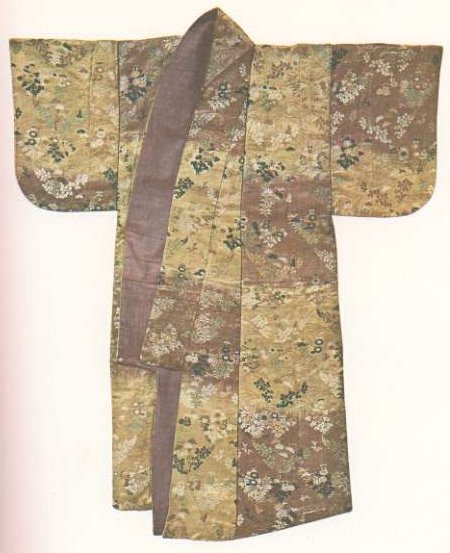
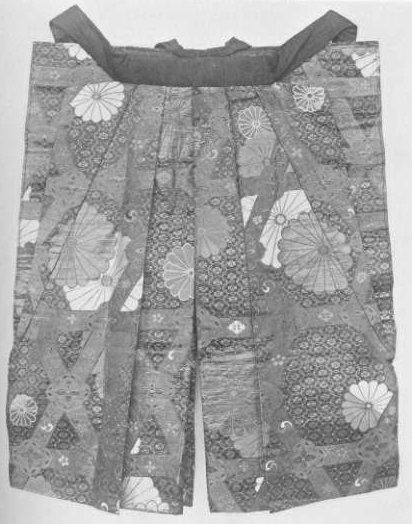
Noh drama has been responsible also for the great development of the textile art achieved in Japan. Wonderful silk brocades of both quiet taste and gorgeous splendour have been produced for the dresses used in noh performances. (Plates 96, 97.) In spite of the encroachment of foreign influence in modern times in the field of music and drama in Japan, the noh remains unchanged, still gathering a large number of followers with the glamour of its classic charm. It will be preserved as having a special significance in dramatic art, like the black monochrome drawings in the paintings of the Far East.
NOTES ON PLATES
Plate 92. Okina, Noh mask carved by Nikko. Owned by the head house of the Hosho school of noh.
Plate 93. Semimaru. Noh mask of a blind man. Carved by Genri. Owned by the head house of the Hosho school of noh.
Plate 94. Fushiki-Zo. Noh mask carved by Zo-ami. Owned by the head house of the Hosho school of noh.
Plate 95. Ukiki Hannya. Noh mask carved by Shakuzuru. Owned by the head house of the Hosho school of noh.
Plate 96. Noh Costume. Karaori silk brocade. Middle Edo period (1681-1788). Imperial Household Museum in Tokyo. Reproduced in colour.
Plate 97. Oguchi Bakama. Skirt for a noh dress. Middle Edo period. Professor Okada's collection, Tokyo.
Plate 98. Hanjo. Shite in the second scenein "Hanjo" dealing with a forlorn lady, who became insane, with a fan given to her by her lover as a keepsake. The Hosho school of noh.
Plate 99. 99. Semimaru. A blind man. The Hosho school of noh.
Plate 100. Left: Moon Maiden in " Hagoromo." The pine sappling represents the pine-tree of Miho, upon whose branch the Moon Maiden hangs her feather-robe. The Hosho school of noh.
Right: Shite (ghost or spirit of jealousy) in the second scene in "Aoi-no-Uye." The Hosho school of noh.
Plate 101. Shite (mother of lost child) in "Sumida-gawa," praying to the Buddha by striking the bell after she learned of her boy's death. Back, front and side views. The Kita school of noh.
Plate 102. Left: Shite (ghost of Taira-no-Tomomori) in the second scene of "Funa Benkei" tormenting Yoshitsune on a voyage. The Hosho school of noh.
Right: Shite in the second scene in "Kokaji." A personification of the god Inari who, with a hammer, assists Sanjo Kokaji Munechika to forge a sword for the Emperor. The Hosho school of noh.
Plate 103. Upper: Noh stage of Itsukushima Shrine. In full tide it stands in water.
Lower: The Former Noh Stage of the Hosho school of noh. In the middle of the stage are two performers in a play named "Kansan": one, sitting on a stool, representing Risei and the other, on the floor, the maid of the inn. Behind Risei are seen four musicians in a row: two in the middle on stools, and two outer ones seated on the floor. Those seated behind them are assistants. The group at the farthest corner forms the chorus. The framework on the stage represents a humble inn with a mysterious pillow in the fore-scene of the play and the spacious palace of an emperor in the after-scene. The play is based on a story in which Risei, under the influence of a mysterious pillow which he used, dreams of becoming an emperor, and gets an insight into the real significance of life.