

X. CHA-NO-YU AS A CULTURAL INSTITUTION
Delivered at Harvard University Fogg Art Museum
ONE day, before I left Tokyo, I paid a call at the iyemoto (head-house) of the Edo Senke school of cha-no-yu and was entertained with a bowl of powdered tea. In the waiting-room my attention was caught by a framed maxim hung on the wall written by Fuhaku, the founder, who left Kyoto eight generations ago in order to establish his own school in Tokyo, then called Edo. In that writing Fuhaku points to Joshinsai's poem on cha-no-yu which may he roughly rendered thus:-
What is it, the thing called cha-no-yu?
It's the voice of the wind
Among pine-trees painted in sumi.
It shall be my endeavour this afternoon to bring you close enough to hear, however faintly, with your mind's ears, or rather feel. however slightly with your aesthetic sensitiveness, the voice, the music, of the pine-trees painted in black monochrome. Like most of the time honoured cultural institutions of our country, it has an elusive quality, which is difficult to express in tangible forms. But I hope you, with your trained ears, may be able to catch at least a strain of that music.
There is hardly any institution which has influenced the art and culture of the Japanese people during the last few centuries more than cha-no-yu, commonly rendered as ceremonial tea. It is still practiced by a large number of people in Japan today in many classes of society - by statesmen, business men, literary people, priests, artists, curio dealers, men and women of leisure, as well as those fully occupied. There are a large number of masters throughout Japan whose profession it is to give lessons in cha-no-yu, and it constitutes one of the important studies in girls' schools, intended mainly to teach etiquette. Without a knowledge of it, one would feel out of place in a cultured community in Japan. Without understanding the spirit of it, it is nearly impossible to appreciate the art and culture of Japan.
Cha-no-yu is made up of three characters: cha or tea, no or of, making tea a possessive, and yu or hot-water. Thus the term means tea's hot-water or the hot-water of tea.
Cha-no-yu is an institution founded upon the adoration of beauty as we find it in the daily routine of life. It teaches us to do the daily household tasks in a beautiful manner based on simplicity and economy of action, to appreciate the beauty in performing the act, and to feel the beauty in seeing it performed by others. It cultivates our minds to see beauty in the very act of making a fire to boil a kettle of water, of preparing bowls of tea, and of drinking the tea. Even in the sweeping of a floor or in the serving of a meal, the devotees of cha-no-yu try to accentuate beauty in all forms in the colour, shape and texture of the objects used, as well as in the rhythm of mo' tion created in the performance of the necessary work connected with this ceremony.
Cha-no-yu as we know it now is based on the principles of the Zen sect of Buddhism. This the history of the use of tea in Japan clearly shows. The use of tea, however, is proved to have been in existence as early as the eighth century in Japan. It is recorded that the Emperor Shomu invited one hundred priests to the palace in the year 729 and had the Hannyakyo (a sutra) expounded and on the following day gave them tea. Though we do not know the manner in which the tea was served on that occasion, it is generally believed that tea at that time was used as medicine. However, it is interesting to note that tea is not included in the list of sixty different kinds of medicines which were dedicated in 756 to the Great Buddha of the Todaiji, Nara, a large number of which are still preserved in the Shosoin, an Imperial Repository.
Nevertheless, the fact still remains that tea was cultivated and used as medicine in that remote period in Japan. It was evidently for that purpose that the famous priest Gyogi, during the eighth century, planted tea when he established temples - no less than forty-nine in number - in the different provinces of Japan. A temple named Yakuwoji in the province of Mikawa is believed to have been founded by Gyogi and a document of a later date speaks of the existence of a tea plantation there.
We also know that there was a tea plantation in the palace ground when the capital was established in Kyoto towards the end of the eighth century, and that the plantation was under the supervision of the Imperial Medicinal Bureau.
It is also recorded that Dengyo Daishi, the founder of the Tendai sect of Buddhism in Japan, brought back from China some tea seed and cultivated it at Sakamoto on the northwestern bank of Lake Biwa. That was in the 24th year of Enryaku (805). More seed was brought from the continent in the following year by Kobo Daishi, the founder of the Shingon sect. The use of tea was known in China much earlier than this.
We find that the Emperor Saga seems to have enjoyed tea as a beverage, more or less as we enjoy it to day, when he was entertained with a bowl of steeped tea by Priest Eichu of the Sufukuji, at the time of his visit to that temple in 815 at Kanzaki on the banks of Lake Biwa in the province of Omi. This was the same emperor who ordered tea to be cultivated in different provinces, including those of Kinai, Omi, Tamba and Harima, and to be presented to the Court annually. By this time the use of tea had become more and more widespread, and we read that in 916 the cloistered Emperor Uda used tea, instead of sake (rice-wine) when he celebrated the fiftieth year of his age. But the use of tea as a medicine persisted for quite a while as may be seen from the fact that the Priest Kuya went about the streets of Kyoto in 951, administering bowls of tea to the sick, when there was a great pestilence, thus saving the lives of many.
But the actual origin of modern tea is generally ascribed to the priest Eisai, who in 1191 brought back from China some tea seed which was planted on Seburiyama in Kyushu in southern Japan, some of it was later cultivated in Kyoto. The Zen sect of Buddhism demanded constant and concentrated thinking; its followers aimed to work out their own salvation by intense meditation, and bowls of tea were given to the priests to keep their minds alert in contemplation. That was the way the use of tea came to be closely connected with the Zen sect of Buddhism. And when, in 1214, priest Eisai administered a bowl of tea to Shogun Sanetomo who was suffering from the excessive use of sake, its beneficial effect was so marked that the Shogun greatly encouraged the use of tea among his vassals. This helped to spread its use.
It was some two hundred years later or more that Noami, who was close to Shogun Yoshimasa, originated the style of cha-no-yu known as "Shoin tencha," in which lea was served in a rather large room with the aid of a daisu, or stand. It was the formal style of cha-no-yu more or less inclining towards luxury, and laying stress on the decoration of the room. It was about this time that Shuko instituted the "Soan" style, an abbreviated form of the ceremony, founded upon the principles of Zen, and emphasizing the value of refined poverty. These were the two main forms of cha-no-yu, each with its followers, which were combined about a century later by Rikyu, one of the greatest masters, if not the greatest, who completed the details of this ceremony. Cha-no-yu throve in the sixteenth and subsequent centuries; it was revived with great enthusiasm not long ago and is in full sway at the present time. With Rikyu as an able exponent, it found favour with the Ashikaga Shogun, and such other military heads as Nobunaga and Hideyoshi at the cud of the sixteenth century. Any number of powerful feudal lords also were among the tea devotees and these exercised great influence upon the people, especially in elevating their artistic taste.
The founders of cha no yu emphasized its spiritual qualities, though at one time there was a tendency to use it in gambling. The tea grown at Toganoo in Kyoto was considered the "true tea" and that grown in other parts of the country was spoken of as "no tea," and those who drank were asked to discriminate between the two. Though some trace of this trivial side of cha-no-yu is still left in the sort of game played in tea-drinking in which the participants are expected to tell the provenance of tea, this is merely a trivial adjunct of the true cha-no-yu. Gambling in the use of tea was put an end to when Shuko formulated the ceremony. Shuko who died in 1500 at the age of 81, emphasized the spiritual qualities of cha-no-yu from the beginning. He emphasized the following four qualities: ( 1 ) harmony, ( 2 ) respect, ( 3 ) cleanliness, and (4) tranquillity. By harmony was meant that in drinking tea the rich and the poor, the mighty and the humble, might drink tea together and still be in perfect harmony. By respect was meant that however intimate one might grow, one should never lose respect for others. By cleanliness was inculcated the teaching that each person entering the cha-no-yu room should be cleanEclean in mind and clean physically from the top of the head to the tip of the toe. Cleanliness was strongly insisted upon by the Shinto religion from the beginning of our history and this quality was further emphasized in connection with cha-no-yu. Finally the word tranquillity suggested that all things gaudy and ostentatious should be avoided and that the quality known in Japan as sabi should be valued not only in the utensils used hut also in the conduct and character of the persons themselves. Sabi suggests the indescribable quality of mellowness which is given to an article by long and fond use. It suggests lacking the assertiveness of the new. To these four essential qualities Rikyu, who perfected cha-no yu some ninety years after Shuko, added another, namely, sincerity, as the crowning virtue of all. It was his contention that none of the original four qualities would be of any value if not charged with sincerity.
Rikyu's attitude towards cha-no-yu may be gathered from the following notice, consisting of seven items, which was prepared by him and Sokei and posted at the waiting bench bearing the date 3rd day, 5th month, 12th year of Tensho (1584):
(1) When all the guests are assembled at the arbour, or the waiting bench, they should signify it by tapping the board.
(2) As to ablutions, the most essential thing in cha-no-yu is that the mind and heart should be cleansed.
(3) The host shall first come out and greet the guests, after which they shall all enter the tea-room. The utensils leave much to be desired, the food is not especially good, and the trees and stones in the garden are just natural, so those who cannot appreciate such simple things had better leave at once.
(4) When the water boils and produces a sound like that of the breeze in the pines, a bell will be struck, and thereupon the guests should re-enter the tea-room. If the heat of the fire and of the water are not as they should be, this is to be deplored.
(5) Both outside and inside the tea-room no ordinary tittle-tattle has been allowed from olden times.
(6) The meeting is one of host and guests as equals, so there should be no flattery.
( 7) The meeting should not be prolonged beyond two toki (equivalent to four hours), but an exception may be made in case an elevated religious or philosophical discussion is in progress.
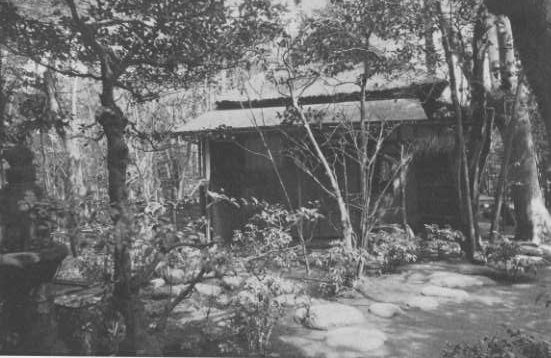
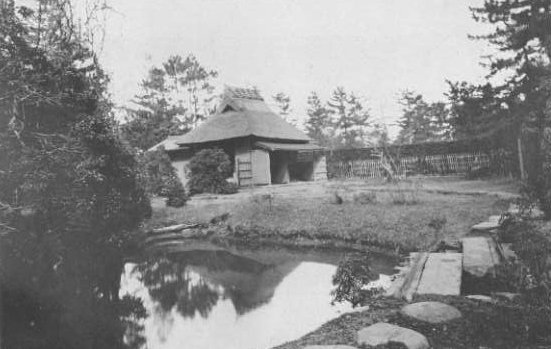
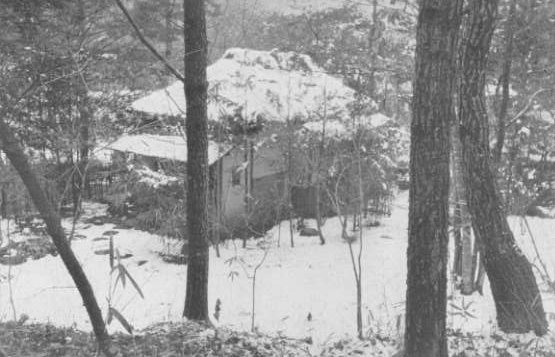
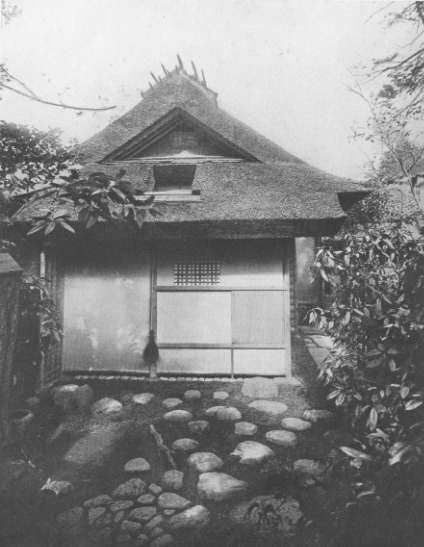
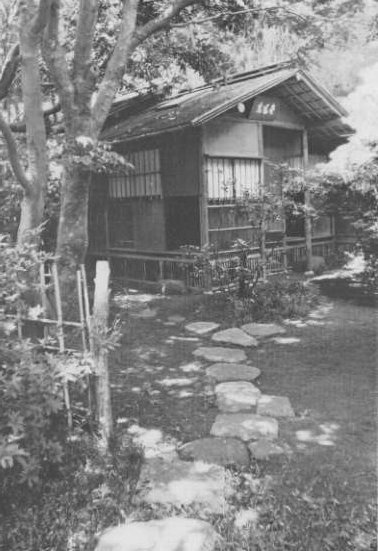
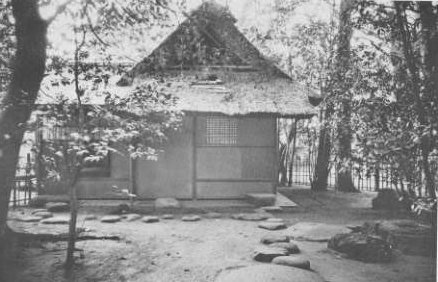
The room in which cha-no-yu is served is called the cha-seki, or tea room. Though cha-no-yu may be served in any room, a part of any room or anywhere else, it is most desirable to have it served in a room detached from the main building, and especially built for the purpose. A cha-seki generally consists of a room about nine feet square, though some are larger and some smaller. It should also have a room back of the tea-room where utensils may be kept and preparations made. The structure, invariably without an upstairs, should have a rustic appearance. Wherever possible it should have a thatched roof and be built of wood, bamboo or other similar fragile material. The purpose of this is that when one sits in the room one may feel sufficiently sheltered and at the same time may not feel a sense of being shut in as is likely to be the case if this structure is built of stone or brick. One should be able to sit in the room and still be able to hear the sound of running water, rustling trees, twittering birds, singing insects or other natural movements that may be transpiring outside the tea-room. Though sitting within the house one should be able to commune with nature outside. That is very essential in meditation, so that one's mind may feel no barrier, one's soul no hindrance, in its flight. Great care is to be exercised in the choice of materials used for the building so that there may be variation in colour, form and texture, and yet a pleasing harmony in the whole. The shape and size of the windows are generally different and the openings placed at different elevations. The various parts of the ceiling of the room are generally treated differently and made of diverse materials, so that one may not feel the effect monotonous, but enjoy harmony in variation. All this is most helpful to quiet meditation. (Plates 121, 122, 123, 124, 125.)
As we sit there, our minds go back to the origin of things. We stand in a field where grass and reeds grow. We gather these reeds and tie them at the top with a rope, clear a place inside, sit there and call it a human habitation. The time comes when the rope snaps; then the reeds resume their former upright position, and the field looks the same as it did before. Even so is our human body, the temporary habitation of our soul. We live for a while and pass on, leaving but little trace upon the eternity of things.
The tea-room is symbolic of this fundamental truth in nature. It reminds us of the evanescence of life, the life in this transient world of ours. It helps to create a suitable atmosphere conducive to meditation when we sit in it. The guests, generally no more than five at a time, are invited into a cha-seki, and the host makes a charcoal fire in the earthen or metal brazier, or on the hearth, according to the season, boils water in an iron kettle and prepares bowls of tea for the guests. We use pulverized tea; a quantity of it is put in a bowl, hot water is poured over it and the tea is stirred with a bamboo whisk. Great masters have studied and formulated the most beautiful way of doing all this. For instance, in the course of the procedure it becomes necessary to remove the cover of the water jar. That cover may be removed in an infinitesimal number of ways and the lid placed in a thousand different positions. But the masters have chosen the most beautiful way of taking that cover off and placing it in a certain position. In determining what and how it is to be done, careful consideration was given to the following points: that the movement of the hand may be not only pleasing to the person performing it, comfortable and satisfying the aesthetic sense, but that it may also be beautiful - not only in itself, but also from different angles and to each of the five guests in the room. Each motion should be beautiful not only in itself, but harmonious and rhythmical as well in its relation to the motion that succeeds and precedes it. The work must be done in proper sequence and with economy of movement so that it may be carried on in beautiful rhythm and with the utmost efficiency.
Taking all these points into consideration, different masters of tea made the rule that the cover of the water-jar should be lifted with the right hand in a certain form and with the assistance of the left hand the grip changed and the cover leaned against the jar at a particular angle of inclination. Of course, some variation is made in accordance with the kind of lid used and the position of the jar. A similar study has been made of the other movements as well, and a definite sequence of these has been decided upon, and forms prescribed, in order to make the whole procedure a rhythmical flow of motions. Thus the whole procedure in preparing a bowl of tea is a sort of music expressed in form and movement.
Even in the building of the charcoal fire similar aesthetic principles are well thought out. Charcoal of various sizes, sawed into suitable lengths, some longer and some shorter, some split and some whole, after being washed and dried, is carefully arranged in a basket together with a few charcoal twigs, covered with white lime, before being brought onto the scene. The live coal is carefully arranged in the middle of the brazier or hearth, and a large piece of charcoal is then picked up from the basket and laid with precision in the ashes in front with the right hand to form a foundation to support the rest of the charcoal structure. Other pieces of charcoal are picked up with a pair of small iron tongs and placed on the ashes with grace and precision in a carefully studied sequence of order which varies according to the season of the year A touch of white on the black charcoal against the grey ashes is not only very effective, but the lime also helps the charcoal to ignite quickly.
There are fundamental rules to be observed, not only in the making of the tea by the host or hostess, but on the part of the guests in order that they too may contribute beauty to the rhythm of the whole. You who sit as a guest should realize that the drinking of the tea is not the end in itself but that it is the means to an end. Tea is used for the purpose of cultivating the five essential qualities just enumerated - sincerity, harmony, respect, cleanliness, and tranquillity. It should be utilized to lead us to a high aesthetic ecstasy that comes from spiritual enlightenment. You take a bowl of tea with your right hand, place it upon the left palm and then hold it with both so that the bowl may be held secure and in perfect balance; for these aspects are necessary in obtaining the mental equilibrium indispensable to meditation. Not only for balance, but also for safety, should the bowl be carefully held and handled, for some of these bowls, as well as the other utensils, are extremely valuable and perhaps irreplaceable. You raise the bowl of tea to your forehead in token of respect and gratitude. You turn the bowl slightly on your left palm with your right hand. You look into the bowl; you take note of the beautiful colour of the green beverage in its relation to the glaze and texture of the bowl itself. You may perhaps observe the reflected glow, an iridescence, on the bubbles of the tea made in preparing it by stirring pulverized tea leaves in hot water with a bamboo whisk. In those iridescent bubbles which change their form even as you watch, there may be a suggestion for you as to the evanescence of life. In all solemnity of thought you take a quaff of the tea. You appreciate its superior taste, you feel its quiet and soothing effect; you take another quaff, followed by the third, and finished by the half quaff, and by draining the last drop. There is a variation in the length of the interval between the quaffs, and a slight variation in drinking each, ending with an appreciative audible sip. Then the traces left by the lea in the bowl, the mysterious design with its innumerable suggestions, should not escape your notice after the drinking is finished. The mark left in the bowl may remind you of the wonderful scenery you enjoyed years ago, and the sound of the water in the garden may perhaps supply the missing link in your memory or imagination. You may now turn the bowl to admire its glaze, its subtle gradation of tone, its mystic depth; and you will look at the underside, noticing the interesting way its bottom-rim stands out and, where the glaze does not cover it, how the honest clay of which the bowl is made is exposed. There may be a mark to indicate the potter who made the bowl.
This bottom, or underside, reveals the personality of the potter - the inner quality of the ware gives individuality to the bowl and reveals a personal touch. You will realize the presence of the great potter in your midst helping you enjoy beauty in the object of his creation - the object you come in contact with.
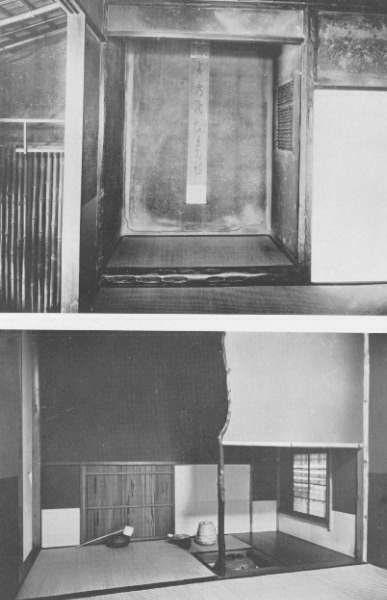
The cha-seki invariably has a tokonoma or alcove for ornaments. When we have cha-no-yu this alcove is generally decorated with a scroll of writing or painting by some famous priest or tea-master to furnish thoughts for meditation, or a basket or a vase with one or two blossoms - a glimpse of nature - is hung on the wall alone. Flowers are never used in profusion. If one is fully open, the other should be a bud, half-concealed by leaves. It should suggest a touch of nature in the room and no more. Nothing else is placed in the tokonoma in the way of decoration, but every utensil used in the room constitutes part of the decorative scheme.
In serving cha-no-yu it is necessary to have a brazier, except in winter when the hearth is used; an iron kettle for boiling water; a water-jar; a pair of small charcoal tongs of iron; a basket containing charcoal; an incense-case containing some lumps of incense or pieces of incense wood; a feather-broom; a small stand for the purpose of resting on it the cover of the hot-water kettle; a bamboo dipper; a basin for waste water; a piece of coloured silk for general use; a piece of white linen or cotton cloth for drying purposes; a tea caddy; a tea scoop and a tea-bowl. These utensils are to be very carefully chosen in relation to the guests, the season and the nature of the occasion for which the party is planned. One must always think of the variety and the harmony of the objects used in order that none of them may be out of place; at the same time care must be taken not to create a sense of monotony. The same rule applies to the choice of food, as well as to the utensils used in serving it. Meals are served on individual lacquered stands with lacquered bowls or ceramic dishes in place. The food should be pleasing to the eye as well as satisfying to the palate, and due consideration is given to the choice of dishes so that they may look beautiful even when empty.
Infinite thought is given to things that are not easily noticed. For instance, fine sifted wood-ash, washed and strained in water, is kept in a jar and lea poured over it and carefully preserved under sealed cover so that when a charcoal fire is made in the brazier, and some of these ashes ground and moistened are sprinkled about the fire, the room is scented with an agreeable aroma, and at the same time the moisture is creating a draught and thus helping the fire. Another instance: the iron kettle generally has extra pieces of: iron at the bottom so that it may furnish music like the pines by the sea when the wind blows through their branches. We speak of the music of the wind through the pines in the tea-room in indicating the sound heard when the water in the kettle boils. (Plates 132, 133 lower.)
Every cha seki should have a garden. The cha-seki garden is called a roji, which has reference to a passage in a sutra which runs as follows: "Escaping from the fire stricken habitation of the Three Phenomenal Worlds, they take their seats on the dewy ground."
The roji is a subject by itself, and I shall not have time to deal with it today; I shall mention only a few facts concerning it.
An ideal roji (meaning dewy path) was described by Rikyu thus: "thick green moss, all pure and sunny warm."
According to Sogi it should have an evening moon; "a glimpse of the sea through the trees."
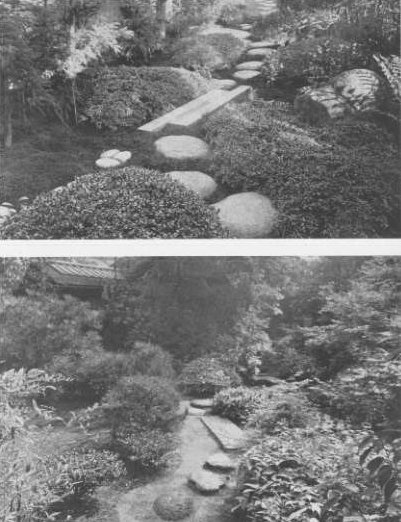
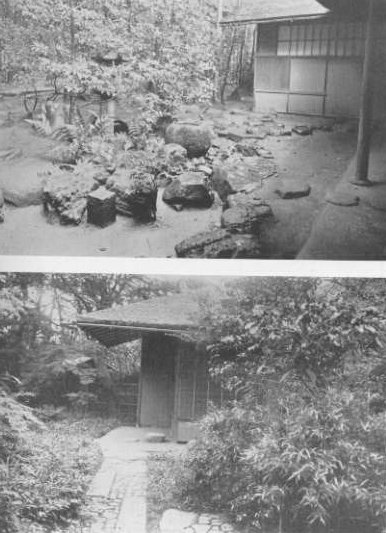
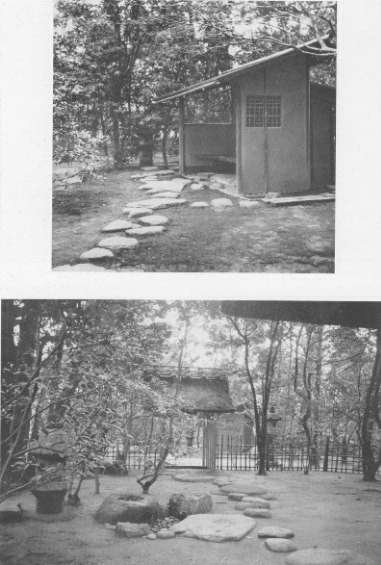
It should be simple but suggestive of a path in the mountains. It should create an atmosphere of sylvan solitude or seaside tranquillity. (Plates 128, 129.)
There should be a gate dividing the inner from the outer section of the garden. Hardly any flowers are tolerated in the garden, in order to intensify the beauty of the flower used in the house. Rikyu's morning-glory will illustrate this point. (Plate 126 lower.)
Not only for flowers, but for utensils as well, a similar consideration was sometimes shown. A story is told of Iyehara Jizen about a bamboo flower-vase named " Onjoji. " On a certain occasion Nomura Soji, a connoisseur of Owari province, called on Jizen in Kyoto hoping to see this famous bamboo flower vase. "Not this year," said Jizen, "but next year when I break the seal of the new tea-jar I shall be glad to have you as a guest and show you the "Onjoji." When the promised time came, and a special cha-no yu party was held to use the bamboo flower vase, Jizen built a special tea room in which no bamboo was visible and, moreover, he cut all the bamboo growing in the garden-path and vicinity in order to secure the greatest intensity of feeling possible for his showing of the bamboo flower-vase in the tea room.
Generally there should be a well, or a stream or a suggestion of a stream in the garden path.
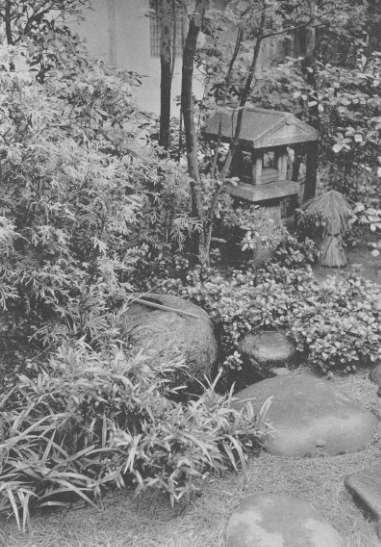
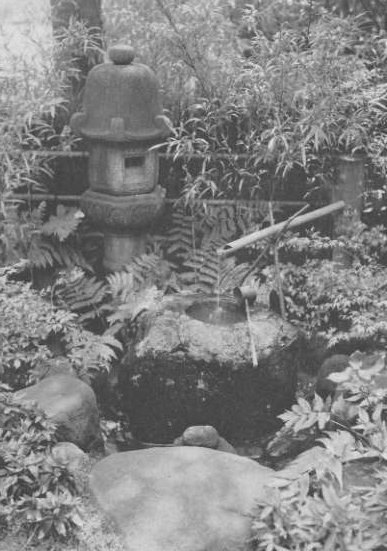
The garden should be provided with a sheltered bench for the guests to rest upon at intervals. There should also be a stone water basin (tsukubai) where guests may stoop to scoop out water with a dipper in order to cleanse themselves by rinsing their mouths and washing their hands. (Plates 126, 130, 131.)
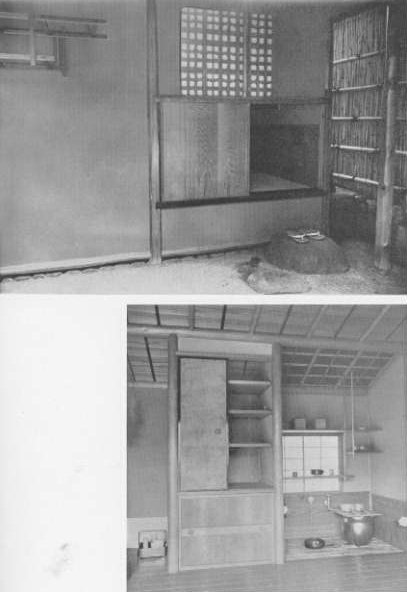
The cha-seki invariably has a nijiro, wriggling in or crawling-in entrance, generally about 2 ft. 4 inches in height, and almost but not quite as wide. When one goes in, one leaves behind one's rank and station in life. Within the cha seki there is equality and harmony between lords and vassals; they take part in the ceremony as equals. (Plates 127, 133.)
There is a shelf outside where swords were left in feudal times. Though it is no longer needed for this purpose, the shelf is still made as a necessary adjunct to the cha-seki, and a suitable rock is imbedded in the ground below it to mount on when using the shelf. One may place there things which one does not care to carry into the room. (Plate 133 upper.)
Each guest has an assigned seat in the room in the order of entrance, sandals are removed and placed aside in order that others who follow may be accommodated. Consideration should always be shown for others.
Tea devotees have always shown great appreciation for the utensils of cha-no-yu, and there are many stories illustrating this point, though I shall not be able to recount them to you this afternoon, except perhaps one. But be fore giving you an account of a tea caddy, let me call your attention to the fact that cha-no-yu was used by such great generals as Nobunaga, Hideyoshi and Iyeyasu for political purposes. Tea utensils were often given as rewards for exploits in wars, and many warriors preferred them to the extension of their domains. The love for and respect paid to treasures were so strong that some went so far as handing over to the enemy a number of treasures in the midst of a fight. Just before Akechi Mitsuharu committed seppuku and set his castle on fire, he lowered from the keep bundles of silk brocade containing more than sixty objects, including celebrated tea caddies, tea-bowls, incense boxes, scrolls of calligraphs and of painting, as well as famous swords, and asked the enemy to take them to their master for safe keeping, adding a remark to the effect that soldiers may perish as the fortunes of war decree, but that he could not bear to destroy these treasures. This occurred in the year 1582 on the banks of Lake Biwa.
Let me give you an account of a famous tea caddy. When Sansai, a warrior and tea devotee, was on the verge of losing his life in connection with a military plot, Hideyoshi pardoned him and gave him a tea-caddy named "Ariake" (dawn), a small jar about 4 inches high, covered with a dark-brown glaze, mottled with gray. Later when Sansai was hard pressed he pawned this caddy for fifty pieces of gold, and it fell into the hands of the priest of the Ankokuji temple. It so happened that in one of the battles Iyeyasu was greatly troubled and discouraged by the fortunes of war. Thereupon one of his vassals named Koan, a tea devotee, spoke up and expressed his wish as follows:
"When the eastern rebels are vanquished, if I am favoured with the tea caddy now in the possession of the Ankokuji temple, I shall drink tea morning and evening and enjoy peace."
The face of the great general was brightened by the remark, and he answered that the wish should be fulfilled. Even so it came to pass, and the caddy was given to Koan as a reward for his exploits in the battle.
Some years after the war, when Sansai was invited to Koan's house to tea, he saw the caddy which had been originally given to him by Hideyoshi. He was so affected that he could not control himself. While the host went out of the room, he took sudden leave with the caddy hidden in his sleeve, asking his friends to repeat to the host a poem which conveyed the thrill of joy that came from this unexpected reunion made possible by the prolongation of his life. Upon his return home he sent a servant to the host with costly presents and 200 pieces of gold, asking his permission to keep the caddy. Koan was willing to let him keep it, but he could not bear to accept gold for it. But on being pressed, he accepted the gold and built a temple with it.
There was a famine later in 1627 in Sansai's fief in Buzen province and his son Tadatoshi sold the caddy for 1,800 pieces of gold and bought rice, beans, wheat and other provisions from Osaka and thus saved his people from starvation. Sansai, who was then stationed in far-off Edo, heartily approved of what his son had done and commented on the act, saying that his son had shown real understanding of true cha-no-yu. According to Sansai it was in accord with the spirit of cha-no-yu that the caddy with which he was so thrilled that he could not refrain from resorting to unusual means in obtaining it, should be sacrificed to save the lives of his people. The caddy was precious, not only for its own sake, but also for the great good which it was capable of accomplishing in one form or another.
A small feudal lord named Sakai Tadakatsu bought it, though he was by no means wealthy. Because of this one of his vassals, Kihei by name, had tried in all sincerity to prevail upon his lord not to buy it and had thereby placed himself in danger of losing his head.
It is recorded that in 1648, about 21 years after Tadakatsu bought the caddy, Sakai Tadarnasa, his son, presented it to the Shogun as a treasure bequeathed to him by his father. Later the caddy was given to Matsudaira, Lord of Iga, in whose family it remained until 1913 when it was bought at a sale by Masuda Koyen of Tokyo, in whose possession it now remains.
The tea devotees not only appreciated beautiful utensils, but they also did much to create them. Some of them made the utensils themselves; others gave ideas, directed artisans, and otherwise encouraged the making of them. As I have already observed, we owe them a debt of gratitude for having preserved many works of art which might have been destroyed if it had not been for the care taken of them.
Cha-no-yu has influenced architecture, landscape gardening, calligraphy, painting, applied arts, interior decoration, and etiquette based on the five qualities - sincerity, harmony, respect, cleanliness and tranquillity. It has exerted a great influence on the aesthetic taste of the people.
Not only so, but it also carries with it lessons valuable in the daily walks of life. Not long ago I made the acquaintance of a successful specialist in pediatrics in Tokyo. He is very deeply interested in cha-no yu and told me that he was drawn to cha-no-yu when first taught how to examine any utensil used in cha-no-yu be it an incense case, or a tea-bowl. bowl. Cha-no-yu teaches us to regard and handle the object in a spirit of reverence. It is a rule in cha-no-yu that the object to be examined should be placed on the floor somewhat removed from the knees so that one may be able to get a general view of the whole. Then the object is taken in both hands and examined in detail. After a careful examination, the object is again placed at arm's length and another impression of the whole is obtained before it is passed on to the next person or returned to the host.
This is exactly the same principle applied in his profession, according to this specialist, when diagnosing a child patient. According to him, a general glance at the child when brought into his room is extremely important. Without it a minute examination, however careful, of the affected region alone will avail little. There are other principles inculcated in cha-no-yu which will prove equally useful in daily life, but I must hurry on.
We have already noted that Cha-no yu is the most democratic institution conceivable; it transcends rank and birth, and seeks to satisfy the innermost yearning of the human soul to realize its highest aspirations, while trying to hold itself in right proportion to the Infinite.
Cha-no-yu is one of the most cherished of the distinctly Japanese cultural institutions. There is one more important point which I must not forget to mention, though it is not possible to deal with it at length here. It is this; that cha no-yu is founded upon the quality known as sabi, or wabi, or shibumi, which is opposed to anything gaudy or ostentatious.
This quality of beauty is by no means confined to Japan. I have found it in many places in your country since my arrival on the west coast about a year ago. A fortnight ago upon my arrival in Boston, I was driven through the country and I felt this particular quality in the subdued glow of the undulating hills, in the clouds of haze receding one behind the other in subtle gradation. Some of the trees in fresh verdure reminded me of the colour of the pulverized tea used in cha-no-yu, and they reminded me also of the weeping willow tree by the river bank "quivering in the slightest breeze mirror'd in the placid depths," described in Lord Ii's verse which he considered expressed the principles of ceremonial tea
It is to be noted, as was pointed out by Jowo, that the secret of the joy of cha-no-yu lies in realizing the calm serenity of what may be termed a commonplace thing as portrayed by Kyogoku Teika in one of his poems:
"Mi wataseba
Hana mo momiji mo
Nakarikeri
Urano tomoya no
Aki no yugure."
"When the landscape lies
Without any flower of spring
Any autumn tint
On the shore a straw-thatched hut
Limned against the sunset gold."
(Trans. by Sadler.)
Last week I had the privilege of visiting a home in the country which commanded a wonderful view of a gentle slope of wild country rolling down to a stretch of marsh land, terminated by sand-dunes which afforded a glimpse of the blue sea. When the glow of the west turned the marsh to an expanse of subdued gold, as I saw it at dusk one evening; or when the mist filled the marsh, accentuating the gentle slopes of the meadow land to one side and silhouetting the graceful maple-trees and more sturdy pine trees in the foreground, as I saw it there at dawn one day, I felt the calm serenity which Teika must have felt when he composed the poem.
Again I felt it late one afternoon, not long ago, in Fenway Park back of the Museum of Fine Arts in Boston, when I watched the sun set behind the row of apartment houses half-concealed from my view by tall reeds growing on the bank of the lake in which was reflected the glowing sky. As I sat there absorbed in the quiet beauty of the scene, the skyline of the buildings being broken by groves of trees on the other side of the lake and by the tall reeds in the foreground, I forgot for a while that I was in the heart of a great city, and enjoyed the tranquillity of the soul. No dower of the spring, no colour of the autumn, not even the straw-thatched huts by the seashore, yet nature is capable of expressing serene tranquillity even in the heart of the city where swaying reeds grow by a calm lake.
Yet, after all, the greatest triumph of cha-no-yu in Japan may be said to be inherent in the human element which it contains - the appreciation of the noble quality, and beautiful thoughts, of each other's minds.
In this connection I am reminded of the views held regarding cha-no-yu by Ii Naosuke, Lord of Hikone, one of the most able and far-sighted statesmen of modern Japan who insisted on signing treaties with the United States of America as early as 1858 and afterward with England and France and dealt severely with the anti-foreign party which opposed his policy. He was also a great tea devotee, who especially realized the value of sincerity in cha-no-yu. He emphasized the fact that each cha-no-yu party was unique, that the like had never happened before and that it was never going to happen again, however often you might hold a similar party, no two cha-no-yu parties would be just the same. How true that is of every moment of our lives! Time passes, never to return. Each moment has its particular significance which it is impossible to repeat or replace by another. Lord Ii tried hard to emphasize that truth and insisted that it should be borne in mind by the host and guests in cha-no-yu - that each person at the party was going through a new expert once each moment, an experience never to be repeated here or hereafter. You may have the same guests, the same scroll of writing or painting, serve similar tea and food in the same utensils, yet the experience of each person in the party would never be the same.
"Such being the case, the host should be careful about everything," he writes in substance in one of his books; "there should not be a mistake anywhere, not a suggestion of rudeness in the treatment of anybody, no careless handling of any object, and each thought and each act should be prompted only by the utmost kindness and sincerity. As a guest you should realize that you are enjoying a great privilege and opportunity which it is impossible to have repeated; you should appreciate every instance of thoughtful care taken by the host in the choosing of the objects of ornament and of use, in the preparation of the food and tea, and should respond with the utmost sympathy and sincerity. Never should a bowl of tea be prepared or drunk in a slapdash fashion or in a frivolous attitude of mind on the part of the host or guest. This is the way, and it is fundamental, to appreciate the spirit of cha-no-yu."
"At the end of a cha-no-yu party conducted in this spirit, the host and guests should be reluctant to part," observes the same statesman and tea devotee; and he continues in the following strain:
"After the exchange of parting salutations, the guests will take their departure through the garden path. They should refrain from loud talking and should move quietly, pausing and turning back now and then to appreciate the beauty of the place and of the hospitality shown. Even greater care should be exercised by you as the host. You should see the guests off and wait at the door even after they have gone out of the gate and are out of sight. You should never be in a hurry to close the gate in the garden or shut the doors and sliding screens of the tea-room. Remember that the noise carelessly made by shutting them is capable of spoiling the day's entertainment. Even if the guests may be well on their way home and can no longer be seen, never hasten to tidy up the place. In calmness of mind you, the host, should return to the tea-room, entering this time through the crawling-in entrance. Sit alone by the brazier and think what more the guests would have liked to talk about, and linger yet a while longer, and in your mind follow the guests on their way home, wondering how far they may have gone. Think of the ideas exchanged and of what has happened at this cha-no-yu which can never be repeated with the same significance. And with these thoughts in mind you may prepare for yourself a bowl of tea and drink it alone. Such is the way to appreciate the real significance of the never to be-repeated party. In perfect tranquillity you are to sit there, there being nobody to converse with save the kettle on the brazier. Thus you will reach the realm of spiritual joy attained only by self-complacency in perfect serenity."
Such in substance is one of the passages in the writing of Lord Ii. It was on one of those occasions, when he was enjoying alone such a bowl of tea after having entertained two men, that he composed a poem with thirty one syllables which may be roughly rendered thus -
This night, in the spring rain,
How I long to see the trail of the two -
Even as the wheels of a cart -
Side by side along the road!
As he sat there alone by the kettle on the brazier, his thoughts were following the footsteps of the two gentlemen he had entertained, imagining them going home as the closest of friends, still in the ecstasy of spiritual joy from the cha-no-yu party. What a beautiful state of mind this is!
Thus cha-no-yu has a human element, which is one of its greatest triumphs, laying as it does great stress on the appreciation of the beautiful quality, nobility and elevation of thoughts in each other's minds.
My talk this afternoon was merely a poor attempt to give you a glimpse of cha-no-yu, to bring you within hearing distance of the music of the pines painted in sumi, so emblematic of cha-no-yu, one of the most cherished of distinctly Japanese cultural institutions, since it is founded upon the adoration of beauty in the daily routine of life, thus lifting life itself to the plane of beautiful art - an institution which seeks to find something great and vital in what appears to be trivial, and ever to find beauty in the commonplace. This glimpse - or the faint murmur of the pines, as it may only have been - I hope may bring you a new suggestion at this time which will prove useful to you in some form or other.
NOTES ON PLATES
Plate 121. "Rokuso-an" (tea-room with six windows). Originally built in the ancient city of Nara; transferred to the present site a few decades ago. The building, with thatched roof, also contains two other small rooms. In the garden of the Imperial Household Museum in Tokyo.
Plate 122. "Hasso-an" (tea-house with eight windows). The main roof is thatched and the building also contains a waiting room for guests. In the garden of the Imperial Household Museum in Nara.
Plate 123. Cha-seki under snow, in Nanko-yen Park, Shirakawa. The park is one of the oldest in Japan, having been established by Matsudaira Sadanobu in feudal times for the enjoyment of the people.
Plate 124. "Yu-in." A tea-room of four and a half mats. The head-house of the Ura Senke school of Cha-no-yu, Kyoto. The plaque at the gable bears the name of the tearoom, " Yu-in." A part of the roof is cut out for a skylight, to admit light into the tea-room. The arrangement of the stepping stones is extraordinary.
Plate 125. Cha-seki belonging to Mr. Hara of Yokohama. It is situated on the hillside, and has a shingled roof. There is a parting of the stepping stones: the left line leading the guests to the nijiri-guchi (crawling-in entrance); the right for the host and leading to an auxiliary room for preparation back of the tea-room.
Plate 126. 126. Upper: Covered Bench belonging to the cha-seki named "Yushin-tei" in the Imperial garden of Sento Gosho, Kyoto.
Lower: Cha-seki garden looking from the "Yushin-tei" towards the covered bench which is seen beyond the gate. In the foreground is a stone water basin and a stone lantern is close by.
By the courtesy of the Imperial Household Department.
Plate 127. "Yushin-tei." A cha-seki in the Imperial garden of Sento Gosho. A stone water basin is seen on the right, and stepping stones lead directly to the nijiri-guchi. Shaded by a grove of trees on the bank of an extensive pond, the thatch-roofed cha-seki is always pervaded with tranquillity.
By the courtesy of the Imperial Household Department.
Plate 128. Upper: Cha-seki garden of Mr. Kanoh of Mikage, near Kobe. A view of the garden path from the covered bench where the guests enjoy a brief recess during the cha-no-yu party.
Lower: Cha-seki garden of Mr. Yagi of Kyoto. A view of the garden-path leading to the cha-seki, a part of whose roof is visible among the trees.
Plate 129. Upper: Approach to cha-seki belonging to the Kitano shrine, Kyoto. The stepping stones arc arranged across a small stream, in which stands a large round stone water basin with a stone lantern close by. The stepping stones lead to the nijiri-guchi at the corner of the building. Lower: Approach to the "Taro-an," a tea-room in Mr. Masuda's garden, Gotenyama, Tokyo. The water basin is on the left beyond the bushes, and the stone seen nearest the building indicates where the crawling-in entrance is situated.
Plate 130. Water Basin in the garden of the head-house of the Edo Senke school of chano-yu. The season being winter, the ground is covered with pine-needles to improve the scene and to protect the moss from snow and frost. The object made of straw and placed in front of the stone lantern is one of the winter decorations for the garden, though primarily it is a protective cover for tender young plants.
Plate 131. Water Basin in the cha-seki garden of Marquis Inouye, Tokyo. A bamboo pipe is often used for its rustic effect in the garden. A beautiful spot is generally created in the garden by a stone water basin, with its accessory rocks about it, and a stone lantern half concealed by plants and shaded by trees nearby.
Plate 132. Upper: Interior of "Tsusen-in" of Shiju-an, Daitokuji, Kyoto. This cha-seki was designed by Kanamori Sowa. On the wall of the tokonoma is hung a kakemono with seven characters which may be interpreted as follows:
Gazing at falling flowers,
One forgets all life's sorrows.
Lower: Interior of the author's cha-seki, showing the iron kettle in the hearth and some of the tea utensils on the tatami (wadded mat). The cha-seki was designed by Miyazaki Soken, a tea-master in Nagoya.
Plate 133. Upper: Nijiri-guchi (crawling-in entrance). The illustration shows also on the left a shelf on the wall used in olden times for depositing swords, etc. before entering the room through the nijiri-guchi, where one had to leave behind one's rank and station in life. A window with a sliding paper screen may be seen above the entrance. Author's cha-seki, Tokyo.
Lower: Mizuya, a room back of the cha-seki for making preparations where every object has its own place. In Mr. Yagi's garden in Kyoto.