

I. SOME CHARACTERISTICS OF THE JAPANESE WHICH HAVE INFLUENCED THEIR ART
Delivered at the University of California
Art in Japan is the product of a race which has lived in the same country from the beginning of its history until now, in a land which has never been conquered by any foreign foe, and has been reigned over by the emperors of an unbroken lineage. Art has been developed continuously in Japan without being replaced by that of any other race, from the very beginning of her history some 2600 years ago according to the orthodox record and this art has been kept up ever since it came to flower some 1300 years ago. This long continued development has given it qualities which are peculiar to the Japanese race. In some countries there have been lapses or interruptions in the progress of civilization, or the indigenous culture and art have been replaced by those of the conquerors. But in Japan the progress has been continuous, though not without external influences having been exerted upon it from time to time. Under the circumstances, it is but natural that tines: peculiarities should be revealed in our architecture, as well as in painting, sculpture and other branches of our art. It is more than natural that the art of the country should be vitally influenced by geographical and climatic conditions, and by the institutions and forms of religion that existed in different periods of our history, as well as by the ethnic characteristics of the people. It is my intention to deal this afternoon with the characteristics of the people in relation to the development of their art, but I hope you will allow me one slight digression at the beginning.
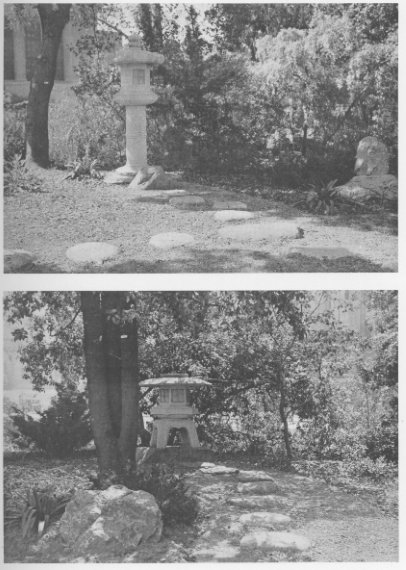
The campus here is so exquisitely beautiful now with such a variety of flowers and such lovely gradations of verdure in the unfolding of the young leaves, and the air is so full of fragrance that it is difficult for me to resist making just one observation concerning nature. On the day of my arrival here three days ago I stood by North Strawberry Creek between the Life Science Building and the Hall of Agriculture - the place where stand the stone lanterns sent across the Pacific Ocean by Japanese alumni of this university as a token of gratitude to their Alma Mater. (Plate 2.) I was deeply touched by the thought that prompted some one here to plant two Japanese maple trees by one of the lanterns; since these trees, with their red leaves, seem to suggest the sincerity of those who sent the gift on the one hand, and on the other to indicate some of the differences which exist in the manifestation of the art and culture of our two countries. With your indulgence I wish to point out one or two things concerning maple trees, merely as a phase of nature. Upon my arrival in the northwestern part of your country last fall, I was struck by the difference there is between the maple trees growing there and those thriving in our country. Compared with yours, ours are more feminine in character; the trunk is more slender, the bark smoother, the branches spread out more gracefully and in irregular shapes, and the leaves are smaller, thinner, more delicate and more finely cut. Yours are more masculine than ours in appearance, with a rough bark, sturdy trunk and branches, and with leaves larger and thicker, the whole tree being much coarser altogether. Not only in the difference in the appearance of the tree, but even more in that of their seeds was I intensely interested. The seeds of your trees resemble very strongly our cicadas, while our seeds resemble butterflies. This difference in the seeds seems to suggest some interesting contrasts. I am giving you my reactions merely as such without trying to reflect in any way on the comparative value of the two cultures, yours and ours, and have no intention whatever of indicating, much less insinuating anything, one way or the other. (Plate 4.)
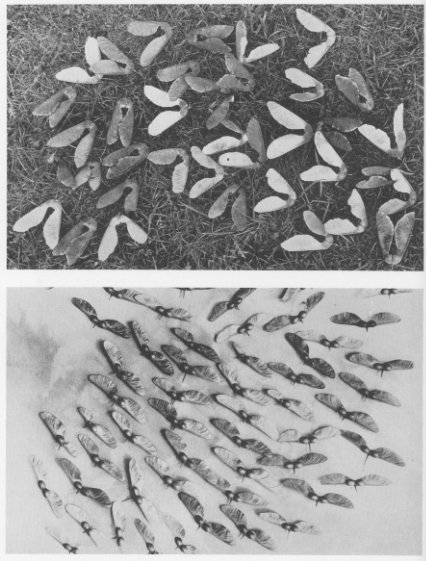
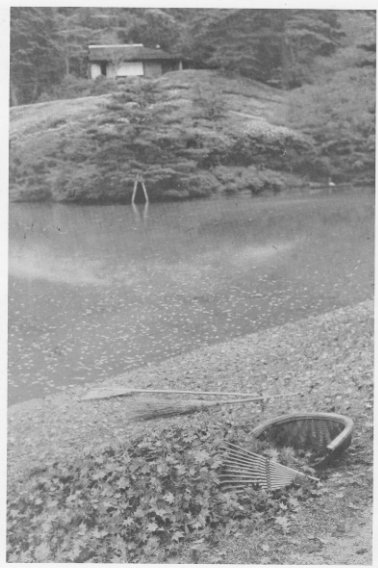
The life of the cicada seems to be wrapped up in its music, in the noise it produces. I am told that they carry a most intricate phonetic mechanism within them. The life of the butterfly is apparently spent in loving beautiful flowers. Both are symbolic of the evanescence of this transient world. One flutters among the bushes, kissing the flowers of spring and is symbolic of frailty, while the other passes its life in the heat of summer in consuming its energy, and in producing sound that seems to exhaust its own life. The children here catch butterflies, but ours let them alone and go after cicadas from tree to tree with long bamboo poles tipped with bird-lime. They derive immense pleasure merely from catching them. They keep them in a cage for a while, but the cicadas soon die, for the duration of their life on earth is extremely limited, though they may live for years beneath the ground prior to their coming to the surface. For that matter, I think, butterflies do not fare much better. Butterflies here may be collected for more scientific reasons than our children catch cicadas over there, but I do not know whether there is much difference after all in the treatment we give them. To return to the tree itself, maples are a great asset to our gardens and landscapes. Ours give colour. Some species have crimson leaves in the spring, like those planted by the stone lanterns, and these turn green in the summer and yellow before falling. But most of the species are green in the spring, and remain so throughout the summer and then some turn crimson and some yellow before they shed their leaves in the autumn. They add brilliancy to the design of autumnal brocade on our mountains and countryside. They have a wonderful effect against the background of vivid verdure of the cryptomeria, and other evergreen trees. Indeed, they present a wonderful sight "when the mighty blasts of October seize them, whirl them aloft and sprinkle them far o'er the ocean," as they do in some of the famous places in Japan. (Plate 3.) Many poets have sung the beauty of the maple leaves and I have a haiku (or seventeen-syllabled poem) in mind which was rendered thus:
"Envied by us all,
Turning to such loveliness:
Red leaves that fall!"
(Trans. by Henderson.)
"Urayamashi
Utsukushiu natte
Chiru momiji."
Shiko
Yes, many of us wish that we may turn into something as beautiful as the maple leaves when we fall.
Many places in Japan have been made famous in literature and art on account of their maple trees, and these have made a great impression upon the minds of the people. Nature has, indeed, a strong influence upon our art and culture; and she reveals different peculiarities in different lands; even a minor detail in nature, such as the shape of the seeds of maple-trees, may play so vital a part in the scheme of things as to indicate the difference existing in the culture of our two nations, and may contain lessons for us to ponder over in respect to the affairs of men. These were some of the thoughts that came to me as I stood by Strawberry Creek.
So much for the digression, and now let me proceed to deal with some of those characteristics of the Japanese people which seem to have affected our art, some more directly than others. I will enumerate them here more or less as they occur to my mind without correlating them or attempting to arrange them in the order of their importance.
(1) Our spirit of loyalty and patriotism. -The people are loyal to the emperor, the descendant of the original founder of the empire, to whom the highest respect is always paid. This love of country is based on the tradition that it was founded by gods and is being governed by their descendants. To the people loyalty and patriotism are one and the same thing; what they do out of respect to the emperor means the same as doing it for the good of the country. The nation is considered a large family with the emperor at the head. Such an attitude has ever been held, not only by the people towards the emperor, but also by the sovereign towards his people. This was shown by a number of poems written by the Emperor Meiji, whose illustrious reign marked the beginning of the new regime in modern Japan. And not only he, but the Emperor Nintoku in the fourth century A. D. showed the same attitude in a touching manner. When there was a famine in the country, the Emperor Nintoku exempted the people from taxation and curtailed the expenses of the Court. When at the end of the depression he saw, one morning, voluminous smoke rising from the houses of the common people, "Behold!" said he with a smile, "we have grown wealthy." He said it in spite of the fact that his palace was sadly in need of repair, the roofs leaking everywhere, and his own garments threadbare. "Our people have grown wealthy," he is recorded as remarking, "for the abundance of smoke issuing from the houses shows it; and when they are rich, we are also rich; when they are poor, we are also poor."
Thus the Emperor looked upon his people. Examples of Japanese loyalty and patriotism are so numerous in the history of the nation that it seems scarcely necessary to cite any of them here.
(2) Our love of purity and cleanliness. The people have an innate love of purity and cleanliness which constitutes the life of Shinto, their indigenous religion. These characteristics are shown in their dress and habitations, and have found expression in their morals, in their love of purity of life and fair play. They have a love of simple and natural surroundings. Their love of purity seems to have been refined by the beautiful environment in which they live. The people have always detested things that were unclean, and their ancestors have even considered uncleanliness the same as sin against the gods. That which is refreshing to the mind they thought refined and graceful; contrary things were considered as mean and ugly. Even a common labourer today would not think of retiring for the night without taking his daily bath.
The Shinto cult consistently insisted on cleanliness. It was largely due to this idea that the imperial residence, earlier in history, was changed at the death of the emperor, and that the Shrine at Ise has been rebuilt every twenty years for many centuries.
(3) Our taste is for things graceful and quiet on the one hand, and for velour and activity on the other, inconsistent as this may seem. Having always lived in the abundance provided by nature and been undisturbed by any outside enemy, the people have developed a taste for all that is quiet and beautiful. But from ancient times the Japanese were known for their bravery and for their skill in the art of war. This is an interesting combination - artistic taste and military prowess - an apparent inconsistency which seems to characterize our people. Perhaps one or two examples illustrative of this combination may be of interest. It was a common practice in olden times for a general of good taste to perfume his helmet with the smoke of burning incense before going to battle, in order that he might not be considered lacking in refinement should he be defeated and his head carried away. Even in our latest wars our soldiers, of their own accord, put on clean underwear when they expected to make a difficult charge on the morrow. Record tells us how a mounted warrior, Kajiwara Kagetoki, in the eleventh century, broke off the branch of a plum-tree in bloom when passing Ikuta shrine near Suma in the course of a hard fight and thrust the branch into his quiver, which was then empty, as he had exhausted his arrows in the fight; and how he then went on fighting and when the battle was over for the day found only a twig in his quiver, all the flowers and buds having been shaken off. A fighting warrior with a branch of plum-blossoms in his quiver!
Some warriors were poetic. When Minamoto-no-Yoshiiye, a famous archer, was in close pursuit of Abe no-Sadato, both being on horseback at the Koromogawa battle in the northeastern part of Japan, he shouted from behind his enemy the second half: of a 31-syllabled poem which he had composed on the spur of the moment - "Ripped are the seams of the dress." With his arrow aimed at the fleeing general, Yoshiiye continued his pursuit, but quickly back came the first half of the poem from the fleeing Sadato who was trying to escape from him - "Unable to bear the disorder caused by the age-worn thread." Thereupon Yoshiiye gave up the pursuit and turned back his horse.
I may call your attention to the fact that there were many warriors towards the end of the sixteenth and the beginning of the seventeenth century, when cha-no-yu (ceremonial tea) was in vogue, who would prefer a stoneware tea-caddy three or four inches in height to the acquisition of additional territory, or would exchange a castle for a pottery tea-bowl. At one time Iyeyasu was greatly troubled and discouraged by the fortunes of war. Thereupon one of his warriors named Koan, who was also a tea devotee, spoke up:
"When the eastern rebels are vanquished, if I am favoured with the tea-caddy now in the possession of the Ankokuji temple, I shall drink tea morning and evening and enjoy peace."
At this remark the face of the great general brightened, and he answered that the wish should be fulfilled. Even so it was, for the battle was won and the tea-caddy given to the warrior as the reward for his exploits and we have an account of his enjoying the use of that beautiful tea-caddy which is even now in existence.
Our people seem to find beauty in inconsistencies and contradictions, and this may be considered in connection with their taste for art and refinement side by side with their admiration of military prowess.
Visitors in Japan are bound to see inconsistencies and contradictions on every hand, especially at the present stage of social and industrial evolution. If you walk through the streets of Tokyo today you will come across very strange sights: a wooden gateway of the old regime still standing close by an enormous modern stone edifice housing a bank; the wall of the mansion of a feudal lord still serving a department of the government by enclosing a group of overgrown barracks; while a row of splendid buildings in marble and granite in European style are reflected in the ancient castle moat with its dark stone embankment embellished by gnarled and aged pine-trees. Of course, in modern Japan these strange contrasts were made possible in the course of her transitional period, especially after the great earthquake and fire of thirteen years ago, and no doubt they were not the result of the conscious efforts of the people. People only chanced to build these new edifices amidst the old. Nevertheless, they seem to indicate what is working within the people in their thoughts and in their lives.
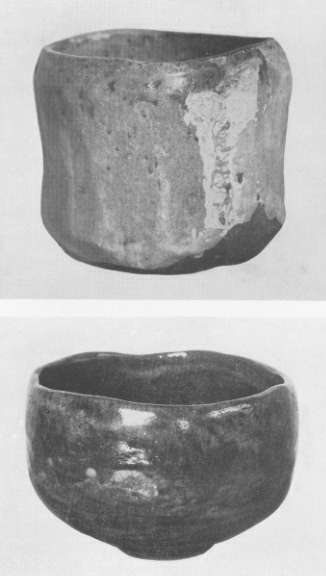
As an illustration of this trait I wish to present the case of cha-no-yu, though I hope to have occasion to deal with this subject more fully and fairly before I leave this campus as I believe it is one of the greatest cultural institutions we have. It is an institution founded upon the adoration of the beautiful in the midst of the sordid facts of everyday life. That is, we try to see beauty in the very routine of everyday life: in the making of the fire, in boiling water, in making and drinking tea, in preparing and eating meals, even in sweeping the room and in dusting the utensils. So this cult of cha-no-yu is founded upon the adoration of the beauty we see in these daily tasks, in doing them and in seeing them done. While the cult insists on utmost simplicity and lauds the joy and dignity of refined poverty, the men of the tea cult think nothing of spending tens of thousands of yen for a sombre tea caddy of simple glaze. I remember once holding in my hands a ceramic tea-bowl at the sale of the Viscount Inaba collection. (Plate 107.) It was sold for ¥167,000 when a yen was equal to your 50 cents - $83,500 for a single stoneware tea-bowl! A small fortune is often spent in the construction of a cha-seki, or hut with a small room for tea drinking, in order to make it look rustic in spite of the rare materials used. The cult is full of inconsistencies, yet there is hardly any institution within the last several centuries which has exerted as great an influence on our minds as cha-no-yu. Different phases of our national life, political, industrial, and social as well, seem to be full of inconsistencies and contradictions which make things rather difficult to understand at first sight. Yet, after all, life itself, as we find it everywhere, is full of inconsistencies, is it not?
Again, you will often come across paintings and designs showing our love of contrasts or contradictions, as suggested by the well known haiku (or seventeen-syllabled poem) by Buson -
"Tsurigane ni
Tomarite nemuru
Kocho Lana."
"Upon the temple bell
A butterfly is sleeping well."
(Trans. by Miyamori.)
The poet apparently had in mind one of those tremendous bronze temple bells, some of which measure as much as ten feet in height and nine feet in diameter, and weigh over seventy tons. What a contrast between the huge bronze bell, capable of producing a boom strong enough to awaken people many miles away, and a tiny butterfly with gay wings perching upon it and sleeping calmly!
Speaking of contrast I may illustrate the point by one of the paintings to be shown in the loan exhibition of Japanese treasures to be held in the Museum of Fine Arts in Boston this fall. I refer to a pair of screens in the possession of Baron Dan of Tokyo, entitled "Crows and Herons" painted by Tohaku, a master who flourished towards the end of the sixteenth century. (Plate 5A, 5B) On one screen there are crows and on the other herons. The painting revels in black and white; no scheme of contrasts could be stronger. Black and white - by the way, have I seen such a name on bottles in show-windows? I believe I have. Black and white with us, however, often signifies right and wrong, as in litigation, or strength and weakness, as in the game of "go," in which the stronger plays with the white and the weaker with the black stone pieces. As in the present painting, it is common to have the herons stand for white, because of the colour of the plumage, and the crows for black, but the crow does not therefore symbolize wrong or weak, nor the heron right or strength. They are used merely to suggest a contrast, and the same motive is carried further by other elements in this painting. The herons are depicted as quiet and peaceful, some of them being asleep, while the crows are noisy and in commotion, a group disporting itself in the air. The screen with the herons on it depicts a willow-tree with its pliant boughs, while the one with the crows on it portrays a pine-tree with its rugged branches. The contrasting scenes, however, show a common background of reeds and bamboo-grass, thus correlating the contrasting elements.
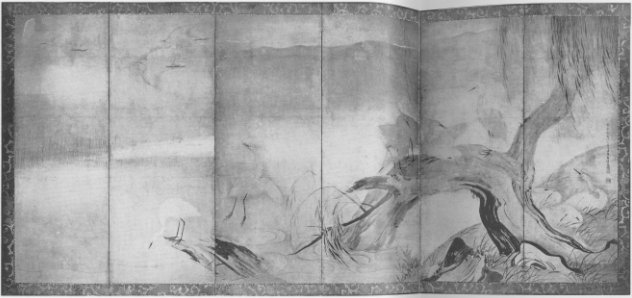
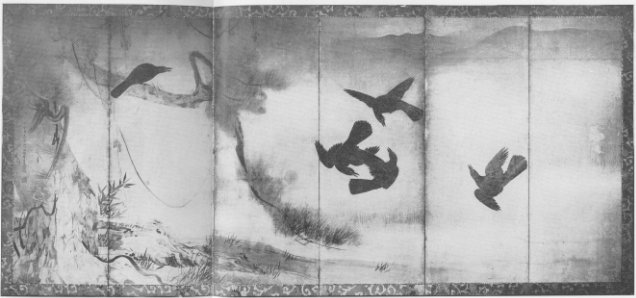
A noted Zen priest once pointed to the whiteness of the heron and the blackness of the crow as an example of those who remain natural, unaffected by the teachings of Buddha. He observed that the heron is white, though it bleaches not; the crow black, though it dyes not. They are just natural as they are. If one should inquire, he further commented, into the very beginning of the beginning of the heron, there one may find the cause within its heart of its being white. Again, if one should inquire into the very beginning of the beginning of the crow, there one may discover the cause within its heart of its being black. The artist who painted this pair of screens may have been prompted by a similar idea, but these birds, nevertheless, are often used to express contrast.
There are many other examples illustrative of this point, but let us proceed to our next item.
(4) Our people are fearless of death; they are more or less fatalists. They sacrifice their lives as a means of justification for any wrong they may have committed. Again they believe in the possibility of accomplishing after death what they are unable to accomplish in this life, and they find in death the solution of problems they are unable to solve here. All this may be taken as due to the influence of Buddhism. Our people are inclined toward fatalism, being prone to believe that some power beyond them must be obeyed when they are confronted by a great obstacle, and to dismiss the subject with "Shikata ga nai" - it cannot be helped. Our parting greeting also suggests this. In place of your "Good-bye," we say "Sayonara," which literally means "if it is so," suggesting that our parting is a logical consequence of what has preceded it. The word may be construed more strongly than that and taken to mean "since it must be so," or that a higher power than mine has ordered it, and the divine will must be accomplished, since there is no other way. Yet the people have wonderful power of perseverance in a noble cause, enduring intense physical pain and foregoing even the elemental needs of existence. The tale of the forty-seven ronin, which must be familiar to some of you, illustrates this point, though I shall not be able to narrate it here.
(5) Our power of observation is intuitive, rather than scientific. The people understand by intuition, by direct contact, rather than by investigation and analysis. They are not logically inclined.
(6) Our people are considered to be sensitive and alert. This quality was doubtless developed by the constant changes which take place in nature during the different seasons of the year in Japan, and by the subtle beauty revealed in nature from the atmospheric conditions which exist there.
(7) Our people have imaginative power, are quick to observe encl. imitate But we do not stop at imitation. We assimilate what we take from outside, choose the best in it, and make good use of this in the formation of something of our own, something new, and I trust better.
(8) We have a strong love of nature. This we could not help having for we live in beautiful natural surroundings. This love is deeply founded in the Shinto cult, and has been expressed in poems and in art; it is shown in the daily life of our people. All over the country, in towns as well as in the rural districts, the people make a holiday of viewing the flowers in the spring. At the time when cherries bloom the nation seems to be intoxicated with the fragrance of the flowers, and sometimes is actually so with sake, or rice wine. "O-hana-mi," or "honourable-flower-viewing," is an important annual event to both young and old, to the leisure class, as well as shop-girls, factory hands, office-clerks and common labourers.
We enjoy nature in all its aspects. We are fond of snow scenes. Snow, the moon and flowers are spoken of together as a group of beautiful things. Our artists are fond of painting a snow scene wherein a man, generally with a horse beside him, is standing by a gate which a servant is about to open. It represents a scene which cook place when the master of a villa in Yamashina, near Kyoto, called there unexpectedly one morning to enjoy the sight of the snow which had fallen during the night. He knocked at the gate and waited for the servant to come and open it, but was made to wait an unconscionably long time. He found later to his delight that the servant had walked a considerable distance along the fence so as not to leave any footmarks on the path to spoil or mar the virgin snow scene which he surmised his master had come to enjoy.
Another favourite subject with our artists is a wooden well-bucket with a long bamboo handle wound with the tendrils of a morning-glory vine. It represents a scene suggested by a seventeen-syllabled haiku composed by Chiyoni a scene at a well one Corning when the hostess went there to draw water and found that during the night a morning-glory vine had coiled its tendrils around the handle of the bucket; and, unable to commit the cruelty of loosening the hold of the tendrils, she went and begged her neighbour for water. The haiku may be rendered thus:
The morning-glory
Has seized my well-bucket,
So I beg for water.
"Asagao ni
Tsurube torarete
Moral mizu."
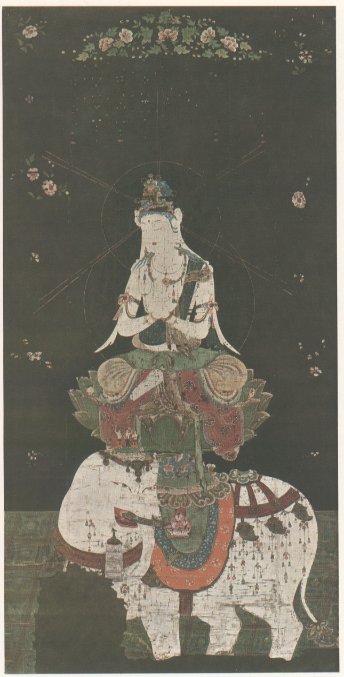
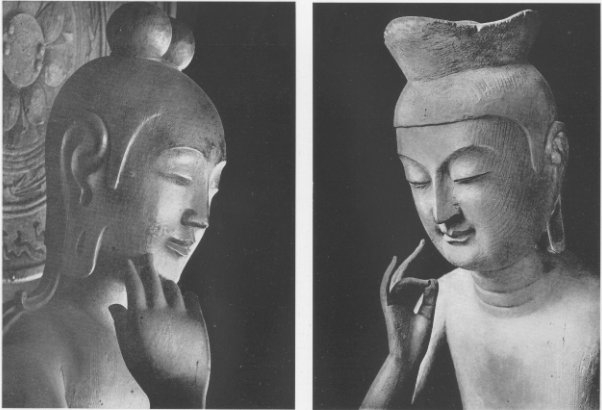
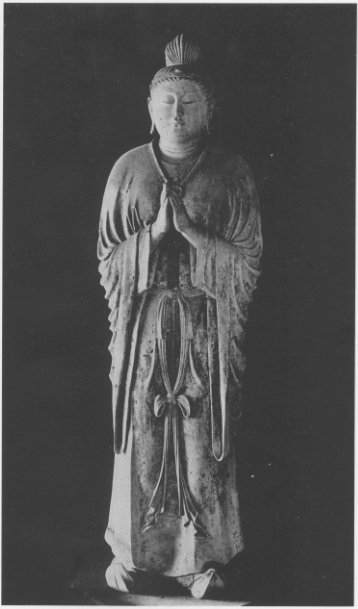
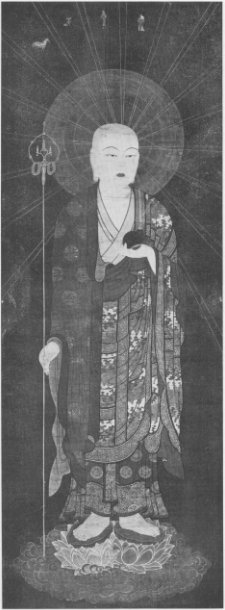
In this connection I may mention our great longing for solitude. It is perhaps an expression of our strong love of nature. We have a great longing to detach ourselves from this world, and live in the heart of nature where we may enjoy a secluded life. Losing ourselves in the beauty of nature is the ideal. The expression "yo o suteru," meaning to throw away the world, reveals the deep yearning hidden in the bottom of our hearts which we hope to realize sometime before the end of our lives. We dream of the tranquillity and serenity expressed in the wooden figures of Miroku Bosatsu of the Chuguji nunnery and the Koryuji temple, in the clay statues of Bosatsu popularly known as the Nikko (sunlight) and Gakko (moonbeam) in the Sangatsu-do, or in the paintings of Jizo Bosatsu and Fugen Bosatsu in the Imperial House' hold Museum. Nearly every one dreams of the ideal future - of living out one's days quietly, away from the hustle and bustle of life when the time shall come for retirement, after giving up one's place to a successor. There are many who live in a world of their own, ignoring entirely what goes on about them. They live in the world, but apparently do not belong to it. There have been many haiku poets who have abandoned this world from choice and nearly every Japanese is something of a haiku poet. (Plates 1, 6, 7, 9.)
(9) Our people are dexterous with their hands and fingers. This enables them to excel in handicrafts. Our products may often be criticized as being decorated but not sufficiently decorative when placed in a room. This is frequently the case, though there are notable exceptions. This peculiarity in art is often exemplified by our work in lacquer and ivory carving. However, we also produce objects of extreme simplicity which suggest a fleeting thought caught and put into form on the spur of the moment. An instance of the latter is often seen in the pottery tea-bowl and other utensils for cha-no-yu.
(10) We are accustomed to things on a small scale. Living on small islands, the scale of our work is generally small. We are somewhat quick-tempered, as inhabitants of volcanic countries often are. We are rather quiet, but excitable. Often we are inclined to hold narrow notions of things, narrow views of life, as becomes an insular people.
(11) Our taste is for simple things, rather than the complicated and ornate; for pure elements rather than the mixed and turbid. We detest gaudy colouring, screaming to the eyes. We avoid strong colours, and choose instead neutral and soft shades, even as the climate of the country seems to suggest. We admire elegance and buoyancy, as suggested by mountains, rivers and trees. On the whole our taste runs more to a quiet beach, than to the sublime ocean, to undulating wooded hills, rather than to a mighty rushing river. To be sure we are fond of something unusual, of variety and action, but we do not carry these tastes to the extreme, to their tragic end. We try to refrain from showing strong emotions in our gestures and conduct - discipline given by Buddhism and Confucianism both.
Concerning our taste I must not forget to mention that we value in art and life nothing quite so much as sabi or shibumi, upon which our cha no-yu is founded. It is an aesthetic quality indispensable in real art according to our way of thinking, and is the exact opposite of anything gaudy or ostentatious. Shibumi in the art and the life of the Japanese is a subject big enough to be dealt with separately, and I shall refrain from dwelling on it here.
(12) We are as a people rather reserved and reticent, and not given to showing everything we possess at one time. This characteristic seems to play such an important part in the daily life of the people that I wish to deal with it somewhat more minutely than with the others, illustrating it with examples from different phases of life and from some branches of our art.
This characteristic is perhaps best revealed in our custom of decorating our homes when expecting a guest. We may possess hundreds of kakemono (hanging pictures) in our storerooms, but out of them all we select a single kakemono or perhaps a pair to be hung on the wall of our tokonoma, or alcove, for our guests to enjoy. In choosing that kakemono, consideration is given to the nature of the occasion which brings the guest, to the season of the year in which the visit occurs, to its relation to the whole scheme of things and to other objects of decoration in the house, and above all, to the taste and temperament of the guest to be entertained. Taking all these factors into consideration, the host makes his choice out of the many art treasures at his disposal; then when the guest is to pay his second visit, the host has a still greater task. He will try to guide his choice of kakemono by taking into consideration, in addition to the above mentioned factors, the impression which the last painting had made upon the guest. Such being the case, the same guest may call at the house dozens of times, yet find something new each time he calls.
Sometimes this idea was carried to extremes. I have in mind the case of the great tea-master, Rikyu. It is recorded that Rikyu had once received at a morning tea the great Taiko Hideyoshi, who expressed his desire to see Rikyu's morning-glory, which was a rare plant with us in the sixteenth century. Rikyu had planted his whole garden with it and its fame had reached the ears of the great general. When he arrived at Rikyu's garden on the appointed day, no morning-glory was to be seen anywhere, the ground being leveled and strewn with pebbles and sand; the visitor was at a loss to understand this. Only when at last he was conducted to a cha-seki, or tea room, in the course of the entertainment, was his good humour completely restored. On the tokonoma was found, in an old bronze vase, a vine of the morning-glory with a single white blossom among a few green leaves wet with dew. Out of hundreds of blossoms in the whole garden, the master had picked a single flower of surpassing beauty, and sacrificed the rest, vine and all, for its sake.
In this instance, the master did not merely conceal the others, but sacrificed them all for the sake of the best one, which he saved. The idea at the bottom, however, the desire to give the maximum of pleasure to the guest with the minimum of objects at hand, is the same. He sacrificed a great deal in order that one blossom might live in great splendour. Out of the multitude he showed the one which he thought would please the guest the most.
In order to satisfy this inclination, or trait, great sacrifices are often made in silence and in secret. We do find also among our people that characteristic which derives extreme pleasure from doing some kind deed to others in secret, the doer or the conduct itself being found out, if at all, by accident. Such characteristics find expression in our landscape gardening also, where beauty is so hidden as to be found and appreciated only by those who look deeply for it. We consider it vulgar to show everything plainly, to let all be seen at a glance. This quality is revealed in other branches of art as well. I have an interesting case in mind, that of a metal-worker. I was told by the late Professor Bisei Unno of the Tokyo School of Art, that he once saw his master in metal-work produce a bronze vase with the design of the valiant Shoki, the demon-vanquisher, whose portrait is much in evidence in connection with the boys' festival, observed on the fifth day of the fifth month, holding down a demon with an open umbrella, by inlaying different alloys of metal. Though this was not to appear on the surface, the master first carefully chiselled and inlaid a perfect figure of a frightened demon with distorted face, and then covered it over With the umbrella with which the demon-killer was holding him down. When the work was finished one could see only Shoki pressing down an umbrella. Of course, to every Japanese it was plain that he was holding down a demon, for he is concerned only with demons, but the demon was not to be seen in the design. The artist figured that years of rubbing and erosion - it might take generations, who knows? - would wear off the thin metal representing the oiled paper of the umbrella and at last reveal the demon hiding underneath. He was thinking of the joyous surprise his work would give years after he was dead and gone.
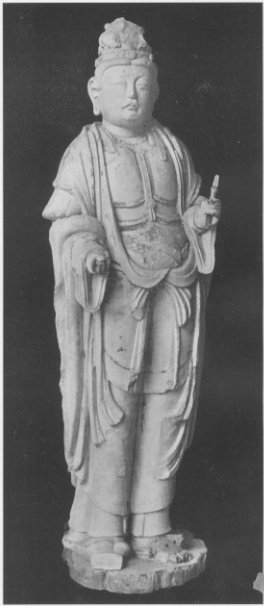
Somewhat similar examples may be found in sculpture. Visitors to the Imperial Household Museum at Nara may have noticed the clay figures of Bonten and Taishaku, which used to stand in the middle hall. A close observation of these will show that each has a wooden foundation, over which a thick coating of clay has been applied. Each of these images is represented as wearing a pair of decorated shoes shaped in clay, but a part of one of them is broken off, revealing the foot underneath carved in wood, each individual toe, and even the nail, being faithfully carved. (Plate 8) There are other examples: Kichijoten and Benzaiten, also in clay, installed in the Sangatsu-do of the Todaiji monastery, Nara, show evidence that the sleeves of the under-garment meets, one on top of the other, were first made before being covered with those of the outer robe.
A parallel case is found in painting. There is a portrait by Mincho (1352-1431), in which the nude figure was first drawn and then clothed with under garments, one on top of the other in proper sequence, before the whole was finished with a beautifully coloured robe on top. The secret of the extreme realism in his painting, the cause of the lifelikeness of his representation so full of dignity, was revealed only when the painting was damaged many years afterwards. He painted in such a way that he concealed a part of his work, though the prime motive in his case may not have been the concealment of it. But I feel sure that he wanted to have his work contain more than what was shown on the surface.
There are evidences of this characteristic in the construction of our gardens, especially in the use of rocks. But I shall not dwell on this point. It may be sufficient to note here that considerable thought is given in garden construction not to have things too apparent. There must be something beyond what one can see at a glance, something that must be sought out, something that is partially, if not entirely, hidden. People take delight in concealing something charming in their gardens to be discovered only by a keen observer, just as they rejoice in doing kind deeds to others in secret to be found out by accident. The waterfall in the garden should not be fully exposed to view; it should have at least the branch of a tree leaning across it to conceal it partially. The stone lantern should stand close to a tree so that it may be hidden in part.
It is evidently the same spirit coupled with the strong love of nature which teaches us to see ourselves in the right relation to the Infinite which caused the great tea master, Rikyu, to plant a grove of trees in his tea garden at Sakai in such a way as to obstruct the view of the sea, while everybody expected him to lay out his garden in such a way as to make the best use of the open view of the sea, which the location had at its command. He planted a grove of trees in such a manner that only when one stooped to the stone water basin to rinse his mouth and wash his hands preparatory to entering the cha-seki (or tea room) did he catch an unexpected glimpse of the shimmering sea through the trees - a glimpse of infinity - thus suddenly revealing the relation of the dipperful of water lifted from the basin to the vast expanse of ocean, and making him realize his own relation to the universe.
(13) I might mention yet another quality, the last in my list, but by no means the least. It is the spirit of Japan, known among us as "Yamato damashii." It is the driving force in us, something in the blood which we ourselves are not always able to explain, even as Yoshida Shoin has said:
"Kaku sureba
Kakunaru kototo
Shiri nagara
Yamuni yamarenu
Yamato damashii."
This may be roughly rendered thus:
I knew full well that if I did so
This would be the result,
Yet I could not refrain,
With the Spirit of Yamato urging.
Our Motoori has defined this in a 31-syllabled poem, rendered into English by the late Dr. Nitobe:
"Isles of blest Japan!
Should your Yamato spirit
Strangers seek to scan,
Say - scenting morn's sunlit air,
Blows the cherry wild and fair."
"Shikishima no
Yamato gokoro wo
Hito towaba
Asahi ni niwoo
Yama zakura bana."
Some authorities interpret it as the glow, instead of the fragrance, of the delicately coloured flowers in the first ray of the morning sun. How exquisite the beauty of their freshness, full of life! Yet when the time comes, when the inevitable moment arrives, they scatter with no sign of distress. No wonder that the cherry blossom has for ages been the favourite of our people and the emblem of our character! Even as the scattering of cherry petals, so the three brave Japanese soldiers ended their lives in the recent unfortunate incident in China. They marched in the face of the enemy's machine guns, carrying an enormous dynamite bomb, its fuse lighted, and so lodged it with the sacrifice of their lives that it blasted the barb-wire entanglement and themselves also, thus opening a way for their comrades to march on. It was the spirit of Japan (Yamato-damashii) which drove these soldiers to the act, and we speak of the beauty of their end even as we do of the scattering of the petals of cherry blossoms.
Crystallized, this spirit becomes the sharpest steel; scattered, it falls like the petals of the cherry.
There are other characteristics, some of which may also have a great bearing on art, but I have given you these as some of the outstanding ones in my mind.
NOTES ON PLATES
Plate 1. "Fugen Bosatsu." Painted in colour, on silk. Later Heian period (898-1185).
The serene countennance and the exquisite flow of the lines are suggestive of peace and the divine thought which emanates from this divinity, causing spiritual vibration centred on the red of the lips. Imperial Household Museum in Tokyo. Reproduced in colour.
Plate 2. Japanese stone lanterns on the University of California campus. Sent from Japan by the Nippon Alumini Association of the University of California. Upper: Sangatsudo gata, a faithful reproduction specially made of the famous thirteenth century lantern standing in front of the Sangatsudo, Todaiji monastery, Nara. Lower: Yukimi-gata (snow-viewing) type of lantern.
Plate 3. Maple Leaves in Autumn. Shugakuin Imperial Garden in Kyoto. Wonderfully beautiful are the crimson leaves of the maple when whirled aloft and sprinkled over the lake.
(By the courtesy of the Imperial Household Department.)
Plate 4. Seeds of the maple-tree. Upper: those of Japan, resembling butterflies; gathered from the author's garden in Tokyo. Lower: those of America, suggestive of cicadas; gathered from the University of Oregon campus.
Concerning a butterly among falling flowers Moritake has composed a haiku which reads:
"Rakka eda ni
Kayeru to mireba
Kocho kana."
This has been translated by Miyamori as follows:
"A fallen flower flew back to the branch!
Behold! it was a flitting butterfly."
Regarding the cicada Basho has made a keen observation through its shell in one of his haiku:
Koye ni mina
Natte shimaute ya
Semi no kara."
This has been rendered into English by Henderson thus:
"So! And did it yell
Till it became all voice?
Cicada-shell! "
Plates 5A, 5B. "Crows and Herons." By Tohaku (1538-1610). Black monochrome, painted on a paper ground faintly decorated with gold. A pair of six-panelled screens, shown at the Special Loan Exhibition of Art Treasures from Japan, held at the Museum of Fine Arts in Boston, 1936. Owned by Baron Ino Dan, Tokyo.