

II. CERTAIN IDEALS AND CHARACTERISTICS OF JAPANESE ART
Delivered at the Museum of Fine Arts, Boston
In the West - America and Europe - Japan's art has been represented mainly by her colour prints. These wood-block prints are known as ukiyoye, which means pictures of the floating or transient world, since they deal with genre subjects showing the manners and customs of the people; they are known also as nishiki-ye, signifying that they are profusely coloured to suggest: silk brocade. These colour-prints came into existence in Japan, as the art of the common people, about two and a half centuries ago. They were produced and developed for the enjoyment of the common people, who were unable to possess the costly works of art which upper class people raved about. Most of these colour-prints were turned out in enormous numbers and sold at a very low price. They were generally bought by the common people of the city, and by country folk when visiting the metropolis. Often they found their way into the homes of upper-class people also, but generally as entertainment for women and children chiefly, and they failed to win the favour of the intelligentsia or art-loving class of Japan. They have not been considered on the same level with painting.
It was the people of the West who discovered beauty and charm in them, and now some of our people, too, have come to study and appreciate them. But somehow or other they have not yet obtained the appreciation attached to painting. It is true that appreciation of their merits is growing among our people, and today many homes have them on their walls, but, with some exceptions, they have not yet won the honour of being mounted as kakemono (hanging scrolls) and hung on the walls of the tokonoma, the alcove reserved for ornamentation in the guest room.
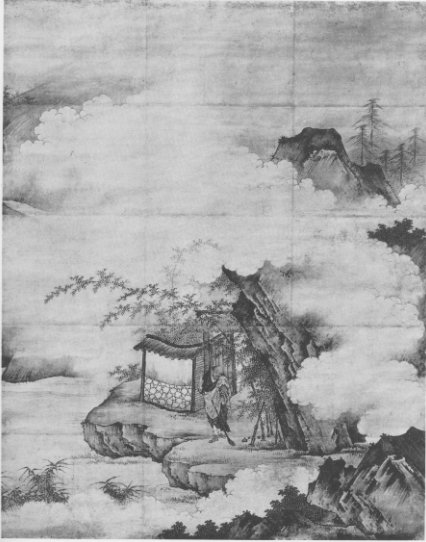
It was the people of the West who first discovered beauty in our colorprints, and it is mainly through these colour prints that their appreciation of Japanese art has been developed. As Arthur Morrison wrote, in the introduction to one of his books, this was in a way fortunate for Japanese art, for the process resembles what a certain Chinese philosopher is said to have favoured. When eating sugar cane, this philosopher always began from the wrong end, the root-end, which was less sweet, and concluded with the sweet end, so that his enjoyment might grow greater and greater as he proceeded with his feast; he was thus passing, as he describes it, gradually into paradise. To begin with colour prints and proceed to the black monochrome paintings of such great masters as Shubun and Sesshu of the fifteenth century will be, I hope, like eating a cantaloup by beginning at the stem and gradually proceeding on one's way to the other end so much more luscious and sweet. (Plates 10, 11, 12.)
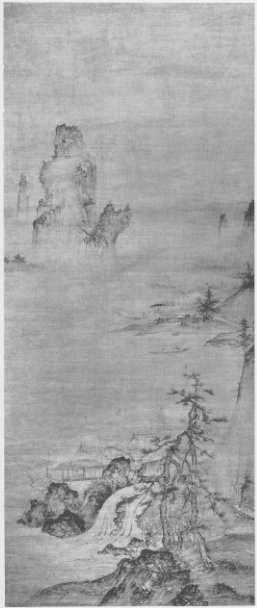
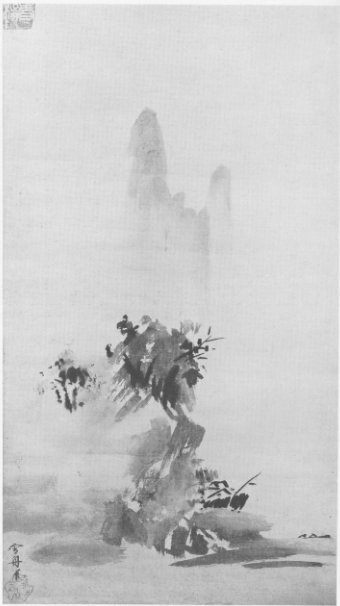
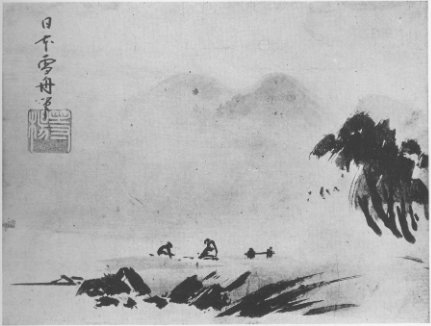
It is unfortunate, however, that Western people, in nine cases out of ten, have stopped at the first bite. One's appreciation of Japanese art should not cud with the colour-prints, though some of them do have admirable qualities. I do not mean to depreciate in any way the admirable qualities of our prints - they have their own merits and I know that this Museum is to be congratulated on having the largest collection in existence - but we should go on, as this Museum has, to the greater works of art Japan has produced in order to be thrilled with purer joy and inspired and elevated to higher planes of thought, and it shall be my endeavour this afternoon to give you a glimpse, even if no more than a glimpse, of some of the ideals and characteristics of Japanese art so that a deeper appreciation may be made possible on your part.
Some of you may be familiar with the story of how Maruyama Okyo, whose painting is represented in the loan exhibition now being held in this Museum, undertook to compete with Tanikaze, each agreeing to show the greatest work he could do, one as a noted painter and the other as a champion wrestler. According to the story the wrestler carried a huge rock from a mountain many miles away and placed it in the artist's garden. He carried it with both hands at one stretch, unassisted and without even resting once on the way. Many months were spent by the artist in finishing his rival painting. When it was finally done, the wrestler was indignant with Okyo over it.
"What is this? Are you making fun of me? This! And you the greatest painter of the day!" exclaimed the wrestler. He was exasperated, and not without some reason, we must admit, for he had waited over six months for the picture, and knew the great artist had been working hard on it all the time. Under the circumstances, it was but natural that he should expect, as he did, to see something elaborate, with an intricate design skillfully executed, and all the details minutely worked out. Instead, here he was confronted with the painting of a bow, merely a stringed bow, life-size It appeared to him as if nothing could be simpler than to draw such a bow.
The painter explained that this was the bow which the wrestler had received in the imperial presence as a mark of his championship. And out of a large box the artist took out a great number of long sheets of silk and paper with lines of varying lengths drawn on them.
"These are the records of my struggles and failures in trying to draw the bow," calmly explained the painter. "It is easy to draw a straight line with the aid of a ruler, but I wanted to draw this bow-string, more than six feet in length, freehand and with one stroke of the brush, even as you brought the rock from such a distance at one stretch, unaided and without resting."
So saying, the painter showed the wrestler sheet after sheet of silk and paper - some with lines three, four, or five feet in length, and others even longer. Some were discarded because the line quivered, and others because the ink gave out.
It was a revelation to the wrestler. He had never thought of these things before. He turned again to the finished picture, and as he gazed upon it he was conscious of something hidden under the surface; he was awed by the dignity of the bow. He felt the vigour and strength of the stretched bowstring, vibrant and latent with power. The tension of it seemed so real that he felt that if he were to touch it with his finger-tips it would resound with the vibration; that if he were to cut it with a knife, the string would snap and the bow spring with the contortion. The painting was not merely realistic, but showed something more, something of the dignity of the symbolic meaning of the bow to the wrestler. Now he found himself susceptible to the spiritual power with which the painting was charged. The greatness of the artist and his work was almost overpowering to him. He was ashamed of himself for not having perceived it before and begged the painter's pardon for his crude and ignorant criticism. Acknowledging his defeat and promising that he would treasure the painting as a family heirloom, he took his leave. (For an example of Okyo's work see Plate 13.)
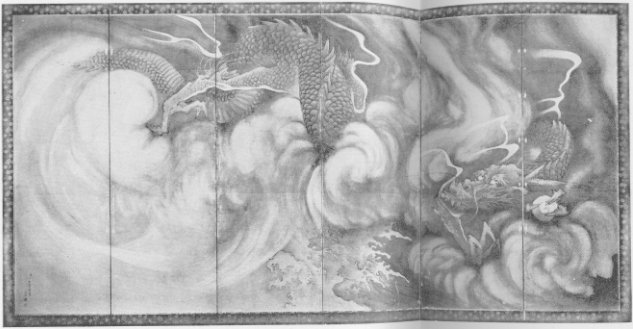
I think this story helps to show the ideal cherished by our artists in various lines of work. It shows the spiritual quality which each tried to infuse into his work by his power of concentration and by resorting to difficult devices. It shows the ideal of the artist in discarding an easy mechanical process in the belief that greater value can be infused into his art by putting his whole energy, body and soul, into the work and accomplishing it by surmounting formidable difficulties. The story not only shows the artist's attitude towards his work, but it also warns us against superficial observation; it teaches us not to be content with observing merely the outward, -visible expression, but to study into its meaning, to search for something deeper, some' thing hidden underneath what is expressed, and thus grow to appreciate the spiritual qualities which line, colour, rhythm and other phases of Japanese art suggest, symbolic as they often are.
How true this is, not only in art, but also in the estimation of the culture of another people, and in the judgment of the conduct of another person in our daily contacts! The study of Japanese art is difficult because the artist desires to suggest rather than to reveal. Another point is the evidence of the great love of Nature felt by our artists; - their understanding of Nature and their efforts to reveal the life of Nature in their art. In order to show the ideal of the painter, let me recount to you what another master painter once pointed out to his pupil, as it also deals with the importance of line and reveals this deep understanding of Nature.
A young student applied to a great master for painting lessons. The master painted before his eyes on paper an orchid plant and told him to study and copy it. The student followed the instructions with diligence, but when he returned to the master with the copy which he thought was good, the master did not approve it. The student tried with greater diligence than before, but could produce nothing that won the approval of his master, who finally explained his ideal to him in the following strain:
"These slender curving leaves of the orchid may droop toward the earth, but you must always remember that they all long to point to the sky, to the sun - this tendency being known in art as 'cloud-longing'. In drawing, therefore, when your brush reaches the tip of the long leaves you must feel that that tip, though it may actually be drooping to the ground, is longing to point to the clouds. When the line is charged with that truth, and only when it is so charged, will the drawing be able to conserve the true spirit and living force of the plant that grows with such graceful curves."
Yes, the artist should know the life of the plant he is painting, and he must try to depict, not only the visual form of that plant, but also its life and spirit. He must feel the truth hidden in the plant, and try to imbue his painting with that truth so that it may be shown in right relation to the greater laws. That should always be the mental attitude of the artist.
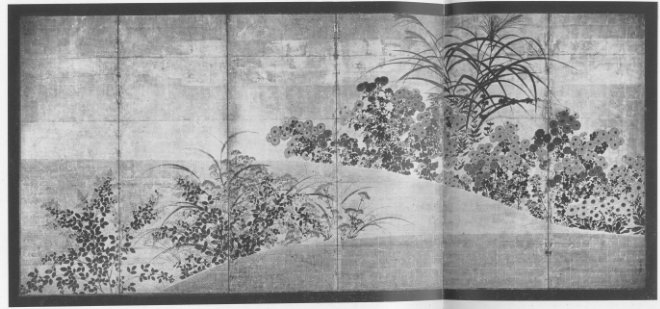
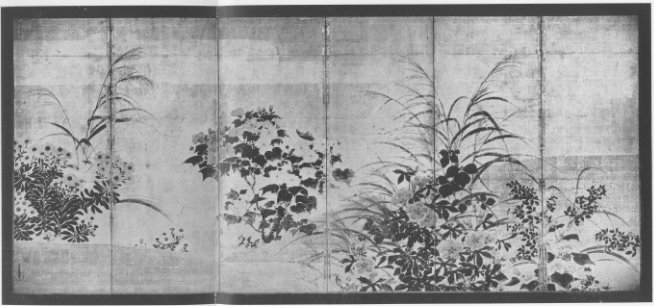
Permit me to call your attention to a pair of screens now being shown in the loan exhibition of Japanese art in this Museum. I refer to the pair entitled "Autumn Flowers" by Sosetsu, a seventeenth century painter. How I wish you could all have the chance to stand a while in front of those screens those of you who have not done so already - and allow yourselves to be impressed by the aristocratic dignity of Nature revealed in them! See how the hibiscus, tree-clover, chrysanthemums and other blooms mingle in harmonious profusion, and how the graceful pampas grass strikes the poetic note as it rises from the rhythmic flow of the clear, crisp and ethereal atmosphere of early autumn which emanates from them. Drink deep, if you will, the spiritual quality of the painting, and realize the poetic understanding of the life of plants and the spirit of Nature which the artist must have had in painting those pictures. (Plates 16A 16B.)
In order to make this attitude of artists toward their work still plainer, allow me to refer you to the story told of the younger days of Minchō (1352-1431), one of the greatest of Japanese painters in the early fifteenth century.
When Minchō was a boy-novice in the Tōfukuji temple under the head priest Daidō, he neglected his lessons in the sacred scriptures, and spent all his time in drawing pictures instead. Repeatedly he was warned against this practice, but without avail. After two interesting encounters, according to the story, Daidō called Minchō to his side and said:
"I have found that all my efforts are in vain - my efforts to turn you away from drawing and make you devote yourself to the study of the sutras in order that you may become a great priest. From now on I shall not try to stop you from doing what you most like. Go ahead with your drawing and become a great master painter. One thing, however, I want you to remember: whatever you do, do not waste your time in drawing anything mean or base, for if you do you will become mean and base yourself. The other day, when you were drawing a cow in the ashes in front of the hearth, you looked exactly like a cow. But when you were portraying Fudō a few days ago, you assumed the form of that divine image. Devote yourself, therefore, to painting only divinities and saints, and if you persist long enough, it is just possible that you may become like one of them. It has dawned on me that what I have been endeavouring to attain by religious discipline and meditation, you may be able to achieve by your painting, if your mind is set in the right direction. Draw nothing but divine images, for by so doing you may attain that spiritual enlightenment which is the ultimate aim of all of us priests."
Minchō followed the instruction of the learned priest, and became a great painter; he has left us many wonderful paintings of the Buddha, Bodhisattvas, Arhats and other saintly figures of Buddhism. For a number of years he held an important office in the Tōfukuji temple, where he received his first spiritual lesson, and he ended his life as the head priest of one of the tributary temples of that great monastery. He found in art what Daidō had sought and found in the sacred books. Like the true artist, he put his whole self into his art, drinking deep of the ethereal qualities of the subjects he painted. In other words, he allowed himself to be possessed by the great spiritual rhythm of the universe with which the divinities were in accord.
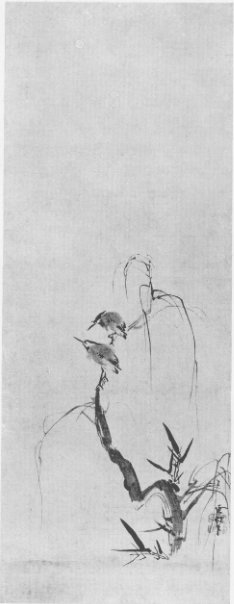
It is this spiritual rhythm, or rhythmic vitality, which has been the supreme aim of Eastern artists for many centuries past. The artists have gone one may say, a step farther than Daidō in the story just cited in that they have taught us to seek the spiritual rhythm everywhere and in everything. The highest ideal of the painter in Japan, as was the case in China also, has been to represent everything he painted in its right relation to the Infinite. I am sure you can feel that spirit in the simple drawing, also in the present exhibition, by Sesson entitled "Herons on a Willow Tree." (Plate 14.) In it you can feel the immensity of the firmament and the relative position of the birds perched upon a swaying willow tree. Yes, that has always been the supreme aim of our painters. Whatever they painted, be it human figure, an insect, or a plant, they have tried, not only to depict the object itself, but to suggest or imply also its relative position in the scheme of the universe, revealing it, however trifling in form, as in right proportion to the Infinite. Not only in painting, but also in other forms of the art of Japan - such as sculpture, landscape gardening, tray-landscapes (bon-kei and bon-seki), designs on pottery or lacquerware, or even flower arrangement - this supreme aim manifests itself.
Thus the Japanese painter is essentially idealistic or impressionistic, in that, whatever the style, he aims on the one hand to paint the poetic sense of things, rather than their mere outward appearance, and on the other to impart tangible reality to the spiritual quintessence of the things he feels. The artist endeavours to suggest the life and the spirit of the thing rather than to paint its form. He often sacrifices the similitude of the object he paints in order that he may better reveal the spirit. In trying to attain that aim, he does not paint from models. He studies the subject he intends to paint in order to understand it thoroughly, and then transfers his impression to the silk mainly from memory, to bring out the inner qualities of this subject, the qualities showing its life and its position in relation to higher laws. If he were to paint a landscape, he would avoid making a photographic reproduction of the scenery. He would have his soul commune with Nature and then try to express on silk or paper the message which he hears - the message of the spiritual rhythm that informs creation.
Those of you who visited the present Japanese exhibition in the Museum must have felt it when you stood in front of that small sketch by Sesshu bearing the long title - "Dialogue between a Fisherman and a Woodcutter." (Plate 12.) Note how the master painter has drawn the figures. With only two strokes of the brush the fisherman is represented, seated on the ground in an interested attitude, apparently enthusiastic over the mode of life he is living. With only a few strokes of the brush the woodcutter is portrayed as sitting on a rock, thoroughly in sympathy with the fisherman, for both have much in common. They live free lives in the bosom of Nature, away from the hustle and bustle of the world. The woodcutter is apparently on his way to town to exchange some fagots for a jug of sake to be taken back to his lonely hut in the woods where yet his livelihood is assured. There he lives close to Nature, free from care and worry. The fisherman is at home on the water, moving with the clouds, rocked by the tide and whispered to by the moon. Free as the air, each in his own thoughts, yet rejoicing in a friendly chat - a touch of human nature in them. Doubtless some of you must have felt, as I have felt, in this sketch done with very few strokes of the brush, the immensity of Nature with the stupendous mountains covered with virgin forests towering in the back, and the vast expanse of water in front, thus suggesting man's trivial position in the universe. It is wonderful what a master painter could accomplish with a few strokes of the brush on a small sheet of paper less than a foot square!
The same attitude is maintained toward everything which he paints. Through everything he sees, he sees the whole universe, as it were. So he is careful, lest the beautiful falling petals of the cherry blossom, so natural and so sensitively a part of Nature as they scatter and lie on the ground, should lose their life and place in Nature when the painting of them is attempted, just as they would turn into mere rubbish the moment one began to sweep them away with a broom, as our haiku poet Buson has it in his seventeen-syllabled poem:
"The scattering bloom
Turns into torn wastepaper -
And a bamboo broom ....."
(Trans. by Henderson.)
This is a vital point in the ideals of our art and in our love and understanding of Nature. We see exquisite beauty in the scattering of the petals. In fact, our appreciation of cherry blossoms largely depends upon their beauty, both actual and symbolic, when they fall and scatter. From the dark, sombre, leafless branches of the tree tiny buds appear, and all of a sudden burst into luxuriant bloom, into full glory and splendour, when the zephyr blows. Having opened fully, the petals fall at the gentlest breeze, scatter at the softest breath of spring. They scatter without showing the least tenacity in holding on to life; there is no clinging to the branch, no sign of distress, not the slightest indication of a desire to prolong life; they scatter to the wind, even like the brave samurai, the warriors of bygone days, who in the splendour of their colourful armour would do their utmost in the service of their lords, and when the time came, when the inevitable moment arrived, would give up their lives smiling in the beauty of devotion and loyalty. And even when these petals are scattered on the ground like flakes of snow, they are still sensitively a part of Nature, whose heart seems to throb through each petal. But a change takes place the moment you take a broom and begin to sweep them into a dustpan; they turn into mere rubbish, or like pieces of mere wastepaper, even as an unsuccessful painting would turn the beauty of Nature into a travesty.
Last fall, too, I was greatly impressed by the exquisite beauty of the scattering of the leaves of the birch trees covering a hillside near the University of Oregon's campus, where I have been lecturing for the last two terms. The tiny delicate leaves, turned golden, quivered on the sensitive slender branches covered with silvery bark and fluttered like the petals of scattering cherry blossoms. They seemed to sing, as they fluttered through the air, not in mournful tones, but in a cheerful sort of way, bidding good-bye to the departing autumn as if assured of their return in a few months. Every breath of wind liberated thousands of those golden flakes and sprinkled them over the grass, vines, and bushes, and the declining sun brightened the countless pieces of gold on the fresh verdure. I knew that the lustre of the gold would not retain its subdued brightness for any length of time, but I could not help admiring the exquisite beauty revealed in the rhythm of motion described by the falling leaves, and in the harmony of colours as the leaves quivered on the branches and fluttered through the air and settled in their momentary resting places. How symbolic of our life it all appeared to me as I stood there and gazed on the scene! In the eternal rhythm of life we swing through the universe and alight on a bed of fresh verdure to reflect the brightness of the sun for a while. Every leaf remains sensitively a part of Nature as it lies on the ground and its life throbs in each tiny leaf until it is swept away into a rubbish heap, perhaps to be transformed into new life. At every turn we see Nature in its eternal manifestations, and our artists have always tried to depict truth and beauty in the changing phases of Nature.
These, I believe, are the outstanding characteristics of our art, which reveal the ideals of our artists. We see them clearly as we examine our art from a proper distance. Yet somehow or other I feel that they are not all; there seems to be something else, something more vital in a way than those characteristics so easily noted. I have pondered upon these peculiarities, even as it was customary for our master painters, for instance, in painting a landscape, to allow themselves to be saturated with all the beauty and spirit investing it and then to try to express the impression received therefrom. Yes, there is something at the heart of it all which makes our art what it is. There is an essential quality of real beauty according to our ideals. That quality may not be so pronounced in our earlier as it is in our later works. Nevertheless, it seems to permeate our art. It is the quality which has been greatly developed since the introduction of the Zen sect of Buddhism into Japan at the end of the twelfth century. It is the quality of art we generally call shibumi (shibui is the adjective), though different terms are used in different circumstances to describe it. In connection with buildings we speak of it as wabi; in connection with the garden, as sabi; and we speak of our taste being shibui, but it all amounts to about the same thing. What then does shibumi mean? With us it is the essential quality of real beauty. It is that quality which is quiet and subdued. It is natural and has depth, but avoids being too apparent, or ostentatious. It is simple without being crude; austere without being severe. It is the refinement that gives spiritual joy; a subtle touch of the modesty of the soul.
A garden without moss covering the ground is considered lacking in shibumi; a dress of showy colours without anything to restrain them is considered as showing a lack of shibumi in taste; a painting which shows everything on the surface and has no philosophy back of it is considered lacking in shibumi. A colour is shibui when it is subdued and unpretentious. Our cha-no-yu (ceremonial tea) is full of this quality; so much so that tea (which is cha in Japanese) is often used as a synonym of shibumi. We speak of a man without tea, without shibumi, who does not find a better reason always behind commonplace reasons; or who fails to find order in disorder; or who refuses to see beauty in the inconsistencies of life. Much of this quality in art which we value so much comes from cha-no-yu and from the Zen sect of Buddhism.
Sabi is spoken of as that which is "mellowed by use, patinated by age, reticent and lacking in the assertiveness of the new." Its essence was suggested in a poem by Kyogoku Teika, and there are many other poems showing shibumi or wabi. The priest Saigyo expressed it in his poem when he sang of the soul's melancholy in the quietude of the marsh at the autumn dusk, and the haiku poet Bashō revealed it in this best-known of haiku poems -
"An ancient pond!
A frog plunged - splash! "
(Trans. by Miyamori.)
"Furu ike ya
Kawazu tobi komu
Mizu no oto."
Bashō was buried in thought one quiet spring afternoon when he heard a faint splash, a sound made by a frog jumping into an old pond - so suggests the poem as it stands. It broke the silence and the poet felt the tranquillity of the spring day intensified. To a number of us this seventeen-syllabled poem conjures up all sorts of ideas verging on profundity. How emblematic of the silent past is the ancient pond filled with stagnant water! And that it should produce a sound intensifying the deathlike stillness of the hour! What was the sound? Was it the water? Has water a sound of its own? Or did it come from the frog? Has it any sound other than its croak? Which was it that made the sound, the water or the frog? Sparks flash between opposing poles held apart, and cease when they are brought into contact. But here the sound was produced the moment the frog struck the water. Whence does the sound come? What is the sound? Whence does life come? And after all, what is life? Thus we think this haiku reveals a touch of wabi, the soul's serene tranquillity.
Shibumi is often felt in our black monochrome paintings, such as "A Landscape" in haboku style by Sesshu (Plate 11). With a few strokes of the brush - so few that you can almost count them - a landscape is depicted. At a glance it may be unintelligible, but as one observes it closely, there will slowly emerge out of chaos, as it were, a precipitous cliff jutting out into the water, with a grove of thriving trees growing on the top of the precipice. You may hear the sound of waves dashing against the rocks at the base of the precipice. On the other side of the cliff you may see some houses and fishing boats. A towering peak may be seen in the distance in the mist, with the suggestion of a vast expanse between the peak and the cliff. All these and still more images are suggested by very few strokes of the brush. The fresh verdure of the grove, the blue expanse of the sea, the vague distance of the mountain, and the fishermen's hamlet nestled on the sunny side of the cliff - all these in black monochrome lines and washes. The painting is simple, yet profound; it is saturated with shibumi.
Let us now get a glimpse of this wabi or shibumi in cha-no-yu - in the tea-room and its garden. It was this quality in taste which prompted our Rikyu to plant a grove of trees to obstruct the free view of the sea in such a way as to afford a glimpse of it through the trees only when the guest stooped to lift a dipperful of water from the stone basin, thus suggesting the relation of the water in the dipper to the vast shimmering ocean, and helping him to realize his relation to the Infinite.
Behind all this, you may say that there lies the spirit of Zen, a sect of Buddhism which has vitally influenced Japanese art in many of its phases for the last few centuries. What then is Zen? I put this question once to a learned priest named Mutei (meaning "bottomless"), who lived in a temple at Kokeizan near Nagoya. He answered bluntly: "I cannot tell you what Zen is."
"How is it that you, who are looked up to by hundreds and thousands of Zen priests as an able leader and guide, that you cannot tell me what Zen is?"
"There are some things in this world, Harada san, which one knows about intimately, but cannot describe in words. I might talk to you many days trying to convey to you the idea of what being wet is, but I think I could not make you understand if you did not know what water is. It would be impossible. But if I were to take your hand and dip the tip of your finger in water, you would immediately understand the sense of being wet. No word of explanation would be necessary. It is the same with Zen. You have to feel it, experience it, yourself. No amount of explanation will convey to you the right meaning."
Such was the answer I received from this high priest. It may interest you perhaps to hear about what I saw and heard in that Zen temple. Zen temples have halls known as dōjō, signifying place of discipline, for priests gather there to discipline their minds. Once while I was there a young priest came from distant Echigo province, asking for the privilege of being admitted as a pupil, though there were about fifty in residence there already. He was refused, being told that there were better leaders for him elsewhere. The young priest made an earnest appeal to be taken in, promising the head that he would strive to be worthy of his guidance, but without avail. The young priest, however, did not despair; he was determined to stay. He found a rock in the garden of the temple and there he sat in meditation. The servant gave him simple food and shelter for the night as if to a weary traveller. Before dawn he arose and continued his meditation on the rock in the same way. This continued for about two weeks before the high priest was convinced that he was really in earnest in trying to find the way of truth. He was then admitted into the house, but not yet allowed to mingle with the rest. He was given the use of a room, in which he continued to sit, facing the wall in meditation. Two weeks of this went on before he was allowed to join in the discipline with the rest. This I was told was the sort of formality required by that temple before allowing any pupil to enter the dōjō, or place of discipline. Becoming a regular member, he was assigned to a mat, a tatami three by six feet, on which to sit in meditation, or to sleep in the night. He was given a problem to solve - a subject was written on a wooden tablet and placed before him; and he sat with his legs crossed, and hands placed one on top of the other in front of him in a natural pose. The position so assumed was to give the perfect ease and balance to the body so necessary for mental equilibrium. He was to breathe softly through his nostrils, so softly that apiece of cotton tied to the end of a long hair and held at his nostrils would not quiver. He tried to get rid of all his previous acquirements and prejudices, and return to the simple mind of a child. Having brought himself to that unbiased state of mind, he was to concentrate his whole soul upon the subject before him. He got up before dawn at the signal of clapping wooden sticks and washed with the rest. At another signal all lined up and marched to the temple hall for a service. Subsisting on thin rice-gruel, the simplest of food, and a very scanty amount at that, they sat long in meditation. They took turns in cooking the meals for all and in tapping the shoulders of their comrades when these were caught napping.
Day after day they sat and meditated and if one felt that he had got a solution to the problem given, he would walk up the steps into the temple and sound a gong to indicate that he wished to have a hearing from the high priest. If the latter was ready to receive him, he would signify it by striking a bell. The pupil would enter the high priest's room, sit in front of him and give his solution. If his solution was correct, "Yes" would be the answer, and he would be given a new problem to work on. If his findings were not correct, the high priest would simply answer "No," and he would go back to his tatami, there to continue his meditation. I met several priests there who had been meditating more than one year and were still working on their first problem, and there were others who had been meditating for several years and were still on their fifth or sixth problem, and I was told that there were some 2,700 problems to be solved before one would consider himself enlightened enough to say "Yes" or "No" to his followers regarding the solutions presented to him. I was told that it generally took twenty or thirty years of hard thinking before that stage could be reached.
"Why do you not assist them a little, to save time and energy?" I once suggested to the high priest; "Instead of saying merely 'No', why not tell him that he is headed wrong or that he is on the right track in his thinking? That would minimize the waste of time and energy."
The high priest shook his head. "That wouldn't do, Harada san. You take a horse and hitch him to a wagon loaded with stones. When the horse comes to a hill, the load becomes heavy and the horse struggles. If out of pity you unload a few stones and lighten his load, the horse will gladly go on. But, mark you, when that horse comes to another steep place, he will stop and expect you to lighten his load again. The human mind acts very much in the same way: if you help it once when it is up against a difficulty, it will expect your help again when it faces another. That is not the way to develop the human mind."
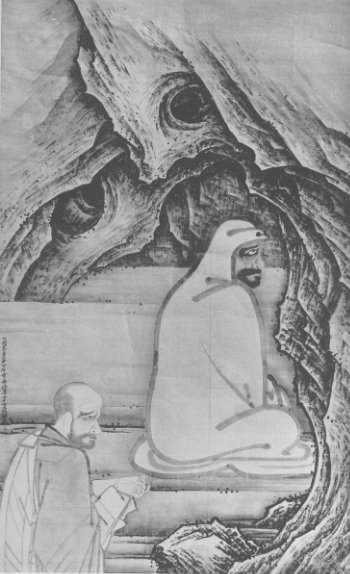
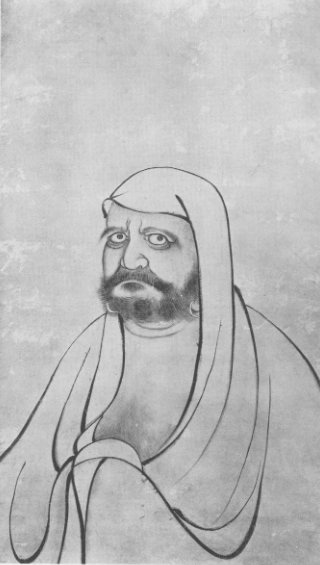
I think the high priest was right, and so in Zen one is expected to work out one's own salvation by meditation. It aims to transmit truth from one mind to another direct, without the medium of words. The meditation in Zen is by no means an easy task. Some may perhaps have seen the original or at least a reproduction of one of our great painter Sesshu's masterpieces representing Eka, a Chinese priest, with his amputated arm. (Plate 18.) For many years Dharma sat facing the stone wall in a cave in meditation, and his disciple Eka was not able to get his attention, until one day he cut off his arm, when for the first time Dharma turned toward him and said, "Ah, you are in earnest." In that way he was able to gain Dharma's confidence and get his great thoughts to transmit to his followers. This is, of course, an extreme case, but the tradition shows how serious one must be before one can attain enlightenment. (Plates 15, 17)
This account of the daily life of a Zen priest is given rather at length in the hope of supplying you with the necessary background for understanding what Zen is and for appreciating our art, for in the influence of Zen there exists shibumi. I am afraid I have made it a little too mysterious, impossible, and inhuman in a way. But let me assure you that it is possible and that you can understand this peculiar quality of shibumi in our art and in our taste, and feel the value of it, if you but approach it in the right attitude of mind.
Shibumi is found in the moss covering the ground, rocks, trees and stone lanterns of a garden. And it is revealed in the story of what Rikyu, the great master, did when his son swept the garden. He told his son one day to clean the garden-path, as he was expecting guests for cha-no-yu. By-and-by the son reported that his task was done, but his father was not satisfied, and told him to try again. After a while he returned and said, "Father, I have swept the garden three times. Not a dead twig or stray straw is left anywhere, and water is sprinkled well over the stepping stones, stone lanterns and trees, and the moss is sparkling with verdure. I cannot do anything more."
"You can't? You little idiot, just watch me!" rebuked the father, who passed quickly over the stepping stones and shook a maple-tree (it happened to be early in autumn), scattering gold and crimson leaves over the ground covered with green moss.
''There!'' said the great master, pointing to the wonderful autumnal brocade thus created; "that is the way to sweep the garden-path."
This story, simple as it is, contains much which explains that phase of our art which is extremely difficult to explain, and goes far to convey that peculiar quality in our taste which we call shibumi, without deep appreciation of which much of the true value of our art will be lost. It is the quality which we consider indispensable to real art. It seems to sum up our attitude towards Nature, the attitude of our artists towards their work; and, together with other points I have presented and other illustrations I have given, it affords a glimpse of the ideals of Japanese art.
NOTES ON PLATES
Plate 10. "Landscape." Attributed to Shubun (ca. 1420). Painted on paper, slightly coloured. Shown at the Special Loan Exhibition of Art Treasures from Japan held at the Museum of Fine Arts in Boston. Owned by Baron Koyata Iwasaki, Tokyo.
Plate 11. "A Landscape." By Sesshu (1420-1506). Black monochrome on paper.
Only about two-fifths of the kakemono mono is here reproduced, the rest being covered with inscriptions. This was painted in 1485 when the artist was 76 years of age as a parting gift to his pupil named Soyen, who was returning to his native town. Imperial Household Museum in Tokyo.
Plate 12. "Dialogue between a Fisherman and a Woodcutter." By Sesshu. Black monochrome on paper; shown at the Boston Exhibition. Owned by Baron Kichizaemon Sumitomo, Osaka.
Plate 13. "Dragons and Clouds." Painted by Maruyama Okyo (1733-1795); in black on paper. A pair of six-panelled screens. Owned by Kanchi-in, Kyowo-Gokokuji, Kyoto.
Plate 14. "Heron on a Willow-Tree." By Sesson (ca. 1560). Black monochrome on paper. Shown at the Boston Exhibition. Owned by Mr. Kaichiro Nezu, Tokyo.
Plate 15. "Kogan: a Zen Priest." He was enlightened by the sound produced by a stone striking bamboo when he was sweeping the temple ground. Slightly coloured, on paper. Attributed to Kano Motonobu (1476-1559). Imperial Household Museum in Tokyo.
Plates 16A, 16B. "Autumnal Flowers." By Sosetsu (XVII century). Painted on gold-leaf ground, in colour. Shown at the Boston Exhibition. A pair of six-panelled screens; owned by His Imperial Highness, Prince Takamatsu.
Plate 17. "Daruma." Portrait of the founder of the Zen sect of Buddhism. By Soga Jasoku (known also as Soyo); died 1483. Painted on paper, in colour. "National Treasure" owned by the Yotoku-in, Kyoto.
Plate 18. "Eka, with his Amputated Arm." By Sesshu. Painted on paper, slightly coloured. "National Treasure" owned by the Sainenji, Aichi prefecture.