

VII. JAPANESE GARDENS
Delivered at Oregon State Agricultural College
IN a half-finished private garden in Kyoto which I recall, there were some notable groups of rocks, especially one group of three, marvellously well composed. So beautifully were the individual rocks shaped and so well placed was the group that it gave character to the whole garden. These rocks, jutting out of the ground, looked so firm and strong that they appeared like the projection of an immense bed of rocks on the mountain side revealed by centuries of natural erosion, and they presented such an impressive front that we wondered again and again how the existence of a single group of rocks could mean so much in this particular landscape garden. Now, it so happened that about twelve years ago the street running immediately outside had to be widened and in consequence the residence for which the garden was laid out had to be taken down, and the garden, which was not yet quite finished, had to be abandoned. Accordingly, the part of the garden which included the admirable group of rocks just mentioned was dug up, and it was quite a revelation to a number of us to find that these rocks, none of which projected more than two feet above the ground, were really each several feet in height, more than three-quarters of the mass being buried under the ground. For the first time we saw the reason why these rocks carried such weight in the garden. The part concealed, the suggestion of latent power hidden under the ground, seems to have invested the rocks with their dominating power. It was a sort of moral force that derived its strength from the sacrifice made in silence.
This group of stones, by the way, was one of those commonly known as sute-ishi in the language of garden architects, meaning thrown-away rocks, and suggesting that they were placed there as a sacrifice, put there not for their own sake, but for the sake of other objects in the garden. In this instance the group was meant to help create the necessary background for two ancient trees in the garden, which required the environment of a wild mountain. These two trees (Japanese kaya, or Torreya nucifera, S. et Z.), one measuring almost ten feet around near the ground and the other somewhat smaller, it may be interesting for you to know, had travelled all the way from Warabi, east of Tokyo, some 350 miles away, each drawn by a number of oxen, mostly at night so as not to obstruct general traffic. When the garden was abandoned, these ancient trees were removed: the smaller one went to another garden in Kyoto and the larger one travelled still farther west, to a garden at Kurashiki (Plate 87-lower.) west of Okayama, nearly 150 miles from Kyoto. I saw both these trees last year and found them thriving, one perhaps 350 and the other about 500 miles from the hills where they originally grew.
To return to the rocks - a similar placing of rocks was made in the construction of the waterfall and the stream which flowed from the basin below, all of which are still intact in that now- abandoned garden. The garden-architect, a young man of great aesthetic taste, had spent nearly three years among the Kibune mountains, in the rear of Mt. Kurama, many miles away from Kyoto, and also on the banks of I eke Biwa, in search of these rocks, and in transporting them to the city. He had tried d to place them in the garden as Nature had placed them in the heart of the mountains. Rocks in deep ravines worn down by gushing streams from time immemorial had been transported to this garden and 50 placed as to continue their resistance to water, this time against the torrent from the cascade in the garden. The gardener had taken lessons from Nature, carefully studied her ways, and tried to make these rocks serve in the same way as Nature had made them serve in the mountains, many of them showing only a small fraction of their size above ground, as if for centuries the earth had gradually been washed away and these rocks been revealed from under the ground. They seemed to possess moral strength derived from the sacrifice made in secret and the power that comes from the consciousness of having a creep though concealed foundation.
The owner of this garden took such delight in its development and had such explicit trust in this young landscape architect that he allowed him entire freedom in the choice of materials and the construction of the garden. This genius among gardeners, it is to be regretted, passed away some years ago. However, the wise owner who trusted him and who takes such great interest in gardens is now in Tokyo, and has commissioned a friend of mine to lay out a garden for his family plot in a cemetery in the suburbs of Tokyo. He had a large carload of natural rocks transported all the way from that now-abandoned, half-finished garden in Kyoto some 350 miles away, and used in that cemetery garden which is now under construction.
This half-finished garden in Kyoto is not the only example of the kind; there are many gardens in Japan where a similar treatment is accorded not only to rocks but to other materials as well. Somehow it seems to give an added meaning to the familiar adage, "True art is to conceal art." And since so much is concealed in the construction of Japanese gardens in order to give a greater depth of feeling than that evoked by a superficial view, perhaps an explanation of some of the hidden meanings underlying the construction of our gardens may be of help to you in learning to appreciate their beauty.
Having started with rocks, let me go on with the common beliefs and long-continued practices which have guided our garden architects in their use of rocks. In some cases they are not hidden so far in the ground. While it is considered red well to bury rocks - not merely to place them on the ground, but bury them in the ground as much as possible in order to show only their best parts and to convey the feeling of their being firmly established - it is not at all uncommon to find a rock so well shaped that the gardener is able to give the desired effect without hiding much of it in the ground.
I have an extreme case of this kind in mind. I know of a famous garden in Tokyo in which the great rocks in the water were placed along the banks of the pond so as to give the dignity of a mountain lake atmosphere to the scene. As they rose considerably above the surface of the water, I often wondered at the immensity of those rocks. But Nature has peculiar ways of exposing man's seers secrets and the tricks of his ingenuity. The great earthquake of 1923 destroyed the spring which used to feed the pond in question and caused it to dry up. This sad condition revealed to me the low wooden piles upon which these big rocks rested. So well constructed was this platform that it was impossible to detect it when the pond was full of water, and I was told that the fresh logs, mostly pine, driven into the bed of the pond were strong enough to support the rocks for hundreds of years. A similar device has oft often been used to form islands in garden lakes with rocks, and to give them the appearance of having risen from the bottom. The use of rocks in this way is no doubt very ingenious and is justifiable in certain circumstances, but it is by no means in accordance with Nature's ways. Her ways are generally followed more faithfully in creating the promontory which juts out into the lake in some gardens. There one is required by the old masters to use some rocks standing up and others lying in the water as if broken off by the waves surging against them in storms, and invariably a certain number of rocks must be entirely hidden in water. Though these rocks arc invisible to the eye when the water is normal, their presence becomes significant when the water is low, or when the wind splashes the water against them and brings out the feeling of a vast expanse of ocean dashing against a jagged cliff. After all, it is more in the spirit of Japanese gardens to follow Nature's ways faithfully.
In order to be faithful to Nature often extraordinary means had to be adopted. I wish to direct your attention to the huge rock that towers on the brink of the lower pond in Korakuyen Park in Okayama. This huge rock . at the edge of the water, its sheer height reflected in the mirror below, looks formidable indeed. It gives the suggestion of proximity to a mountain lake. Looking at it no one would think for a moment that it had not always stood there and no one would fail to admire the wisdom of the garden-designer in choosing the present site for the pond, and thereby taking advantage of this huge rock. However, the fact is that it was transported from an island in the Inland Sea miles away. Of course, it was altogether too large to be transported en bloc; so it was blasted into more than ninety pieces and transported from that island in bits, and these pieces were then put together in the garden to assume the original form of the cliff as it stood on the shore of the aforesaid island. So well was the cliff reconstructed and covered with trees and vines that many people fail to notice the traces of the blasting. Here, the gardener's cunning art is well concealed, and its exposure cannot but heighten our admiration. The same park has another rock called "Eboshi Iwa." It is so called on account of its general resemblance to the headgear of that name, and it was brought from the same island, this one in thirty-six pieces, and reconstructed on the spot. It now has a few good-sized trees growing from the crevices, and it is hard to realize that this large rock was actually transported from so far away.
At any rate, it is one of our Japanese characteristics not to wish to show everything we possess all at one time. This characteristic is best revealed in our custom of decorating our homes when expecting a guest. We may possess hundreds of hanging pictures, but we choose only one or two to show on each occasion. The choice is guided by the taste and temperament of the guest to be entertained, and the nature of the occasion which brings the guest, with due respect to the season of the year in which the visit occurs. And only a few ornaments are selected to go with the painting. So the guest may call at the same house dozens of times, yet find something new each time he calls.
It is not possible to do quite the same in a garden - no, I am wrong there; it was possible with a great master. I refer to an incident in the life of Rikyu, who once carried this idea even further when he received a distinguished guest at a morning tea. Although the guest came to see the garden of morning-glories in full bloom, the master displayed in an old bronze vase on the tokonoma, a morning-glory with a single white blossom showing among a few green leaves wet with dew. Out of the hundreds of blossoms in the whole garden, the master had saved a single flower of surpassing beauty and sacrificed the rest, vine and all, having cleared the garden and covered it with sand and gravel to suggest the seashore.
That was an exceptional case, possible only with great masters. Yet considerable thought is given in garden construction to have things not too apparent. There must be something beyond what one can see at a glance, something that must be sought out, something that is partially, if not entirely, hidden. People take delight in concealing something charming in their gardens which can be discovered only by a keen observer, just as they rejoice in doing kind deeds to others in secret to be found out if at all only by accident.
Not only in the construction of the garden, but also in the treatment of it afterwards, arc such principles upheld. When the members of the Garden Club of America paid us a visit about a year ago, I had occasion to see, a day or two ahead of them, some of the private gardens being prepared for the party . I saw men engaged in cleaning up the gardens. I saw the lakes in two of the gardens drained and the bed being actually swept with bamboo brooms by a number of men in order that the lakes might be free from broken twigs and other undesirable objects and filled with clear water when the guests arrived. The stony beds of the streams in the garden were being scrubbed with brooms so that the water running over them might sparkle with laughter upon the arrival of: the visitors. Stacks of fine white sand were ready to be sprinkled over the garden paths so that the visitors might walk over them and enjoy the same pleasure as when walking over a fresh sandy trail after the rain. I saw the garden fences being renewed, and the rain pipe on the eaves of the cha-seki being replaced by freshly cut green bamboo, as the custom is in the cha-no-yu when expecting guests. In one instance I saw the tatami, wadded mats, being given a new covering, for the fresh colour and odour of the new matting are greatly appreciated in Japan. At another place I saw the ladies of the house, in addition to the large number of men and women employed, weeding in the garden in order that the soft moss covering the ground might give the guests a touch of sylvan tranquillity. At that I was extremely pleased, for that is the right spirit underlying Japanese hospitality. Cha-no-yu teaches us that the host and hostess should not leave the preparation to the servants alone, but that they themselves should go about and busy themselves in making the necessary preparations.
There must be something concealed, something more than one can see at a glance. So we insist on planting a tree by the stone lantern in such a way that a branch may conceal a part of the hibukuro where the light is. We take infinite care and forethought in the construction of the waterfall, for it is one of the most important features of our landscape garden, and yet it is considered imperative to have at least the branch of a tree lean across the fall to hide it partially from view. Of course, this has a most natural effect and there is an exquisite charm as the branch sways in the wind revealing the waterfall in different aspects, or the leaves of the branch, wet with spray, sparkle in the sun. The appreciation of that charm is partly responsible for this practice, no doubt, but the desire to conceal a part of what is very precious in the garden may be considered as one of the prime motives.
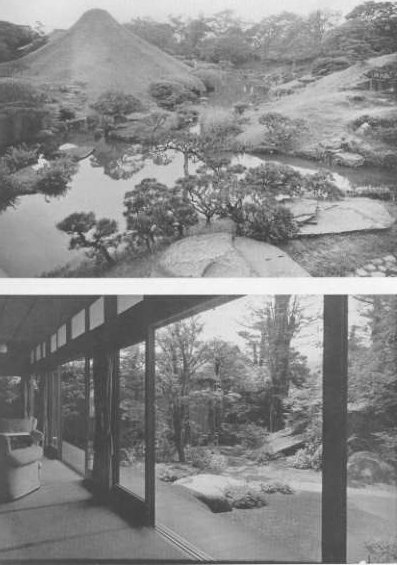
Stones are used in the garden to remind one, by their shape and position, of some famous scene. In such a case, they serve merely as a reminder, often a symbol, of some well-known scenery, bringing back to the memory of the observer the charm or grandeur of the natural scene he has visited. In that respect the Japanese gardens are like paintings full of suggestion. Many of the masters constructed gardens in a mood similar to that of an artist in painting. Indeed, we still have several gardens laid out by a great painter of the fifteenth century named Sesshu, he being only one of the many painters, poets and priests who designed our gardens. As in a landscape painted according to the canons of the Far East, the Japanese garden, too, is impressionistic and full of suggestion. (Plates 80, 87-upper)
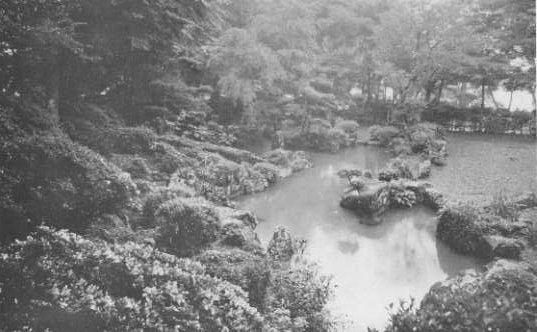
We have deep appreciation of rocks. We appreciate not only the beauty of the shape and texture, but also the very substance. A strong love for natural stones has existed in our people for more than 1,300 years. It was customary in ancient Japan to cover Imperial burial mounds with cobblestones for decoration as well as for the preservation of the mound against erosion. The people were so fond of using large natural rocks in the construction of burial chambers that an edict was issued in the middle of the seventh century restricting their use. Ever since the beginning of the seventh century, when stones of rare shape were presented by a Chinese Emperor to the Imperial Court of Japan, if not from some time prior to that, our people have admired stones, sometimes on account of the beautiful lines or shapes that might perchance suggest inspiring mountains or tremendous precipices, but also for their specific qualities - solid reality, unchanging and enduring virtues which are believed to have the power of softening the hardened hearts of men. Some enjoyed arranging small stones of beautiful shapes or colours on trays, and later with sand. That form of appreciation has developed into what is known as bon-seki, the art of depicting landscapes on lacquered trays with stones and sand. This art, as one of the accomplishments of cultured ladies, is very popular in Japan today. There are many schools or styles of bon-seki with a very large number of followers throughout Japan.
Stones were enjoyed by our people in many other ways. One form of ap- preciation of rocks is known as ki-seki (rare or strange stones) in which they are enjoyed for themselves alone. They are placed on writing tables, on the shelf or the tokonoma to lead the gazer into reveries from fancies suggested by their shapes, colours and markings.
Another form of appreciation is known as sui-seki, meaning "water stones." Rocks of different shapes and textures are placed in pottery trays or shallow basins with water so that the rocks may represent an island in the sea. The stone is constantly watered, and great appreciation is shown for the moss that may be grown by careful attention, perhaps after months and years of patient watering and culture, thus enlivening the stones with a verdure that transforms them into a landscape with forests and meadows, some chance streaks suggesting streams and cascades.
Still another form of appreciating rocks is to place them in a tray with low-growing grass or miniature bamboo grass in order to emphasize the immensity of Nature suggested by these rocks. In these forms the rocks arc appreciated in the homes and used as interior decorations.
But rocks have always played a very important part in our landscape gardens. They have generally been considered indispensable, in whatever form they might take. There are very important gardens in Japan which rely almost entirely upon rocks for their beauty and significance. The importance these rocks assume in our gardens seems to have grown with the introduction of the Zen sect of Buddhism. It was soon after this that a great effort was made to inculcate in gardens the spirit which permeates the black monochrome drawing, an idealistic style of painting in which the subtlest of colour gradation is suggested. Not only did the designs of the gardens express the hidden ideals of Zen, but even the rocks themselves were extremely suitable for the expression of these ideals. As the painter tries to express beauty and gradation of colour, the subtle effect of light and shade given by various textures in different materials in the single stroke of a black line, so the landscape architects tried to do the same with rocks in the garden. The people have learned to appreciate beauty in its subtlety in rocks. Some artists have designed gardens as they would paint landscapes, using different rocks to get effects similar to those secured by painters with brush strokes. Not only the scene which the shape and marking suggest, be it a mountain with a stream or an island with a sandy beach or a waterfall, but the subtle beauty of the mere surface of these rocks has been greatly valued. The surface gains by centuries of watering a sort of patina, a quality that time alone can give. Some arc covered with beautiful moss or lichen. In using these rocks in the garden, architects not only placed great emphasis on the value of each individual rock for its shape and texture, but they have always valued their beauty in groups as well. The people tried to group them as if they were sculpturing in rocks a mountain or a range of mountains in the garden.
One of our early books on gardens speaks of how the rocks should be grouped or strewn:
"Some stones at the skirts of the hills and in the fields should lie like fat sleeping dogs; others should look like frightened little pigs scuttering away; others like calves playing with their mother cow. Remember always in planting stones that if there are one or two stones suggesting a flight, there should be seven or eight placed as if they were chasing these."
Again, some have taught us to regard earth as the emperor, rocks as his counsellors, and water as his subjects. Water flows from the mountain along the path as willed by earth, but wherever the way is obstructed the water accumulates in a pond. When the water is too strong and the mountains too weak, the latter will fall, even as an empire falls when the subjects are too strong and unbridled. To prevent this it is necessary to strengthen the mountains by using rocks, even as the emperor assembles wise counsellors to assist him.
Years of study have enabled our garden artists to classify these rocks according to their shape - generally in five classes: first, the kind of rocks more or less tapered at the top and bulged at the bottom. Second, the kind which is taller than the first with a substantial body. The third is the kind which is somewhat flat. The fourth includes those rocks with projections, and the fifth those of a declining form. The first is often used as the guardian rock of the garden; and the second, in forming a waterfall. The third is used for the "worshipping rock" and stepping stones, and the fourth and fifth for pedestals for garden ornaments and sute-ishi (sacrificed rocks). These five kinds of rocks may be grouped in various ways, different combinations expressing different moods. They can be grouped in twos, threes or in five. A successful grouping of these rocks requires the exercise of great art.
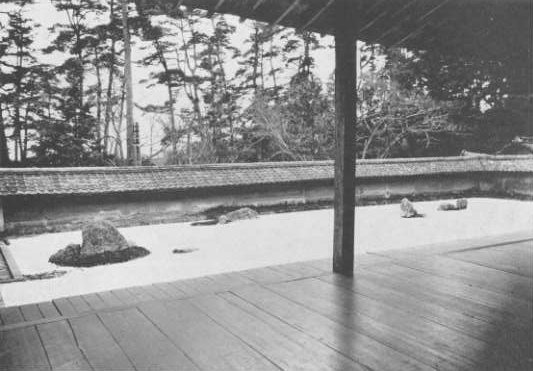
There are a few outstanding gardens in Japan which mainly or exclusively rely upon the rocks used. The most prominent among them is the garden of the Ryoanji temple in the suburbs of Kyoto. This garden consists of a spacious level plot in front of the main rooms of the temple, surrounded on three sides by low walls. There fifteen rocks are in five groups of 2 twos, 2 threes and 1 five. With the exception of the moss growing immediately around the rocks and along the wall, there is no vegetation in the garden, not even a single tree, these rocks being imbedded in the ground which is covered with white sand raked into patterns. Trees are seen beyond the walls which now obstruct the view of the distant hill. All sorts of religious and philosophical interpretations have been suggested in order to account for the layout of this garden which is attributed to Soami of the fifteenth century. (Plate 81.) The garden of the Daisen-in temple, which is also attributed to Soami, and those of the Shinjuan and Daitokuji temples are also famous, the first from the interesting shapes of the rocks employed, and the other two, because each is made with groups of seven, five and three rocks on narrow strips of ground off the outer corridors of the main buildings.
General ideas arc given in old books as guidance for the placing of rocks for different purposes. One passage says that when one is creating the feeling of a large river, stones should be placed along the edge of the water in a form suggesting a crawling dragon. The main rock in this case should be placed where the river turns, where the water dashes against it and changes its course. There should be sandy places where the current is weak.
"To indicate a mountain stream," another passage says, "rocks should be distributed somewhat close together. There should be some rocks in the middle of the stream, but in that case it must be borne in mind that the flow of the water will then be divided and made to dash against both banks, where rocks should be revealed."
Some stones in the garden have useful functions to perform, but these should be artistically placed. A great master, in giving instruction to his pupil about laying stepping stones in the garden, insisted on giving 60% to utilitarian as against 40% to artistic considerations. But another great connoisseur reversed the ratio, thus giving greater importance to art than utility.
Now turning to rocks in general, we find specialists often spending hundreds or even thousands of yen for a single stone for the garden. They gather them from the mountains or seashore hundreds of miles away. Some' times fine rocks are found in a distant mountain and then weeks and even months are spent in bringing them home, usually by bull carts. Indeed, I know of one or two instances where the owner went bankrupt during the time the stones for his garden were on the way, so that they had to be abandoned en route - bankrupt not from the cost of the rocks, though some of them were extremely costly, but because the transportation took so long that there was time meanwhile for many things to transpire. (Of course I am mentioning only the unfortunate happenings.) It takes a long time to transport rocks, not only on account of the slow speed of the bulls drawing them, but also because many small bridges on the way have to be reconstructed or strengthened to prepare them to withstand the heavy weight. I was very much touched on one or two occasions when I saw the tender care given to a small flowering plant that happened to be growing from the crevice of a rock, and also to the moss or lichen covering the rock, so as to protect them on the road. Some rocks are exquisitely beautiful when wet, revealing inexpressibly mysterious depths in the rain or a subtle iridescence when the sun shines upon them while wet after being watered. Other rocks with a coating of moss, or a patina obtained only by centuries of exposure, are indeed reassuring to our souls, softening the hardened hearts of men.
It must be difficult for Western people to realize the extent of the trouble the people of Japan take to get suitable rocks for their gardens. I know of a gentleman who built a villa with a garden on the banks of Lake Biwa. This villa was honoured once by the presence of the Emperor Meiji. Because his villa was made use of by His Imperial Majesty, though only for a few days, he wanted to keep the building as a memorial of the Imperial visit and to erect a stone monument in his garden engraved to that effect. To find a rock suitable for that monument he commissioned his gardener to travel all over Japan. For many weeks the man wandered about until finally he discovered a hill in a far off province where there were some interesting rocks which might be suitable. The master was taken to the place and a few rocks were dug out, but in order to find one that would satisfy him he went so far as to buy the whole hill which was in the possession of three persons living in three different villages. Thus a suitable rock was obtained for the monument which now stands in the garden. And later on some of those rocks were taken to Tokyo and are being used in the cemetery garden to which I referred earlier in my talk.
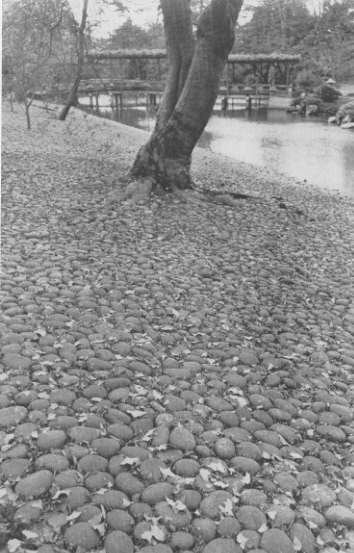
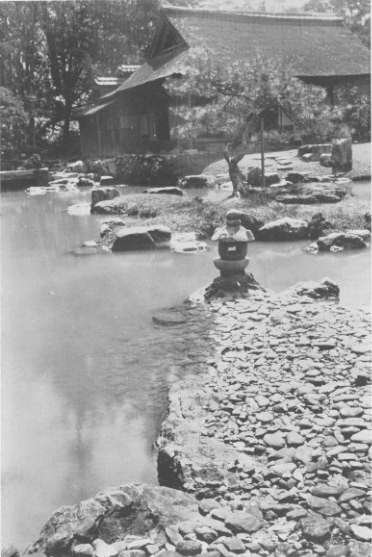
Some of you may know that one of the Imperial gardens in Kyoto has tens of thousands of oval cobblestones thickly strewn along the sloping banks of the pond. You may know that they were all gathered from the shores of Odawara, some three hundred miles away, where each stone was exchanged for a sho of rice (about one and one-half quarts) which represented the pay for about a day's work, and sent to Kyoto wrapped in cotton. (Plate 88.)
Again, in the garden of Marquis Tokugawa in Tokyo, a quantity of black pebbles was used for the dry bed of a stream formed in the garden. Bags of these beautiful pebbles, I understand, were accepted by the feudal lords from farmer tenants in place of rice in a year when the crops were very bad.
There are different ways of using rocks in the garden in order to have them perform their required functions. One important rule to be observed in placing rocks in the garden is that they shall be firmly imbedded in the ground and not merely placed on the surface. It is difficult to determine just how much is to be buried and how much and of which portion is to be exposed. The best part of the rock should be shown and to its greatest advantage, and according to the location where it is to be put, one must judge how much of it is to be shown above the ground.
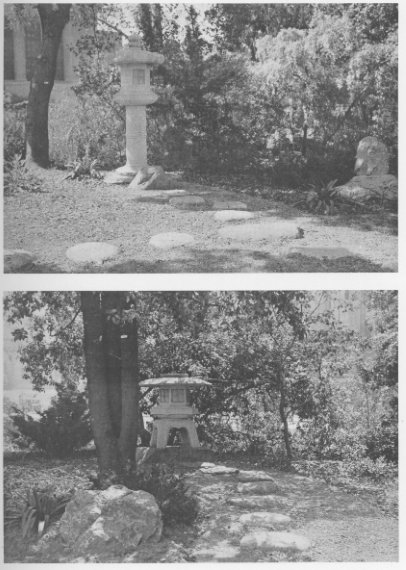
About a year and a half ago, the alumni association in Japan of the University of California sent to Berkeley two stone lanterns with sets of stepping stones and a few accessory rocks. Before these were shipped from Tokyo I had my gardeners install them in the temple grounds near my home so as to prepare blue prints and take photographs to serve as guidance for their installation on the campus in Berkeley. There were two rocks in that collection which were to be imbedded near one of the lanterns. Just how far these two rocks should be exposed was the subject of a heated discussion between a father and son, both excellent gardeners. The young gardener placed them in the way whicl1 he thought brought out the best view of these rocks, but his father was of the opinion that they should go about two inches deeper into the ground, and I had to mediate in the matter. Last spring I went to the University of California to give a series of lectures and saw the stone lanterns and stepping stones as they were then installed on the campus and was reminded of the discussion which took place between my gardeners before the stones were shipped. I had some of the rocks covered with slightly more earth than what I found about them, and I think there is now a bit of Japanese atmosphere on the bank of North Strawberry Creek between the Biological and Agricultural Buildings. (Plate 2.)
Attention may be called to the fact that the landscape garden is often taken to represent the whole universe, symbolized by the five elements: earth, water, fire, wind and ether (chi-sui-ka-fu-ku). Earth is represented by hills and islands, and suggested by the colour yellow; water, by the pond, and suggested by black; fire by the flowers of the trees and grasses, and suggested by red; wind by the invisible power which causes the flowers to bloom and scatter, and suggested by white; ether by the colour of the leaves of the trees and grass, which is intangible and suggested by blue. These five elements, as represented in the stupa known as gorin-to and used as a tombstone in the Koyasan monastery and elsewhere, assume the following forms, named in order from the bottom: earth, the base of the stupa, a cube; water, a sphere; fire, a pyramid; wind, a semi-sphere with the flat surface up; and ether, a pyramid on a semi-sphere, or a jewel-shaped object.
The garden shows the influence of the Buddhistic conception just mentioned which is known as go-rin. This has been merged with a similar idea in Taoism known as go-gyo (five lines), which concerns the following five elements: earth, mineral, wood, fire, and water, and these are represented also by tastes: as sweet, pungent or hot like red pepper, sour, bitter, and salty. Another Taoist idea which has crept into our garden lore is that known as kuji (nine letters) which came to be used to ward off evil spirits. Of similar conceptions, perhaps none has had a greater influence on our garden construction than in-yo (or on-yo) meaning positive and negative, male and female, light and shade, active and passive, hot and cold, day and night, life and death, strong and weak, justice and mercy, etc. Nothing exists which does not possess these two opposing elements, and a harmonious combination of the two is essential in everything and every place. A tall rock is considered yo, while a low spreading one is in. A balance or harmony of in and yo in every object that goes to make up a garden is considered essential in the construction. If there is a projection there must: be a depression to balance it. If one waterfall in the garden is high, the other should be low; if one part is light and open, suggestive of hope, the other part should be shady and closed, conducive to introspection. A sort of balance or contrast such as one finds in our gardens everywhere is based upon this principle of in-yo.
Is it not true that Nature is full of these contrasts, and life, too, full of inconsistencies, the love of which is rather strong in the Japanese? Perhaps it may be interesting to consider for a moment the tsukubai in this connection. Some of our tsukubai (a stone basin to hold water for rinsing the mouth and purifying the hands before entering the cha-seki, or ceremonial tea-room) are covered outside with moss, but the inside of the bowl is always carefully scrubbed. Great care is often taken to keep the moss alive or to grow a small plant in the crevices (if there happen to be any) of the stone water basins to suggest similar rocks which we often come across in mountain ravines. The outside look>; neglected, and the moss sometimes grows to the very edge of the bowl, but the inside of the bowl is scrubbed with a brush and kept immaculate, and filled with clear, crystalline, sparkling water fit to wash away all impurity and cleanse our very souls. It reminds us of the clear, cold spring water flowing over clean sand in the heart of the mountains and brings with it the cool refreshed feeling which we l-rave when we suddenly discover a stream in the heat of summer. Such a feeling as that prepares us for the full enjoyment of the spiritual atmosphere in the cha-seki (tea-room).
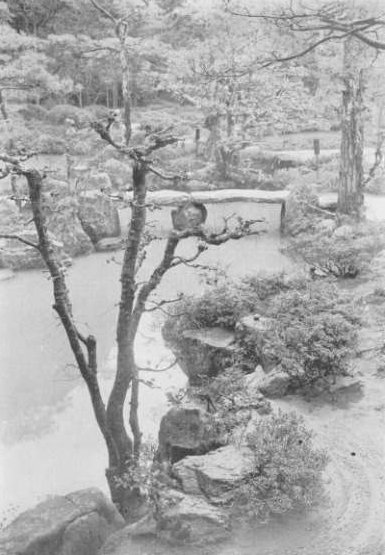
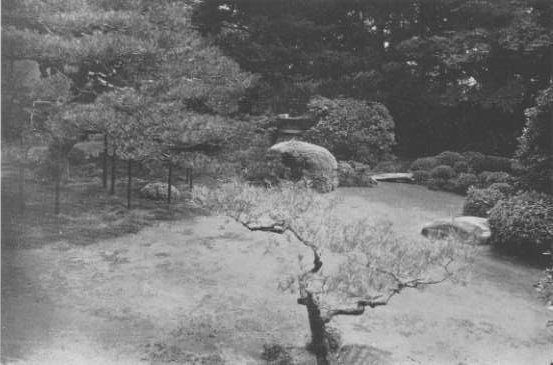
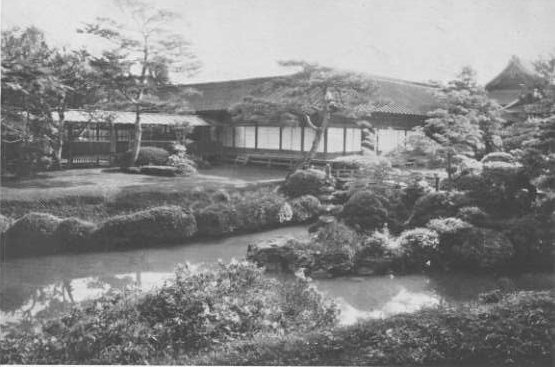
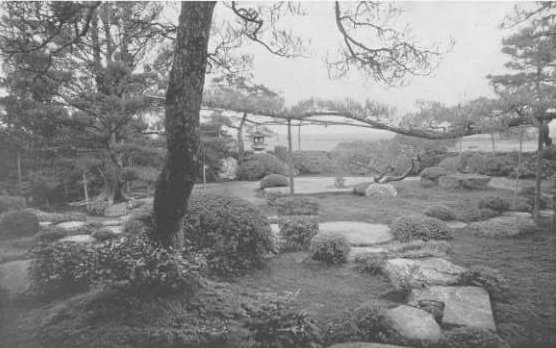
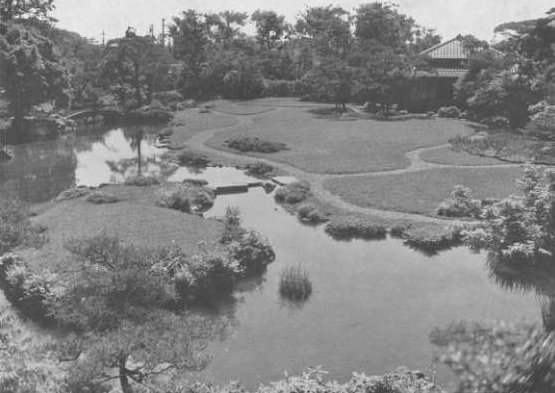
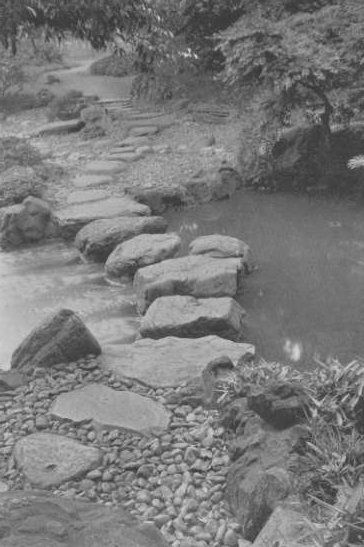
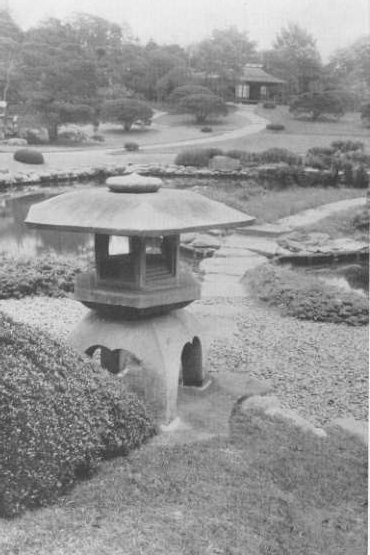
There are different kinds of gardens: gardens with artificial hills, and flat gardens; dried-up landscape gardens and gardens for the cha-no-yu room. There are different styles of treatment: shin (formal), gyo (less formal), and so (informal). There is a sort of formula for the general layout of the garden: the guardian stone and a small l-fill for the cascade; hills on the back and on the side, some near and some distant; a lake with an Elysian isle in it; the guest's island and the master's island on the side, and the worshipping stone near the water in front. All sorts of variation are allowed, but the fundamental principles of this formula are respected. Whatever the type or style, it has always been the aim of the Japanese to have the garden so constructed as to bring man close to Nature in its precincts. That has been the ultimate aim in the Japanese garden, for the realization of which all sorts of efforts have been made. Religious teachings, philosophical doctrines and even superstitions have been used in the desperate struggle to make the garden a fitting abode for Nature and a place for man to elevate himself spiritually in and see himself in right proportion to the Infinite. (Plates 79, 82, 83, 84, 85, 86, 87, 89, 90, 91)
It was this desire that caused Rikyu, the great tea master, to plant a grove of trees in his garden for cha-seki at Sakai in such a way as to obstruct the view of the sea. So that only when the guest stooped to the stone water basin to rinse his mouth and wash his hands preparatory to entering the tearoom did he catch an unexpected glimpse of the shimmering sea through the trees - a glimpse of Infinity - thus suddenly revealing the relation of the dipperful of water lifted from the basin to the vast expanse of ocean, and of himself to the universe.
In conclusion I wish to call your attention to a warning which we should all do well to heed. Let me recount an incident in the life of a great painter, Tani Buncho, in this connection.
It was on an afternoon early in spring, a little over one hundred years ago, that Tani Buncho called on Shirakawa Rakuwo at his mansion in Tokyo, then known as Edo. It may be mentioned here that Lord Rakuwo was responsible for the creation of many famous gardens, and that it was he who established Nankoyen Park at Shirakawa, not far from Tokyo, one of the earliest public parks to be created in feudal Japan and which is still enjoyed by the people of to day. Lord Rakuwo informed Buncho that the time was close at hand for him to receive the long-awaited appointment of Edokoro, or master painter to the Shogun. Now the Shogun was already familiar with Buncho's work, and it was only as a matter of formality that a brief record of his training as an artist and of the different styles he had mastered was required, and this Buncho was asked to prepare in writing. He was left alone in a room with some sheets of paper and an ink-box. As he sat there he heard the clear, crisp clicking of the gardener's shears without. Quickly taking up his brush he wrote on the paper the names of the different schools whose styles he had mastered - beginning with the Kano with its strong Chinese in fluence then the southern school of the literary man's style, next the Tosa in the old traditional style, and finally the decorative school of Korin. Indeed he was a great master, being an arduous worker from his boyhood, seeking one master after another, and acquiring the different techniques and absorbing the ideals of the various schools of painting. He read over the draft twice and was just ready to submit it for Lord Rakuwo's approval. His heart was exultant at the prospect of receiving an appointment to the official position to which he had so long been aspiring.
He stepped out into the garden for awhile and watched the old gardener trimming and pruning a tree. Finally he approached him and commented on how good he was at his work and how it was a pleasure to watch him.
Then he said, "Although you work with such ease and facility, no doubt you are following the rules and principles of the particular style you have adopted."
"No," humbly answered the old gardener, who recognized the noted painter; "my work is different from the art you are master of; nothing like it at all. The only principle by which we are guided is that of parents in trying to bring up their children to be healthy and beautiful; that is all."
"That must be the right principle," observed Buncho; "it requires a mother's heart to take proper care of these trees, and to look after the welfare of the garden. However, I should think there must be a particular set of rules or the canons of certain schools you find it advisable to follow."
"There are schools, to be sure, and any number of rules great masters have formulated," quickly came the answer; "yes, certain branches of the tree should lean across the waterfall to conceal a part of it from view; likewise the lighted part of the stone lantern should be partially concealed by a branch; the tree planted over the embankment should lean outward, leaving only about three-tenths inside and seven-tenths outside; the tree planted at the foot of a bridge should lean over so as to reflect its image in the water; and hundreds of other things like that. It is all very well and good to follow the spirit of these rules, but to copy merely the form is a procedure to be despised. These rules are precious to the master who devised them after years of study and experience, but they are valueless to those who merely copy them. To copy others is nothing more than imitation, and imitation kills life."
"I was once fortunate enough to visit the famous gardens in Kyoto and to see with my own eyes the work done by the great masters," the gardener continued; "I was thoroughly convinced then that it is the creative devices of each individual that count, and not the imitation of an established form."
There was something well worth considering in the words of this aged gardener. Pensive yet resolved, Buncho returned to the room, and sat down at the desk upon which his manuscript lay. "To learn from the old masters, but not to imitate them." "To get at the spirit of the thing, and not to copy the outward form." Of course, these ideas were by no means new to him; quite the contrary, as he had taught them to thousands of his pupils. Yet they seemed to have a new significance for him that day; they carried a new message. "To be familiar with the styles of the founders of the different schools, or even to master all of them, does not matter much in painting," Buncho soliloquized. Of course, this was a familiar thought, but something had happened which had caused him to become introspective.
When Lord Rakuwo reappeared and had approved the draft, Buncho asked to be allowed to reconsider his application for the proposed appointment. He intimated that he felt his own unworthiness for the office and withdrew, leaving Lord Rakuwo in great bewilderment.
The words of the aged gardener had changed the life course of a great master painter. They contain truth strong enough to change the lives of any one of us. So strongly bound Up with rules and traditions does the Japanese garden culture appear to be that there is a warning here for us all to heed: Mere imitation is lifeless; it is the spirit of the rules and traditions that is to be followed; it is the spirit of Nature, and not the outward form. This we should bear in mind especially in laying out our landscape gardens. This incident reminds us also that it is with a mother's heart that we should care for our gardens, and should take heed lest we destroy their charm or render them lifeless, by our sheer devotion to rules, our efforts to conform merely to style and outward appearance.
The secret the aged gardener learned direct from Nature is applicable to all the branches of art and especially so to our garden art. The highest aim here, let me repeat, is to make the garden a fitting place for Nature to dwell in so that within it man may have spiritual communion with the Infinite.
NOTES ON PLATES
Plate 79. Garden of the Ginkakuji (Silver Pavilion), Kyoto. XV century. Attributed to Soami. Very dexterous use of natural rocks along the hanks of the winding pond is noteworthy. Recently a part of the original garden, with groups of the rocks in their original positions, was revealed by removal of earth on the hillside back of the temple, which showed the extent of the original layout.
Plate 80. Garden designed by Sesshu (1420-1506), a famous landscape painter. The pond is fed by a small waterfall, and the moss-covered rocks harmonize with the azalea bushes, suggesting the chiaroscuro in the black monochrome painting in which this master artist excelled. The garden looks secluded and full of peace, thought it is in a high altitude with an open view.
Plate 81. Garden of Ryoanji. Attributed to Soami (flourished about 1521-7), with fifteen rocks grouped on a level ground covered with sand. There is not a single tree within the enclosure; only the moss is growing immediately around the rocks and along the wall. All sorts of imaginations may be stirred by this unusual garden. In it some people observe groups of islands in the sea; others imagine a mother tiger carrying a number of her cubs and a wolf from one island to another, protecting the cubs against the wolf while so doing - a sort of puzzle picture difficult to resolve. To some people they are merely rocks in sand; to others they suggest a serious religious problem that requires profound thought.
Plate 82. Garden of Kohoan, Daitokuji, Kyoto. Designed by Kobori Enshu (ob. 1647). Though there is not a drop of water here, the garden successfully suggests a great expanse of calm water. The natural stone bridge is very effectively placed to carry out the suggestion of water in the garden. The large pine-tree seen on the left, with its branches all propped up, seems to be growing on a bank, like the historic pine-tree of Karasaki on the shore of Lake Biwa.
Plate 83. Garden of Rinnoji, Nikko. XVII century. Very few rocks are used in this garden, azalea bushes being clipped to suggest a variety of natural rocks along the banks of the pond. At one end of the garden there is a small edifice which commands a view of the entire garden.
Plate 84. Mr. Nishimura's Garden at Yawata, Kyoto prefecture. Original design by Sho- (ob. 1639), a tea devotee, painter and connoisseur. The garden is so laid out as to take in the open view of a vast stretch of field when seen from the house.
Plate 85. A Nobleman's Garden in Kyoto. Designed and executed by Ogawa. XX century. A lawn between the pond and the house and the artificial hills on the other side of the pond allows a view of the distant hills of Kyoto, as if the garden continued thus far.
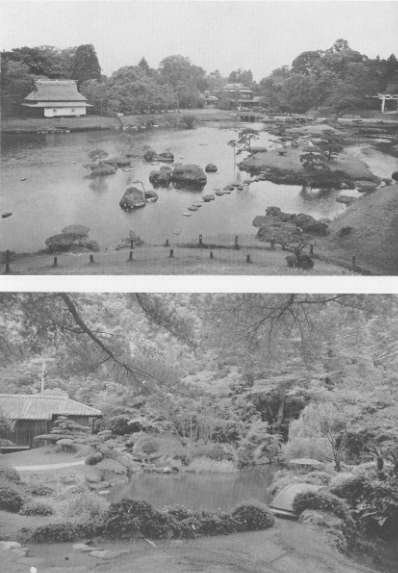
Plate 86. Upper: Garden of Suizenji, Kumamoto, Large natural rocks, which have trees growing in their crevices, are grouped in the water to suggest islands in the sea. A rest-house is seen on the left; the best view of the garden with a miniature reproduction of Mt. Fuji in the background may be had from there. A granite torii is visible on the right; a shrine is erected in the dense grove of trees in the garden.
Lower: Prince Shimazu's Garden in Kagoshima. The water is led into the garden from the stream running back of the mansion. A stone lantern ("snow-viewing" type) is very effectively placed by an arching stone bridge. This pond is at one end of the garden, the main part of which contains areas covered with sand and planted with rows of pine-trees in such a way as to include a view of volcanic Sakurajima across the water in the background.
Plate 87. Upper: Garden of the Shinonome-ro, Kumamoto, The garden has a miniature reproduction of Mt. Fuji encircled by an irregular pond with a number of tiny isles in it.
Lower: Mr. Ohara's Garden at Kurashiki, showing at the farthest corner the big tree which was transplanted from Warabi, some 500 miles away. The gigantic rock near the tree has more than one-half of its volume buried in the ground.
Plate 88. Cobblestones in the Garden of Sento Gosho Palace in Kyoto. These stones arc said to have been sent from Odawara nearly 300 miles away, each wrapped in cotton. The design of the garden is attributed to Enshu (ob. 1647). A stone bridge, covered with a wisteria arbour, is seen in the distance.
(By courtesy of the Imperial Household Department.)
Plate 89. 89. Korakuyen, Koishikawa Ward, Tokyo. Designed by Daitokuji Sahel, and con' structed for Tokugawa Yorifusa (ob. 1661) and Mitsukuni (ob. 1700), feudal lords of Mito. The garden now belongs to the City of Tokyo. The stepping stones seen in the illustration are laid across the water where the basin below one of the waterfalls narrows before pouring its waters into the lake in the garden.
Plate 90. Garden of the Katsura Detached Palace, Kyoto. Designed by Kobori Enshu, who is said to have undertaken the task under three conditions: no limitation as to time, unlimited expense, and no interference until completion. It is said to have taken him fifteen years to finish. Our illustration shows the garden in front of the tea-house named " Sho-kin-tei." The name of the tea-house refers to the sound of the waterfall audible at the building, the sound suggesting the music of the pine-tree by the sea she meaning the pine-tree, kin, a lute named koto, and ted, the edifice. In the illustration may be seen rock formations at the projections into the water where some rocks are half or entirely concealed in the water.
The light in the stone lantern by the water, with its shimmering reflection in the pond, is often enchanting beyond words at night. (By courtesy of the Imperial Household Department.)
Plate 91. Imperial Garden at Shinjuku, Tokyo. XX century. This extensive garden has been used for many years for the Imperial garden parties - cherry blossoms in the spring, and chrysanthemums in the autumn - and is treated in various styles, including the traditional Japanese layout as shown in the illustration. (By courtesy of the Imperial Household Department.)