

VI. ANCIENT LACQUER IN JAPAN
Delivered at Mills College
IT is my intention this evening to talk on Japanese ancient lacquer, dealing with artifacts in that material produced in the eighth and previous centuries in general, and with those in the eighth century Imperial Repository, the Shoso-in, in particular.
At the outset let us consider for a few moments what lacquer is. As many of you must know, lacquer is prepared from the sap of a tree possessing qualities very much like your poison oak, which must be a distant cousin or in some way related. The sap is treated, refined and worked in a fluid form, but when once hardened it becomes a most resistant material. Lacquer is peculiar to the Orient, the lacquer tree (Rhus vernicifera) being found only in the region between Siam and South China and in Korea and Japan. Some foreign authorities claim it exists in India, but our specialists believe that to be a kind of gum tree and different from our true lacquer tree. Lacquer is a peculiar material with a mysterious property that seems to defy chemical analysis. Scientists so far have found that it contains a quantity of mysterious "lacquer-all," a quantity of nitrogen as in white of egg, some gum and water, but no one is able to define or show further analysis of the mysterious quality of lacquer. Although a report was issued some years ago by the chemical laboratory of the Department of Agriculture of Japan which defined lacquer to consist of 78.25% of carbon, 9.6% of hydrogen, and 12.15% of oxygen, many scientists still claim that a satisfactory analysis is impossible.
It is interesting to note that lacquer dries in moisture; it forms a chemical reaction with oxygen and hardens. In its fluid form it is weak, easily acted on by a small quantity of salt, vinegar, oil, or the weakest of acid, but when hardened, by forming chemical action with oxygen, it resists strong acid or salt and insulates electricity and can preserve itself underground and in water for 2,000 years or more, as the artifacts show. It is, in a way, a convenient material to work with, for you can work with it as long as you wish; it remains fluid as long as you want it so, or until you subject it to moisture to harden it Nothing like it has been found elsewhere - this mysterious fluid material that hardens with moisture and changes to a substance of wonderful hardness and durability.
Of course, the length of time and great trouble required in the process of drying it have been a great hindrance in many instances, especially when the work necessitates applying many layers or coats of lacquer and each coating must be dried before a fresh layer is put on, and all has to be finished in a hurry. Furthermore, its poisonous property while in the fluid form, though it loses its power when it gets hardened and old, has been an objection to its use, though nothing serious has resulted to the worker before he becomes immune. But investigations, which I understand are likely to be successful, are now being made in a laboratory in Tokyo in order to discover ways and means of overcoming these two difficulties.
Before proceeding to deal with the works in lacquer to be found in Japan proper, let us review for a moment some of the earliest examples found on the ancient site of Lo-lang, a Chinese colony in Korea existing from the second century B.C. to the fourth century A.D. The oldest date incised on a lacquerware piece corresponds to 85 B.C. That date is on an oval cup with extended lips. There are at least four other lacquer pieces bearing the date of the first century before and several with those of the first century after Christ. The inscription is incised with something like a needle point; and in many cases it includes the name of the factory, of the artist, and of the officials who supervised the work. Not only on oblong cups, but also on lacquer trays and plates recovered from the ancient tombs of Lo-lang are these inscriptions found.
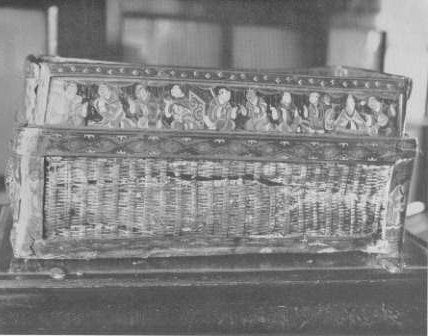
Some of these early pieces of lacquer-ware are decorated with paintings in - red, green, yellow and black predominating. One of the most wonderful finds from the Lo-lang site in recent years is the painted basket, perhaps dating from the third century A.D., now preserved at the Keijo Museum in Korea. It is a lacquered bamboo basket decorated with paintings of rows of figures of wonderful vividity as may be seen in the reproduction. (Plate 78.) I regret, however, that I can not show you the freshness of the beautiful colour. The same burial chamber which yielded that painted basket contained also a large lacquered table with conventional design in coloured lacquer. By the way, this wooden burial chamber, together with the three lacquered coffins which it contained, has been reconstructed in the compound of the Heijo Museum in Korea.
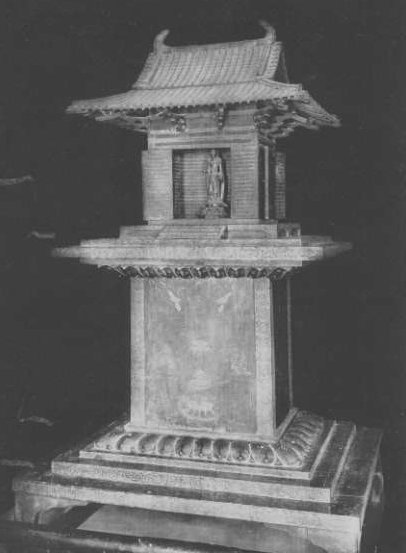
The oldest example of lacquer in Japan proper is the tamamushi-no-zushi, or portable shrine, preserved in the kondo of the Horyuji monastery. It has never been buried It is made of wood and lacquered, and ornamented with iridescent tamamushi (beetle) wings - hence the name. The panels of the doors and the back as well as the four sides of the pedestal are decorated with paintings. For a long time these paintings have been considered to be in litharge, containing oxide of lead - something like oil painting Recently, however, one great lacquer specialist has insisted that these paintings are in lacquer and not in litharge, and we have not been able to decide definitely on this point. This portable shrine is believed to be a product of the late sixth or of the beginning of the seventh century A.D. Some authorities are of the opinion that it was imported and others believe it to be a home product. (Plate 65.)
Among the lacquer products of the eighth century, we have a large number of Buddhist images in what is known as dry lacquer, a technique peculiar to the Nara period. There is a great deal of misunderstanding in the West concerning the term "dry-lacquer," and perhaps you will allow me to say a few words in the way of explanation as to what we understand by the term "dry-lacquer," which is the literal translation of Japanese "kan-shitsu."
We generally apply the term "dry-lacquer" to all statues having a thick coating of lacquer, when the coat is unusually thick, but strictly speaking the term designates hollow lacquer statues with or without a wooden framework inside and utensils in which thick lacquer is laid on hempen cloth without a wooden core. In making such a dry lacquer statue two methods were in general use. One method was to make a finished model in clay and take molds from it as in modern casting. By means of the mold the required thickness was built up by laying on different coats of lacquer mixed with other ingredicnts such as one called tonoko (a kind of clay) and fine powder of incense-wood and finishing with a strong foundation (as it will be the inside of the statue when made up) of many layers of hempen cloth, the entire thickness being anywhere from a quarter to half an inch. The pieces so made in parts were put: together or sewed together on a wooden framework, such as is employed to keep the form in good shape, and then finished with a further coating of lacquer. The other method required the reversal of a part of this process. First a rough clay figure was prepared to be used as a foundation and then the required thickness of lacquer was built up on it by laying on hempen cloth with lacquer first, finishing with a top surface and then when the lacquer was sufficiently dry, breaking and extracting the clay foundation, leaving the lacquer figure hollow. The second method seems to have been much more commonly employed than the first. Small complicated portions, such as arms and legs, were made separately, cut open while soft, the clay extracted, and the lacquer then sewed together and finished with other coats of lacquer.
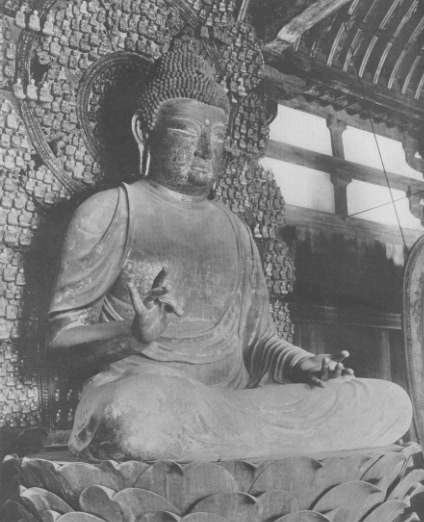
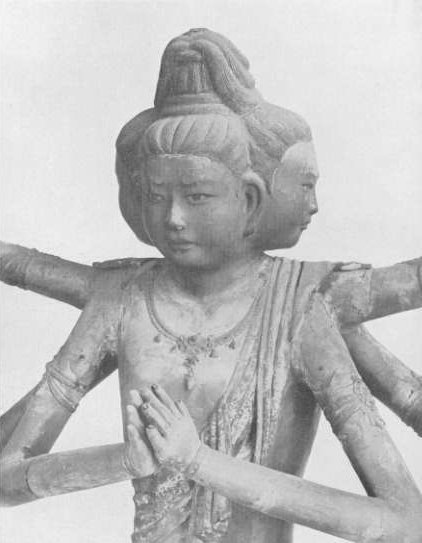
Of this type there are a number of examples preserved for us. One group of eight Buddhist deities known as Hachibushu and another group of ten statues, representing Ten Great Disciples of Buddha, both belonging to the Kofukuji of Nara; Fukukensaku Kwannon, Two Deva Kings and Four Guardian Deities, as well as Bonten and Taishaku, all of these being kept in the Hokkedo of the Todaiji, also in Nara, and the Vairocana Buddha and portrait of Ganjin Kasho (or Wajo) both in the Toshodaiji in the vicinity, are outstanding. Although the paint is now almost obliterated, they were originally decorated with designs painted in colour. These figures, some of which are life size and others much larger, are excellent examples of early Japanese sculpture showing the soft, yielding and warm effects peculiar to the material used. (Plates 73, 75, 76, 77)
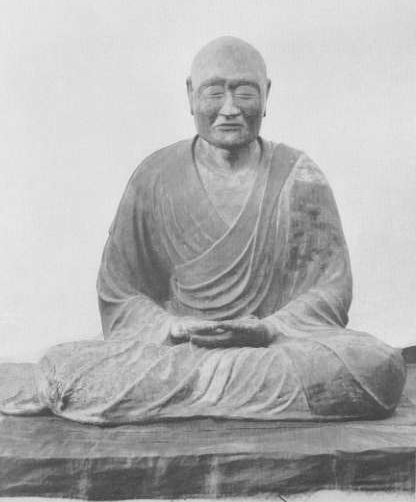
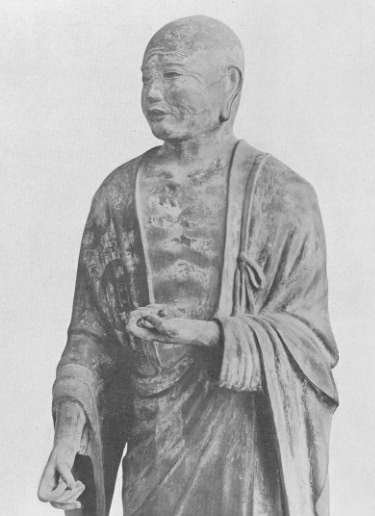
The dry-lacquer technique used on these images is peculiar to the Nara period (645-780). Being hollow, the statue thus made is light; because of the material used it is not easily breakable and so is extremely durable. In spite of there being these reasons favouring their production, our sculptors apparently stopped making these figures after the eighth century. And the true cause of their disappearance is a subject of diverse conjecture among scholars. Perhaps these statues proved to be too extravagant, for the lacquer itself must have been costly, and, in addition, in order to give thickness to the lacquer when making a statue, costly incense in powder form seems to have been used mixed in lacquer. This was done as an offering to the Buddha, as well as to enhance the value of the statue. Perhaps the technique was not congenial to the Japanese sculptors; the material and method employed may have proved distasteful to them whereas wood we know was greatly favoured. It may be that it was due to the scarcity of the material: there may have been difficulty in getting a supply from China or in preparing it at home. Or perhaps the art was lost in some manner. It is, however, more than likely that a change in the mode of worship in Buddhism was the real cause of their disappearance, for as the introduction of the custom of carrying these figures about during the service may have stimulated their first appearance, so the cessation of this religious custom may have put an end to their manufacture. Probably the tedious and laborious process involved made it difficult to meet the great demand which then rose for statues, especially since great progress had been made in carving wooden statues. Whatever may have been the real causes of the appearance and disappearance of this technique in sculpture, we do not find examples of dry lacquer statues either before or after the Nara period.
The wooden statue with an unusually thick coating of lacquer is designated dry-lacquer on wood in order to distinguish it from the hollow type. Of this type also there are a goodly number of excellent examples in the eighth century sculpture. Miroku Bosatsu with a high hokitsu (chignon on top of the head) in the possession of the Koryuji temple is noteworthy. (Plate 74.) This is believed to be the earliest example of this type, while the Nikko Bosatsu in the imperial Household Museum and the Gakko Bosatsu, its companion, belonging to the Tokyo School of Art, are generally considered to be the latest examples, they having been produced at the end of the eighth century. The above mentioned Miroku Bosatsu is carved in wood, covered first with hempen cloth, then with thick layers of lacquer, and finally with gold leaf, as the damaged parts clearly show. Pieces of leather are used for the foundation of the lacquer in places. The drapery flowing over the shoulders is of this same material. Among other examples of this type mention may be made of the Eleven-faced Kwannon in the Shorinji, and portraits of Gyoshin Sozu in the Horyuji and Giyen Sojo in the Okadera. (Plate 74.)
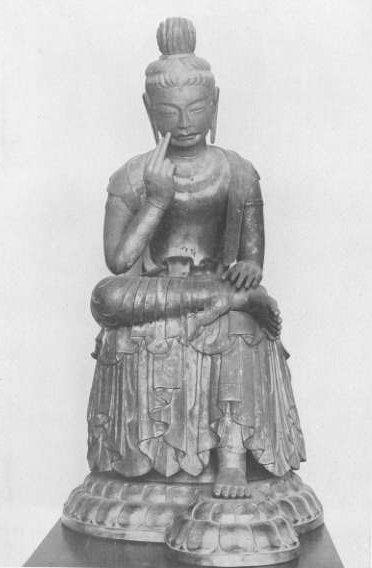
When the lacquer coating is thin, the piece is called a lacquered wooden statue. There are many examples of wooden pedestals and nimbuses lacquered, some with designs in relief in lacquer, as in the case of the halo in the Horyuji monastery. (Plate 72.)
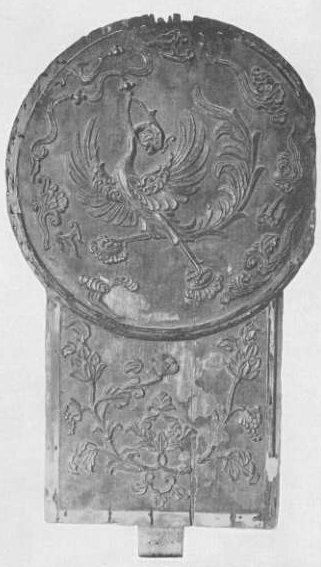
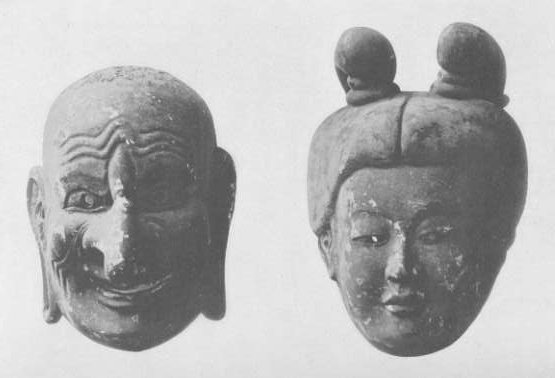
The same technique was employed for making gigaku masks as well as images. Japan is proud of possessing no less than 222 of these masks of the seventh and eighth centuries, and quite a number of them arc in dry lacquer.
Now let us proceed to deal with the lacquer in the Shoso-in collection. Although the unique position which the Shoso-in occupies in the art world is dealt with in a separate lecture, let me impress upon you now the facts that the nucleus of that collection was the treasures which belonged to the Emperor Shomu and which were dedicated to the Todaiji by the Empress Dowager Komyo soon after his death in the year 756; that the collection contains a number of treasures which can be identified as those in the original memorandum of dedication made on the 21st day in the 6th month of the 8th year of Tempyo Shoho (756), and that these treasures have been kept intact for nearly twelve centuries in the original edifice, which was built in 752. Of course, there are in other parts of the world objects which are much older than those preserved in the Shoso in, but they were all first buried under ground and then dug up, while the treasures of the Shoso-in have never been buried, and have always been kept in the air, in this building, for nearly 1,200 years. Nothing like it is found elsewhere in the world. The collection is authentic and unique.
The lacquer pieces in the Shoso-in may be classified according to the foundation upon which the lacquer is applied as follows:
(1) Objects with lacquer applied on wood: Examples: a cabinet (46), many boxes (101, 133, 204, 206, 305, 366, 411, 427, 439, 450, 451, 452, 453) and chests (55, 56, 138, 139, 390, 405, 752, 753, 758, 760, 761), scabbards of knives (29, 30, 31), and swords (96, 306-318, 320-331, 740, 741, 742, 74.3), bows (301, 381), tips of rollers for scrolls (380, 381), drum-bodies, (734), door panels, (770, 771, 792), masks (98, 718), a couple of large barrels (419), a number of almsbowls (642), a harp with seven strings (99), arm-rest (420), chest of drawers (423), tall table (457), dedication stand (502), wooden dishes (607), boxes for mirrors (79, 608, 609, 699, 701, 708), case for vase (617), incense tray (620), box for shubi (654), box for priest's staff (660), box for Buddhist sceptre (670), flower shaped tables (757), etc.
(2) Objects with lacquer applied on metal: Examples: backs of bronze mirrors (65, 67, 69, 71, 73, 75, 77, 80, 81, 696, 700), many padlocks (759), iron chains and stirrups in horse trappings (349-352), spear shafts wound with wire (354), sockets of pocket knives (432), iron and copper mounting of many swords (3I3-3I8), etc.
(3) Objects with lacquer applied on cowhide: Examples: boxes for kesa or priest robes (18), boxes for mirrors (66, 68, 70, 72, 74, 76, 82, 84, 86, 88, 90, 610, 611), tomo or archers' wrist-guards (304), a box for gold (200), and other boxes (373, 407, 433, 434, 449, 454, 683, 773), etc.
(4) Objects with lacquer applied on woven vine (tsuzura), or strips of birch-bark:
Note: The italic numerals in parentheses designate numbers of items in the "Catalogue of the Treasures in the Imperial Repository, Shoso-in," and are inserted for the convenience of those who wish to investigate further.
Examples: quivers (340-344), a box containing cakes of ink (377), sword hilts and spear shafts wound with birch-bark strips (312, 316, 354).
(5) Objects with lacquer applied on bamboo or wicker basket work: Examples: a ewer with silver inlay on bamboo basket-work foundation (54), spear shafts covered with bamboo strips (354), box for sugoroku board (131), boxes for rosaries (682), etc.
(6) Objects with lacquer applied on texthe fabrics: Examples: fragments of the Imperial headdresses (205), which contain lacquered sha (a very coarsely woven silk); a squarish flat box with lid, decorated with floral scrolls in reddish silvery medium (447).
(7) Objects with lacquer applied over cords: Examples: shafts of hoko (spear-like weapon) (353, 354) and hilts of swords (311, 313, 314, 315, 317, 318, 320, 321, 323, 324, 325, 328, 329, 331).
(8) Objects with lacquer applied on ivory: Example: dice for sugoroku (39) with eyes filled with black lacquer.
Viewed from the technical side the following varieties may be observed:
(1) Plain: (a) translucent, (b) opaque, dark and dark-brown.
(a) Two boxes containing the Imperial headdresses (303, 304), a few quivers woven with vine tendrils (340-344), and a number of chests seem to have been coated with translucent lacquer. But the outstanding example of this kind is the keyaki (zelkowa acuminata) cabinet (46), which was bequeathed by the Emperor Temmu (673-686) to the Empress Jito (690-696) with the succession first to the Emperor Mommu (697-707), then to the Empress Gensho (715-723) and the Emperor Shomu (724-748), and finally to the Empress Koken (749-758), who donated it to the Vairocana Buddha. It is of an interesting shape, being described in the catalogue of the year 756 as old fashioned. The beautiful grain of the wood may be appreciated through the translucent lacquer covering it. (Plate 51.)
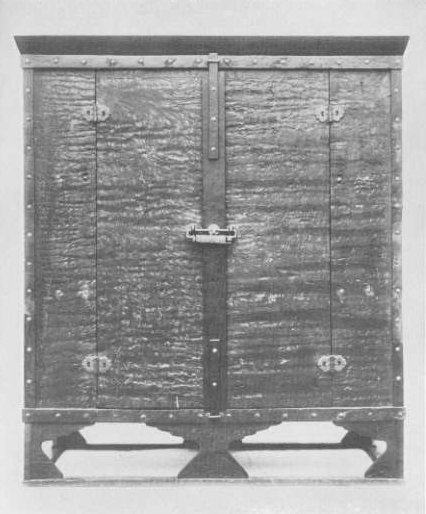
(b) More than a dozen of the large chests in which the treasures were originally kept are covered with dark or dark-brown lacquer and left plain without any decoration. There are also twenty-two hour glass shaped wooden drum bodies lacquered almost black (734). Some of the lacquered hide boxes have plain surfaces (18, 66, 68, 70, 72, 74, 76, 79, 373, 433, 434), etc.
(2) Lacquer decorated with designs by using small particles, or filings, of gold.
This method of decoration was described in the eighth century document as makkinru. An example may be found on the scabbard of the Emperor Shomu's sword (96). Some people believe this to be the earliest example of the lacquer technique known as makiye (sewn design). According to this technique the scabbard was first finished in black lacquer, and when the surface was dry, the design of clouds, birds and animals was drawn on it with fresh lacquer. Before the drawing was dry particles of gold were scattered over it, and allowed to stick to the wet lacquer of the design. The superfluous gold filings were brushed off, and then many coatings of lacquer were applied on top of the whole scabbard, to bury the design in gold, and build up the necessary thickness of the lacquer. Then the surface was ground down and polished with charcoal until the design in gold dust was revealed. (Plate 71.)
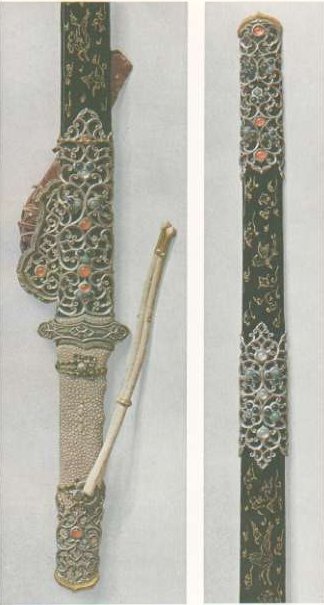
There are specialists who claim that the design on this scabbard was achieved by another method. According to them the design was drawn on the lacquered surface with lacquer mixed with gold filings. The particles of gold were not sewn after the drawing was done, but the drawing was done with lacquer mixed with them. Other coatings were placed over it and then the whole surface was ground and polished as in the other method. A specialist in Tokyo claims that he has obtained the identical result shown on the scabbard in question by this process of work in his studio.
(3) Decorated with gold or silver makiye.
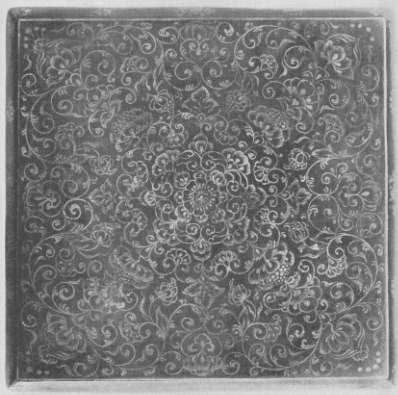
Some specialists are of the opinion that the scabbard was not decorated with makiye, and that there is no example of makiye to be found in the Shoso-in. But there are others who believe the above-mentioned scabbard is a specimen of makiye. There are some who think that a small, squarish, flat box with overlapping lid (447), kept in the Middle Section, is decorated with silver makiye, and covered over with litharge, though the design on this box is generally accepted to be in litharge. (Plate 68.)
(4) Gold and silver inlay described as hyomon in the eighth century document.
As the only specimen of this style of work, we have a lacquered kin profusely inlaid with gold and silver in figures of men and animals, birds and insects, flowers and plants, and lines suggestive of water (99). Some of these designs are wonderfully carved, intricate details of trees and human figures being cut out of a single sheet of gold and inlaid in lacquer. (Plate 56.) There is an inscription on the underside of the kin, the words of which are cut in silver and inlaid in lacquer, and may be rendered as follows:
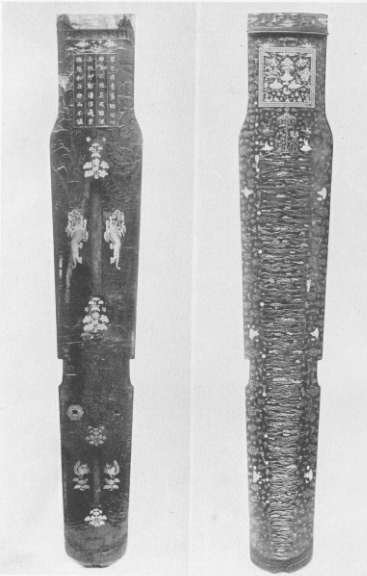
"The music of the kin Cleanses hearts impure. Even though unblemished the nature, Its impression nevertheless is profound.
It holds unto the pure, debars the vulgar, And forbids frivolity. Purified and unrestrained, fraternal and upright, We rejoice, yet ever in moderation."
The kin seems to have been made in different sizes according to the num- ber of strings used. The size common in the T'ang dynasty seems to have been about 1.1 m. long with seven strings similar to the one in question. The paulownia wood kin (a fragment) in the South Section, and the lacquered kin, which is dated the 11th year of K'ai Yuan (724) and is in the Imperial Household collection, though originally of the Horyuji, are both shaped similarly to this and provided also with seven strings. The notes of its music no longer exist, and the manner in which it was played is not precisely known. How ever, it appears to have been played usually on the lap by plucking the strings with the fingers as shown by the inlaid figure on this kin.
(5) Inlay described in the language of the eighth century as heidatsu: (a) gold and silver inlay; (b) silver inlay alone.
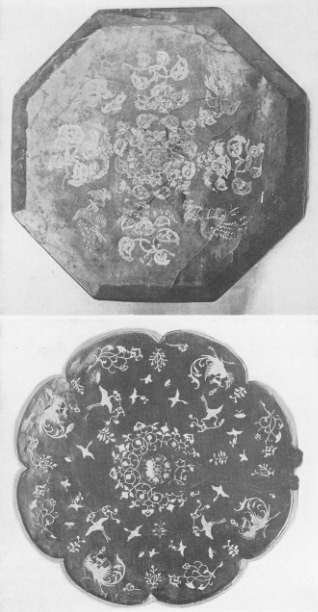
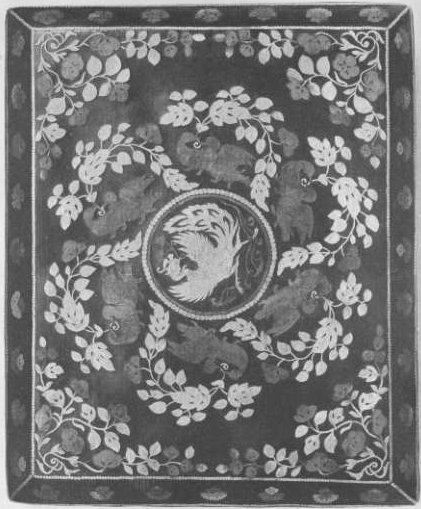
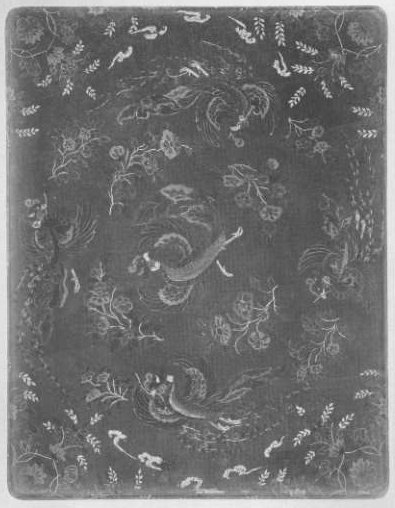
(a) There are two noteworthy specimens: an eight-lobed mirror (77), the back of which is covered with black lacquer and inlaid with gold and silver in birds and floral designs (Plate 54-lower.); a pair of lacquered hide boxes (449) with overlapping lids, decorated with inlay work of figures of phoenixes, water fowl, long-tailed birds and flowers in gold and silver. (Plate 66.)
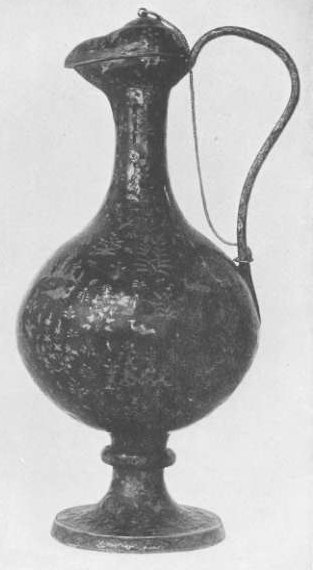
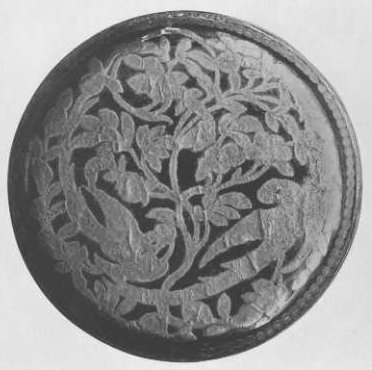
(b) There are a large number of examples of this style, viz., lacquer inlaid with silver. Prominent among them is a ewer with bamboo basket foundation (54), covered first with hempen cloth, lacquered and then inlaid with silver, having flowers, birds and animals as principal motif. (Plate 55.) Among other examples mention may be made of a small round box (101), now containing koto strings, with lid decorated with silver inlay of flowers and birds carrying flowers in their beaks (Plate 69.); four similar boxes to keep go pieces in (133); the base of the sho and wu (seventeen-piped mouth organ), inlaid with flowers and Kalavinka (725, 726); a round mirror box with a design in heidatsu of birds, surrounded by a band of floral patterns and butterflies (70I); an eight-lobed mirror box with lid, decorated with silver heidatsu with figures of phoenixes and floral scrolls further incised (608), and another mirror box with lid (609), round outside but the inside made to contain eight-lobed mirror, decorated with circular patterns of flowers and birds likewise in silver heidatsu.
The last-mentioned two mirror boxes may deserve special mention here. Though it has been customary to designate them as specimens of silver heidatsu, they appear different from others. In these instances the silver in the design is lower, instead of higher, than the surface of the lacquer. It appears as if the silver pieces cut in the required designs were stuck on the lacquered surface of the box and lid, and then many coatings of lacquer applied on the top of the whole. Afterwards, instead of grinding the surface to remove the surplus lacquer and reveal the metal design, as in the usual process, the lacquer was scraped off from the top of the silver by means of a needle like instrument, a process involving extremely tedious, laborious work. The broken edge of the lacquer around the silver and the scratches on it, as well as the sunken condition of the silver, indicates such a process, though it seems almost in credible as this process involves tremendous skill and labour. This specimen deserves further study.
In designating inlay in lacquer, two terms have been used in the Kenmo- tsucho: hyomon and heidatsu. Some argue that they are identical, while others insist on their being different without being able to agree as to the distinction. The kin, the seven stringed lute, is described as being decorated in gold and silver hyomon, and it is the only object remaining in the Shoso-in the decoration of which is described in the Kenmotsucho as hyomon. To be sure, the term hyomon does appear also in connection with decoration on the scabbards of six swords, which no longer exist, three being in gold and silver hyomon and the other three in silver hyomon. However, in the description of the sword furniture, the term heidatsu does not appear and it seems that the term hyomon was used, here at least, so as not to distinguish it from heidatsu. The Kenmotsucho records that twenty scrolls of calligraphs were placed in a box of silver heidatsu and kept in a brocade bag. However, the record of October, 820, when they were disposed of, describes the box as silver hyomon, whether erroneously or otherwise. Probably the terms were interchangeable, though the gold and silver inlay on the kin appears to be much thicker than on the objects described as heidatsu, and the surface of the kin, the design as well as the lacquer, is well polished - a feature not so apparent in other examples in the Repository. Many experts believe that the expressions hyomon and heidatsu were interchangeable, while others maintain that in hyomon the gold and silver surfaces were level with the surface of the lacquer, while in heidatsu the metal pieces projected slightly from the surface of the lacquer. Hei means flat and datsu to protrude; hyo means flat and mon design. In the case of hyomon extra coatings of lacquer over the metal inlay were polished off, whereas in heidatsu thin pieces of silver were stuck on the surface of the lacquer while it was still wet, without any further coating or polishing. The inlay designated as hyomon in the Shoso-in seems to be of a better class of work than that called heidatsu.
(6) Inlay: (a) with mother of-pearl, amber, particles of malachite; (b) with mother-of-pearl, set with rock crystals.
(a) Eight of the mirrors (six in the North Section and two in the South Section) have their backs covered with thick lacquer and inlaid with mother-of pearl in floral and bird designs set with amber, the intervening spaces being filled with particles of malachite, etc. The inlay of mother of-pearl is known as raten or raden. (Plate 70.)
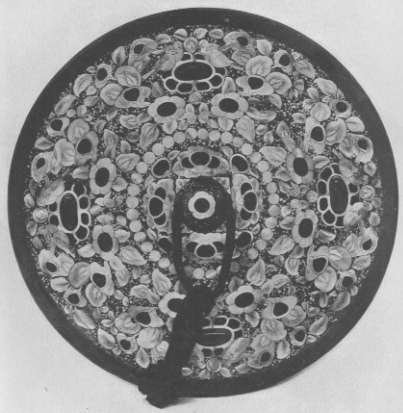
(b) A lacquered box with lid inlaid with mother-of-pearl in figures of birds in flight, conventional cloud forms and flowering plants, the hearts of flowers being set with semi-spherical rock crystals over colour (415).
(7) Decorated (a) with litharge; (b) with cut gold in addition.
Litharge contains oxide of lead and resembles oil paint. This was extensively used to decorate the surface of lacquer ware. It was a convenient medium at that time when coloured lacquer was very scarce, if not nonexistent in Japan. There are scores of sticks, or rollers, to wind sutras round, and one or two of them have their tips covered with red which appears to be lacquer, though its age is somewhat questionable. Other than that there is no evidence of any coloured lacquer in the Shoso-in collection, if what we accept to be litharge is not erroneous.
(a) A number of lacquered boxes are decorated with litharge painting: one with conventional floral design (451); another with strange birds and dolphin-heads, both using yellow, red and green (453). There are also seventeen round shallow bowls of wood, the insides of which are covered with white litharge and decorated with paintings in yellow litharge; their undersides are lacquered black and decorated with paintings in red litharge. Some of the boxes with litharge decoration have a dull surface, while others retain a shining finish. The latter may have been coated with transparent lacquer or litharge, while the former were left without such coating. (Plate 53.)
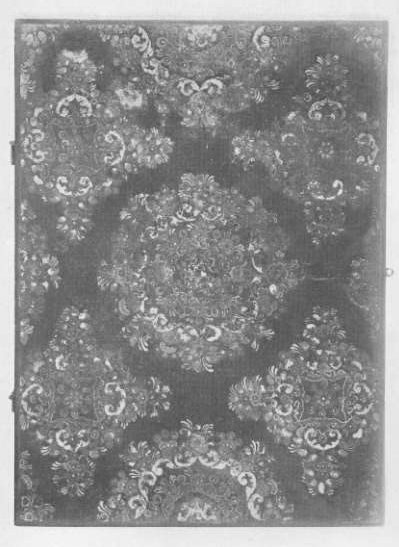
(b) There is a lacquered box in the Middle Section decorated with litharge painting of flowers and birds, clouds and butterflies. In addition cut-gold was applied for the stems and leaves of the plants. (Plate 67.)
(8) Decorated with lacquer painting (?).
Some of the paintings on lacquered surfaces which are generally accepted as those of litharge are questioned by some people, who are inclined to believe them to be of coloured lacquer. This requires further investigation.
(9) Decorated with gold and silver painting.
An excellent specimen of this type of work is the mirror box, octagonal in shape, in the North Section (82). The motif of the decoration is flowers and birds carrying sprays in their beaks. The parts painted with silver have a blurred effect on the lacquer, apparently the result of chemical action that must have taken place by combining silver with lacquer. (Plate 54-upper.) There is also another mirror box in the South Section. The lid of that box is decorated with gold and silver in flowers and birds on the obverse and a landscape on the reverse (6I2). There is still another mirror box (616) and also tips of four rollers for scrolls (380), decorated with flowers and birds painted in gold and silver.
Furthermore, there are four lacquered wooden panels (792) and another panel (770) of zushi decorated with paintings in gold and silver of Buddhistic figures, landscapes, flowers and birds. Gold, however, is almost all gone and silver tarnished and very much obliterated without showing any blur on the lacquer - the peculiar effect referred to above. Though there remain only slight traces of gold, the lines of the design are visible on the lacquer in parts.
Gold and silver powder, when used in painting, seems to have been mixed with glue, litharge or lacquer. Judging from the artifacts, glue seems to have been utilized mostly, if not exclusively. Questionable in this respect are the writings on two ivory tablets: one accompanying the Zensenko Incense Wood (207) in the North Section, the other (383) in the Middle Section belonging to the sutra kept by the Empress Gensho.
(10) Lacquered surface decorated with colour mixed with glue.
A great number of the gigaku masks in the collection are of wood, covered first with hempen cloth, then lacquered and decorated with colour, though most of the colour is now lost (Plate 45.). In the South Section there are twenty-nine flower-shaped lacquered tables (757) of wood in pierced work, the petals being hollowed out. Five of these tables, with borders of the petals in cut-gold, have their underside painted in colours in floral motif. Some claim these colours to be in litharge. Colour mixed with glue does not adhere firmly to the lacquered surface, so in order to preserve the design the whole surface was often treated with colourless litharge. Even then such a decora- tion was not very lasting as shown by a number of objects in the collection.
(11) Lacquered surface first covered with gold-leaf and then painted over.
A superb example of this technique is a pair of lotus-flower pedestals for trays for burning incense (636). Each pedestal has thirty-two petals arranged in four tiers, and each petal is richly decorated with flowers, birds and angelic figures painted in colours, and in many instances on gold-leaf, which covers the lacquer foundation on the wooden petal. A similar technique has been commonly used on Buddhist images of subsequent periods.
(12) Decorated with gold painting and then coated over with lacquer, showing the gold in the design through the translucent lacquer.
This is an interesting technique still practiced in modern times, though gold leaf is generally used for the design instead of gold paint. Only by con stant use may the top lacquer coating be worn off, revealing bright gold un- derneath. There is an example of this on the panels (771) of a portable shrine in the South Section. Though most of the designs are obliterated, one panel still retains the figure of a Buddhist deity standing. A similar technique is employed on one of the mirror boxes in the South Section, the motif of decoration being flowers (699). The gold appears rather dull under the lacquer on this box.
(13) Dry lacquer.
There are in the Shoso-in 164 gigaku masks, of which thirty three are in dry lacquer; that is, the masks were made of lacquer applied on hempen cloth. Two or three small boxes with lids are also made in this manner (447).
(14) Lacquered hide.
There are quite a large number of boxes which are made of cowhide, a sheet of it being softened and pressed into the required form, and then cover ed with hempen cloth and lacquer when dry and hard. Some of them are left plain, like boxes for kesa with overlapping lids; some are inlaid with gold and silver like a pair of boxes with lids, decorated with a design of phoenixes and flowers (Plate 66.); and some are decorated with gold and silver painting, like a mirror case in the North Section with silver lines blurred with lacquer. (Plate 45-lower.) There is also a hide mirror-box (608) in the South Section decorated with silver heidatsu.
So far I have spoken of the varieties of technique by which lacquer was used to cover the whole surface of the object. However, lacquer was used in other ways as well, viz.,
(15) Lacquer used as a medium for drawing designs, or for writing words, on some material not lacquered.
The minute drawing of musicians, dancers, singers, acrobats, jugglers, onlookers, etc. on the dankyu, or bow to shoot a ball instead of an arrow (480), kept in the Middle Section, is believed to have been done with lacquer. The names of persons on some of the dedication tags also are apparently written with lacquer (386). It may be that the drawing and writing were done with sumi mixed with glue, thus giving an appearance of lacquer. (Plate 61.)
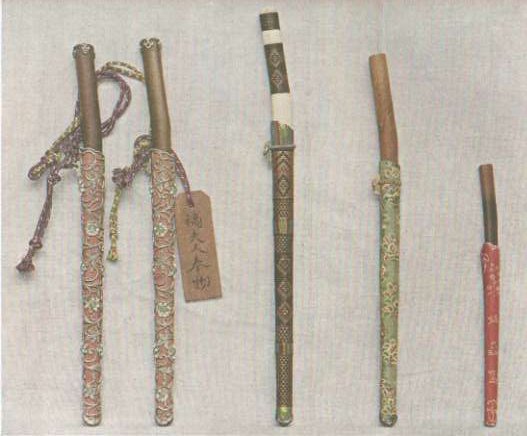
(16) Lacquer used to glue things together.
Lacquer has a strong adhesive power, and it has been used on some objects for gluing different parts together or for filling in lines or dots, such as graduating marks on measuring sticks, and dots on dice. It was also used in sticking gold-leaf, cut in small strips, on different objects to form designs, this technique being now known as cut-gold, orkiri-kane. It has been customary to use a sharp bamboo knife in cutting the gold-leaf involving skill difficult to acquire. Nowadays the blade of a safety razor has come to the rescue, though the difficulty in applying the gold-leaf leaf strips still remains extremely great.
It was only recently thathearned that lacquer is used in mending cast-iron kettles for boiling water. There is frequent necessity for this work in Japan, for in ceremonial tea old hot-water kettles often require new bottoms. When lacquer is mixed with iron filings and used on iron, it becomes as hard as iron itself and can withstand fire. Of course, lacquer is a convenient medium for mending ceramic tea- bowls and other costly utensils in cha-no-yu.
The technique involved in the use of lacquer as shown by the Shoso-in treasures reveals at least the sixteen different ways I have just enumerated. There may be others outside our knowledge, for the study of these treasures is far from being exhaustive. By these treasures we may see that the artists and artisans of twelve hundred years ago showed wonderful skill in their work and extreme resourcefulness in devising means of achieving the desired end.
Before closing my remarks I may mention that there was also a different kind of lacquer known, though very seldom used.
According to the description used in the original memorandum of dedication, there seems to have existed a special kind of lacquer called "kin-shitsu" (gold lacquer). The bronze socket of a pocket file and that of a pocket plane in the shape of a spear, both found among a cluster of knives, are described as being covered with "gold lacquer." It is believed to have been made from the sap of a different species of tree called "gold-lacquer tree" (kinshitsuju). This kind of lacquer is mentioned in connection with the sword furniture on no less than twenty-six out of a hundred swords enumerated in the original memorandum of dedication in the Shoso-in. It was principally used on bronze, though it was also put on gold and silver for some purpose or other. The bronze socket of the file, the only existing example covered with this particular kind of lacquer, now appears almost black.
The important role which lacquer played in the art and craft of the eighth century may be gathered from the fact that out of 644 items recorded in the "Catalogue of the Treasures in the Imperial Repository, Shoso-in," no less than 150 are treated, either wholly or in part, with lacquer. The high state of development then attained in lacquer art may be seen on some of the splendid examples of art preserved in that Imperial collection.
Thus lacquer played an important part among the treasures of the Shoso- in. Not only do the art treasures in this unique Imperial collection, but the works of art produced in the eighth and subsequent centuries in the history of Japan also show how well the people of Japan have utilized this worthy but mysterious material peculiar to the Far East - this mysterious material that dries in moisture, is weak in its liquid form, but strong and durable when once hardened.
NOTES ON PLATES
Plate 65. Tamamushi no Zushi. A portable shrine; of wood, lacquered and decorated with paintings and pierced metal work over iridescent beetle-wings. "National Treasure" owned by the Horyuji monastery.
Plate 66. 66. Lacquered Hide Box. Decorated with gold and silver heidatsu in the design of flowers and birds. Top of lid. (449) Middle Section of the Shoso-in.
Plate 67. Box with Lid. Lacquered dark-brown, decorated with litharge painting in a design of flowers, birds, clouds and butterflies. Cut-gold is used for the leaves and stems in the design. (452) Middle Section of the Shoso-in.
Plate 68. Lacquered Box with I Hemp-Cloth Foundation. Decorated al] over the outside with conventional floral design in fine lines painted in litharge, or decorated in makiye. (447) Middle Section of the Shoso-in.
Plate 69. Lacquered Box with Lid. Of wood, lacquered and inlaid with a silver design of birds and floral scrolls: an example of gin heidatsu. (101) North Section of the Shoso-in.
Plate 70. Bronze Mirror. With back lacquered and inlaid with mother-of-pearl and set with amber. Amber evidently turned dark with age, for there is colour underneath it which must have shown through at first. (80) North Section of the Shoso-in.
Plate 71. Emperor Shomu's Sword. The scabbard is lacquered and decorated with a design of clouds, birds and animals in gold filings. (96) North Section of the Shoso-in.
Reproduced in colour.
Plate 72. Halo. Thick lacquer on wood. The design of phoenix, clouds and flowers in relief, as well as the ground, are in lacquer. VIII century. Horyuji monastery.
Plate 73. The Vairocana Buddha. Dry lacquer. Main deity of the Kondo of the Tosho-daiji. VIII century. "National Treasure" owned by the Toshodaiji temple.
Plate 74. Nyoirin Kwannon (or Miroku Bosatsu). Thick lacquer Oil wood. "National Treasure" owned by the Koryuji temple, Kyoto. VII century.
Plate 75. Ashura-O. One of the group of eight deities called Hachibu shut Dry lacquer. VIII century. "National Treasure" owned by the kofukuji temple, Nara.
Plate 76. Portrait Statue of Ganjin Kasho (or Wajo). A blind priest seated. Dry lacquer. VIII century. "National Treasure" owned by the Toshodaiji temple, Nara.
Plate 77. Furuna Sonja. One of the ten great disciples of Shakamuni. Dry lacquer. VIII century. "National Treasure" owned by the Kofukuji temple, Nara.
Plate 78. Painted Basket. Excavated from a tomb in Lo lang, a Chinese Han colony in Chosen (Korea) from 108 B.C. to 313 A.D. Government Museum at Keijo, Chosen.
(Treasures of the Shoso-in by the courtesy of the Imperial Household Museum.)