

IV. JAPANESE ARCHITECTURE
Delivered at the Seattle Art Museum
It was inevitable that the art of the country should be greatly influenced by geographical and climatic conditions, by the ethnic characteristics of the people, and by the institutions and forms of religion that existed in different periods of our history. It is necessary, therefore, to know something of these conditions in order to understand the art of Japan. However, without going into details permit me to note here merely that these peculiarities are somewhat differently expressed in different forms of art. We shall briefly deal now with some of the distinctive features to be observed in our architecture.
Arches are conspicuous in Japanese architecture by their total absence. Japanese architecture is based on the lintel or trabeated system, which throws the structural weight on pillars, the walls serving mainly as enclosures and part)' tions. This enables us to make large openings or windows without materially weakening the structure. The main building material is wood, there being an abundant supply of such excellent timber as hinoki (chamaecyparis obtuse), sawara (chamaecyparis pisifera), tsuga (hemlock), sugi (cryptomeria), matsu (pine), and keyaki (zelkowa serrate) in Japan. Some of this wood still remains in excellent condition even on buildings which are 1200-1300 years old, as may be seen at Horyuji where the Monastery built at the beginning of the seventh century is still standing intact. Statistics show that even now the greater part of the entire area of Japan is covered with forests, and there is reason to believe that the country was almost entirely covered with primeval forests at the dawn of our history. It was natural, therefore, for the inhabitants to build with wood. In an earthquake country like Japan this timber supply was a great boon, for no other material could have so minimized the danger resulting from earthquakes. This abundance of timber supply and the national characteristics of cleanliness and simplicity have determined or at least guided the general trend of Japanese architecture.
The chief beauty of Japanese houses may be said to be in their roofs, which present a pleasing combination of straight and curved lines. The roof indeed plays a very important part in Japanese architecture. There are to be found the following four general types of roof: (1) kiri-zuma (gabled roof); (2) shichu, yose-mune or azumaya (tripped roof, in which the roof slopes in four directions from the ridge-pole without forming gables); (3) irimoya (a roof consisting of two sections: the upper with gables as in the kirizuma and the lower with surfaces sloping all around the building as in the shichu), and (4) hogyo (a roof sloping primarily in four directions, though sometimes more, from a vertex without the ridge pole; a pyramidal roof). These roofs are covered with thatch (straw or reeds), shingles, sheet-bronze, the bark of hinoki, or tiles, according to the nature of the building to be roofed. Generally speaking, thatch or thatch-and-tile combined is used for farmhouses, shingles for cha-seki (structures containing a room for cha-no-yu, or ceremonial tea) wherever city ordinances permit, sheet-bronze bronze and bark of hinoki for palaces and shrines, and tiles for temples and ordinary dwelling-houses. houses. The beauty of these roofs is found mainly in their pleasing proportions, in the combination of roofs of varying size, in the curves on their surface called teri (suggesting a sheen) and in those on the eaves line called sori (or curvature). These curves show Chinese influence but greatly modified, being much more subtle and refined than their prototypes.
Some of the roofs, especially those of tile on temple buildings, are made extraordinarily heavy with piles of absorbent tiles and a quantity of mud used underneath the tiles on the roof to keep them in place. Usually the whole structure rests on comparatively meagre foundation stones, the building being held down by the weight of the roof. Such a roof helps the building to resist the wind but it becomes a destructive force during great earthquake shocks. Many buildings were crushed by the weight of the heavy roof in the great catastrophe of 1923 in Tokyo and vicinity. The structural weakness is to be found also in the lack of sufficient connection between the roof and the substructure.
Projecting eaves are another feature of Japanese houses. They add grace to the roof and give a sense of stability to the house. Not only from an artistic standpoint, but also from necessity have these eaves been favoured. Such eaves are necessary to protect a house against heat and rain, and to allow it to be kept open on rainy days. Furthermore, in our latitude low eaves do not prevent the sun from shining into the house in the winter. We should not overlook the inspiring quality of the eaves line of Japanese buildings. I have often stood in front of large temples, fascinated by the beauty of simplicity in their eaves lines. I have often admired the eaves line of the Nishi Hongwanji temple in Kyoto. Though its line is broken by the projection of the middle section, you can feel the continuity of the line by standing at a certain distance in front of it and be thrilled by its grace and beauty. I have often been deeply impressed by the line of the upper roof of the Higashi Hongwanji. Often have I been inspired by the noble qualities of the eaves line of the Higashi Betsuin of Nagoya. Indeed, wonderful is the eaves line of the massive roof of Japanese buildings. It looks straight, yet not rigid; it seems to slack almost imperceptibly on either side from the middle, yet it does not lose its strength and vitality. It turns slightly upward at either end in exquisite grace. The subtlety of the curvature seems to infuse spiritual life into the line It possesses a quality somewhat akin to the grand sweep of the majestic curve in the contour of mighty Mt. Fuji as it rises to its noble height from the Bay of Suruga. Both lines seem alive with spiritual life. I often think that the greatest triumph of Japanese architecture is in the subtle beauty and inspiring simplicity of its eaves line.
Another special feature in Japanese architecture may be found in certain structural details, namely: the masu and hijiki, brackets for supporting the eaves, the use of which is now practically confined to religious edifices. This peculiar form of bracketing was originally imported from China and used as a structural element above the pillars and beams, but it has been modified to serve mainly as a decorative detail.
Another peculiarity may be found in the colouring. Primarily Japanese buildings were not painted; the wood was left plain, as the natural colours of different species harmonized beautifully. And the colouring on Buddhist temples, which still retain traces of Chinese influence, became much more subdued in tone. The Japanese people have a special admiration for the netural grain of a wood, its texture and colour. They delight in the exquisite finish of woodwork. Carpenters work like skilled joiners in building houses, exercising great care and skill in planing the boards for the ceiling, for instance. Often an expert planer will spend a whole day working on a few boards only six feet long and one and one half feet wide, to give that exquisitely soft sheen to the surface which comes merely from planning. No one would ever think of defiling such a surface with paint. Paint is considered useful chiefly to cover up inferior wood or hide defects in workmanship. Of course, nowadays, it is commonly used on the foreign-style buildings which are rapidly growing in popularity.
The above-mentioned mentioned traditional attitude toward the plain surface of wood is a manifestation of the love of nature so strong in the Japanese. It reveals a phase of our national characteristics, which is the keynote in our architectural system. Perhaps it would be well to elaborate this point a little further. The cleanliness of our people, which we have already mentioned, cannot be over emphasized notwithstanding many evidences to the contrary. It is the essence of Shinto, the indigenous cult or religion of Japan in which uncleanliness was considered a sin against the gods. Even a common labourer cannot enjoy his night's rest without his daily bath, which is easily accessible to every one, in cities as well as in rural districts. Love of nature and cleanliness, combined with a refined taste for subtle beauty, are evident in all the phases of Japanese architecture. The people are fond of the pale green of the tatami (wadded mats covering the floor); the texture of the natural wood in pillars and beams; the subdued colours of the plastered walls - generally of fine sand - which absorb rather than reflect light; the elegant designs on the sliding screens (fusuma); and the beautiful grain of the wood with its soft sheen in the ceiling. All these, mellowed by the light passing through the white paper sliding screens (shoji), create an exquisite atmosphere. The people have a subtle and delicate taste, refined and subdued, rather than coarse and glaring, and this has its bearing on their architecture. They are of light and joyous nature, rather than serious and vigorous. Their innate taste may be summed up in the word shibumi, which is difficult to translate, but its meaning may be suggested by saying that it stands for quiet, delicate, refined taste, the beauty that does not show on the surface, austerity in art without severity, and that it is opposed to anything which is gaudy, crude or ostentatious. It is a trig subject by itself, but let us dismiss it by saying that without shibumi, according to our ideas, no art can be worth while, no person worth knowing, no furniture worth having, and no house worth inhabiting.
The strong love cherished by Japanese people for the fine grain of woods is greatly in evidence in Japanese houses, the different kinds of grain being carefully considered in relation to their use. Practically all the ceilings of Japanese rooms are of boards generally from a foot to a foot and a half wide and six feet and infinite care is expended on the choice of these boards. The ceiling of one room should be a consistent whole so far as the species of the tree and the character of the grain are concerned. Wherever possible we try to use boards sawed from the same tree for each room. The ceiling of one room should differ from that of another so that there may be variation in the house. It would be quite a revelation to many of you to see the variation in the cha-seki, or room for ceremonial tea, secured by the use of different materials and of varying sizes, colours and textures, and to sense the pleasing harmony of it all in a room.
Cha-seki architecture was developed along its own special lines. Great teamasters and connoisseurs of art combined their efforts in establishing a standard of their own. sukiya-bushin, as cha-seki architecture is called, has fostered the creation of specialists, differing from the carpenters who build dwelling houses. Cha-seki are built more or less in the fashion of a cabinet, every piece being carefully fitted and exquisitely finished. The materials, as well as the size and proportion of the walls and windows, have all been studied by masters, the standard adopted by different schools varying slightly, but being essentially similar. Usually the ceiling of the cha-seki is treated in three different styles: shin (formal), gyo (less formal), and so (informal). That is, the middle of the ceiling or that part over the mats reserved for "noble persons" on special occasions, is generally in the shin style with a level ceiling supported by wooden sashes of planed or natural surface. That part of the ceiling over the place where ordinary guests are to be seated is usually less formal, being slanting and covered with boards of uneven width held firm by sashes of bamboo. The ceiling over the mat where the host prepares tea is in abbreviated style, usually being covered with a rush matting held in place by smoked bamboo. Materials of different texture are used in the construction; windows are of varying size and at different elevations with bamboo or rush lattice work and paper-covered sliding screens. All this is intended to produce in the mind of the occupant a sense of harmony conducive to peace and meditation. The room is almost invariably provided with a crawling-in entrance, an opening of less than two and a half feet square. In entering, each guest should leave behind him his worldly rank and pride, for within the room all are equals. Bare mud walls of subdued tone and fragile materials, essentially in their natural form, afford a comfortable shelter without giving the sense of being shut within close walls. Seated in the room, one may enjoy the rustling of the tree leaves and the sound of the running water in the garden. Though sitting within the house, one may commune with Nature outside. The structure, which is full of that quality known as wabi or shibumi, symbolizes in a way the human body, the temporal habitation of the soul, thus assisting us to see ourselves in right relation to the Infinite.
The religious ideas of the people have, of course, been a great factor in influencing the trend of Japanese architecture. Shintoism, the indigenous faith based on nature and ancestor worship, and Buddhism, which was imported from Korea and China, both have gone far in shaping and developing Japanese architecture, the former insisting on simplicity and the latter showing a tendency to the ornate. These two opposing elements have been struggling against each other. The result seems to prove the strength of the innate taste for simplicity as shown by the fact that some of the Shinto shrines still retain their original simplicity, while Buddhist temples show marked traces of having been simplified in many respects. Simplicity is the keynote of Japanese dwelling-houses.
One outstanding feature which should be noted in Japanese architecture is the existence of a convenient unit - kern - which equals about six feet and serves as the basis or unit of measurement. Some scholars trace the origin of the ken to the beginning of the eighth century when the capital of the empire was established at Nara with perfectly regular streets parallel and at right an ales like the lines on a checker board However that may be, it is clear that early in the history a ken or ma designated the distance between two pillars in a building, though the distance varied, the word ken being used in ancient times in designating the length of an edifice, men the depth. But with various modifications, ken came to represent a fixed measurement in the second half of the fifteenth century, when tatami (wadded mats) came into common use.
Strictly speaking there are four regulation sizes of the tatami with slight variations: length 7 ft., width 3.5 ft., thickness 4 inches for rooms in a palace; length 6.6ft., width 3.3ft., thickness 2 1/4 inches for the "Koya-ma" (of the Koyasan monastery); length, 6.3ft., width 3.15ft., thickness 2 1/3 inches for "Kyoma" (rooms of Kyoto houses), and length 5.8 ft., width 2.9 ft., thickness 1 7/8 inches for "Edo-ma" (rooms in Tokyo houses). But commonly for dwelling' houses either the "Kyo-ma" or "Edo-ma" size is used, generally speaking the "Kyo-ma" size prevailing in the western part of Japan, and the "Edo-ma" size in the eastern part. The difference in the two standards arises chiefly from the fact that the ken unit is applied in the former to the distance between the pillars, while in the latter the measurement is taken from the centre of the pillars. In fact, in the "Kyo-ma" the size of the tatami is fixed and uniform and the rooms are built to accommodate an exact number of mats, the mats thus being interchangeable with those of other rooms, while in the "Edo-ma" the tatami are made to fit each particular room exactly, there being a very slight variation in dimensions, but each measuring about 6 ft. by 3 ft., roughly speaking.
The size of a room in Japanese houses is expressed by the number of mats covering its floor space completely, the common sizes of rooms requiring 4 1/2, (6, 8, 10, 12, 12 1/2, and 15 mats, respectively. Two mats laid alongside, forming a 6-ft. square, is one tsubo, which is the unit of measurement for surfaces.
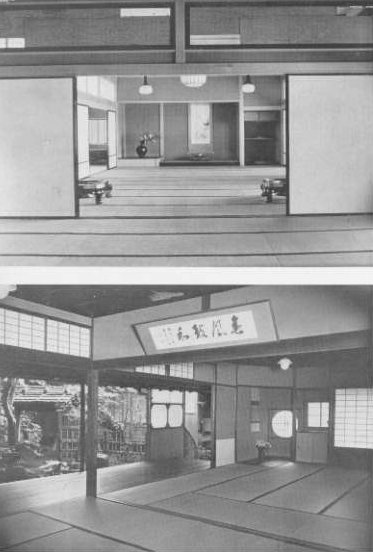
The tokonoma (a recess in the main room for paintings and other ornaments) is an important feature in the house, and may be regarded as the most striking peculiarity in the interior of a Japanese home. Without going into details, a few salient points may be mentioned. It is generally 1 or 1.5 ken (6 or 9 ft.) in length and one-half or a quarter of a ken (3 or 1.5 ft.) in depth in ordinary sized rooms. It is the place of honour, and the matting in front of it is always reserved for guests. Adjoining it is usually another recess called the toko-waki (tokonoma-size) with shelves of uneven length on different levels, and small cupboards with sliding doors; and the pillar dividing the two recesses or alcoves, called tokobashira, is the most important pillar in the house.
Gardens are almost an integral part of a Japanese house, since no home is complete without a garden of some sort. This feature - the close and harmonious relation existing between the house and the garden - may offer some suggestions to those in the West who are interested in the problem of dwelling-houses. For many centuries the Japanese house has been developed as a necessary part of the garden wherever the premises were large enough. A stone water-basin installed close to the house serves as an ornament in the garden and can be used from the verandah for washing one's hands. There is generally a short fence known as a "sleeve fence" built out from the house a few feet into the garden, partly as an ornament and partly to obstruct the view of an other part from the verandah. This too serves to connect the house with the garden. Large natural stones are placed close to the verandah to be used as steps leading into the garden and these are followed by a number of smaller stepping stones. All these kind the house close to the garden, forming the two into an inseparable whole. Some trees should be planted close enough to the house to allow their shadows to be silhouetted on the paper sliding screens in the house. By pushing these screens to one side, or removing them altogether, the entire room is thrown open to the garden, thus satisfying the strong desire of the people living in these houses to be close to nature even when in the house.
The use of sliding screens and sliding doors is another feature of a Japanese house. Solid walls are comparatively few; wherever possible sliding screens are employed, between two posts. This enables one to throw the house open into one large room when occasion requires the accommodation of large crowds of people at one time. (Plate 42.)
The genkan, or front entrance, is another feature of the Japanese house. It generally provides for a sheltered extension, into which vehicles may be drawn. It is convenient to have such a protection because of the necessity of removing shoes or whatever footgear one may be wearing before entering the house, a custom still followed very closely in most of the homes. The custom of kneeling on the floor, and the habit of cleanliness of the people further support the custom of barring the outside dirt which is carried into a house with footgear. The genkan is a decorative adjunct to the house; it gives dignity and an artistic touch where these are most needed. At one time during the feudal regime the genkan was thought to be too extravagant for the dwelling' houses of the common people and its construction was prohibited. But such a law was in force only for a short time, and this feature was developed as an integral part of the Japanese dwelling-house.
Generally speaking, Japanese buildings are not on a large scale as units, though in some instances they assume immensity collectively. Japanese arch)' lecture is not generally considered to constitute a basis for or the consumma- tion of all branches of art. The reasons for building on a small scale are to be found in the following considerations:
(a) The people live on small islands.
(b) Immense structures seem not quite in harmony with the charming, graceful landscape in which they are to be set.
(c) Limitation comes also from the building material, which is mainly wood.
(d) The custom of sitting on the floor has placed certain restrictions on dress, furniture and architecture.
(e) Among the reasons which hindered building on a large scale may be mentioned the custom of changing the Imperial Court in ancient times at the death of each emperor, of constructing a separate building for the dead, the restrictions placed on the dwelling-houses of the common people to differentiate them from Imperial palaces, the simplicity of dwelling-houses houses favoured by the samurai later in our history, and all sorts of restrictions placed on buildings at different periods of our history in order to save the people from extravagance.
(f) Constant earthquakes acted as a warning against anything permanent, though earlier in our history when the centre of Japanese culture. was in Kinai, a region seldom visited by earthquakes, this may not have been the case. But it may be said that on account of earthquakes stones are often found broken before they are quarried, and it is difficult for the people to obtain them in large sizes. Small houses were preferred in order to avert any possible danger that might be caused by the upheavals.
Now let us turn to the historical side. The history of Japanese architecture is often divided into seven periods, somewhat different from the ordinary division applied to other branches of art, such as painting and sculpture. They are as follows:
I. The pre-Buddhistic period, extending down to the official introduction into Japan of Buddhism in 552 A.D., when primitive houses were gradually developed without being subjected to foreign influence.
II. The first period of Chinese influence, extending from the introduction of Buddhism to the rise of the Fujiwara clan; that is, from the middle of the sixth to the end of the ninth century.
III. The period of first nationalization, lasting through the late Heian period, or from the end of the ninth to the end of the twelfth century.
IV. The second period of Chinese influence, which lasted through the Kamakura and Muromachi periods; that is, from the end of the twelfth to the second half of the sixteenth century.
V. The period of second nationalization, which lasted through the Momoyama and Edo periods; that is, from the second half of the sixteenth to the second half of the nineteenth century.
VI. The period of European influence, including the Meiji and Taisho eras; that is, from the second half of the nineteenth to the first quarter of the twentieth century.
VII. The present period, starting from 1927. While there are indications of a period of third nationalization in many branches of art, architecture may be considered to be in a period of assimilation, emerging out of that of imitation.
Without going into details, a very brief historical survey follows, in form and substance essentially the same as I have given in my book entitled, "The Lesson of Japanese Architecture":
I. Pre-Buddhistic Period
In primitive ages the Japanese race lived in caves and pits, mostly in the latter, but when they were sufficiently advanced to build houses they built wooden huts of the simplest kind which developed the most primitive type of building known as tenchi-kongen-miyazukuri. It consisted of two posts set in the ground supporting at the top a ridge-pole, to each end of which were fastened two rafters sloping to the ground. To these rafters a number of beams were tied horizontally to support a thatch which served for roof as well as walls. Later this whole structure was elevated by introducing walls on four sides and a raised floor - a simple type of house with gabled roof.
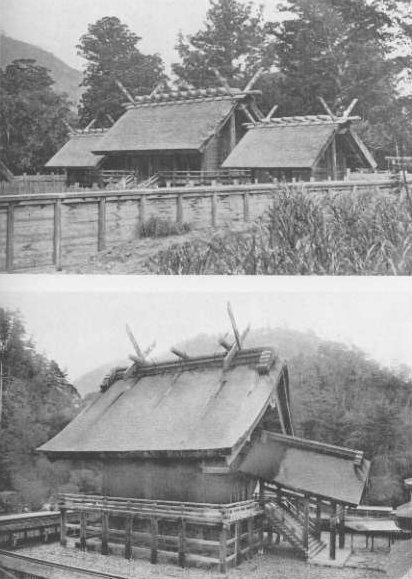
It was natural that this form of house construction should be adopted first for shrines, for they were to be the living houses for the spirits of the dead, for whom an offering of food was made. This oldest type of shrine is known as Taisha, or O-yashiro, and is still preserved in the shrine at Izumo by the reproduction of the original type whenever the shrine is rebuilt. This was later modified and slightly differentiated from living-houses, forming a special type for shrines, and thus the types known as Otori and Sumiyoshi, and still later Shimmei, came into existence. The Otori type may be seen in the shrine at Otori; the Sumiyoshi type is still perpetuated in the Sumiyoshi shrine near Osaka; the Shimmei type finds its perfect prototype in the Imperial Shrines at Ise which are rebuilt every twenty years exactly in the same style, faithful to the minutest detail. These are the four early types of Shinto architecture, which reproduced in a large measure the Imperial palaces of the time. We know that they differed somewhat from ordinary dwelling-houses, for documents show that the common people were forbidden to use certain decorations on the roof known as chigi (the horn-like projection of timbers at each gable-end) and katsuogi (a row of weight-blocks of wood placed on the ridge at right angles to it) in the reign of the Emperor Yuryaku (455-479 A.D.). Practically all the shrines retain these peculiarities on the roof. (Plate 30.)
The of Korea by the Empress Jingu Kogo, presumably in the third century A.D., resulted in intimate communication with the peninsular kingdom, which doubtless influenced Japanese architecture. It is recorded that one of the Korean kings presented to the Japanese Emperor five kinds of pigments which are supposed to have been used for colouring buildings. It is also recorded that the Emperor Nintoku (313-399) deprived himself of palace decorations at the time of a famine during his reign, and that he ascended a "lofty structure" to see the smoke issuing from the houses of his people. A "lofty structure" is referred to also in connection with the reign of the two succeeding Emperors. It may be gathered from this that the palaces at that time were no longer of the simplest form. However, the progress of: palace architecture was greatly retarded by the custom which then existed of changing the seat of the Imperial Court at the death of each Emperor. This was not at all conducive to establishing any elaborate or substantial style of building. Real progress did not come, therefore, until this custom was abandoned with the establishment of the Court at Nara in 710, where it remained until it was removed to Nagaoka in Yamashiro province to remain there for ten years and then again removed to Kyoto in 894; here the capital of the empire remained almost eleven centuries until it was finally removed to Yedo, now called Tokyo, in 1868.
II First Period of Chinese Influence
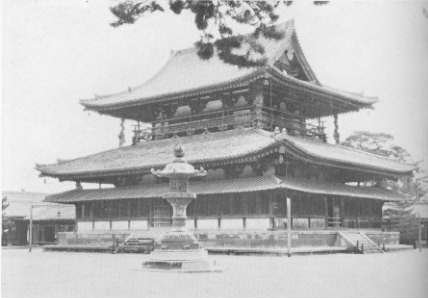
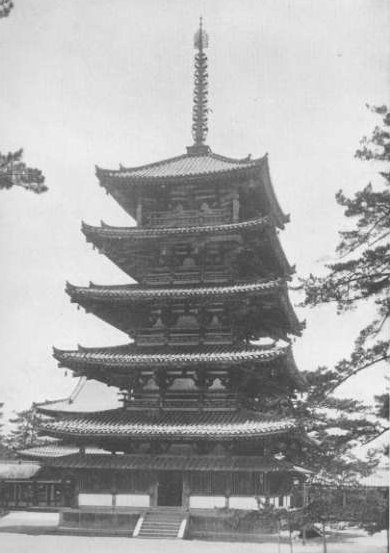
A great change came over architecture, as well as other branches of art with the official introduction of Buddhism into Japan in 552 from Korea. A large number of temple builders, painters, tile-makers and other artisans from Korea Korea in 588. Temples were built on a grand scale under the leadership of Prince Shotoku, who is worshipped in Japan as the patron-saint of art and culture. Such temples as the Hokyoji (later called Gangoji), the Shitennoji, Hokiji, Horinji and Horyuji were established. The last mentioned was completed in 607 and still preserves some of the original buildings - the Kondo (the main sanctuary), the five-storied pagoda, the middle gatehouse, and a part of the corridor. Nothing remains of the original Hokyoji building, or of the Shitennoji; but the Hokiji and Horinji each still retains an original three-storied pagoda. What remains of these temples to this day eloquently speaks of the grandeur of scale and the magnificence of the buildings. Though constructed by the aid of Koreans, these buildings show the influence of the Six Dynasties of China, with pillars with entasis and arms in the cloud design (kumo-hijiki) on the brackets supporting the eaves and masu over the pillars. Though we have no specimen left of the living-houses of the common people of the time, these it may be supposed cannot have been changed very much by foreign influence. The residences of the aristocrats are the ones that were most affected. Naturally, of course, immigrants from the continent would have built their dwellings in their native style. (Plates 31, 32.)
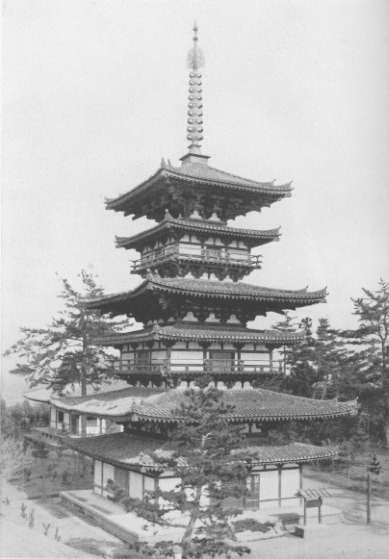
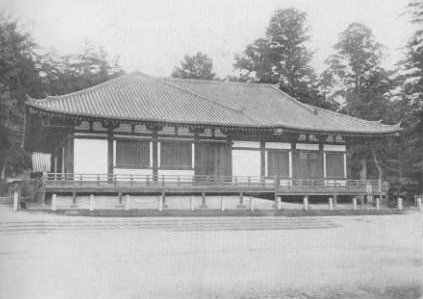
In the Nara period (645-781) the influence of the T`ang culture was irresistible. The capital was laid out on a magnificent scale after the Chinese plan; the Imperial palace buildings had roofs of green-glazed tiles and pillars painted red. No less than twenty of the original buildings of the eighth century are standing to-day, chief among them being the West Kondo of the Kairyuoji temple, the Hokkedo of the Todaiji monastery, the Saiinjikido, the Yumedono (Dream Hall) and Dempodo of the Horyuji monastery, the main building of the Shin Yakushiji, the Kondo (Main Sanctuary) and Kodo (Lecture Hall) of the Toshodaiji temple, and a few repositories in the azegura style, the most important of which is the Shosoin at Nara. The Shosoin, which dates from about 752, was built of triangular timbers laid horizontally one on top of another, crossed at the corners like a log cabin, making the interior surface smooth and the exterior highly corrugated. This type of treasure-house may have already been in existence in the preceding period, though we have no extant example. The temples under the T'ang influence assumed a still greater grandeur of scale as may be seen from what remains of the Todaiji monastery in Nara completed about 750. (Plates 33, 34.)
Regarding other features, the decoration on the brackets became less profuse, the arms of the brackets in the cloud design disappearing or leaving faint traces only on the underside. The exterior of the temples was painted in red oxide of lead and the interior in full colour, the peculiarity of the decoration of this period being the gradation of different shades of colour, the result being known as ungen.
Even after the new regime - Early Heian period (782-897) - was begun with the removal of the capital to Kyoto, the influence of the T'ang culture still continued to be felt, but the people became more discriminating than be' fore. The rise of the two great esoteric Buddhist sects - Tendai and Shingon - vitally changed religious architecture. Hitherto the temples had been built in cities and on level ground, but now they came to be constructed on mountain tops. The Tendai established a monastery on Hiyeizan, a high mountain near Kyoto, and the Shingon one on distant Koyasan, a plateau surrounded by mountains. Both of these monasteries are still maintained as the main seats of their respective sects, though none of the original buildings now remains. On the mountain slopes it was impossible to arrange the buildings of the temples symmetrically as the custom was on level ground. Freedom was allowed not only in the arrangement of the buildings, but also in the construction of individual structures. A part of the tiled floor was changed to a raised Wooden floor for convenience in sitting. The main sanctuary and the five-storied pagoda of the Muroji temple, the former built about 848, are precious relics of this period. The pillars still show a slight entasis from the Asuka period. The palace, too, underwent a change: some of the buildings were given roofs of chamaecyparis bark, instead of glazed tiles, and otherwise modified, the changes showing a tendency toward the style of the Period of Nationalization which followed.
There was a movement to harmonize the faiths of Buddhism and Shinto, and this effort was manifested in Shinto shrine architecture. As a result of this effort, a certain curvature was introduced into the roof, though this tendency toward elaboration was conscientiously discouraged. As a consequence, the following four types were developed: (1) Kasuga, with a roof sloping from below the gable and over the entrance steps (the type is preserved in the Kasuga shrine of Nara); (2) Nagare, with the same plan as Shimmei, but with curves to the roofs and the front extended to cover the steps (an example, though not the original, may be seen at the Kamo shrine of Kyoto); (3) Hachiman, with two rooms, each with a roof over it (an example is furnished by the Usa Hachiman shrine of Kyushu); (4) Hiyoshi, with roof extended to front and sides in the shape of irimoya with the back cut off (a prototype is to be seen at the Hiye shrine on the banks of Lake Biwa).
III. Period of First Nationalization
There was a great reaction against imported culture in the late Heian period (898-1185). For a time the custom of sending scholars to China for the purpose of study was stopped after having been maintained for about 280 years. Left alone, Japan had time to discriminate and digest what she had taken in, and to reassert herself. It was the period in which art and literature flourished, full play being given to the development of native taste The people of the time welcomed the newly risen, easy-going faith of Nembutsu or the Jodo sect, rather than the solemn and mystic Tendai and Shingon already referred to. Many large temples were established for the new sect, but it was natural that they should lack, as they did, the stability and grandeur of the older temples. Yet what is now regarded as true Japanese taste in architecture, as well as in other branches of art, was developed during this period. The art produced then was remarkable for grace and refinement; it lacked force and strength, but was full of dignity and elegance.
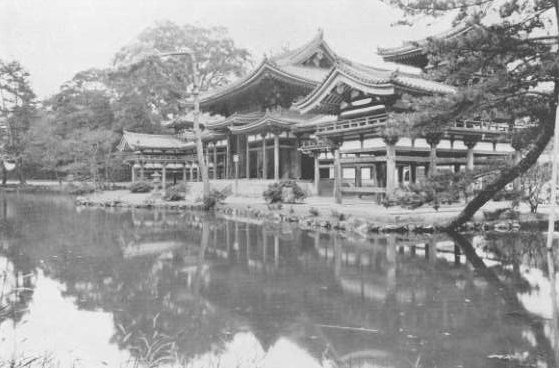
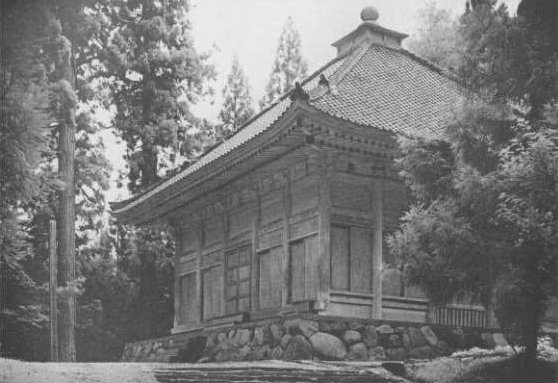
Among the temples built by the Emperors of this period mention may be made of the following six: the Hoshoji, Sonshoji, Seishoji, Saishoji, Yenshoji and Enshoji, all of which were conspicuous for their great scale and elaborate decoration. Among those established by the Fujiwara aristocrats, who revelled in power, wealth and luxury, the most famous were the following: the Daigoji, Hoshoji, Byodoin, Ryogonji, Hoseiji, Hojuji and Hokoji. Among these the Hoseiji built by Michinaga was most magnificent, according to the documents, although nothing now remains of the original to prove it. Some of the important buildings now existing from this period may be enumerated below: the five-storied pagoda of the Daigoji, and Sanzen-in, the Lecture Hall of the Horyuji monastery, the main building of the Joruriji, the Konjikido of the Chusonji, the Byodo-in (Phoenix Hall), the Amidado of the Hokaiji, the Lecture Hall of the Horyuji, etc. Most of these may be termed Amida-do (Halls for Amitabha) which came into existence with the rise of Jodo, the new sect. One of their peculiarities was the absence of demarcation between the inner and outer sanctuaries within the temple building, thereby causing all the Buddhist images to be placed on the central altar (Shumidan), and another was the profuse decoration given to the interior to suggest Jodo (Sanskrit, Sukhavati) the Buddhist paradise. (Plates 35, 36.)
Not only did the aristocrats build temples - and they were so powerful and wealthy that: many of them established separate family temples - but they also built their own mansions on an elaborate scale, developing a style known as shinden-zukuri, which consisted of a number of rectangular buildings joined by long corridors, with a landscape garden on the south side containing a large pond with an island in it connected by bridges, one in front and the other in the back, the front one being arched to enable boats to pass under it. Such was also the plan adopted for palace architecture. The houses of the common people remained simple with thatched roofs.
The four types of the previous period continued to exist for shrines, but a marked preference was shown for the Kasuga and Nagare, while minor buildings necessary in connection with festivals, etc., were added as accessory structures. Furthermore, ocher features were elaborated: corridors were substituted for the fences surrounding the shrine, and the simple torii was replaced by an eight or four-post gate. As in the case of the mansions of the aristocrats, these structures were characterized by dignity, reflecting the spirit of the age, and revealing the highly developed taste of the Japanese race.
IV. Second Period of Chinese
With the establishment of the Shogunate at Kamakura in 1186 the political centre was shifted from Kyoto to Kamakura, the power being transferred from the aristocratic to the samurai (warrior) class, and the tendency of the age passing from grace and refinement to simplicity and vigour. Kamakura was so far removed geographically from Kyoto that in the earlier part of this period aristocratic taste still continued to prevail in Kyoto, while samurai taste was developed in Kamakura. But a little later the simplicity of the samurai found its way to Kyoto, while the refinement of the aristocrats pervaded Kamakura, thus causing an exchange in the fashions of these two metropolises for a time. It was natural that the rise of the samurai class should affect the architecture of the period, for this meant the birth of a middle class which soon gained power and caused aristocratic taste to be superseded by democratic. In the previous period temples were built by wealthy individuals single-handed, but now this was no longer done; the necessary fund had to be raised by public subscription. Not only so, but there was a change in the style of architecture caused by the Zen sect of Buddhism.
Although the custom of sending cultural missions to China was dispensed with in 894, private intercourse was continued by merchants and Buddhist priests. The Zen sect of Buddhism was brought to Japan from Sung, spread among samurai and aristocrats and was destined to influence all branches of art, including, of course, architecture. The Zen temples of Sung were reproduced in Japan and the style of these new buildings was called Kara-yo Chinese style) in contradistinction to the tenjiku-yo (Indian style) which had been imported into Japan earlier in the period and applied in the reconstruction of the main hall and the south gate-house of the Todaiji monastery. The older style which continued to exist from the previous period was named wa-yo (Japanese style). These three styles existed side by side until the wa-yo and the kara-yo merged into one and developed a mixed style, while the tenjiku-yo failed to make much headway.
A brief comparison of these three styles will help to bring out their striking features. The wa-yo allowed great freedom in the planning of the temple and in the arrangement of the different buildings of the temple, while the kara-yo retained, as in the case of the Buddhistic architecture first introduced from China in the seventh century, the symmetrical arrangement. The kara-yo revived the tiled floor, discarding the raised wooden one of the wa-yo The kara-yo increased the height of the altar, the ceiling, and the building itself. It established the custom of leaving the woodwork plain and of placing a single image of Buddha on the altar, instead of many, and otherwise simplifying the whole interior to have it conducive to Zen meditation - a great contrast to the profuse decoration of the Jodo sect. However, in the kara-yo there was a certain increase of decorative details on the exterior: the brackets were no longer confined, as in the wa-yo, to the top of the pillars, but were increased in number and introduced between the posts as well; certain carved decorations came to be used for the gable-ends, and also on the ends of beams, etc. The striking feature of the tenjiku-yo may be seen in the elaborate system of bracketing, the arms projecting to the front of the pillars being often as many as seven, instead of two or three as in the wa-yo.
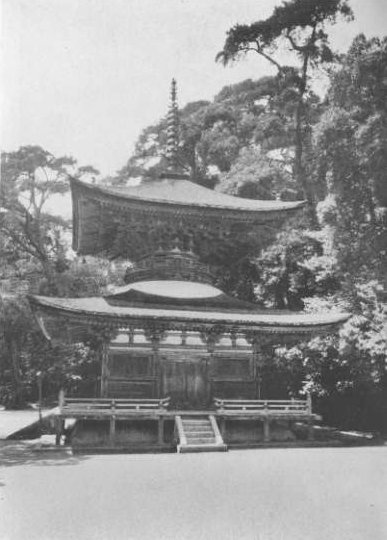
Mention may be made here of a few buildings dating from this period. The Fudo-do of the Koyasan Monastery, a square building with its graceful sweep of roof line; the main hall of the Renge-woin, of Kyoto, a long building with a corridor all around; the Tahoto (double-roofed stupa) at Ishiyama-dera temple, the oldest and one of the best of its type, and the beautifully proportioned three-storied pagoda of the Kofukuji temple, Nara, are all in the wa-yo, though they are entirely different in shape. The Shari-den of the Engakuji temple of Kamakura and the Jizodo of the Shofukuji temple of Tokyo, represent the kara-yo, while the main hall and the south gatehouse of the Todaiji temple show the tenjiku style. The best example of the mixed style of kara-yo and wa yo is the main building of the Kanshinji temple, Kawachi. This mixed style was further developed and became the principal style in subsequent periods. (Plates 36, 37.)
These influences did not confine themselves to Buddhist temples alone, but extended also to Shinto shrines, some of which came to assume irimoya roofs.
The destruction of the Imperial palaces by repeated fires and also the political disturbances that caused a division in the Imperial lineage to the north and south have prevented us from having any reliable data concerning the architecture of the Imperial palaces of this period. On the whole, however, the shinden seems to have continued in favour with the aristocrats of Kyoto, while the buke (samurai) style, which was in the main the simplification of shinden-zukuri, was devised for the samurai class. It was customary in the buke style to surround the house with a ditch and fence. Instead of having many separate buildings joined by long corridors, as in the case of the shinden style, the buke style had many rooms under one roof, or groups of roofs joined together. The houses were thatched or shingled, there being hardly any evidence of tiles. This style finally evolved into the shoin style of the Muromachi period which followed.
The Muromachi period also comes under the fourth division of architectural development - the period under the second Chinese influence. The power now went to the Ashikaga clan which lived at Muromachi in Kyoto. Kamakura being abandoned, Kyoto again became the political centre. The simple ways of the samurai were forgotten by the time Yoshimitsu, the third Ashikaga Shogun, began his life of luxury. Yoshimasa, the eighth Shogun, carried the fashion still further; he was a great patron of art, being himself a great devotee of cha-no-yu, ceremonial tea based on Zen, which exerted a powerful influence on all forms of art. Its far-reaching effect cannot be overestimated. Powerful personages rivaled each other in building magnificent mansions for themselves, thus giving a stimulus to the development of painting, architecture, gardening, and the various branches of applied arts. The advancement of art in this period may be compared in importance to that of the Fujiwara regime in the Late Heian period.
This was followed by many wars, yet the influence of the Ming culture was persistent through Buddhist priests. Towards the end of the period European merchant ships began calling at Japanese ports - Portuguese, followed by Spanish and English ships. Thus an European influence, though slight, also began to be felt.
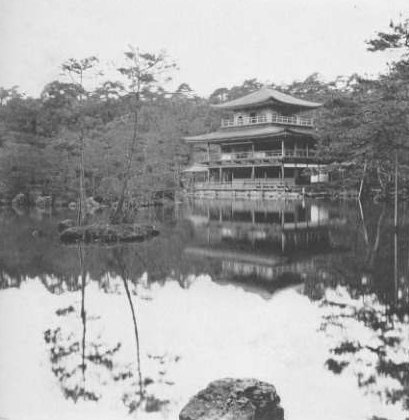
While esoteric Buddhism still remained the religion of the Imperial Court and Shogunate, the spread of the Zen sect among the middle class made its influence felt not only on the literature, manners and customs, but also on architecture and other branches of the art of the time. Therefore it was natural that kara-yo and the mixed style of kara-yo and wa-yo should thrive, as it did, the pure wa-yo and tenjiku-yo being much neglected. Such a tendency was extended even to the Shinto shrines. The samurai style which originated at Kamakura was perfected during the Muromachi period, resulting in the creation of a style known as shoin-zukuri. This style introduced into the dwelling-houses the tokonoma (alcove), shelves on the wall, a fixed table by the window, sliding paper screens (fusuma), and wooden panels (sugi-to), both generally decorated with landscapes in monochrome, coffered ceilings, narrow verandahs, and an entrance room (genkan). As noted architectural examples built by the Shoguns of this period the Kinkakuji (golden pavilion) and the Ginkakuji (silver pavilion) may be mentioned. Among other temples of this period may be enumerated the East Kondo of the Kofukuji temple, Nara, rebuilt in 1411, the five-storied pagoda of the same temple rebuilt in 1426, and the gate-house of the Tofukuji temple of Kyoto. Among examples of shrines, the Kibitsu Jinsha, of Okayama, and the Takemigumari Jinsha of Kawachi may be mentioned. (Plate 38.)
V. Second nationalization
With the downfall of the Ashikaga clan, the nation fell into Nationali- disorder, but soon order was partially restored under Nobunaga, a great general who established a new regime - a short but significant regime, especially from the art standpoint - known as the Azuchi-Momoyama (Momoyama for short) period: 1573-1602. Nobunaga was loyal to the Court and built Imperial palaces and repaired shrines, and Kyoto gradually regained its former aspect. He built his own magnificent castle on Azuchi hill overlooking Lake Biwa and gave the master painter, Kano Eitoku, a free hand in decorating its interior. The castle contained a seven-storied keep, about one hundred feet high, and showed in many respects marked progress in the architecture of fortification. This splendid castle, with living apartments gorgeously decorated, was entirely destroyed by fire only about seven years after its completion.
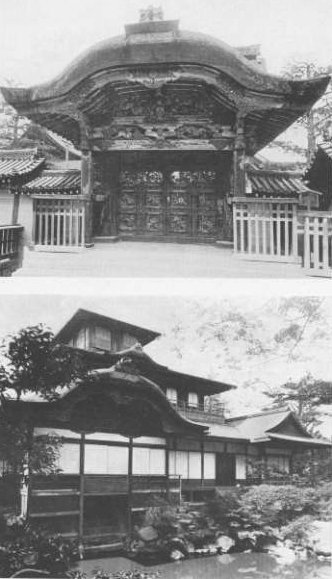
Hideyoshi, when he rose to power, built many important structures among which the following may be mentioned: Osaka castle, the keep of which was recently restored in re-enforced concrete; Juraku palace in Kyoto which was removed to Momoyama during his lifetime and a part of which now stands as the "Hiunkaku" in the compound of the Nishi Hongwanji temple in Kyoto, and the Momoyama castle. This Momoyama castle was an elaborate affair, parts of which are still preserved as follows: the gate-houses houses of the Daitokuji temple, of the Hokoku shrine, and of the Nishi Hongwanji temple, and also the "Stalk Chamber" of the last mentioned temple, all in Kyoto. The Nagoya castle, completed in 1611, famous for the pair of gold dolphins on the roof of the keep, remains in an excellent state of preservation, and contains a building from the Kiyosu castle constructed in the previous period. Hideyoshi also built a temple named Hokoji in Kyoto on a colossal scale, but it was burnt, rebuilt and finally destroyed by lightning. Among the temples and their accessory buildings dating from this period mention may be made of the following: the Zuiganji temple at Matsushima completed in 1609; the Kondo of the Toji temple rebuilt in 1606; the Founder's Hall (Kaisando), the mausoleum (Rei-oku) and the Front Gate of the Kodaiji temple in Kyoto built in 1605. Hideyoshi was a great hero and was mainly responsible for the grandeur and splendour in art known as the "Momoyama style." Though he was the central figure, it was essentially the age of the common people, full of masculine power, opposed to social classes and traditions. It was the spirit of the age to be bold, daring and free. This spirit was clearly reflected in the architecture as well as in other branches of the art and craft of the period. (Plate 40.)
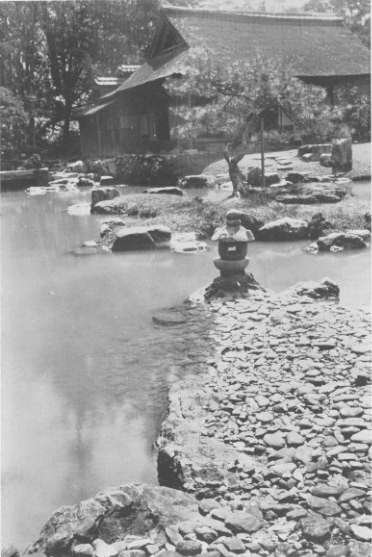
It may be mentioned that Hideyoshi was a tea devotee, who utilized cha-no yu for political ends, causing a great development of the cha-seki (tea room) architecture, which embodied simplicity and played an important part in the subsequent architectural history of Japan. Hitherto cha-no-yu had been a sort of pastime for the upper classes, but now it entered into the life of the common people, having been popularized by the great tea master, Rikyu. The development of this simple style of architecture was an interesting contrast to the gorgeous style formerly in vogue. Yet the simplicity shown in earlier types of Shinto shrines and cha-seki may be pointed out as similar in spirit and as expressing the fundamental ideas of Japanese architecture.
The shrines of this period were somewhat modified, and a style known as gongen-zukuri came into existence. It consisted of one building for the sanctuary, another in front for worship, and these two buildings joined together formed between them an ai-no-ma or sunken room paved with stone. This gave a complicated system of roofs; hence the style is often called yatsumune or "eight-roofed." A noteworthy example remaining from this period is the Kitano Jinsha completed in 1607.
European intercourse was opened at the end of the previous period and continued throughout this period, and as a consequence Christianity wax spread with remarkable rapidity all over Japan, no less than half a million converts being made in fifty years, from 1549 to 1598. Through Christianity was partially prohibited by Hideyoshi in 1587, a number of Christian churches in a foreign style must have been built, though they left scarcely any influence on our architecture, not a single example now remaining.
Hitherto the development of Japanese architecture had been centred about Buddhist temples, but now it took a different course - the attention of the people was turned more towards men and things directly connected with daily life, viz., castles, palaces, and dwelling-houses. Such was the case with sculpture and painting as well: instead of Buddhist statues the sculptors were engaged in carving ramma (panels fitted between the beam above the partitions of rooms and the ceiling) and kaeru-mata (decorative supports of beams); in stead of making Buddhist images the artists devoted themselves to painting secular subjects on the sliding screens and ceilings. In no other period in Japanese history did architecture, sculpture and painting all cooperate in such perfect harmony as they did in the Momoyama period. The peculiarity of the architecture of this period was the disregard for traditional methods and the creation of a new style. The architects were not bound either by the native (wa-yo), the Chinese (kara yo), the Indian (tenjiku-yo), or the mixed style. They were bent on devising original modes of expression, transcending them all. The shoin-zukuri, the style of dwelling-house with a study, which was originated about the middle of the previous period, was now more fully developed. Since the Wars of Onin (1467-1477) the practice has become general of covering the entire floor in the Japanese house with tatami (wadded mats); of having gold sliding screens with paintings on them; of coffering the ceiling and decorating it with lacquer and pictorial painting; and of installing a tokonoma (alcove with a raised floor), and chigai-dana (shelves at uneven levels) in the main room.
Because of the great influence exerted by cha-no-yu on architecture as a whole, mention may be made of some important tea masters who lived about this time and of the cha-seki built then. Among these tea masters were Sen~o-Rikyu, Furuta Oribe, Hosokawa Tadaoki, Oda Urakusai, Kobori Enshu, Katakiri Sekishu and Kanamori Sowa. They were not only masters of cha-no yu, but also artists of great attainments, having designed cha-seki (houses for cha-no-yu) and gardens as well. The following may be mentioned as some of the important cha-seki built at this time and at the beginning of the Edo period; the cha seki of the Shinjuan of the Daitokuji temple; the Karakasa-tei and Shigure-tei, of the Kodaiji temple; the Myokian of Yamazaki, the Sekkatei of the Kinkakuji temple, and the various buildings of the Katsura and Shugakuin detached palaces. (Plate 90.)
The period of the second nationalization continued throughout the Edo period (1603-1867) when the Japanese were able to free themselves almost entirely from foreign influence. The culture of the Edo period was that of the common people, not of the aristocrats. Looking back we realize that in the sixth, seventh and eighth centuries the influences of the Sui and T'ang cultures strongly affected our civilization. From the ninth century nationalization began, and in the tenth our own culture was developed; this was maintained through the two centuries that followed, but was confined to the aristocrats. The Sung and Yuan influences were felt from the thirteenth to the middle of the sixteenth century, while cha-no-yu, poetic dialogue (ren-ka) and noh drama helped to maintain and spread the native culture among the common people who were most active in reasserting themselves in the latter half of the sixteenth century and who carried the native culture still further in the three centuries that followed when popular Japanese literature and art - such as novels, plays, haiku (seventeen-syllabled poems), and ukiyo-ye (genre paintings) - reached the height of their development.
Religious architecture of the Edo period remained somewhat stagnant, though earlier in the period the Obaku sect of Zen Buddhism was introduced into Japan from China and a temple built at Uji, the Mampukuji, which still remains. Yet Buddhism was by no means inactive: in the Horeki era (175-163) there were no less than 121,000 temples of the Jodo sect, 81,000 of the Hokke sect, and 80,000 of the Hongwanji sect. The buildings were influenced by the spirit of the age, and grew more and more Japanese in style. The grandeur of the Momoyama period, however, gradually disappeared, and the long-continued peace had a tendency to make people conservative, weak, and concerned chiefly with non-essentials. All of this was reflected in the buildings of the period. Different styles of architecture lost their distinctive characteristics; they were blended into each other, differences being revealed only in minor details while architects remained conservative.
Noteworthy was the development, in this period, of the mausoleum, a complicated form of Shinto architecture of the gongen-zukuri style. Its most prominent examples are the shrines at Nikko, a part of which were built in 1616-7 and the rest completed in 1634-6. There were other mausolea erected likewise for the spirits of the dead Tokugawa shoguns, within the compound of the Zojoji temple at Shiba and the Kwanyeiji temple at Uyeno, both in Tokyo. When the spirit of the people was more active in the first part of this period, such large temples as the above mentioned Zojoji and the Kwanyeiji, the five storied pagoda of the Toji temple, Kyoto, and the Daibutsuden ( Hall of Great Buddha), Nara, were built, and many neglected temples in Kyoto were either reconstructed or repaired. (Plate 41.)
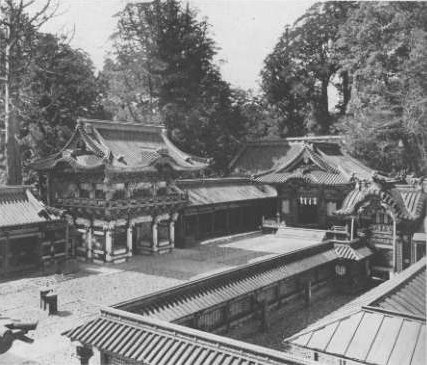
As the study of Confucianism was encouraged by feudal lords, Confucian temples were built in various provinces throughout the country. In some instances similar Chinese edifices were copied, though on a small scale, but these buildings failed to make any lasting impression on Japanese architecture. Castles continued to be constructed, a notable example being the Edo castle, parts of which still remain in the Imperial palace grounds. Another example is the Nijo castle of Kyoto which was begun in 1603 and completed in 1624 by the addition of various buildings from the Fushimi castle. The Nijo castle contains apartments which constitute the best specimens we have of shoin-zukuri and which reflect the grandeur of the Momoyama period, as the people building them were still under the spell of its influence. The homes of the samurai were developed on a more or less definite plan: the lord's dwelling-house was surrounded by quarters where the vassals lived. So extravagant did some of the samurai become that in the Genroku era (1683-1703) it was found necessary to restrict the size and form of the mansions, by prescribing different types of gate according to the rank and income. The dwelling-houses of the common people of Edo were thatched at first, but repeated fires brought about the use of thes on the roofs in the early part of the eighteenth century, and buildings like godowns with thick mud walls became the fashion. Cha-no-yu continued to be in vogue, developing many "schools," but hardly anything striking in the way of architecture was in evidence.
VI Period of Western Influence
Following the Restoration of 1868, Western culture was eagerly sought. People went so far, at one time, as to try to destroy every institution which had no counterpart in the civilized West. Western institutions were introduced, and with them men to operate them. These included architects who taught the people how to build in brick, iron and stone after the Western style. Many school and government buildings, railway stations, modern factories, office buildings, theatres and department stores were built in the Western style. It became the fashion among the wealthy to possess an European-style house, and among the middle class to furnish at least one room in European style for the reception of guests. The great earthquake and fire of 1923 proved a catastrophe to many of these foreign-style buildings, and hastened the evolution and development of special styles suited for an earthquake country like Japan.
VII. Present: Third Nationalization
A reaction was inevitable. Especially since Japan's recent secession from the League of Nations, the national spirit has begun to reassert itself in all directions. Already its influence is being felt on architecture, designers reproducing buildings in traditional forms in re-enforced concrete, and otherwise trying to reveal the native characteristics of the people while meeting the advanced requirements of the age.
In conclusion allow me to make an observation. In spite of the modern tendency just referred to, we see a remarkable increase of apartment houses in cities and foreign-style style domestic buildings of questionable nature called by the alluring name of bunka jutaku (cultured residences) going up in the suburbs like mushrooms after the rain, and we cannot help wondering about the future of our architecture. For that matter, it is not the future of our architecture alone, but also the future of many other phases of our national life, the consideration of which bewilders us and causes us anxious thought. But somehow I feel the strength of the spirit of old and true Japan can preserve itself against the encroachment of foreign influences, and reassert itself in time to save Japan even if she may seemingly be carried away by the zeal to welcome things new. In this connection my attention is drawn to the fact of the preservation of primitive simplicity in the shrine architecture. Though we have allowed ourselves to be influenced practically in every branch of art, is it not marvelous that the primitive architecture of our Shinto shrines - the Taisha, the Otori, the Sumiyoshi and the Shimmei types - should still be preserved to this day in their original forms, and be essentially as they were some twenty centuries ago? To be sure, some of the styles of Shinto architecture have been influenced by other styles and modified to permit somewhat complicated designs, but the four primitive types mentioned above are still maintained throughout the country. This fact seems to explain many phases of our national activities which are seemingly contradictory. We dash to things new, yet hold on to something of the old, something of our own. Our love of nature and simplicity, so well symbolized by our Shinto shrines, is doubtless one of the most sacred things that we possess, and it is the hope of the people that we may cling to that which is the most sacred in us in spite of the rush we may make from time to time towards new things of foreign importation, not only in art, but also in other lines.
Today there are no less than 140,000 shrines throughout the country, nearly every ancient grove of dense trees harbouring a shrine, each with one or more torii - a simple framework of wood or stone consisting of two horizontal beams supported by two posts set in the ground - serving as their symbol. These shrines are all built of wood - with very few recent exceptions in re-enforced concrete but built in traditional style - and are constantly being rebuilt in the same original simple style. Not only do these shrines represent the primitive type of ancient imperial palace and suggest common dwelling-houses, louses, but they stand to day as sacred symbols of the ideals of the people, ever reminding them of the houses of the gods, making them realize the presence of the spirits of the dead, and transporting them to the days of yore when their ancestors lived simple lives close to nature. No one can help being deeply moved by the extreme simplicity of the shrines, by something i ntangible, something sacred which seems to emanate from them. This simplest form of architecture is in perfect harmony with the ancient trees, suggesting the primeval forest in which it was set, and is profoundly impressive. Not long ago I revisited the Imperial Shrines at Ise and was profoundly awed. My soul was thrilled with the invigorating freshness of the verdure and moved by the echo in the mystic murmur of the ancient cryptomeria and camphor trees that half conceal the simple and sacred edifice. What the noted priest Saigyo wrote about the Ise Shrines in a thirty-one-syllabled poem -
I know not what is within, But I am in tears with gratitude.
"Nanigoto no owashi masukawa Shirane domo Katajikenasa ni namida koboruru."
is true. Basho too was evidently struck with the overwhelmingly divine power while he was worshipping at the Ise Shrine, as he sang in his seventeen-syllabled haiku: -
"I cannot tell what flowers it came from, But an unnamable fragrance filled me." (Trans. by Miyamori.)
"Nan no ki no Hana towa shirazu Nioi kana.''
The sentiments of these poems are echoed in the heart of every Japanese visiting the shrine, all being deeply struck by the sanctity of the place. Real Japan, the old and true Nippon, seems to dwell there, speaking to the people in the silent language of the past, of the eternity of beauty and of truth as revealed in Nature.
NOTES ON PLATES
Plate 30. Upper: Ise Shrine. The Shimmei-zukuri, one of the four oldest types of shrines preserving the primitive style of Japanese architecture.
Lower: Izumo Taisha. The Taisha-zukuri, one of the four oddest types of shrine architecture in Japan.
Plate 31. Kondo (Main Sanctuary) of the Horyuji monastery. Completed about 607; one of the oldest wooden buildings in Japan still used for the original purpose.
Plate 32. Five-Storied Pagoda of the Horyuji monastery. One of the oldest wooden buildings in Japan still used for the original purpose for which it was built at the beginning of the seventh century. The lowest roof is called mokoshi, built later as an auxiliary.
Plate 33. Three-Storied Pagoda of the Yakushiji, dating from the eighth century. In reality there are six roofs, but the three smaller roofs are considered auxiliary, each to the one above.
Plate 34. Sangatsu-do (or Hokke-do). Tributary temple of the Todaiji monastery. The left half, the rear part of the building, was built in 733, and the right half at the end of the twelfth century. Each shows characteristics of its period, more than 400 years apart, and both are wonderfully well harmonized.
Plate 35. Phoenix Hall. Ho-o-do of the Byodo-in temple at Uji. Originally Fujiwara Yorimichi's villa, but turned into a temple in 1051.
Plate 36. Konjiki do of Chusonji temple, built in 1126. The illustration shows the edifice (Saya-do) constructed in the XIII century, completely covering the Konjiki-do to protect it.
Plate 37. Tahoto. Stupa belonging to Ishiyama-dera; one of the oldest and best examples of its type. End of the XII century.
Plate 38. Golden Pavilion. Kinkaku of Rokuonji temple in Kyoto. Originally Ashikaga Yoshimitsu's mansion built in 1397. After his death it was turned into a temple.
Plate 39. Nagoya Castle. Completed in 1611. The keep is visible in the background; the buildings in the foreground have long served as an Imperial Detached Palace. Given to the City of Nagoya a few years ago.
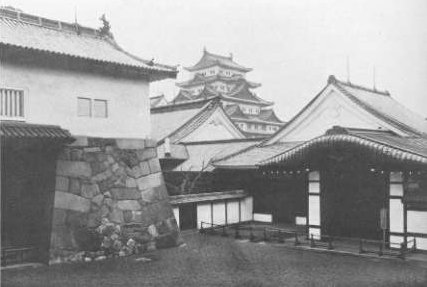
Plate 40. Upper: Chokushi-mon (Imperial Messenger's Gate) now at the Nishi Hongwanji temple in Kyoto. It was removed from Hideyoshi's palace at Momoyoma, the construction of which was begun in 1594.
Lower: Hiun-Kaku. Now in the garden of Nishi Hongwanji in Kyoto; originally it belonged to Hideyoshi's residence known as Jurakudai in Kyoto completed in 1587 and taken apart in 1592. The edifice is approached by a monolithic bridge across the pond in front, and entered by the steps partly shown on the right. The flight of steps reaching the water and shown on the left is accessible from the building by sliding open the floor of the hall when getting into the boat on the pond. The roofs are covered with shingles and barks of hinoki-wood.
Plate 41. Toshogu Shrine at Nikko erected in memory of the founder of the Tokugawa dynasty. The shrine was completed in 1636. The illustration shows the gate-house named Yomei-mon. It is popularly known as "Higurashi-no-mon which signifies that one may spend a whole day in admiring it because of its exquisite beauty.
Plate 42. Upper: Interior of a Japanese house, showing tokonoma at the end with a kakemono. Partitions of sliding screens may be taken out to make a large hall. Ramma may be seen over the sliding screens betwocn the two rooms Lower: Interior of a Japanese House. Some of the sliding screens have been removed, leaving the entire house open to the garden. A corner of the room, with a round window, has been turned into a tokonoma without raising the floor. A kakemono may be seen on the wall, and a vase of flowers on the wooden floor. Over the grooved beam partitioning the two rooms may be seen a frame enclosing handwriting, the ideographs reading " Spring wind brings harmony. "