

XI. FALLEN LEAVES
Delivered before the Rotary Club, Eugene, Oregon
Following the suggestion of one of your members, I wish to speak today on some of the impressions I have received from the natural beauty of this state in which I have resided since my arrival here last September.
Before giving you these impressions, allow me to call your attention to the fact that there is an elusive but very precious quality of beauty in art and Nature which we in Japan call shibumi. It is that quality which makes Japanese art what it is. Without understanding it, it is well-night nigh impossible to appreciate Japanese art thoroughly. It is that quality in art which is essential and gives depth, but is far from being flamboyant or too conspicuous or ostentatious. It is simple without being crude; austere without being severe. It is the refinement that gives spiritual joy; a subtle touch of modesty of the soul.
A simple incident in the life of Rikyu, a great tea-master who lived in Japan some three hundred years ago, will help to elucidate this point.
Rikyu told his son to put the garden in order one day when guests were expected for tea. Later the son reported that he had done his father's bidding. Thereupon Rikyu glanced over the garden path and told the boy that his work was not satisfactory, and that he should do it over again. He obeyed and a little later returned and said:
"Father, I have swept the garden three times; there is not a broken twig or a stray straw left anywhere to be removed. I have watered the garden well; see the stepping stones nicely wet and the moss on the stone lanterns gleaming with dew. I cannot do anything more to the garden."
"You can't? You poor little idiot, stand here and watch me."
So saying the great master tiptoed quickly over the stepping stones to a maple tree growing by a stone lantern. He caught hold of one of its branches - it was early in autumn - and shook it, scattering a few golden and crimson leaves over the stone lantern and the ground covered with green moss, and thus producing a wonderful display of brocade.
"There! That is the way to clean up the garden path!" said the master.
The story seems to explain much of that indescribable quality in Japanese taste and art known as shibumi, without the understanding of which it is almost impossible for any one to appreciate our art thoroughly.
Looking back upon my work during these two terms, fall and winter, at the University of Oregon, it seems to me as though I have spent my time pointing to the fresh fallen leaves on the ground, and calling the attention of the students to the subdued and dignified beauty of these leaves. I arm glad that I found Nature in this part of your country (at least where I have visited) so strongly imbued with that aesthetic quality known as shibumi which we Japanese value so highly.
Oregon seems to be endowed with many superb natural beauties, one of which I was permitted to enjoy soon after my arrival here when Dean Bovard drove me up to McKenzie Pass. I had some enchanting glimpses of the crystalline waters of the beautiful McKenzie River through the golden and crimson foliage of vine-maples as we traced the river up towards its source. There were wonderful vistas of mountains as the road cut through the forests of towering fir trees. It was fascinating to watch, as we sped on, the changing ing aspects of the Three Sisters. They seemed to disclose, as we might in the course of intimate conversations among ourselves, their different attitudes towards life. How beautiful beyond words they were as they stood bathed in the alpine glow, that ethereal purplish glow of the setting sun ! They seemed to reveal something precious from within, something of a spiritual quality, which seemed to me all the more impressive, coming as it did from such rugged realism. There was a radiance that seemed to etherealize the angular contours of the Northern Sister, who in the glaring sun seemed to reveal her old age, all haggard from the hard usage of centuries. (Plate 138 upper.)
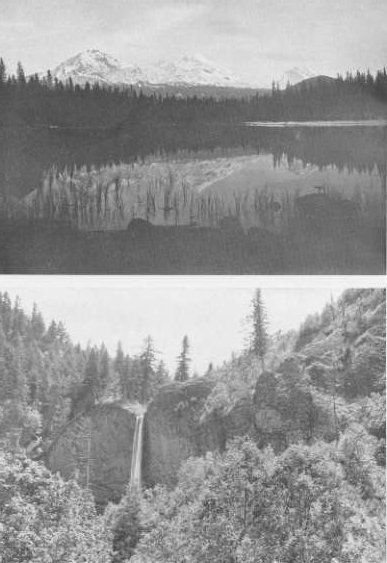
The Middle Sister, who appeared repining in the bright sun, seemed to reveal her truly noble character, as she turned the eternal burden of her glacier into a luminous flowing drapery. The Southern Sister, happy in the fullness of her hopes, seemed now to reflect the more serious phase of her existence in the fading light of day, as if giving an account of herself in the august presence of a great Power. What a strange spiritual atmosphere there was and how it seemed to fill the valley until it overflowed the mountains, and etherealized the Three Sisters! They no longer remained a massive, distorted crust of earth, but revealed themselves as a spiritual entity, and then faded away into the mystery of the shadows.
Then I saw a long valley lying stretched below us westwards as we hastened on our homeward way. It was a dreamland; a series of long undulating hills, covered with aspiring fir trees, faintly suggested in the mystic expanse, as they reflected the afterglow of the western sky. The exquisite subtle gradation shown by the long valleys and hills gradually faded into oblivion. But all of a sudden I realized that there loomed at my right a huge precipitous mass, the tremendous cliff of Deer Butte. Boldly it stood silhouetted against the glowing west. It seemed to stand there as a symbol of might and power. What a contrast it was to the dreamy expanse which it seemed to be gazing down upon! The strength and vigour breathed out by the cliff was overwhelming. There was the gentle sweeping curve of the line at the top and then a sudden drop into the mystery of the valley below. The profile of the cliff was extremely interesting, with its bold general contour filled in with minute details. I noticed a number of cone-shaped fir trees growing on the edge of the cliff at different altitudes, apparently unmindful of the huge rocks which hung over them in threatening attitude. It seemed to me as though a mighty sentinel was standing there, as he had stood for centuries, trying to impart a message to mankind. I then hoped that some day I might go back there, come into closer contact with him, watch and listen, in order to receive that message, for I believe he has a message for everyone of us if we would only place ourselves in the right attitude to receive it. Indeed, it was marvellous to note what wonderful qualities of Nature the twilight could bring out, and it was a great experience to be in the heart of Nature and to see and feel this marvel. It is indeed a pity, as my hostess remarked, while we were driven through the valley, that the affairs of men are so conducted, the hours for meals and for various arrangements so fixed, that we cannot more fully enjoy the beauty of twilight, which, like the dawn, is the best time of the day. I felt that my seeing these mountains and valleys at the time of day when they thrilled me with spiritual joy, had enabled me to obtain a glimpse of the real America, not only her physical features, but her people as well.
I was fortunate in being able to repeat the trip, thanks to Dean Onthank, before the road was closed for the season, and each time I discovered some new charm and beauty. The autumn tints - the gorgeous colouring on the slope of Deer Butte and the crimson and golden leaves of the undergrowth in the fir and pine forests brightened by the streaks of sunlight filtering upon them through the trees - will long be remembered.
On another occasion I was motored through Willamette valley and later through the coast mountain range, and both times I saw some marvellous effects of fog on the landscape. There were wonderful views of valleys with numerous wooded hills, one behind the other, fading into the distance in soft cadences. It was fascinating to watch the subtle gradations the fog made in the verdure of the trees, mingled with the saffron ash that fringed the rolling hills of gold, and the mystic shadows cast by the towering Douglas firs, and the mysterious play of sunlight over the bluish-gray atmosphere.
Last Sunday I was driven to the coast by Dean Macduff. Along the Siuslaw River we went; there vast stretches of oats, fresh with rain, gave a soft sheen to the rolling hills, and the purplish brown patches of burned forest on the mountains looked wonderfully rich and beautiful against the fresh verdure that surrounded them. Never have I seen such a profusion of wild rhododendrons as that we passed along the Oregon coast. What a marvellous colour harmony there was - rhododendrons mingled with huckleberry bushes with their flaming young leaves! The wonderfully picturesque coast line, with its numerous promontories, one behind the other in subtle gradation, veiled in mist, was a fitting subject for a Japanese master to paint on silk with the sweeping strokes of a broad brush. Subtle beyond words was the beauty of the hills along the Alsea River at dusk. It was like the faint fragrance of some unknown flower in the wilderness visualized.
As I look back upon the various trips on which I was taken and upon the various scenes which attracted my attention, I feel that I have seen touches of shibumi almost everywhere I went in this state. It was strongly revealed to me by the autumnal colours of the grass and shrubbery on the slope of Deer Butte, and by the basswood trees fringing the McKenzie River with their sensitive leafless branches against the dark green of the forest, last fall. In the winter I saw some of it revealed to me one day in the rain, in the trees adorned with greenish-grey lichen growing upon the undulating hills covered with deep-brown bracken ferns along the Siuslaw. I saw it again on the banks of the Umqua River early in spring in the moss-covered rocks and the young willow trees when they were almost ready to bud. It was shown in the glow of life that came from the patient endurance of their buffetings; it was shown by the suggestion of new life that surged at the tips of the leafless branches. I was deeply impressed by shibumi last fall as I stood and watched the exquisite beauty of the scattering leaves of the birch trees covering the hillside near the campus. The delicate tiny golden leaves quivered on the slender sensitive branches and fluttered like the petals of falling cherry blossoms. How symbolic of our life it all appeared to me as I stood and gazed upon the scene ! In the eternal rhythm of life we swing and flutter through the universe and alight on beds of fresh verdure to reflect the brightness of the sun for a while. A manifestation of a great truth in Nature in this quiet manner embodies the very essence of shibumi.
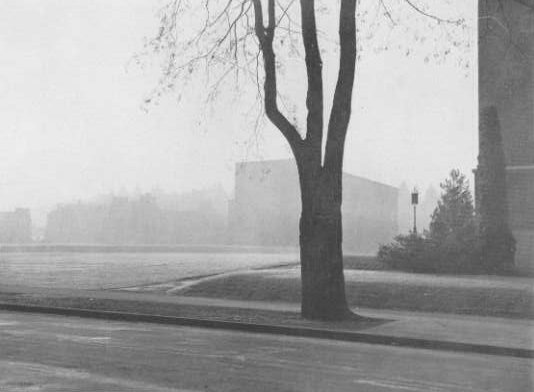
I found the same quality of beauty revealed in the colour of plants on the campus. I saw it in the moonlight on the group of sumac at the back of Gerlinger Hall shortly before the leaves were shed. For a long time I admired it every morning in the sparkling dewdrops on a young cedar tree in front of that building. I saw a touch of it in the morning mist on the row of poplar trees on University Avenue when their leaves were dressed in dull gold. I have felt it in the intricate illuminated cobweb effect produced by the leafless branches of the silver birch, and in the hieroglyphic designs in light, composed in shining lines by the linden trees, on the campus against an arc light on a rainy night. (This I was able to appreciate only after I had accustomed myself to walk in the rain without an umbrella.) I saw a tinge of it on the cotoneaster horitontales and crataegus coriaria (back of the Art school and in front of Susan Campbell Hall) with their red berries and tinted leaves when covered with heavy frost. On the campus I have seen and admired many other fragments of Nature's brocade with their dignified designs and refined colour schemes, showing exquisite taste full of shibumi. (Plate 134.)
While that element of quiet beauty was best expressed by Nature in autumn and winter, other seasons also revealed it. I felt it when I saw, in early spring, the weeping willow trees in Chancellor Hunter's garden and on the bank of the Mill Race. Their young leaves had the colour of the pulverized tea used in cha-no-yu (ceremonial tea) and reminded me of one of Lord Ii's poems. This expresses the principles of cha-no-yu, and has been rendered as follows:
"By the river bank
See the weeping willow stand,
All its pliant boughs
Quivering in the slightest breeze
Mirror'd in the placid depths."
(Trans. by Sadler.)
Yet I feel with our tea-masters that the secret of shibumi lies in realizing the calm serenity of what may be termed a commonplace scene. Yes, the essence of real beauty may be gathered from the commonplace, from what lies close around us in life. By learning to appreciate this truth, our lives will doubtless be enriched and ennobled.
Speaking about common things, have you ever observed the complexity of motion in turbulent water? Have you ever stopped by the Mill Race and watched the water for a while? Have you ever paused there long enough to note the countless number of little whirls that spin as they quickly move about, commingling with chaotic ripples and long eel-like shifting deceptive lines in the current and then disappearing? Have you ever noticed the deli cate straight lines resembling spectral rays which seem to radiate and revolve constantly on an axis - a visual phenomenon in the sunshine on water so strange that you doubt your own eyes? I have. Seated on the bleachers near the Anchorage one sunny morning about a fortnight ago I was fascinated by the manifold motions of the water in the stream. Leaves floated down and crossed these radiating lines visible on the water, without disturbing them, as if they were something ethereal and could not be affected by material objects. Countless white fluffy particles from the cotton-woods and numberless tinted leaves from the willow-trees trees on the bank fell on the water; they floated dancing down the stream while birds sang overhead, some particles moving at a different speed from others, some crossing and recrossing each other's paths, but all moving on and on down the stream. Everything moved without a moment's rest, urged by an irresistible force; everything moved on its onward flow to eternity. We in Japan are accustomed to associate the flowing water of a stream with man's destiny in life - as it ceaselessly moves on toward the unknown and unknowable. The silence of the water in the Mill Race was profound, and upon its swift current were reflected images of the trees on the bank, the reflection being somewhat static deeper in the water, though perturbed on the surface. Trees cast their shadows on the surface; they impress their images more deeply below. The shadows changed with the position of the sun, and the reflection distorted each object according to natural law. A perfect reflection is possible only on calm water, as a correct observation is possible only to a calm, unbiased mind.
Still, it is strange, is it not, that we see things much more clearly in the dark when the object is bright and serene? Strange, is it not, as a Japanese poet has observed, that though the water of the stream flows ceaselessly, the image of the moon reflected upon it is calm? The eternity of truth is persistent. A thirty-one-syllabled verse runs thus:
"Nagare yuku
Ogawano mizu wa yamane domo
Utsureru tsuki no kage
Shizuka nari."
This may be roughly rendered thus :-
Ceaselessly changes the water that flows on
In the little stream,
Yet calm is the image
Of the moon reflected upon it.
To return to the interesting phenomenon noted in the Mill Race - over the current the radiating lines revolved and fascinated me. I leaned against the railing and craned my neck over the water to examine the lines closely. In so doing I saw on the water my own shadow, not a reflection. Then for the first time, to my great astonishment, I found that the mysterious lines radiated from my head. I put my hand over my head; the radiance was not caused by the reflection and the gesture made no difference to the lines. Rays of light seemed to radiate from the head, forming a halo. Whatever may be the cause of this visual phenomenon, whatever may be the scientific explanation of it, the sight was indeed wonderful. Nature has mysterious ways of revealing truth to men. What can the truth be in this particular instance? Are we so egoistic in all our observations as this seems to indicate? These radiating lines can hardly be said to be imaginary; they were plainly visible. Are we so made in this universe as to conceive everything as if converging to or radiating from our heads, each individual's head assuming to be a centre of radiating rays ? Receding from the brink of the water, the lines appeared less radiating; but they were there all the same. The further I went from the water, the more parallel did these lines appear. With it all, however, I could not get away from the fact that the lines converged to the shadow of my head now cast on the bleachers. Proceeding to the brink again and leaning against the railing over the water, with the sun nearly over my head, I found the halo-like effect astounding, with lines radiating in all directions from the head, even conveying the suggestion of a mysterious power that seemed to emanate from the head with a sort of liquid vibration.
Never before have I seen anything so symbolic of divinity in man as was suggested in that shadow on the Mill Race. The message to me was the existence of a greater and higher power in man than we are accustomed to believe in. Nothing ever brought home to me so vividly as the vision I saw that morning on the Mill Race - for it was no less than a vision - the significance of an utterance attributed to Shakamuni, the founder of Buddhism. Soon after his birth the boy Shakamuni, standing erect, his right hand pointing to the heaven and his left to the earth, is said to have uttered these words, "Between heaven and earth I am my own lord," or according to another version of the same utterance, "Throughout heaven and earth, I alone am holy." This sentence is not to be construed to make US boastful of ourselves, but to give us self respect and instill in us faith in ourselves and in our capacity for greater and nobler possibilities. Your Mill Race has revealed to me by a fitting symbol the existence of divinity in man, urging me to strive ever harder to live nobly. I hope some of you may find it worth while to step down to the lowest scat on the bleachers by the Anchorage, lean over the current with the sun behind you, and see your own halo, thus reassuring yourselves of the inherent divinity in your own lives.
The other day I climbed Spencer's Butte, or rather I was dragged up by a strong friend of mine, in the moonlight, to see the sunrise. In the tranquillity of night, I sat for a while on a rock on the summit and was deeply impressed by the stillness everywhere. It was wonderful to watch the world growing lighter, by imperceptible degrees, and the peaks of the distant mountain ranges being awakened to face the realities of life. A glorious sunrise greeted us. The morning mist in the valley gradually accentuated the hills and, rising, revealed stretches of golden fields studded with groves of evergreens. I felt shibumi in the richness of the colour, half-concealed as it was; in the grandeur of Nature veiled in refinement.
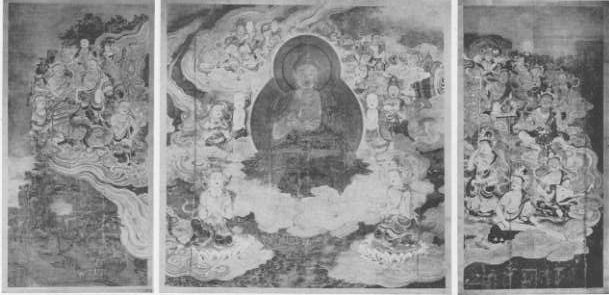
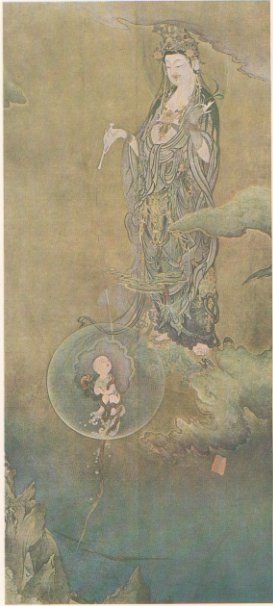
I felt the same quality of beauty in the deep but clear blue water of Crater Lake. It was indigo blue when I arrived there about noon, having been motored up winding and ascending roads banked with snow. In the shadow of the bank on the northwest the water deepened into purple. Wizard Island looked enchanted in its perfect calm. As I stood on the edge, the water was intensely blue immediately below me, a sheer drop of one thousand feet. (Plates 137 upper, 143.) Curious steep ridges projected into the water and upright pines and firs stood in rows on them, reminding me of the landscape in the Buddhist painting entitled "Twenty-five Bodhisattvas" (Plate 142.) belonging to the Koyasan Monastery and also of that in "Merciful Mother Kwannon" (Frontispiece) painted by Kano Hogai and now in the possession of the Tokyo School of Art. Snow still covered the ground, except on these ridges, whose irregular contours in yellow and red stood out clear against the blue of the lake.
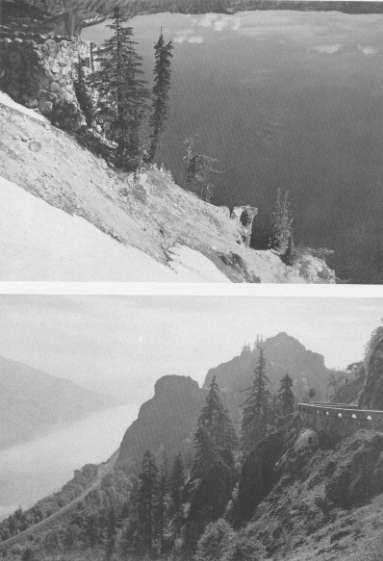
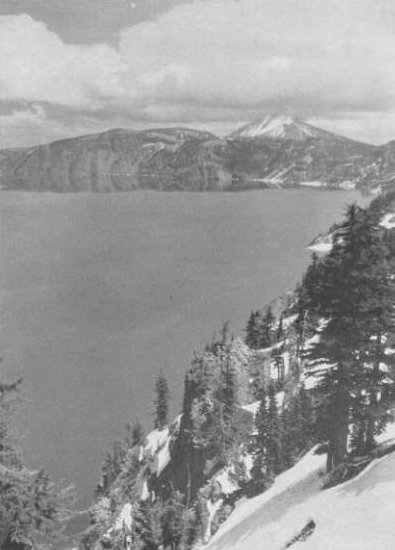
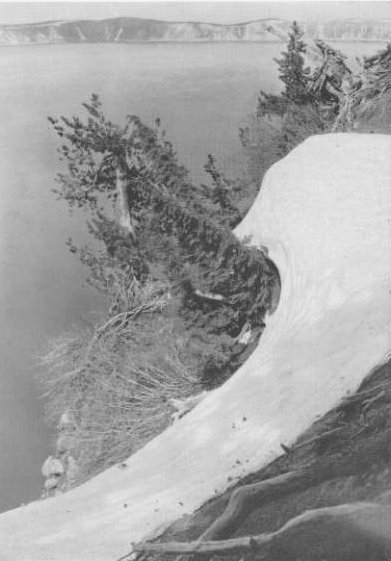
Some weather-worn trees clung to the jagged precipice with their gnarled roots swaying over the water. (Plate 136.) The colour of the water was fascinating as I looked down upon it from one of the hills towering up from the brink of the lake. A part of the lake reflected the surrounding cliffs and the clouds above as well, while the rest was a clear sheen, reflecting nothing but the brightness of the sky. When the sun was low and the trees on Wizard Island cast long shadows, the quiet was intense.
I watched the lake in the moonlight and at the break of day. The ceaseless change in hue was fascinating. The sun rose and I thought I saw mist or vapour rising from the surface of the water, but I found that what I took to be mist was nothing but the reflection of the clouds in the sky. How often do we mistake a mere shadow, a reflection, for reality! What we conceive to be real, changes and disappears as it moves about! Nature shows shibumi in a thousand and one different ways.
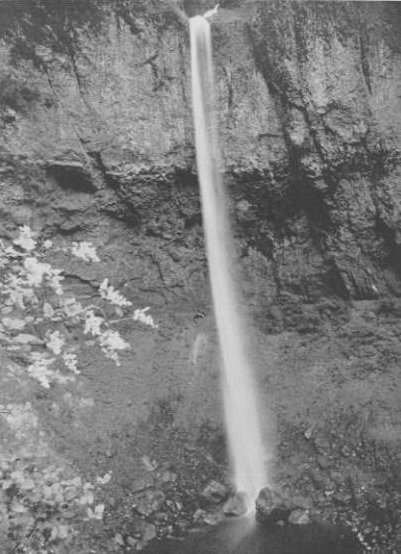
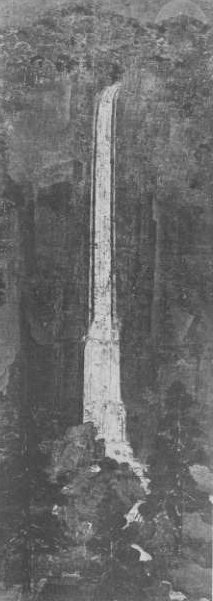
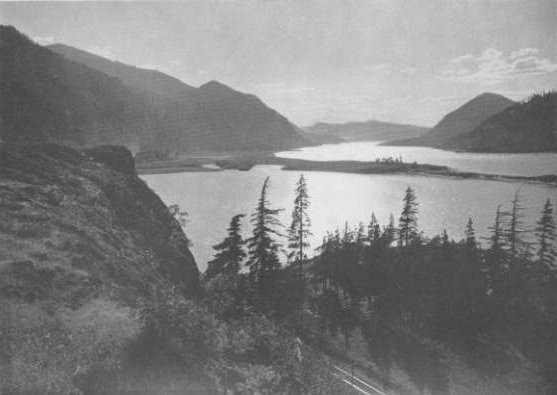
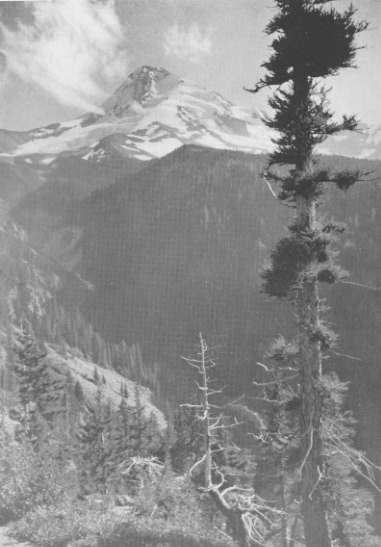
Wonderful was the drive along the banks of the Columbia River, with its thundering waterfalls, some of which reminded me of our famous paintings, and interesting gorges along the highway. (Plates 138 lower, 139, 140.) Especially when the setting sun shimmered on the mighty river (Plate 141.). or when the picturesque hills on its banks were silhouetted against the early morning sun (Plate 137-lower.). did the valley reveal its manifold powers and charms. I was also driven up to Cloud Cap Inn where I watched snow covered Mt. Hood in its varying moods; now completely hidden or half-concealed in cloud, and a moment later clear against the azure sky, or faint bellied a thin luminous veil. (Plate 135.) It was indeed grand to see it towering into the sky facing a vast stretch of low hills one behind the other in endless rows. The serenity of this mountain was awe-inspiring as I watched it at dawn from the window of a house on a height in Portland many miles away.
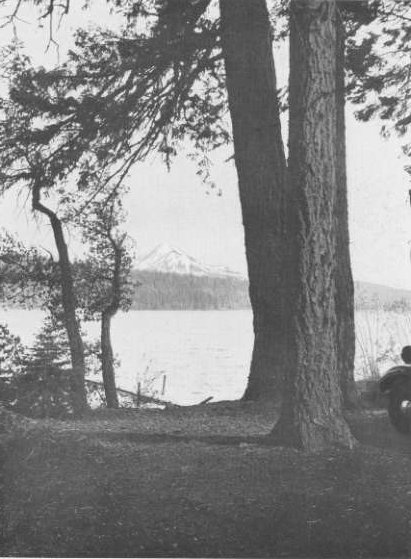
The sylvan quietude on the banks of the Lake of the Woods, with a magnificent view of the snow covered Mt. McLoughlin rising above the range of wooded hills, was extremely impressive. (Plate 144.)
Reverting to the campus scenery let me say, I have admired the majestic sweep of the mighty rivers Willamette and McKenzie flowing close by the University, and I have treasured the glimpses caught of the serene Sister Mountains from the campus. Frequently have I been refreshed by the spirituelle blue of the Coburg hills beyond the river, the same beautiful blue that often veils the landscapes of Japan. In the presence of these sights, I cannot help quoting the words of a great poet of the Orient -
"Where heroes rise,
There the mountains and rivers are pure."
Heroes to-day are eagerly sought after in every branch of human activity; and we look for true heroes in the common walks of life. Let us try to make the best of what has been bestowed upon us. "Where heroes rise, there the mountains and rivers are pure." You have your mighty rivers of clear water and your mountains, pure and noble. Your state is indeed abundantly blessed by Nature!
NOTES ON PLATES
Plate 134. University of Oregon Campus in the mist on a frosty morning. The windowless Museum of Art in the distance. Eugene, Oregon.
Plate 135. Mt. Hood. Constantly changing its aspect. From below Cloud Cap Inn. Oregon.
Plate 136. Remnant of Snow on the Bank of Crater Lake; suggesting a rhythmic flow with dead tree-trunks, gnarled roots, straggling shrubbery, and staggering broken trees. Oregon.
Plate 137. Upper: Crater Lake of wonderful blue water, reflecting the changing images of heaven. Oregon.
Lower: Columbia River filled with mist, and with hills of fantastic shapes against the early morning sky. Oregon.
Plate 138. Upper: Three Sisters mirrored on a quiet lake in McKenzie Pass. Oregon. Lower: Latourelle Falls, Columbia River Highway. Oregon.
Plate 139. McCard Creek Falls, Columbia River Highway. Oregon.
Plate 140. "Nachi Waterfall." Painted on silk, in colour. Attributed to Kose no Kanaoka. (XII century.) "National Treasure" owned by Mr. Nezu, Tokyo.
Plate 141. Columbia River at Sunset. Full of tranquillity, the peaceful clouds in wonderful colours suggest descent of a host of celestial deities. Oregon.
Plate 142. "Twenty-Five Bodhisattvas." Painted on silk in colour. Attributed to Eshin Sozu (XII century). "National Treasure" owned by Daiyen-in and other temples of Koyasan Monastery.
Plate 143. Looking Down at Crater Lake. Strangely shaped pinnacles seen from above against the blue water give a thrill which awakens the memory of religious paintings such as "Merciful Mother Kwannon" by Kano Hogai. (See Frontispiece.)
Plate 144. Snow-covered Mt. McLoughlin seen from a peaceful secluded spot on the bank of the Lake of the Woods, Oregon. The subtle changes of hue on the snowcovered peak at dawn and dusk were fascinating to watch from across the water.
Frontispiece. "Merciful Mother Kwannon." Painted on silk by Kano Hogai. In the possession of the Tokyo School of Art.
Reproduced in colour.