

Floral Art of Japan
Tourist Library 11
Floral Art of Japan
by Issōtei Nishikawa (西川一草亭)
Tourist Library 11
Board of Tourist Industry, Japanese Government Railways, 1936
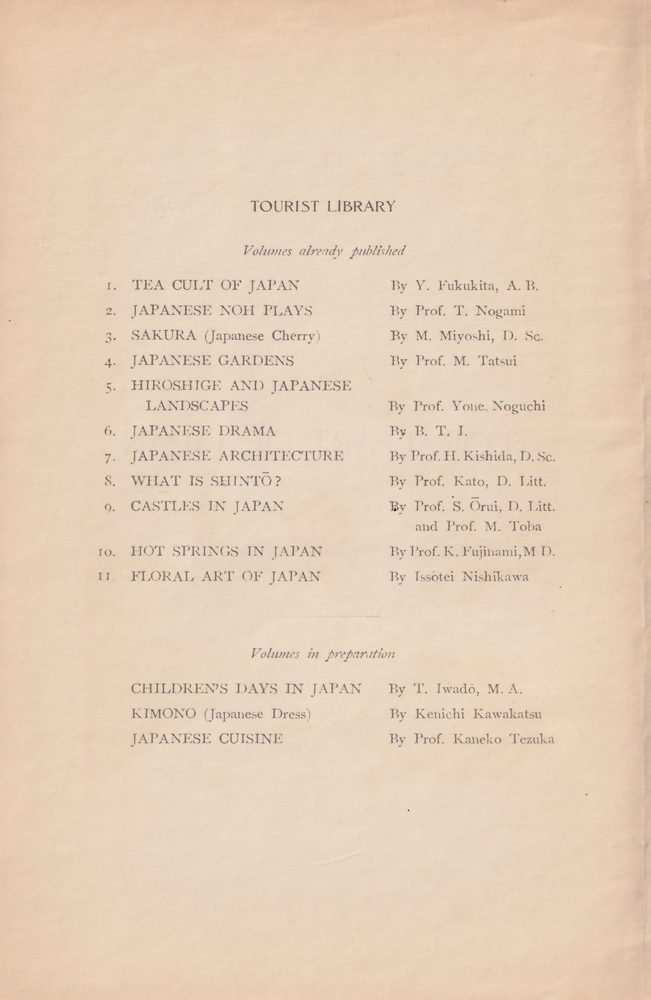
TOURIST LIBRARY
Volumes already published
1. TEA CULT OF JAPAN
By Y. Fukukita, A. B.
2. JAPANESE NOH PLAYS
By Prof. T. Nogami
3. SAKURA (Japanese Cherry)
By M. Miyoshi, D. Sc.
4. JAPANESE GARDENS
By Prof. M. Tatsui
5. HIROSHIGE AND JAPANESE LANDSCAPES
By Prof. Yone Noguchi
6. JAPANESE DRAMA
By B. T. I.
7. JAPANESE ARCHITECTURE
By Prof. H. Kishida, D. Sc.
8. WHAT IS SHINTŌ?
By Prof. Kato, D. Litt.
9. CASTLES IN JAPAN
By Prof. S. Ōrui, D. Litt.
and Prof. M. Toba
10. HOT SPRINGS IN JAPAN
By Prof. K. Fujinami, M D.
11. FLORAL ART OF JAPAN
By Issōtei Nishikawa
Volumes in preparation
CHILDREN’S DAYS IN JAPAN
By T. Iwadō, M. A.
KIMONO (Japanese Dress)
By Kenichi Kawakatsu
JAPANESE CUISINE
By Prof. Kaneko Tezuka
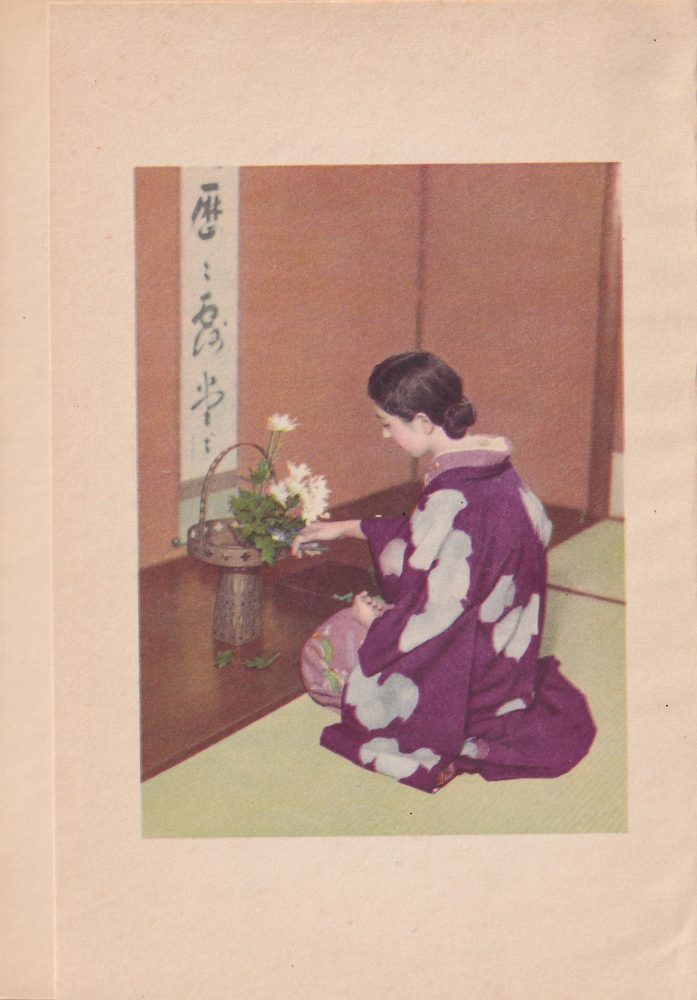
FLORAL ART OF JAPAN
BY
ISSŌTEI NISHIKAWA
BOARD OF TOURIST INDUSTRY
JAPANESE GOVERNMENT RAILWAYS
COPYRIGHT 1936
It is a common desire among tourists to learn something of the culture of the countries they visit as well as to see their beautiful scenery. To see is naturally easier than to learn, but flying visits merely for sightseeing hardly furnish the time or opportunity for more than a casual glimpse of the culture of any foreign people. This is specially true of Japan.
The Board of Tourist Industry recognizes the difficulty of attaining this high purpose, viz., to provide foreign tourists with accurate information regarding the various phases of Japan’s characteristic culture. It is endeavouring therefore to meet this obligation, as far as possible, by publishing this series of brochures.
The present series will, when completed, consist of more than a hundred volumes, each dealing with a different subject, but all co-ordinated. By reading therefore the entire series the foreign student of Japan may gain an adequate knowledge of the unique culture that has developed in this country through the ages.
For those who wish to follow up these studies with a closer investigation, bibliographies are appended, which we trust may be found reliable and authoritative guides in their study.
Board of Tourist Industry,
Japanese Government Railways
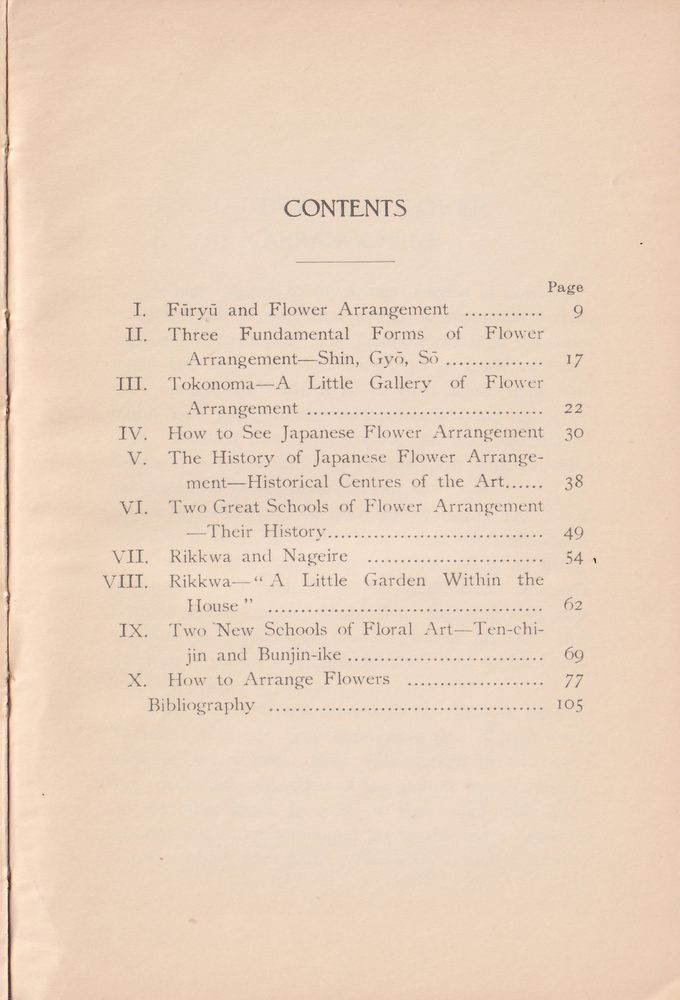
CONTENTS
Page
I. Fūryū and Flower Arrangement ........... 9
II. Three Fundamental Forms of Flower Arrangement—Shin, Gyō, Sō ............. 17
III. Tokonoma—A Little Gallery of Flower Arrangement .............................. 22
IV. How to See Japanese Flower Arrangement 30
V. The History of Japanese Flower Arrangement—Historical Centres of the Art...... 38
VI. Two Great Schools of Flower Arrangement—Their History........................... 49
VII. Rikkwa and Nageire ........................ 54
VIII. Rikkwa—“A Little Garden Within the House” .................................... 62
IX. Two New Schools of Floral Art—Ten-chi-jin and Bunjin-ike ........................ 69
X. How to Arrange Flowers ................... 77
Bibliography .................................... 105