

I. FURYU AND FLOWER ARRANGEMENT
When I speak to my foreign friends of flower arrangement in Japan, what comes to my mind is the Japanese word fūryū. The Japanese call their tea ceremony and flower arrangement fūryū no asobi, or “elegant amusement,” which is, to their mind, quite different from going to the theatre, or playing tennis or golf. Without knowing therefore the true meaning of fūryū, it is impossible to grasp the spirit which underlies Japanese flower arrangement.
In former days, the word fūryū might have been understood very differently from what we understand by it now. Most Japanese now think of it as being in opposition to Bushidō, or the Way of the Samurai. Bushidō values bravery more than anything else, and applauds him who fights at the risk of his life. But the way of fūryū is to shun all strife and to lose oneself in the joys of peace.
The Japanese are essentially an artistic people. Therefore they are very impressionable. If then their passions are aroused they will engage in whatever they undertake regardless of the gain or loss involved. On the other hand, in order to seek relief from life’s tension, they may sometimes go to the other extreme of bequeathing their entire possessions to their relatives,
of abandoning all the rights and duties of a husband, and of enjoying that peace of mind which comes only from a life devoid of all worldly desires. To the Japanese such a life of renunciation is one realization of fūryū in life, and cha-no-yu (tea ceremony) and ikebana (flower arrangement) are but expressions of this phase of life.
How can the love of flower arrangement be understood as fūryū? Because it is the love of the peace of nature. Similarly, to lay out a garden around one’s house may be taken as an act of fūryū, since its purpose is to provide the enjoyment of trees and stones, which symbolize the quietude of nature. When looking at some flower arrangement or a garden, Japanese often say that the style of the arrangement is quite in fūryū, or the design of the garden is out of fūryū. The term may also be applied to household goods, as one may often hear that such and such is not to be recommended, since it is not fūryū, although its shape or colour is very interesting.
What is then the meaning of fūryū in these cases, you may ask? If an article is said to be fūryū, it is, as a rule, of imperfect shape or of poor and meagre appearance. When a branch of a tree is twisted or dwarfed instead of allowed to grow straight and luxuriant, or has but few scattered flowers instead of bearing many fully blown flowers; or when a tree has become moss-covered, old and dying, such a branch or tree is said to be fūryū. And if the term is used in describing household goods, you may be sure that they are of a delicate nature, often crooked, and usually antiquated and frail.
You may wonder what such things have to do with fūryū. How could they be connected with the love of peace? The answer is to be found in the fact that their frailty impresses one, not with a feeling of dominating power, but with one of tenderness; anything perfect or nearly perfect excites in one the desire for possession, and then, too, behind it there is felt to exist a powerful personality; a thing apparently poor in appearance and distorted or deformed, however, does not rouse any such desire or feeling in anyone. Wherever there is no covetous eye being cast, there is peace, and the beauty born of peace. And this beauty is that of fūryū, the beauty of ikebana.
Therefore, fūryū is servile in disposition, one might say, and negative in its attitude towards life, which fact seems hardly compatible with that of the ever active and strife-loving Bushidō. But, curiously enough, this fūryū has existed side by side with Bushidō in the life of the Japanese people, and it has even been nourished by Bushidō itself, since it has served as a safety-valve in tempering the nature of the Japanese.
The growth of the influence of fūryū upon Japanese life can be clearly traced in the history of the nation. It was about the 15th century that the Japanese as a people began to understand and appreciate this peaceful way of living. For a long time there had been continuous civil wars in Japan, and the people had come to realize most acutely the evils of strife. The first man who upheld and encouraged fūryū was no other than Ashikaga Shōgun, the chief of warriors and administrator of the country at that time. He was succeeded
by two great heroes in the age of the civil wars, Oda Nobunaga and Toyotomi Hideyoshi. These two great men, also appreciating the life of fūryū, gave preference to such men as Sen-no-Rikyū, the master of tea ceremony, and enjoyed to the full the pleasures of cha-no-yu and flower arrangement.
At the back of the gay, flower-like Bushidō, whose virtues are persistency, fidelity, endurance, bravery and activity, the poor, retiring fūryū with its tender heart and negative attitude towards life has been highly valued by the people. Even in the days of continual warfare, those who did not understand this art of life were despised as being uncultured and vulgar men. But, on the contrary, one who knew and mastered it was highly esteemed, however low his social rank might be. A warrior, who should be concerned with bravery more than anything else, might find infinite joy and peace in the meanest flower set in a humble vase. The union of these two—Bushidō and fūryū—may seem to some people to be one of the greatest inconsistencies in the life of any nation. Yet, as far as the actual life of the people is concerned, there has really been no inconsistency or contradiction between these two ways of living. This seems to be one of the most interesting characteristics of the Japanese people.
The illustrations
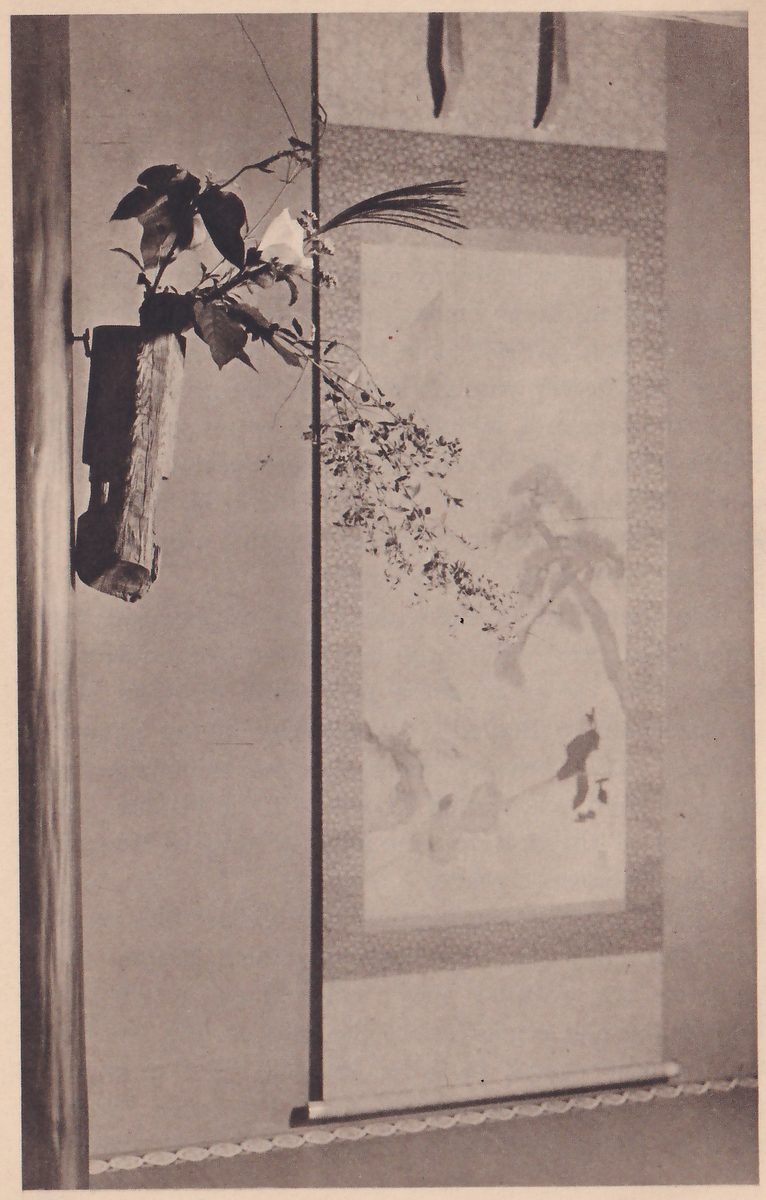
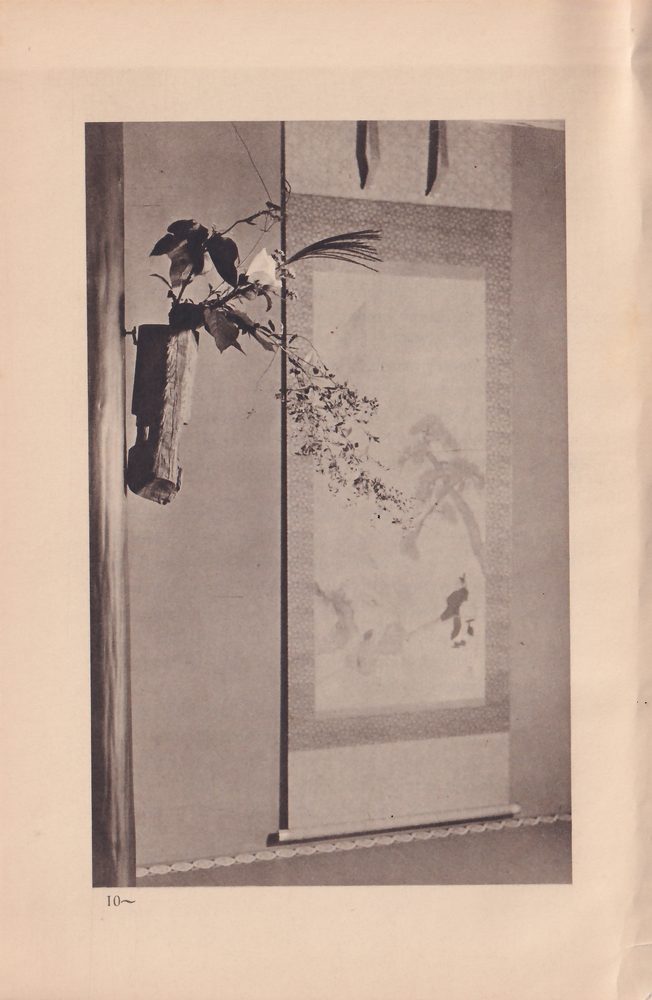
Tokonoma with Flower Arrangement. (Facing page 10)
Flowers are arranged in a vase hanging on the pillar. Note the artistic effect of the flowers produced by arrangement in harmony with the pictures in the scroll. The drawing on the scroll is by the famous artist Maruyama Ōkyo. The flowers in the vase are the seven grass flowers of autumn—a favourite theme of the poets of old Japan.
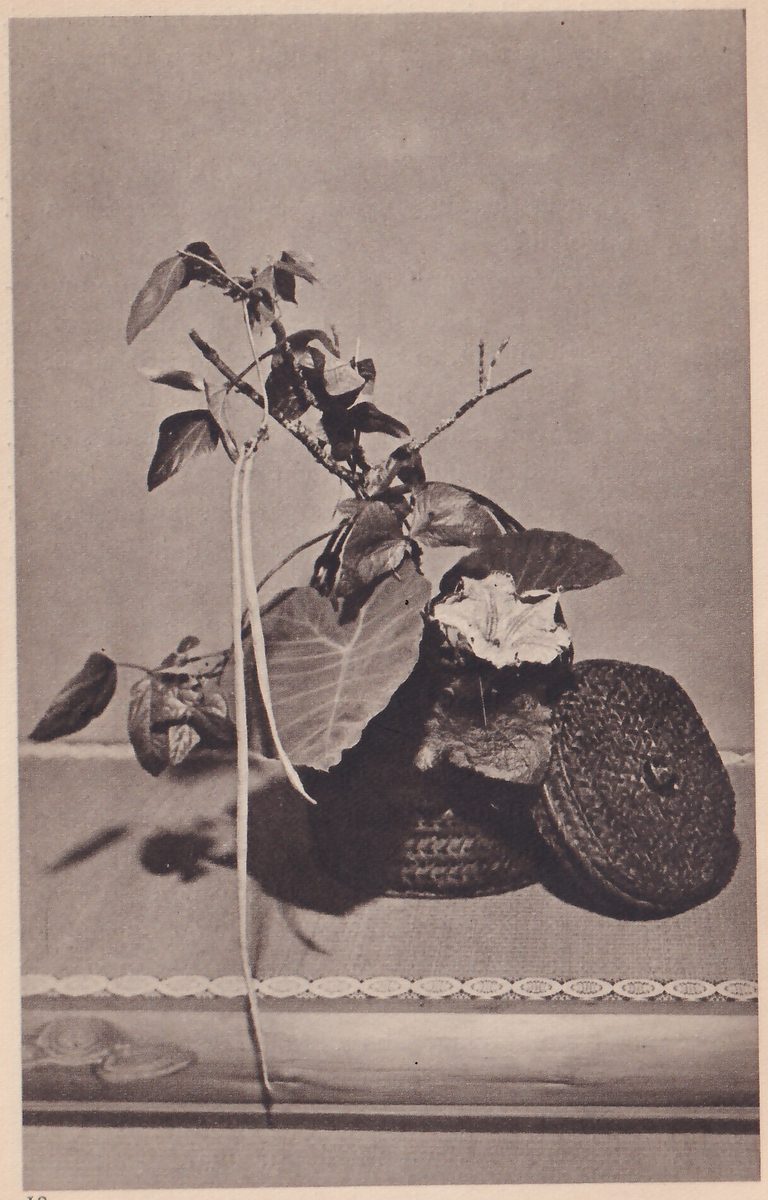
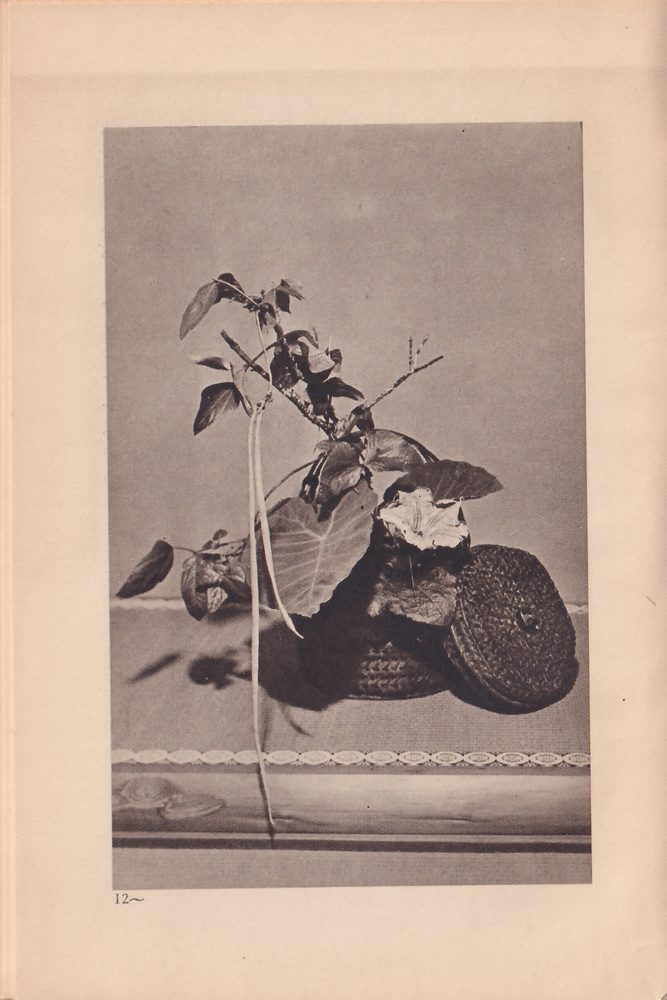
Flowers arranged in a basket. (Facing page 12)
Vase—Basket with lid
Flowers—Jūroku-sasage (vigna sinensis),
Japanese potato leaves,
Japanese pumpkin
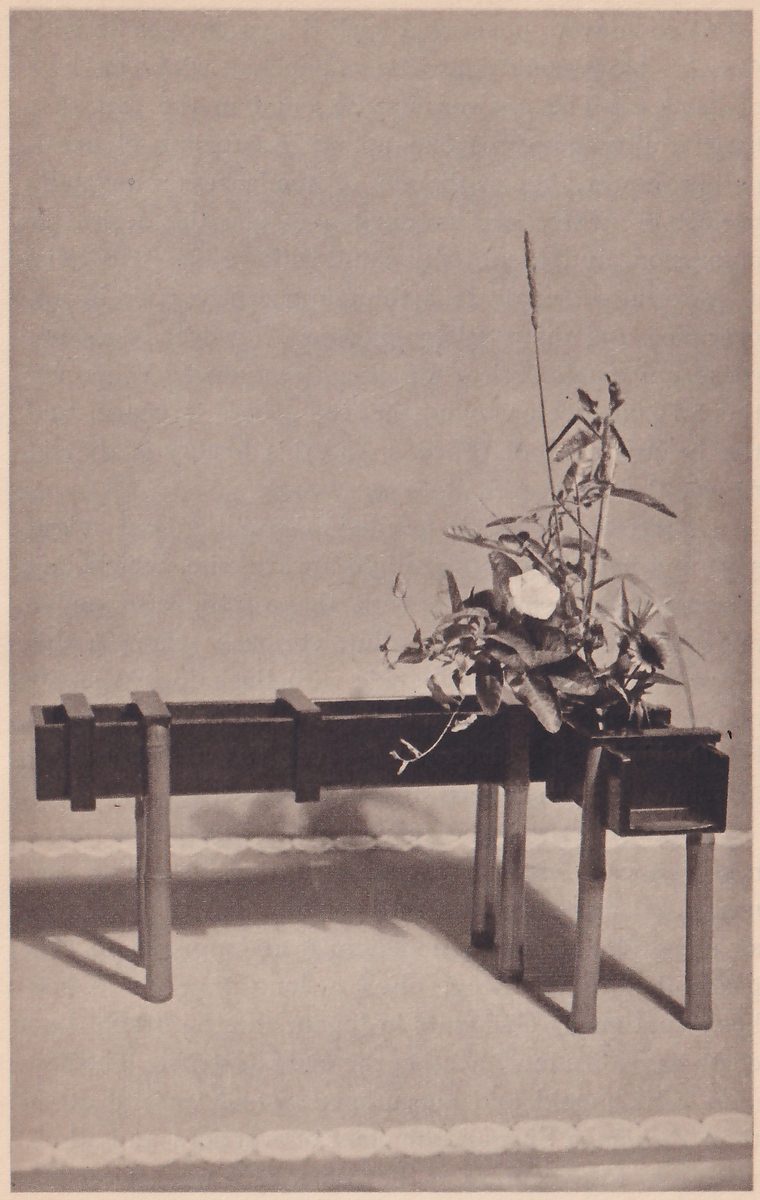
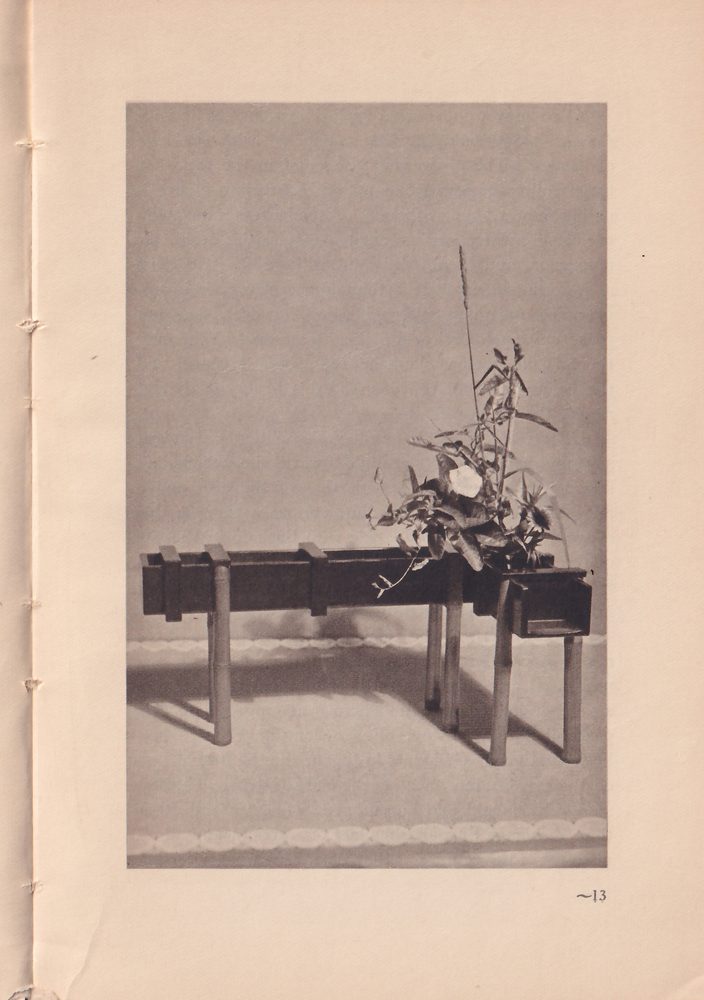
Flowers arranged in a Kakehi vase. (Facing page 13)
Vase—Kakehi (spout) vase, designed by the author
Flowers—Wild morning glory