

III. TOKONOMA—A LITTLE GALLERY OF FLOWER ARRANGEMENT
There is neither table nor chair in a strictly Japanese-style house. As Japanese sit upon the floor, which is composed of thick mats made of tightly pressed rice straw covered with fine rush matting, they find their rooms very tidy and simple. There is, moreover, no bright-coloured paper covering the walls, which are made of earth. Hence, those who have been accustomed to the bright-coloured Western rooms may feel as if they were in an unfurnished room rather than being able to appreciate its simplicity and neatness. Moreover, unlike Westerners, Japanese do not, as a rule, decorate their rooms with sculptures in a corner, vases upon shelves, or pictures upon the walls: their rooms may appear very much as if they had been deserted for a long time by their master. Why do they not decorate their rooms like Westerners, you will ask? The reply is, because there is always a tokonoma, or alcove, in the best room of every Japanese house, where a picture scroll and some flowers in a vase are displayed. If the walls were covered with bright-coloured paper, these flowers and the picture would attract no attention from the eye. The tokonoma is no other than the point of focus of the room, at which the attention of all eyes in the room is to be directed. To do
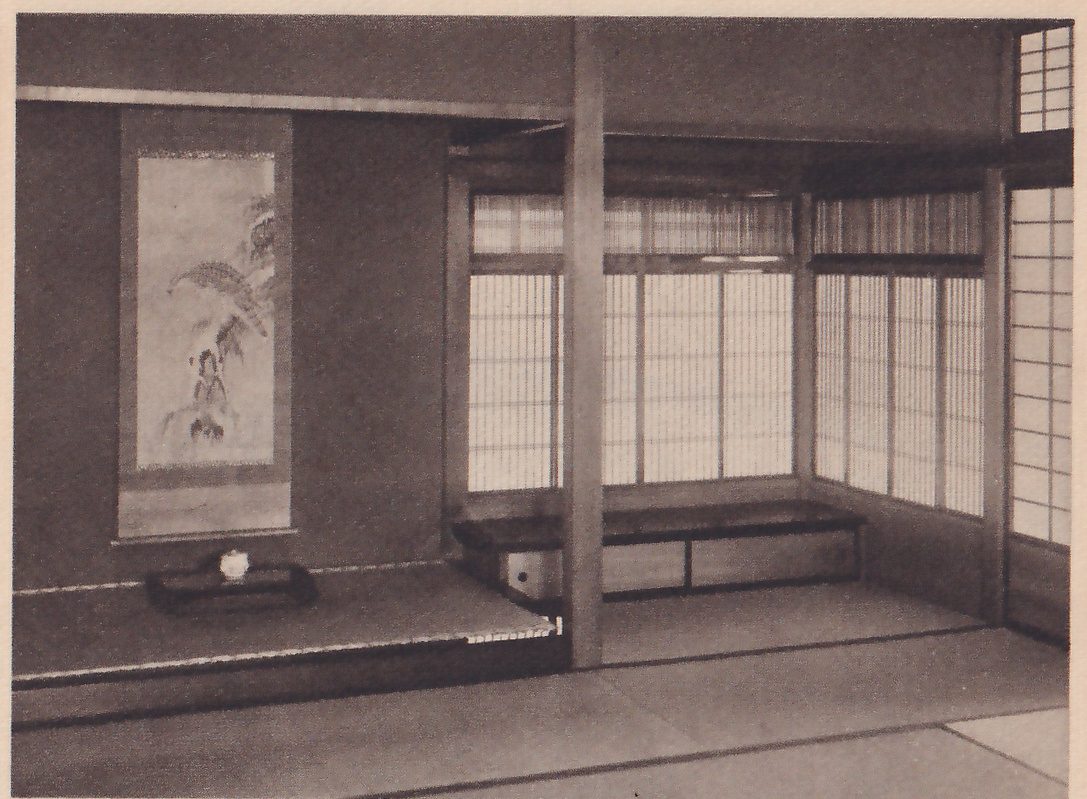
away with wall paper, to dispense with all other decorations in the room, or, in other words, to eliminate all distracting colours and designs from the room, is to give spirit and animation to the quiet, simple and yet refined Japanese flower arrangement in the tokonoma.
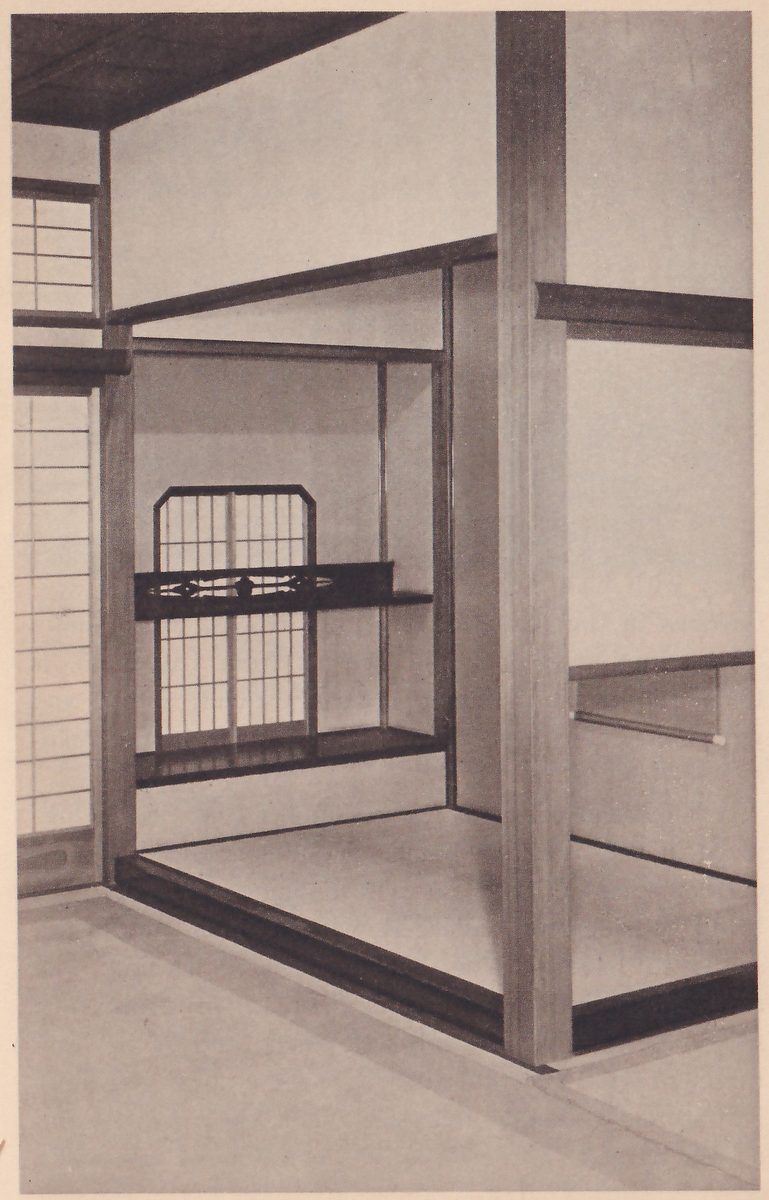
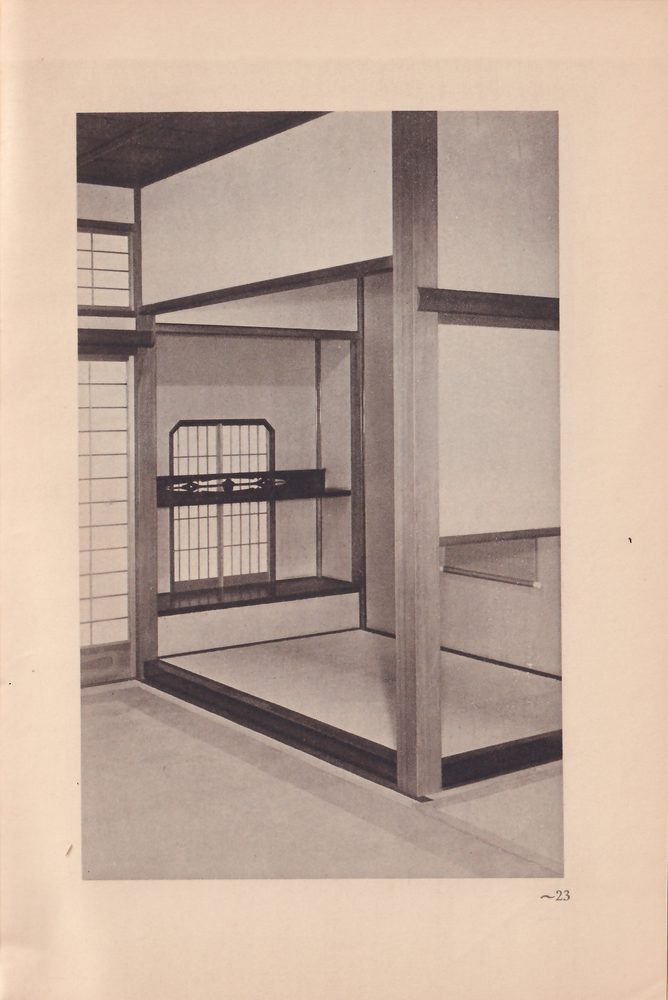
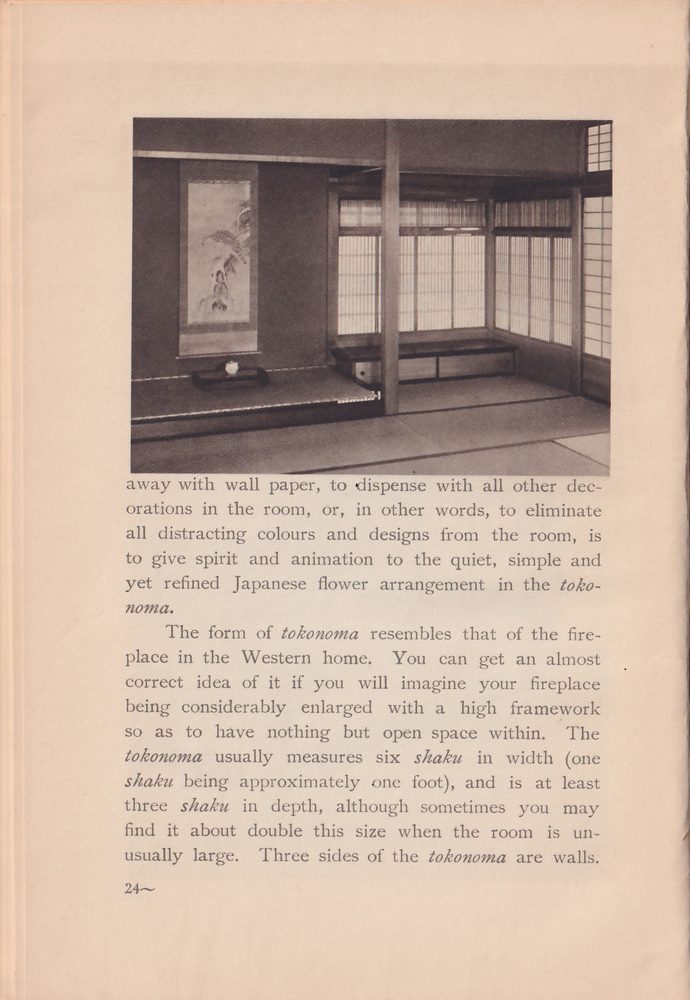
The form of tokonoma resembles that of the fireplace in the Western home. You can get an almost correct idea of it if you will imagine your fireplace being considerably enlarged with a high framework so as to have nothing but open space within. The tokonoma usually measures six shaku in width (one shaku being approximately one foot), and is at least three shaku in depth, although sometimes you may find it about double this size when the room is unusually large. Three sides of the tokonoma are walls.
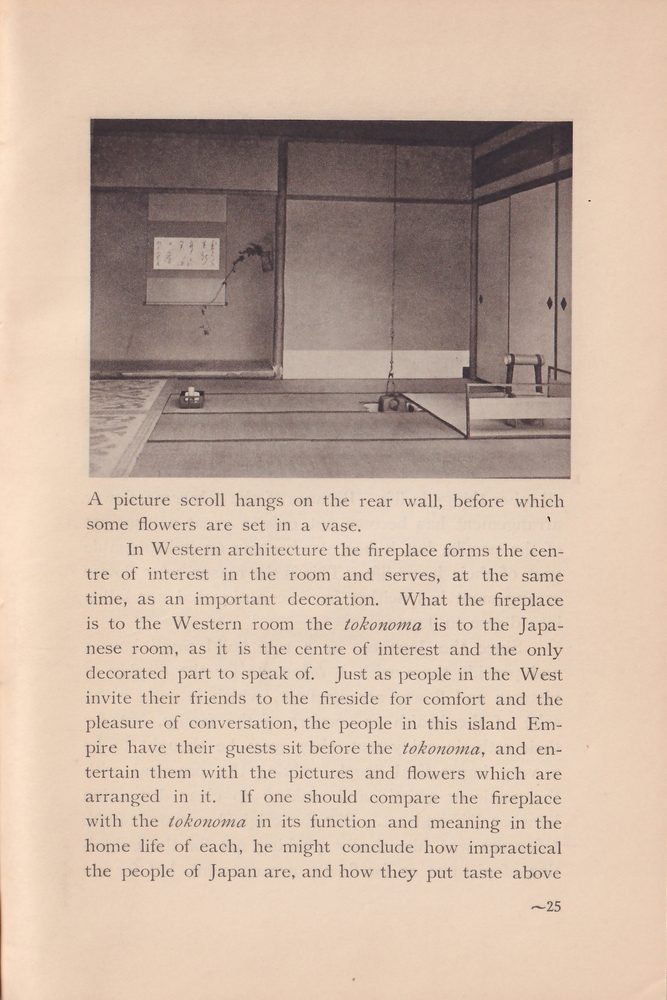
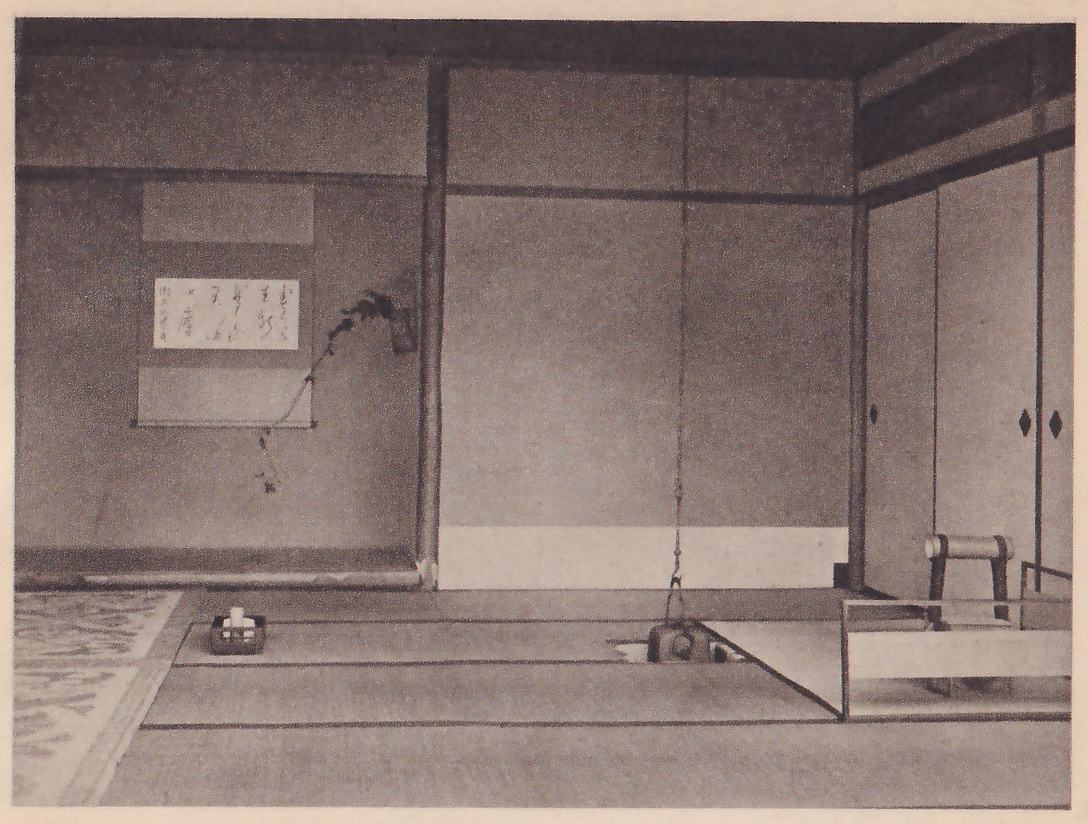
In Western architecture the fireplace forms the centre of interest in the room and serves, at the same time, as an important decoration. What the fireplace is to the Western room the tokonoma is to the Japanese room, as it is the centre of interest and the only decorated part to speak of. Just as people in the West invite their friends to the fireside for comfort and the pleasure of conversation, the people in this island Empire have their guests sit before the tokonoma, and entertain them with the pictures and flowers which are arranged in it. If one should compare the fireplace with the tokonoma in its function and meaning in the home life of each, he might conclude how impractical the people of Japan are, and how they put taste above
all other things in life. Because of the tokonoma, flower arrangement has become not only a great amusement of the people, but it has also become an indispensable part of their home life. This is the reason why flower arrangement has neither become antiquated nor fallen into disuse in Japan.
Since the Japanese as a rule build small houses and provide them with a tokonoma for the display of pictures and flower arrangement, which is not for the sake of the health or comfort of the family, but for their esthetic enjoyment, they may be thought to be a very impractical people, mixing the practical with the poetic or artistic, and making no clear distinction between life and art. But the original purpose of the tokonoma was, historically speaking, not for the exhibition of pictures or for flower arrangement, but for re-
ligious exercises. The tokonoma was, in fact, the family altar. Here was placed an image of Buddha, together with an offering of flowers and burning incense, before which in the mornings and evenings the whole family gathered together to worship. This religious use and meaning of the tokonoma gradually disappeared, however, and later the place came to have only esthetic significance. But even long after its original meaning was lost, it was somehow felt to be sacred, and it continued to be adorned with chaste flowers and edifying pictures.
The Japanese who first invented the tokonoma meant to dedicate it to the memory of Buddha; and to make the place appropriate for his abode, they set flowers before it and laid out the surrounding garden in such a way that it could be seen from the tokonoma.
In their minds, therefore, these creations were not primarily intended to be simple imitations of nature for the gratification of the esthetic sense, but for the realization of their religious ideals. Or at least they were efforts at bringing this earthly life of theirs as close as possible to that of the other world which existed only in their imagination. This fact, I think, accounts for the peculiar character of their early flower arrangement and gardening, the forms of which seem today, even to the Japanese themselves, so unnatural that they can hardly be thought to be beautiful. This is not because the men in those days were unable to appreciate natural beauty, but because they tried to improve upon nature.
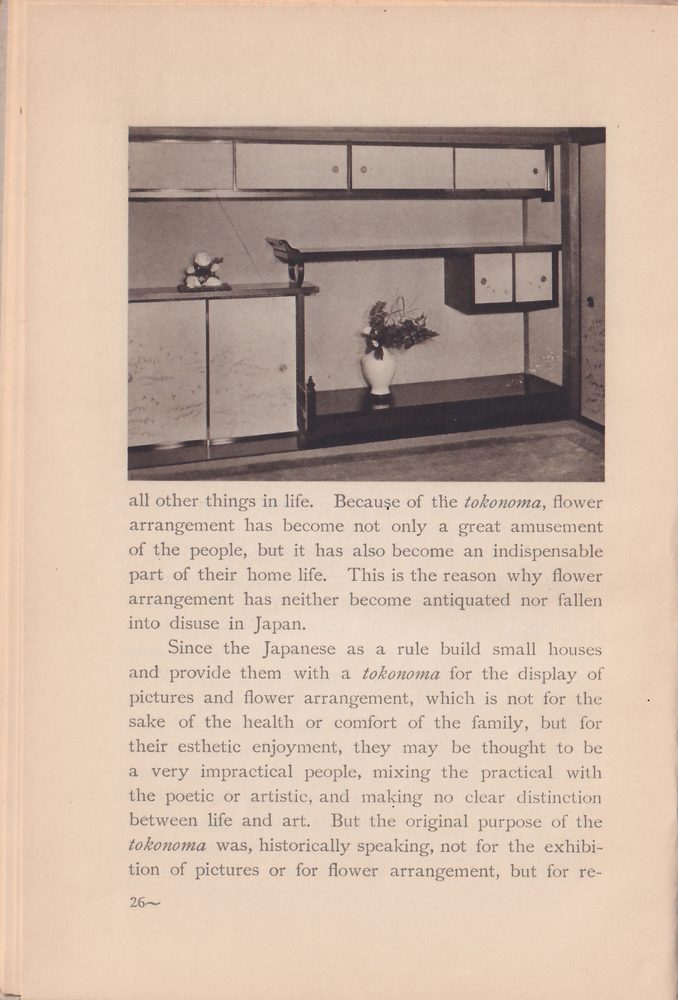
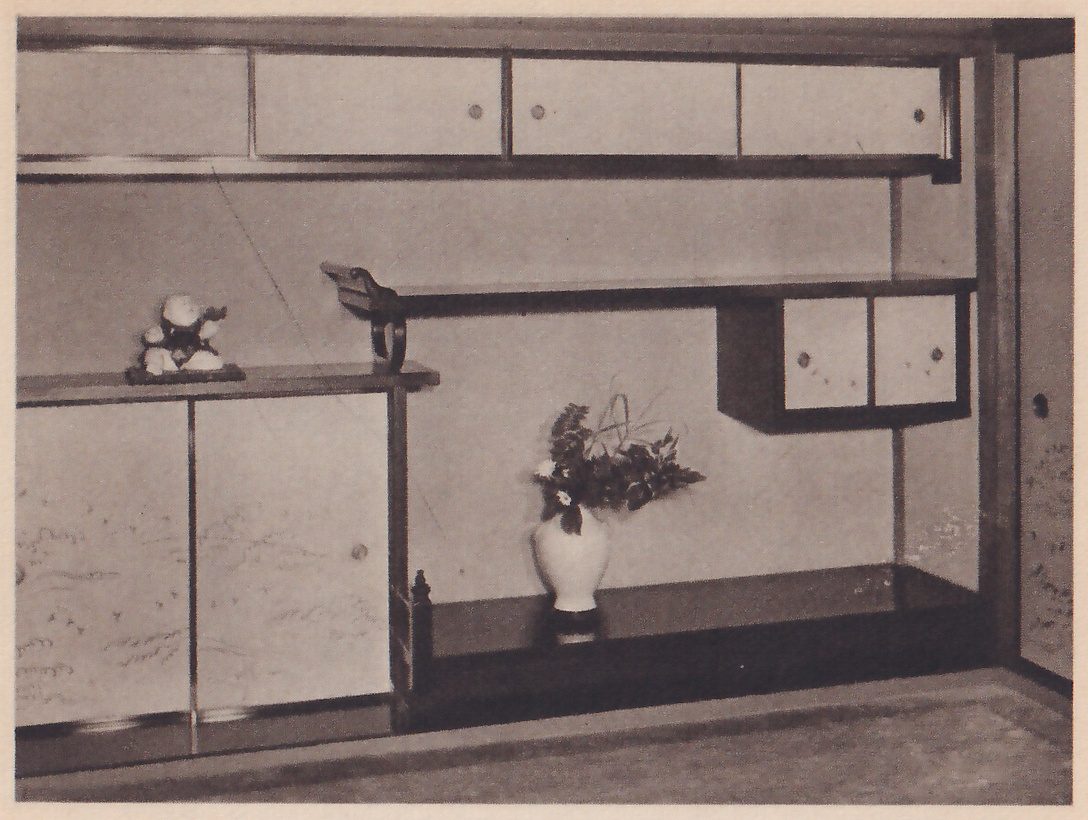
By the side of the tokonoma there is sometimes a shelf or two arranged step-wise, upon which, besides flowers, chinaware or some other objets d’arts such as raised lacquer objects may be set. Thus, this shelf may be likened to a little cabinet for the display of art wares.
The illustrations
Tokonoma in the Feudal Age. (Facing page 23)
This tokonoma is modelled after that of a temple in the feudal age. It is 9 shaku in width and 6 shaku in depth. Near the window is a little shelf, which is partly for purposes of displaying objets d’art and partly for decoration of thePrinted: the the room. This tokonoma possesses more dignity than one in an ordinary dwelling house. The pillar is of angular shape; the walls are papered like Western walls. Wall-paper with bird or flower designs is rarely found, and as the designs often mar the effect of the pictures on hanging scrolls, plain or white wall-paper is commonly used.
Tokonoma with a Study. (Facing page 24)
The best room in a fashionable house, of 15 mats size, with a tokonoma and a study. The study, or shoin in Japanese, was really a desk in olden days to be used for writing and reading. A writing-box and books were usually put upon it; over it is a bell hung from the ceiling for calling a servant. This study or desk has now become a part of the decoration of the room and serves for displaying objets d’art. The tokonoma has three walls as it is intended to display a picture scroll, while the shoin or study has a window for light.
Tokonoma in a Tea House. (Facing page 25)
Plain and simple tokonoma, with a round natural pine tree for the pillar. The lower part of the wall is papered in order to prevent the earth from falling when the tokonoma is cleaned with a broom. The paper used is often of a light black colour or it may be letter-paper which has been used and is covered with Japanese writing. This tokonoma is 6 shaku in width and 3 shaku in depth, with a picture scroll on the rear wall and flowers in a vase hanging on the right side wall.
Step-like Shelf. (Facing page 26)
The adjoining room to the one shown in No. 7, showing a step-like shelf, with flowers arranged in a vase, and a wooden sculptured piece on it. On this shelf such articles as stones, bonsai, raised lacquered boxes, china, art-picture books, or scrolls may be placed. The shelf is made of mulberry wood, the dark brown colour of which provides a pleasant contrast with the light blue colour of tatami, Japanese matting, on the floor.
Room with Two Tokonomas. (Facing page 27)
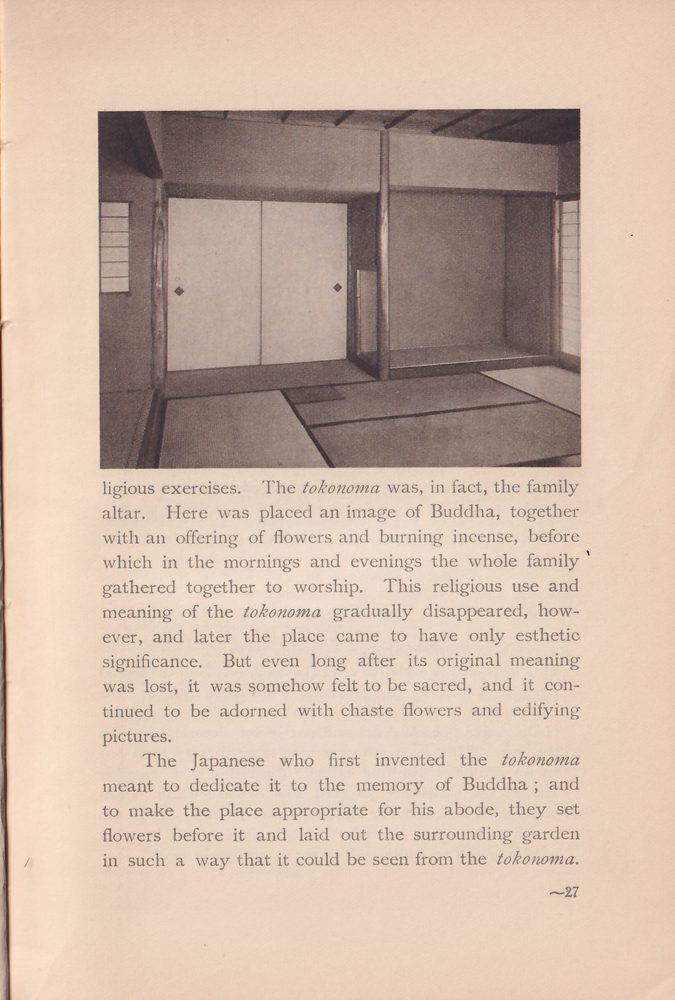
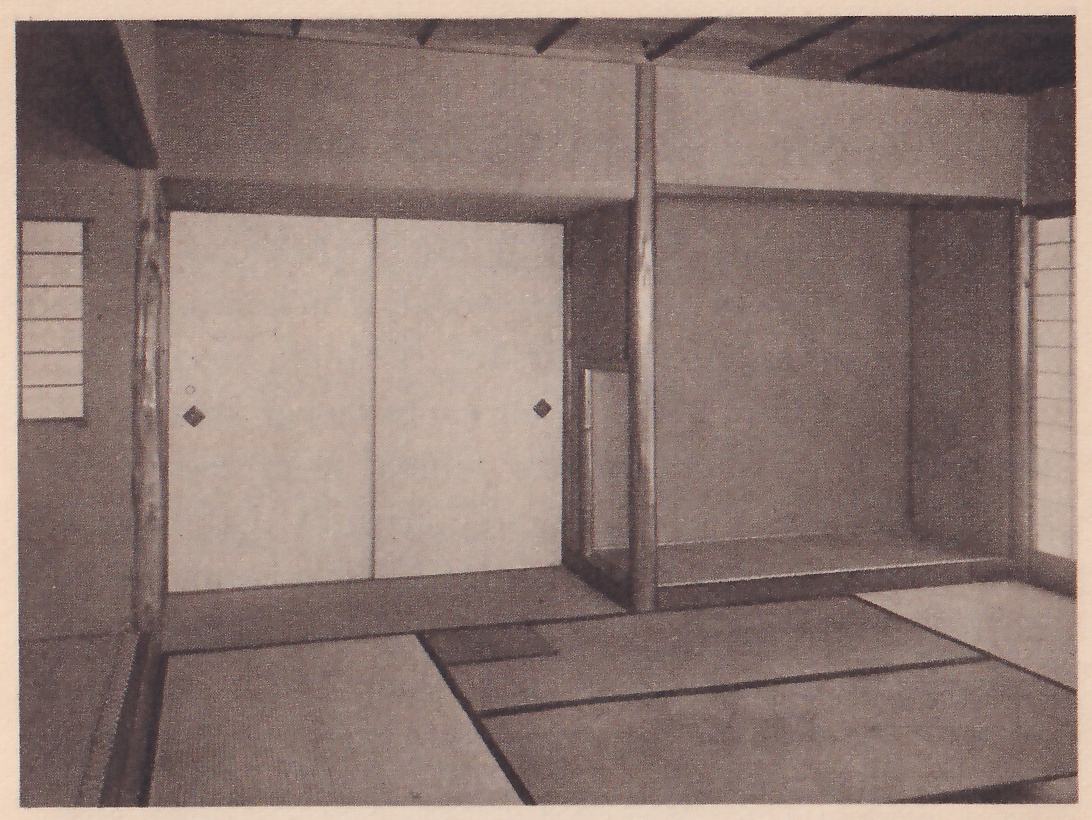
Room of 9 mats size, with 2 tokonomas side by side. This room is in the author’s house. One tokonoma is for picture scrolls, the other for flower arrangement. The tokonoma for flower arrangement is 12 shaku in width and 3 shaku in depth; the tokonoma for picture scrolls is 6 shaku in width and 3 shaku in depth. The pillar is a round cedar tree; the frame of the side window is made of bamboo; the low ceiling appearing in the picture is called “earthen ceiling,” or a ceiling covered with earth very much like the walls in a room.