

VII. RIKKWA AND NAGEIRE
Both the rikkwa and ten-chi-jin styles are formal, while the nageire style is free and natural. The difference between these two styles, however, may appear very slight to foreigners, though it is quite clear to the Japanese eye. But the differences in the method of arrangement may be very easily discerned. Rikkwa and ten-chi-jin both have a flower-holder at the mouth of the vase. This holder is a wisp of straw in the rikkwa, and in the ten-chi-jin is a forked tree branch or twigs crossed like the letter X, through which the flowers or branches are to be arranged. In ten-chi-jin the length and the angle of each branch, or of heaven, earth, and man, are fixed, whereas in rikkwa the shin branch is arranged vertically, the other branches being put at the left, the right, and in front of it. These branches may be tied with wire to the shin or main branch, and a bamboo water-container filled with flowers may be attached to the middle of the main branch. The water-container is usually covered with large tree leaves such as the leaves of the loquat.
Such a use of wire, bamboo water-container, and the like, in the rikkwa style, if regarded as mere decoration, need be no obstacle to its appreciation by generously minded people. But to most Japanese, who are always particular about even minor details in any art, and regard flowers as something sacred to
natural life, these devices or inventions are really sacrilegious and hence repulsive. The love of naturalness, especially in connection with flower arrangement, seems to be one of the characteristics of the Orient, as the same thought is found in the writings of a certain Chinese on floral art. He, too, observes that the binding of the roots or branches in flower arrangement is really sacrilegious to the art.
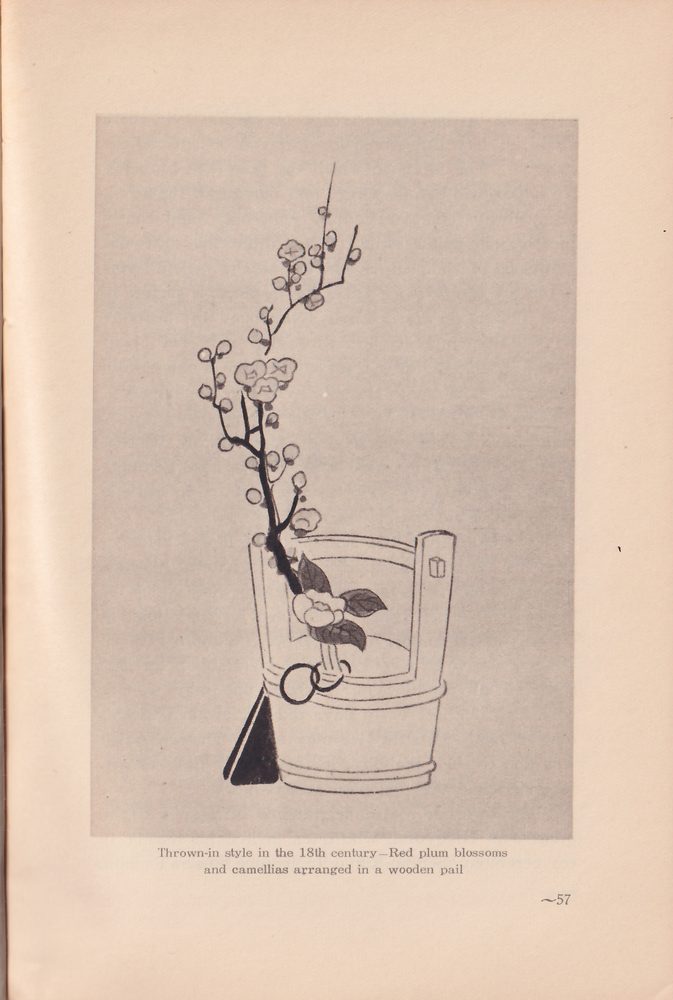
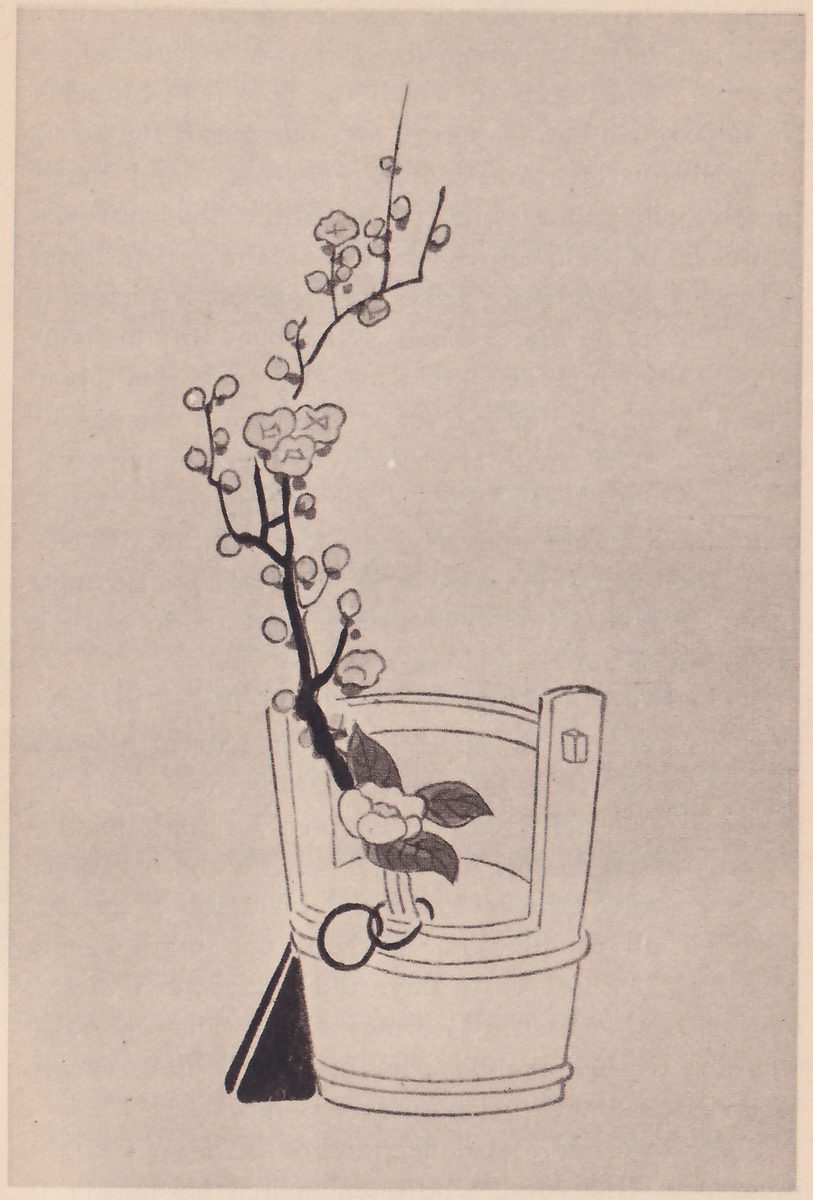
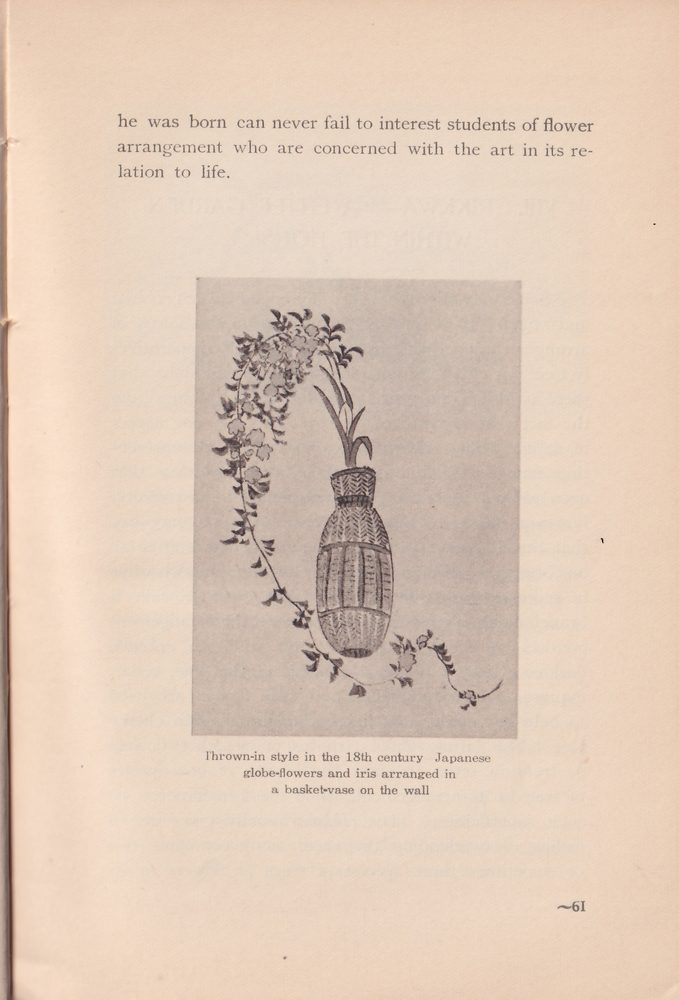
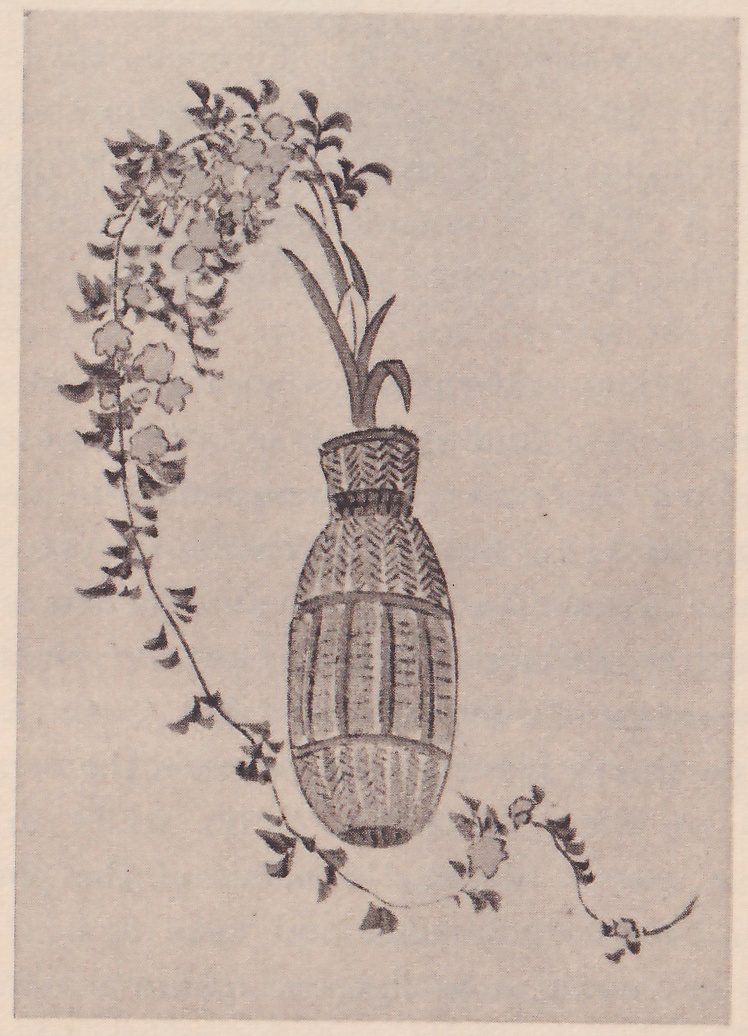
The school which has abolished all these devices in arrangement is nageire or the thrown-in style. According to this style, flowers are to be arranged in a vase as naturally as possible, no matter what the flowers or branches may be. Of course, there must be some balance or beauty maintained, even when the branches are not all made to stand perpendicularly. To illustrate this, a beautiful stream cannot be obtained simply by digging a formal ditch for water to run in; to be beautiful the stream must make its own natural way. The fundamental conception is that great beauty will be found wherever there is no artificiality. To find and express natural beauty in whatever or wherever it may be is the end and aim of nageire—the simple and natural form of flower arrangement.
The materials to be used in floral art are natural flowers, leaves or branches of trees. It may be supposed that all flowers are alike. Yet upon examination they will be found to be quite different from one another, just as human faces, though they seem to be of the same cast, are really different from one another. This is the view held by a certain master of floral art. If the forms of flower arrangement were rigidly pre-
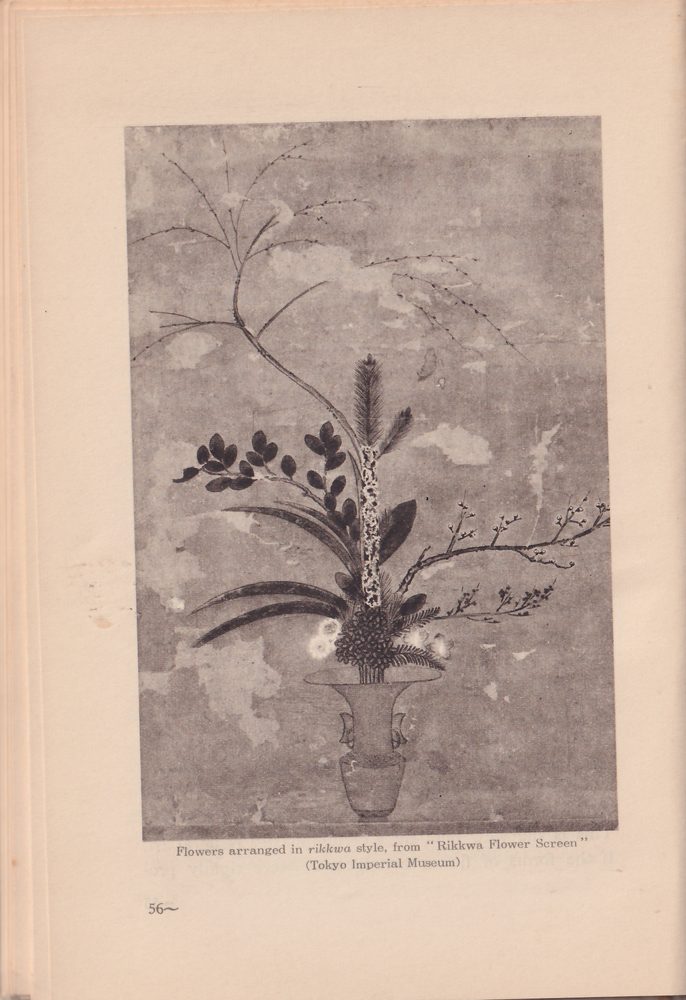
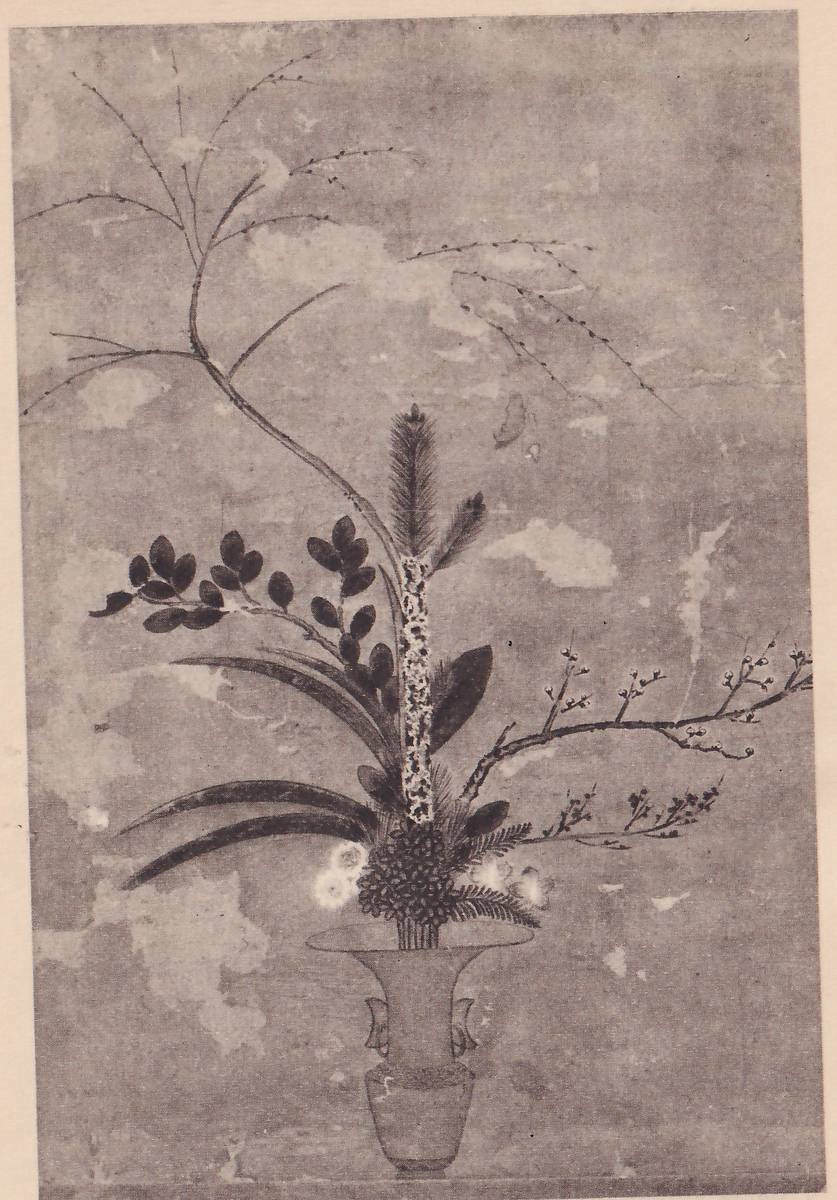
(Tokyo Imperial Museum)
scribed as in the rikkwa or the ten-chi-jin style, there would be very little room for variation or personal expression. The forms to which the flowers or branches are subject will become forced and unnatural, the result being always characterized by uniformity, and consequently quite uninteresting. The truth of this statement is attested by the pictures which show the ancient forms of the art of rikkwa. Take, for instance, a picture of lotus flowers in the rikkwa style found in the book called “Contemporary Rikkwa Style,” published about 1700. The lotus flower represented there is unnaturally twisted to conform to the rikkwa or the standing style. As this style is primarily for the arrangement of trees, such plants as the lotus having a form entirely different from trees are hardly suitable for this style of arrangement. The result of such arrangement and its esthetic value can easily be imagined.
Therefore from the standpoint of flower arrangement as the art of appreciation of natural flowers, nageire, which does not prescribe any rigid rules for flower arrangement but leaves room for variation according to the nature of the flower, is more rational and progressive than rikkwa which invariably prescribes rules for all the flowers. Perhaps one may wonder why men in those early days did not awaken to this obvious truth. To this we may simply answer that it was due to their inability, in those early days of art, to understand the real nature of things.
We owe our real understanding of nageire to the great man Hideyoshi, who often invited his master of tea ceremony, Sen-no-Rikyū, to arrange flowers for him.
We are told that he invited this master even to his war-camp because of his enjoyment of the art. Moreover, he himself, it is said, took pains to learn flower arrangement. A certain master of tea ceremony tells in his diary that one day when he was invited to a tea party held at the Osaka castle, then the palace of Hideyoshi, he saw some daffodils beautifully arranged in the tokonoma, which, to his great surprise, was Hideyoshi’s own art.
Rikyū, the master of tea ceremony, was equally famous for the art of flower arrangement, and specially skilled in the nageire style. This is evidenced by the fact that he stood high in the estimation of Hideyoshi, and also because his style in the nageire school has preserved his name to this day. He conceived the art of nageire to be essentially spiritual. Hence he left no book or writing on the subject. He seems to have considered the art as hardly admitting of any explanation in words. To him words seem to have been inadequate to communicate the true meaning of the art. When Nanbō, one of his disciples, (as is told in his writings) one day showed his master the notes he had taken from Rikyū’s instruction in the floral art, and asked him if they were true, the master answered that they were true, but that such writings would be misleading to posterity, and so advised him to burn all he had written.
In the notes taken down by Nanbō there is a saying attributed to Sen-no-Rikyū, that most detestable of all in the thrown-in style is to make an interesting show of your arrangement. The best in the floral art,
he seems to say, is the unforced, or natural. Of course, what is found in nature will often be fragmentary, and therefore can hardly be called an art. The emphasis laid by Rikyū is upon the naturalness of arrangement. He is here cautioning against the overdoing of decoration or artificiality. The deeper one penetrates into the understanding of nature, the more conscious will he become that natural beauty far surpasses the artificial, and he will appreciate simple and unadorned beauty more than anything else. Then these words of Rikyū will become most significant in the appreciation of the art of simple and natural arrangement, or nageire.
Again, when we consider the age in which Rikyū was born, we may realize the value of his saying. Born in the age of the civil wars, or in the latter part of the 16th century, and having lived seventy years, this man must have seen many of the evils of civil war, and though his ability was recognized in later years by Hideyoshi, yet his tragic life ended in opposition to this great warrior.
It is indeed interesting enough to think that this tragic man, being born in such an age of bloodshed and slaughter, lived all his life ever hateful of artificiality as the source of all evils, and insisted on naturalness in all things, especially in the art of flower arrangement, as being the true fount of life and beauty. Men born in a peaceful age sought beauty in artificiality, while those born in the age of turmoil and war found beauty and true joy only in things simple and natural. Above all, the fact that a man’s attitude towards flowers reflects the character of the age in which
he was born can never fail to interest students of flower arrangement who are concerned with the art in its relation to life.