

VIII. RIKKWA—“A LITTLE GARDEN WITHIN THE HOUSE”
Some may think that the difference between rikkwa and nageire is in the degree of fixity in the forms of arrangement, one being rigid and the other comparatively free. A closer examination, however, will show that there is also a difference in feeling, which comes from the fact that nageire tries to represent only one aspect of nature, while rikkwa makes an attempt at representing nature in miniature. True, one may say that even rikkwa can never represent nature in its entirety, however much it may try. Therefore, one may say that the difference between the two schools is after all one of degree, and not of kind. However, the two ways of representation differ widely. For example, take a branch of cherry blossom. In nageire, the arrangement consists of cherry blossoms only, while in rikkwa, besides a cherry branch, branches of the pine, cedar, cypress, bamboo, camellia, and even azalea are used to help in creating a background for a mountain cherry tree. The latter school requires many other flowers or trees in order to show the beauty of one species of tree in its arrangement, while the former needs no such superfluities. Thus rikkwa usually gives one a feeling of overloading the vase, as it combines two or sometimes three species of trees or flowers in its
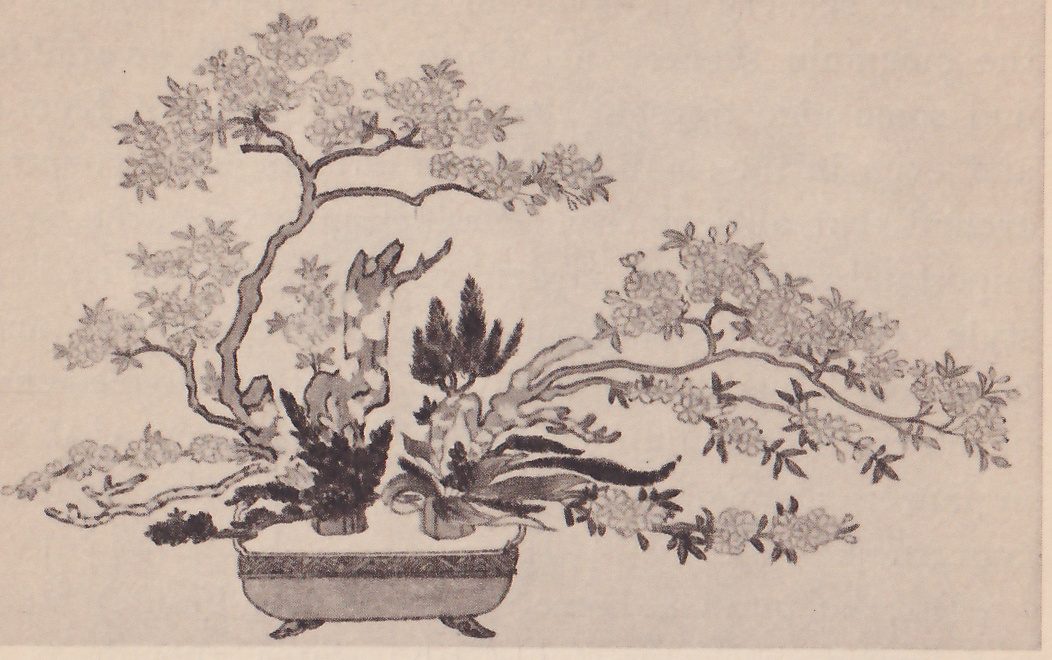
arrangement. This perhaps may be overlooked, and yet, to represent a landscape by means of flower arrangement is to approximate floral art to that of gardening. And although landscape gardening may have some elements in common with floral art, since both make use of natural flowers and trees, these two arts—landscape gardening and floral arrangement—should be kept distinct and never be confused with each other.
In any case, when one looks at rikkwa, one cannot help thinking that by means of flower arrangement it has built up a miniature landscape; hence the rikkwa style may better be called “a little garden within the house.”
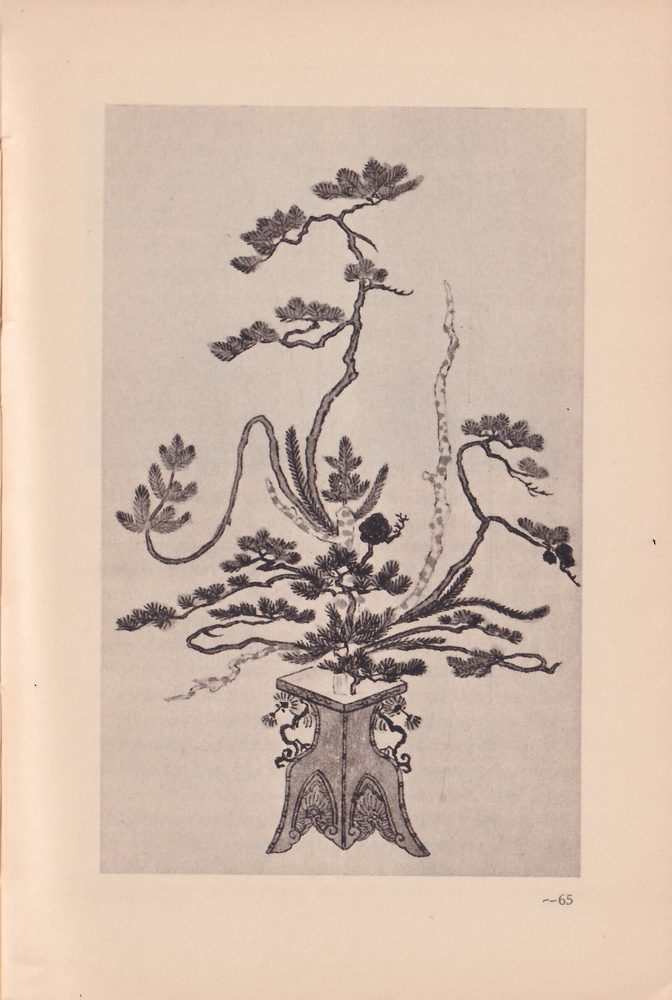
In rikkwa there is always a pine tree of five or six feet in height arranged in the centre of the vase. This tree represents the beauty of Japanese landscape, since the pine is an indispensable element in the sandy
seashore scenery or mountain views, and especially in the mountain scenery at Kyoto. You will invariably find some pine trees in the famous gardens of Kyoto, and even in the small gardens of farmers in the country around that ancient city. Besides pine trees, the most important trees for a garden, as well as for the rikkwa style of arrangement, are cedars, cypresses, and bamboo. Thus it may easily be seen that the elements or materials constituting a garden are the same as those in flower arrangement, as far as the rikkwa style is concerned.
In the garden, however, there are, besides trees and flowers, rocks or stones, and water, though as a rule no flowers were cultivated in gardens after the 17th century, it being thought that flowers in the garden might lessen the effect of those arranged in the tokonoma. In any case, important materials which produced the beauty of landscape gardening were invariably utilized in the rikkwa style of floral art. This might have been an incidental result, as the rikkwa school had at first no intention of creating a miniature landscape garden through floral arrangement. But the founder of the rikkwa school was the famous landscape gardener, Sō-ami, and therefore the suspicion that he may have arranged flowers just as he would have laid out a garden may not be unreasonable. And it would make no difference whether or not he was conscious that the same principle was operating in him, if the result in either art was virtually identical.
So keeping this in mind, if one looks at rikkwa more closely, one will find some other things which
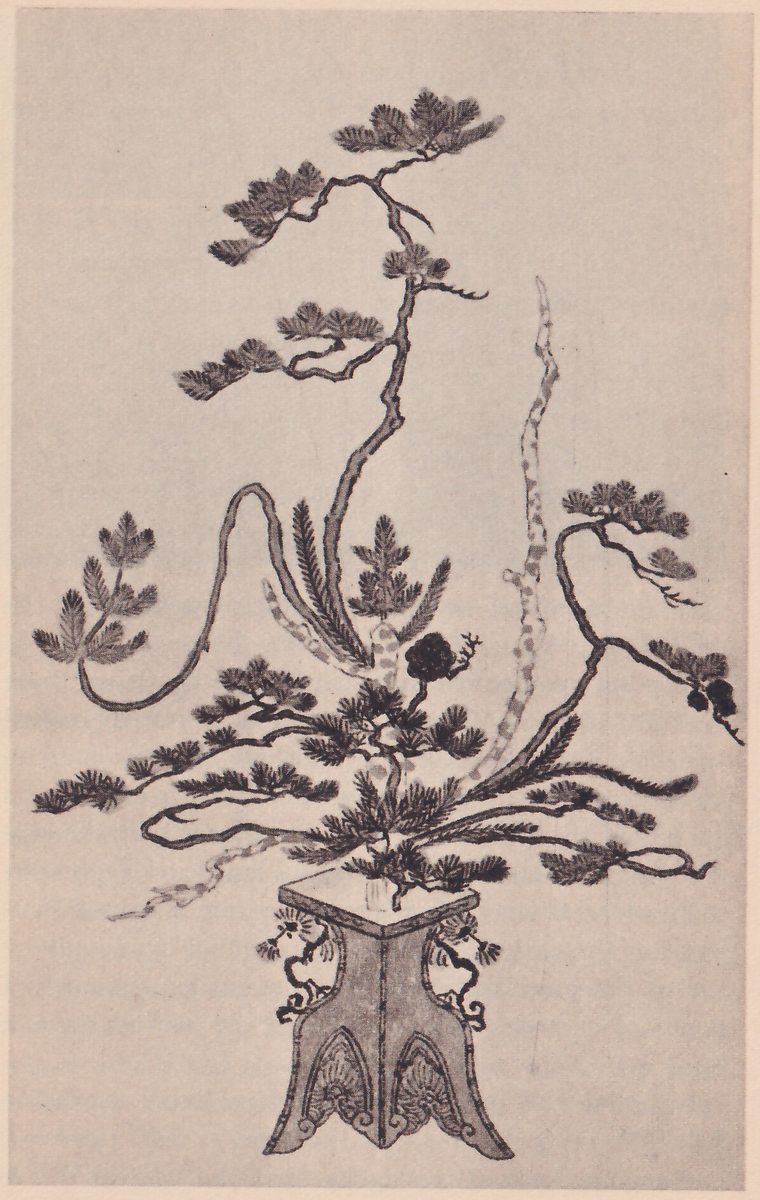
greatly resemble gardening. There is sunamono (“sand-arrangement”), which is an arrangement of flowers in a bronze vase, in which is spread white sand. It has been called “sand-arrangement” since sand is always used, and the vase is called a sand-vase. In the days of Sō-ami white sand covered a part of the garden ground. In the Ginkakuji garden you may see white sand, upon which the traces of sea-waves are represented by the sweeping of bamboo brooms. White sand is found in such gardens as those belonging to the Daitokuji Temple, the Ryōanji Temple, Nanzenji Temple, and other famous temples in Kyoto. The green pine trees growing in the white sand suggest perhaps to one that since Kyoto is in a mountainous district, far from the seashore, the people there planted green pine trees amid white sea-sands in their gardens as the symbol of the land of their heart’s desire.
In the same period in which rikkwa flourished there was also in use a form of decoration popularly called bonseki. Bonseki consists of a lacquered wooden plate partly covered with white sand and with a stone upon the sand. It is intended to suggest a rock by the seashore, or a seascape. This artificial landscape represented by bonseki may be regarded as one means of expressing the artistic sense for gardening by supplying one of the essential elements in a garden, namely, a stone. But stones are not used in the rikkwa style of floral art.
Again, the use of the term rikkwa, “standing flowers,” in contrast to the ordinary term ikebana, “arranging flowers,” to signify that the central flower
is arranged in vertical position in the vase, and the frequent use of risseki, “standing stones,” instead of a term meaning “arranging stones,” in laying out a garden, shows that there were here elements common to both rikkwa and the art of gardening.
The rikkwa style or school has become old-fashioned; it is now an antiquated form of the floral art. As it was not able to maintain itself, it has lost its hold upon the people of today, and is therefore rarely seen. For information on the subject the student of this style of arrangement now has to resort to the Ikenobō School at Kyoto, which is perhaps the only school which has preserved this form, or to the ceremonies of the Shin sect, the Jōdo sect, or the Zen sect (in which this style of arrangement is often presented), or to the old books and pictures depicting this style of

arrangement.
About forty years ago I learned this style from my father and continued its study for a number of years. The above statement in regard to the rikkwa style is therefore the result of study based upon my own experience and also upon standard writings on the subject.
The illustrations
Sunamono, the sand arrangement, in the 17th or 18th century (Facing page 63)
Rikkwa, the standing style of floral art, in the 17th or 18th century (Facing page 65)
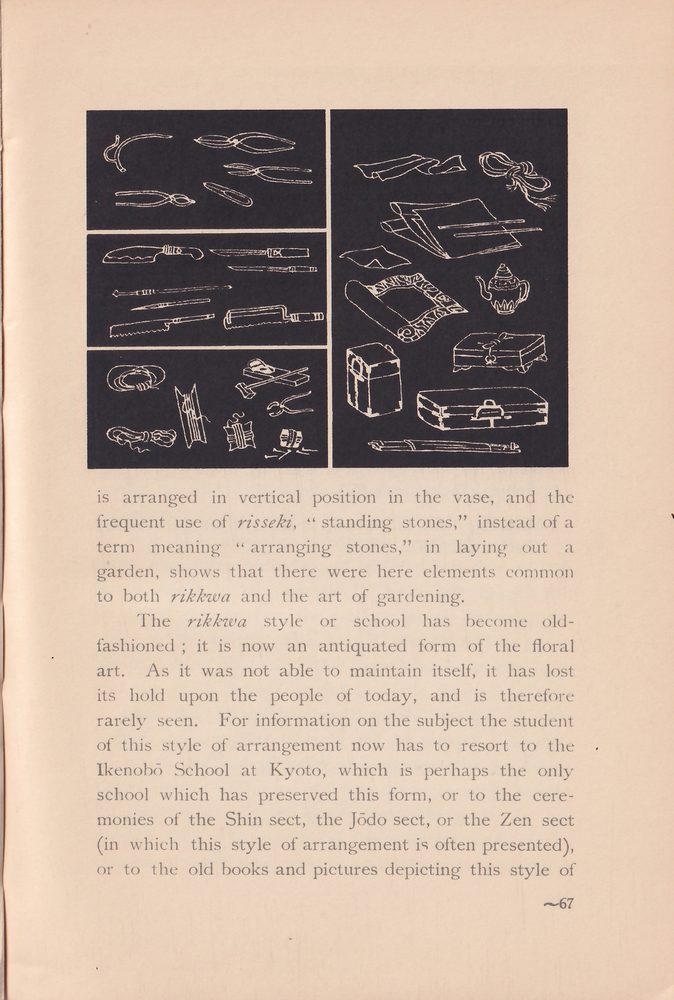
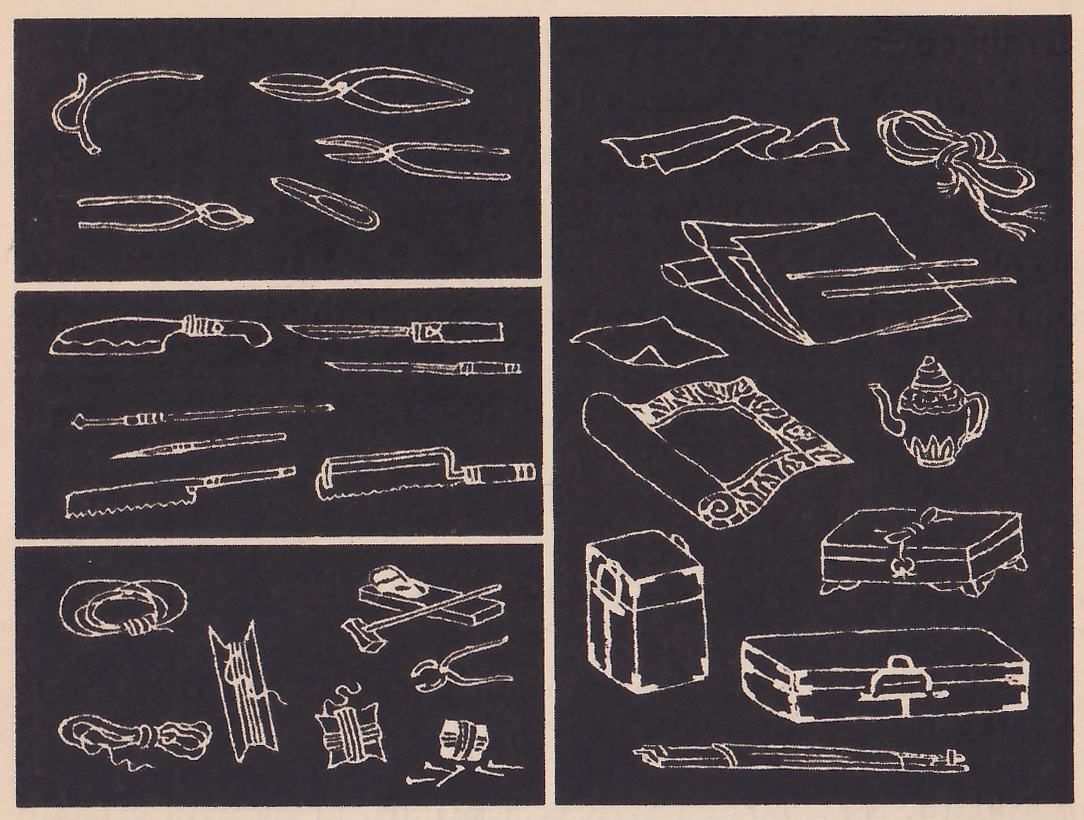
Instruments used in rikkwa, in the 17th or 18th century (Facing page 67)