

V. THE HISTORY OF JAPANESE FLOWER ARRANGEMENT—HISTORICAL CENTRES OF THE ART
The Ginkakuji Temple and the Ashikaga Shogunate
Those who have visited Japan are most likely to have seen a temple called Ginkakuji and its beautiful garden in Kyoto. As the temple is one of the most famous sights in that ancient capital, the guide will not fail to take you there, if you visit the city. It is built at the foot of a mountain on the outskirts of the town. Passing by a dozen or so of the straw-thatched farmhouses standing as of old on either side of the road leading to the gate, you will enter the temple yard where you will behold some old pine trees with their green needles, growing out of the clean white sand, upon which traces of the sweeper’s broom are clearly seen. You will be impressed by the neatness of the ground and the artistic quality of the building, and may say to yourself, “This is certainly a silver pavilion!”
This Ginkakuji Temple, or “Silver Pavilion” as it has been called by foreign visitors, is the birthplace of Japanese flower arrangement. Cha-no-yu, the tea ceremony, also originated here. When the mountain was the seat of the Ashikaga Shōgun’s villa long, long ago, a small house of four and a half mats in size was
dedicated to the memory of Buddha for the purpose of family worship, and this became, we are told, the first tea house in Japan. The temple itself was built by the eighth Ashikaga Shōgun, or Ashikaga Yoshimasa, who was a representative of the aristocracy of that time, as he was the head of the samurais as well as chief government administrator. But being tired of mundane affairs, and having abdicated his seat in the government to his son Yoshihisa, he retired to this place and built a villa which included a beautiful garden and a three-storied temple, the ceiling of which he ordered to be plated with silver. Hence it came to be known as the Ginkakuji, or the “Silver Pavilion.” The villa served the purpose of viewing the mountains afar, the gardens around, or the flower arrangement within; gatherings for the tea ceremony and incense-burning were also held there. The incense-burning was called kōdō in Japanese, kō meaning incense and dō way, the object of which was to burn incense and to enjoy its fragrance. The men who gathered here enjoyed themselves in these games—they are, indeed, hardly to be called games, so quiet is their nature,—for they loved so quiet a life. This was about the year 1478, or four and a half centuries ago.
A born Shōgun, a high aristocrat, and the most powerful of all rulers, such as Yoshimasa, might have given himself up to pomp and luxury, and have spent a life of debauchery. Such was, however, by no means the case. Forsaking all the affairs of the world, he retired to the lonely foot of the mountain, and contented himself with viewing such inanimate objects as trees, stones,
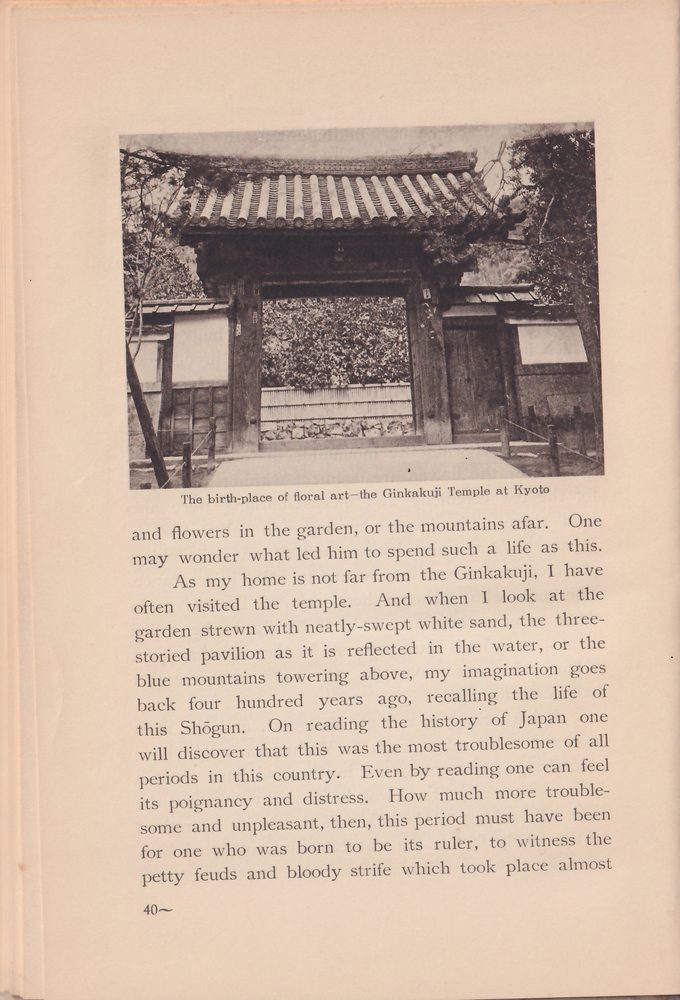
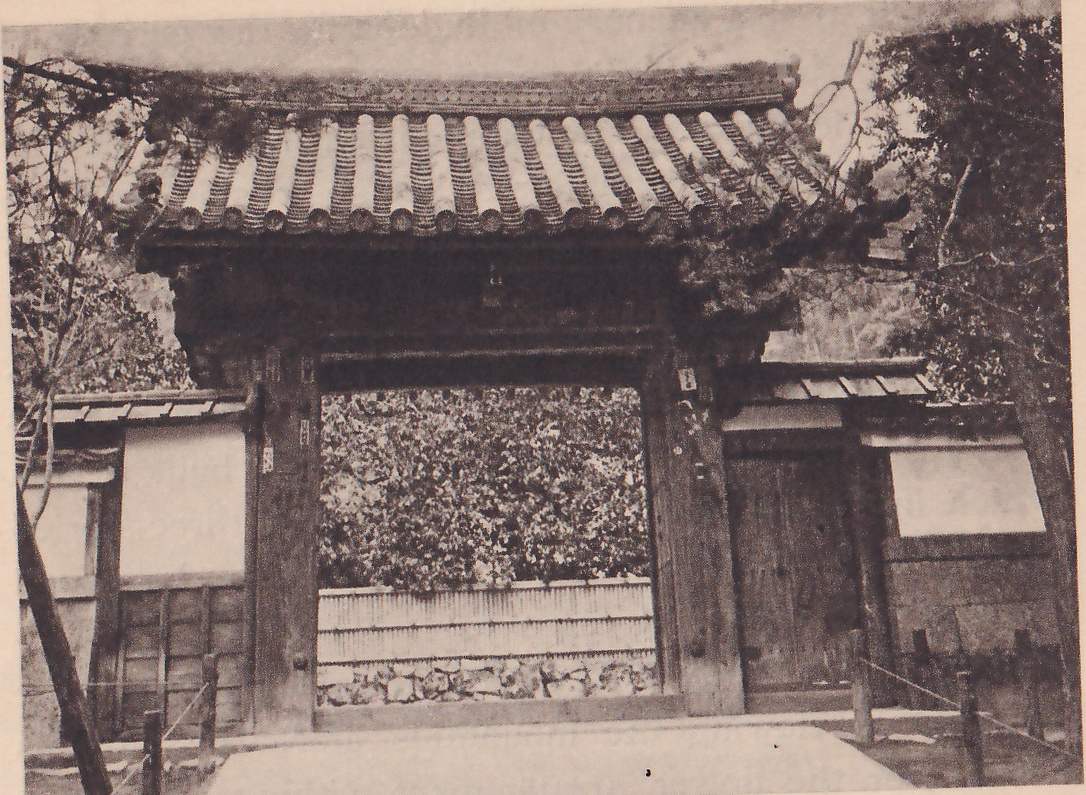
and flowers in the garden, or the mountains afar. One may wonder what led him to spend such a life as this.
As my home is not far from the Ginkakuji, I have often visited the temple. And when I look at the garden strewn with neatly-swept white sand, the three-storied pavilion as it is reflected in the water, or the blue mountains towering above, my imagination goes back four hundred years ago, recalling the life of this Shōgun. On reading the history of Japan one will discover that this was the most troublesome of all periods in this country. Even by reading one can feel its poignancy and distress. How much more troublesome and unpleasant, then, this period must have been for one who was born to be its ruler, to witness the petty feuds and bloody strife which took place almost
every day among the lesser nobles or samurais. How relieved he must have felt when he retired to this villa and quietly sipped his tea in a room (about 9 ft. square), while looking at the mountains in the distance, the trees and stones in the garden, or the simple flower arrangement in the tokonoma!
The Japanese see an exemplification of fūryū, or elegant life, in Yoshimasa: they have called him the fūryū Shōgun and great master of tea ceremony. As may be easily seen, it was the troubles and sorrows of life in this world which gave rise to the life of fūryū: to forget these troubles and anxieties, to heal the wounds of life, was to lead a life of fūryū, to apply oneself to tea ceremony, flower arrangement, or to lay out a garden like that of the Ginkakuji Temple. Therefore, it may be said that fūryū can hardly be appreciated by any except those who, like Yoshimasa, having a keen sensibility, have drunk much from the bitter cup of life.
Yoshimasa’s statue is installed in the Hall of the Ginkakuji Temple. The figure represented there is a monk with shaven head and wearing priestly robes. When he lived at the Ginkakuji, he seems to have had a few attendants (chabōzu, “tea-priests”) who looked after the tea ceremony and flower arrangement for him. From the names of these attendants, which were such priestly names as Sō-ami, or Gei-ami, and also from the priestly robes which they wore, we may rightly infer that life at the villa was very much like that of a regular priest in a Buddhist temple. And from this it follows that to see flowers in a vase, to drink tea, or
to breathe the perfume of incense, was to do a priestly service at a Buddhist temple. So we may not err in thinking that these men at the Ginkakuji Temple must have learned the art of flower arrangement, or the tea ceremony, in the same way as a priest attained his enlightenment at a temple, dedicating his heart and soul to the one and eternal Buddha above, and forsaking all the affairs of the world below.
Among these attendants of Yoshimasa’s the one who was best versed in the art of flower arrangement seems to have been Sō-ami. His father was called Gei-ami, and his grandfather, Nō-ami. These three were able teachers of Yoshimasa as they all had skill in drawing pictures as well as a knowledge of the tea ceremony, besides a mastery of the art of flower arrangement. But Sō-ami was specially famous for his talent in the art of gardening. The garden of the Ginkakuji Temple is said to have been of his design. As for the art of flower arrangement, there is a book called “Gojō Shikimoku,” the writing of which is attributed to him. The book shows his deep knowledge in the art, and also makes clear the great influence which he exerted upon the art of flower arrangement at that time.
The Temple Rokkakudō and Ikenobō Senkō
Besides Sō-ami, there are in this period Ritsu-ami and Mon-ami who were both famous in the floral art. Ritsu-ami was an attendant of Yoshimasa, and as appears in his diary, was often asked by the Shōgun to arrange flowers. After Sō-ami came Ikenobō, the priest
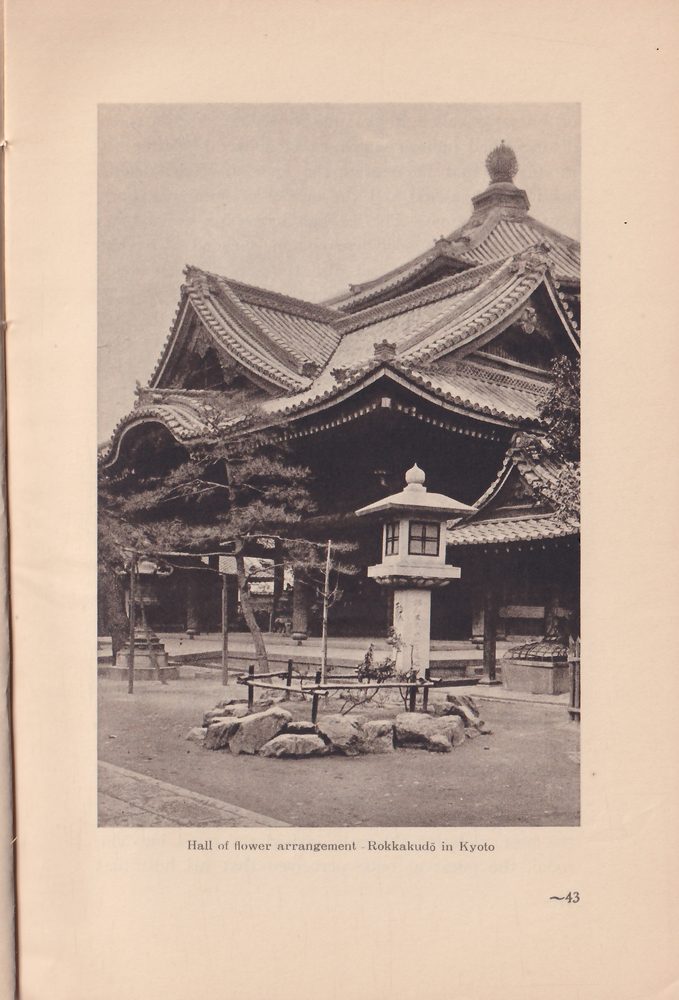
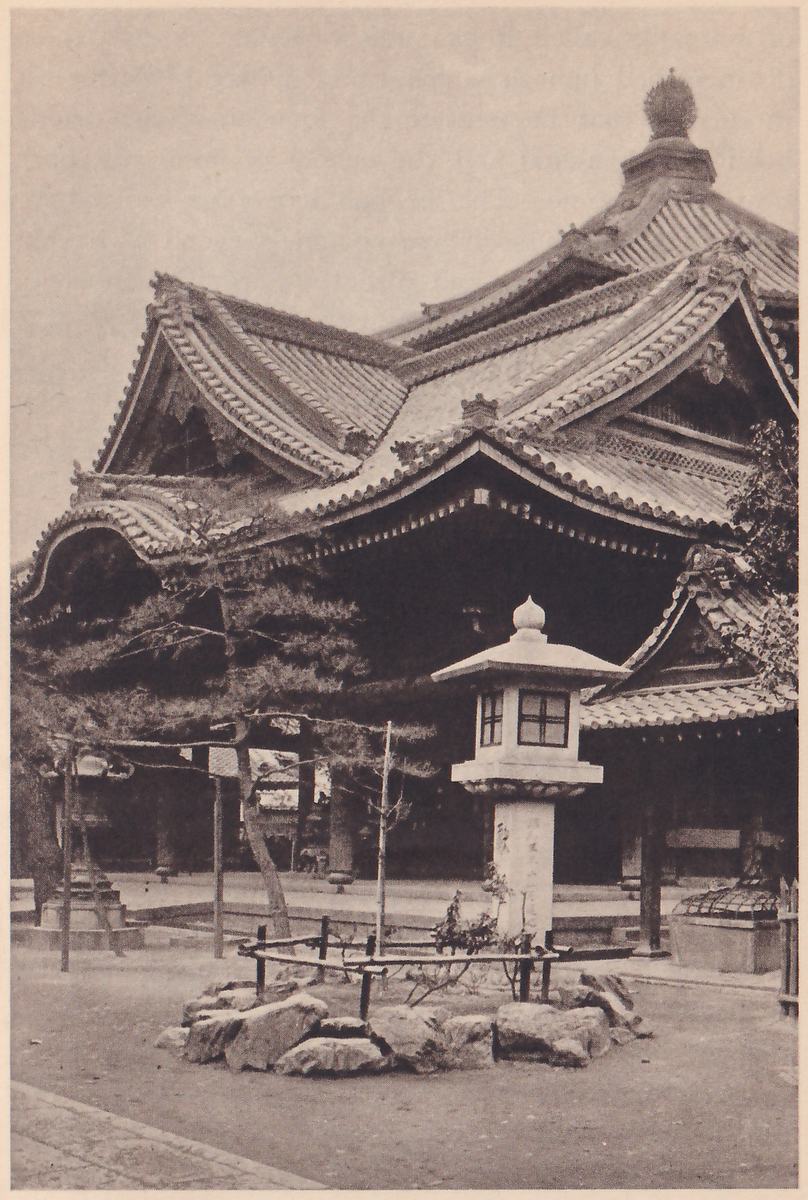
of a temple called Rokkakudō in Kyoto, who later so distinguished himself as priest and master of flower arrangement that he became the founder of the priesthood at Rokkakudō and the school of floral art, both bearing his name. The Ikenobō School has existed for more than four hundred years and is proud of having the longest tradition and also the largest number of students throughout the country.
Among the masters of the Ikenobō School the one who specially excelled in the floral art was Ikenobō Senkō, who flourished in the 17th century. For the first time in the history of the art he is said to have arranged cherry blossoms in a vase so beautifully and so attractively that ever since the style has been called “Senkō’s Single Colour Arrangement of Cherry Flowers.” A sketch of it is still extant, and to this day the style has been kept up by his followers as one of his great secrets.
The following story is told of Senkō, the master of floral art:
One day a party was held at the house of Konoe Ōzan, a powerful aristocrat of those days. It happened that Senkō had just returned home from his travels and called on him just before the tea ceremony was to begin. The master of the house was greatly pleased that he had come, and requested him to go to the tea house and arrange the flowers for him. This Senkō did. However, in tea ceremony as a rule, the flowers should be arranged by the host himself. And when the host, violating this rule, invited the guest into the room, the guest at once perceived that his host had
not arranged the flowers and said, “The flowers must have been arranged by Senkō himself. But as I hear that he has been travelling these days, may I ask when he returned home?” Thus the host’s trick was easily discovered.
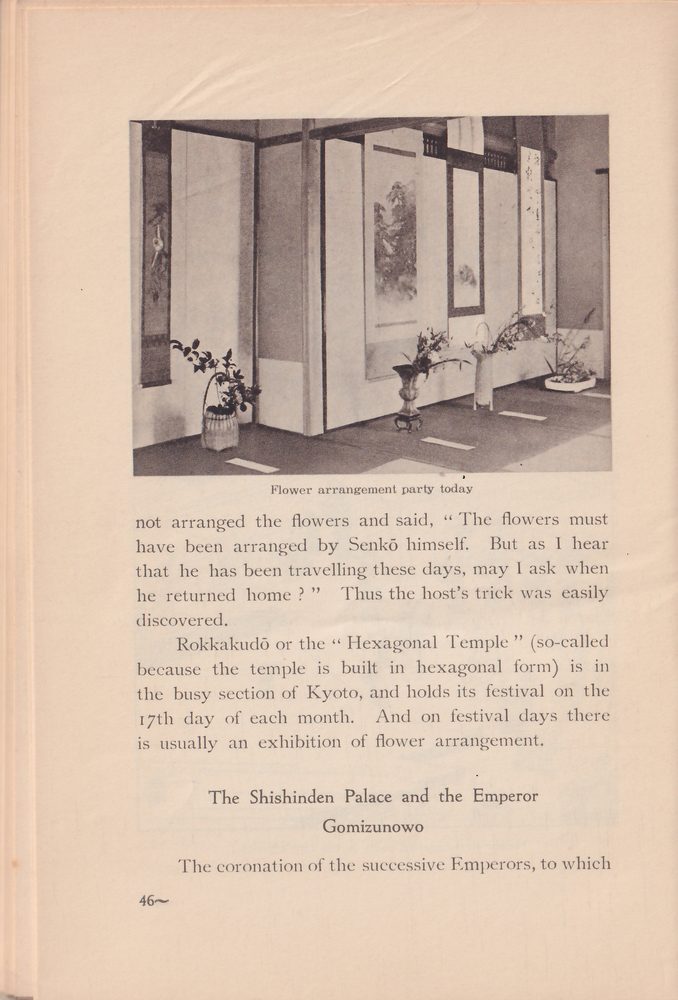
Rokkakudō or the “Hexagonal Temple” (so-called because the temple is built in hexagonal form) is in the busy section of Kyoto, and holds its festival on the 17th day of each month. And on festival days there is usually an exhibition of flower arrangement.
The Shishinden Palace and the Emperor Gomizunowo
The coronation of the successive Emperors, to which
the military and civil officers of the State and envoys and ambassadors from foreign countries are invited, is held at the Shishinden Palace in Kyoto. This palace has a very interesting connection with the history of Japanese floral art.
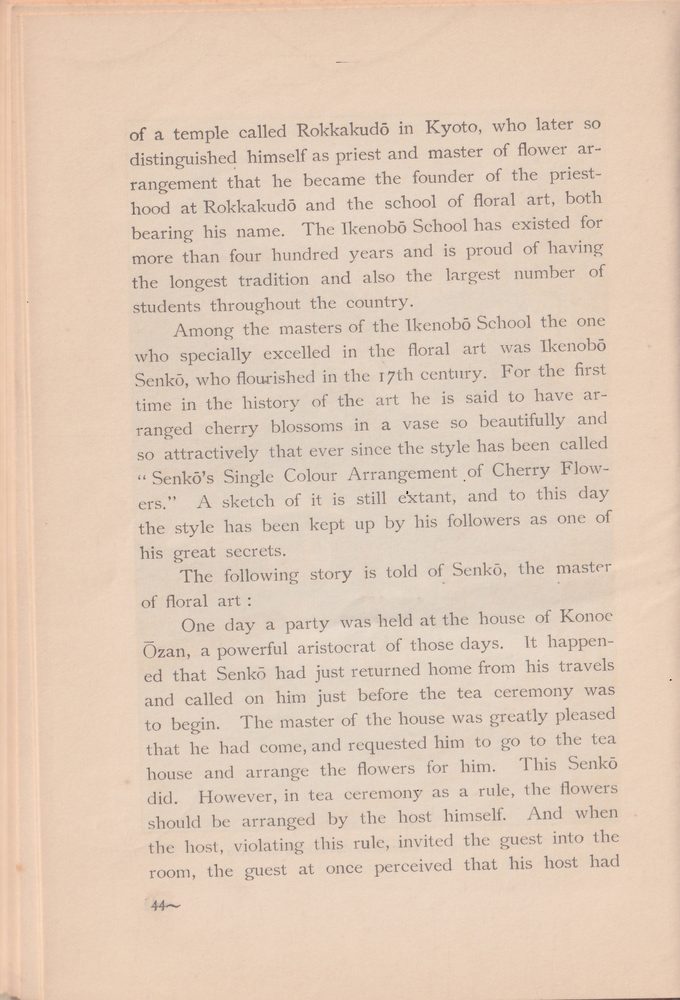
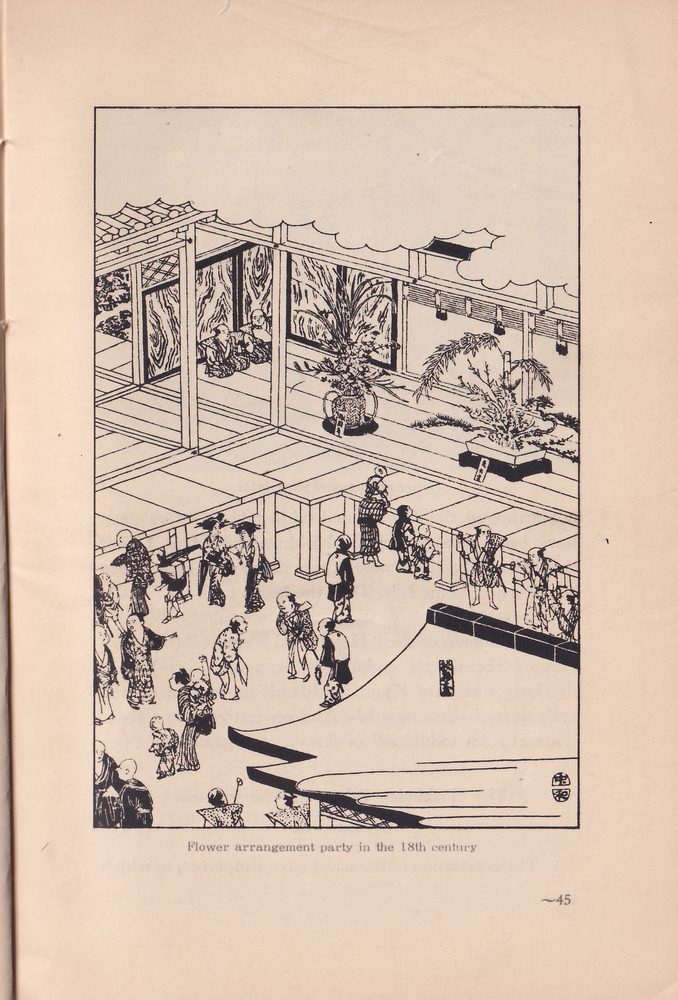
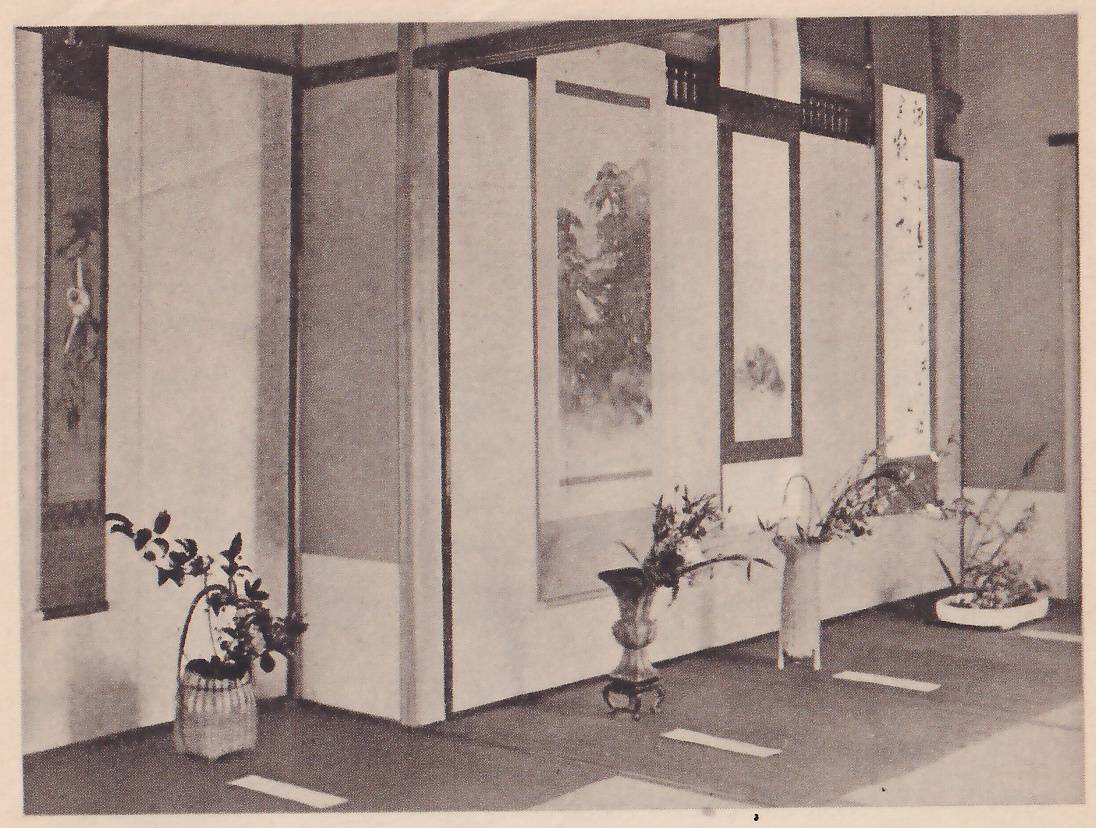
During the 17th century a certain Emperor took great interest in the art and mastered it himself. Because of this, a great many courtiers, nobles and high officials gathered together at court, and the art of flower arrangement became very fashionable among them. A hall had been provided in the court for the tea ceremony, to which all the masters of tea ceremony were invited, and an exhibition of flower arrangement was held to the delight of all the cultured people. The Emperor’s own art was exhibited in the court, while that of high officials or of the masters among the commoners was shown in the house which had been temporarily built for that purpose in the garden before the palace. An account of this significant event in the history of Japanese floral art is given in a book called “Kwai-Ki.” The author compares the event with the great tea party held by Toyotomi Hideyoshi of historic fame. Such exhibitions of flower arrangement were held frequently during the 18th and 19th centuries, but that the Emperor himself should appear as an exemplar of the art and show his own productions to the public is quite rare. That the palace which is the centre of political affairs should thus be opened for floral art is unique in the annals of the Empire.
This wise and cultured ruler was the Emperor Gomizunowo, who had, besides a mastery of flower
arrangement, an appreciation of gardening. The garden in the Shugakuin Villa in Kyoto, which is regarded as a representative garden in Japan, was created at this Emperor’s request, and it seems that he had often visited the garden during his lifetime. As there are many points common both to flower arrangement and gardening, the garden must have been laid out in a large measure according to the Emperor’s own design.