

VI. TWO GREAT SCHOOLS OF FLOWER ARRANGEMENT—THEIR HISTORY
The Formal School versus the Natural School
The best-known style of flower arrangement in Japan is probably the one called ten-chi-jin or heaven-earth-man. Lately nageire, or the thrown-in style, has come into vogue. Besides these two, however, there has been a still older style called rikkwa, or the standing style. Of the nageire style there have been two schools, the older and the newer. Of course, there have been innumerable schools or styles belonging to both of these. But we may note that there have been roughly four great schools, and these four may be classified into two groups, namely, the formal and the natural.
The term ikebana came to be applied to the floral art of Japan in the early part of the 19th century, before which the term rikkwa had been synonymous with the art. The rikkwa in its day was more complex and solemn in form than the ikebana style, and was called the “true style,” being considered the only correct and representative form of the art.
The rikkwa style has a definite form of arrangement, which is called the “seven branches.” This later developed into the “nine,” and still later into the “eleven branches,” when the art became a pastime
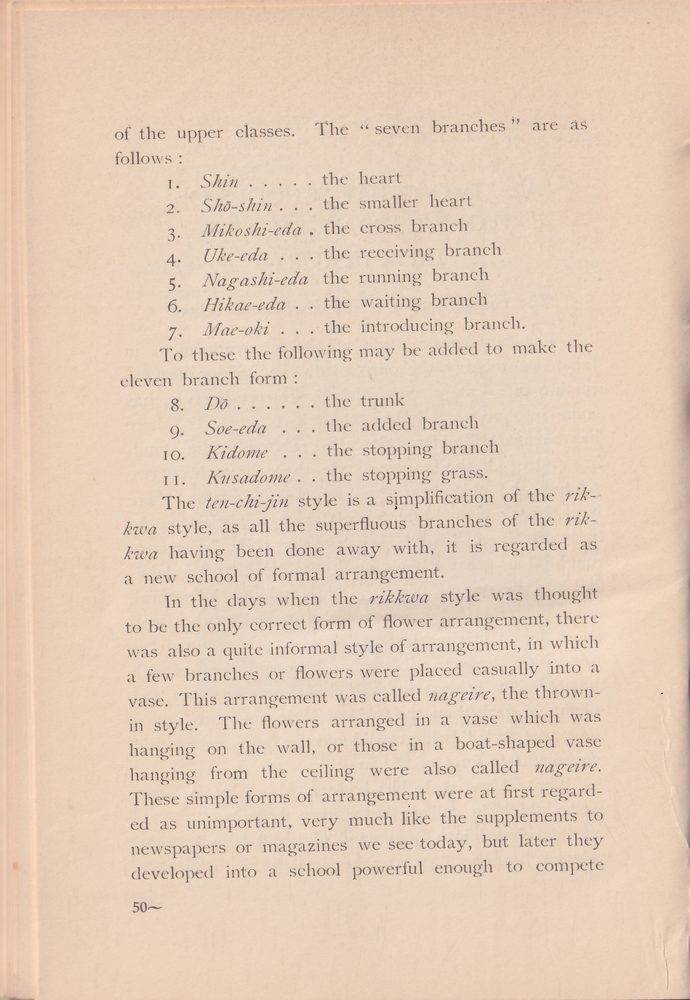
of the upper classes. The “seven branches” are as follows:
1. Shin . . . . . the heart
2. Shō-shin . . . the smaller heart
3. Mikoshi-eda . the cross branch
4. Uke-eda . . . the receiving branch
5. Nagashi-eda the running branch
6. Hikae-eda . . the waiting branch
7. Mae-oki . . . the introducing branch.
To these the following may be added to make the eleven branch form:
8. Dō . . . . . the trunk
9. Soe-eda . . . the added branch
10. Kidome . . . the stopping branch
11. Kusadome . . the stopping grass.
The ten-chi-jin style is a simplification of the rikkwa style, as all the superfluous branches of the rikkwa having been done away with, it is regarded as a new school of formal arrangement.
In the days when the rikkwa style was thought to be the only correct form of flower arrangement, there was also a quite informal style of arrangement, in which a few branches or flowers were placed casually into a vase. This arrangement was called nageire, the thrown-in style. The flowers arranged in a vase which was hanging on the wall, or those in a boat-shaped vase hanging from the ceiling were also called nageire. These simple forms of arrangement were at first regarded as unimportant, very much like the supplements to newspapers or magazines we see today, but later they developed into a school powerful enough to compete
with the rikkwa, because the style, being very light and free from formalism, appealed to many people. Thus in time there came to exist two distinct schools. At one time one school predominated, and at another time the other school flourished. The popularity of the thrown-in style was, however, greatly strengthened by cha-no-yu as the cha-no-yu house must be provided with a tokonoma just like one in an ordinary home, which is invariably decorated with at least a picture and some flowers. But since the tea house is a simply built one, devoid of all other ornaments, the picture and flowers in the tokonoma must necessarily be simple and natural in order to be in harmony with the house. This is the reason why the nageire form of the art has been better adapted to cha-no-yu than the complicated style of rikkwa. And the vogue of cha-no-yu has in fact thus brought about a deeper appreciation of the nageire style. Those who had learned and appreciated the tea ceremony came likewise to learn and appreciate this simple and natural form of floral art.
As days went on the art of flower arrangement became fashionable among the aristocrats, and gradually spread among the common people. The complicated style of rikkwa, however, was not for the common taste, and even the simpler style of nageire was beyond their appreciation. For this reason there came to exist a new school taking the place of rikkwa. This was the ten-chi-jin style, to be specially welcomed by the merchant class of the country.
If we look back now over the history of the art of floral arrangement in the past four hundred and sixty
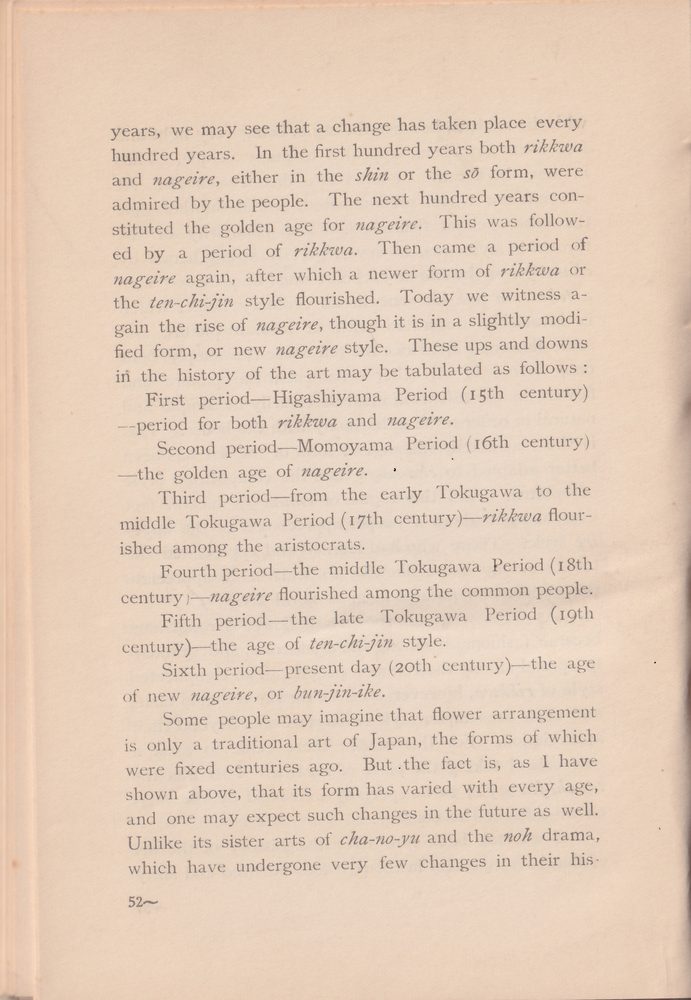
years, we may see that a change has taken place every hundred years. In the first hundred years both rikkwa and nageire, either in the shin or the sō form, were admired by the people. The next hundred years constituted the golden age for nageire. This was followed by a period of rikkwa. Then came a period of nageire again, after which a newer form of rikkwa or the ten-chi-jin style flourished. Today we witness again the rise of nageire, though it is in a slightly modified form, or new nageire style. These ups and downs in the history of the art may be tabulated as follows:
First period—Higashiyama Period (15th century)—period for both rikkwa and nageire.
Second period—Momoyama Period (16th century)—the golden age of nageire.
Third period—from the early Tokugawa to the middle Tokugawa Period (17th century)—rikkwa flourished among the aristocrats.
Fourth period—the middle Tokugawa Period (18th century)—nageire flourished among the common people.
Fifth period—the late Tokugawa Period (19th century)—the age of ten-chi-jin style.
Sixth period—present day (20th century)—the age of new nageire, or bun-jin-ike.
Some people may imagine that flower arrangement is only a traditional art of Japan, the forms of which were fixed centuries ago. But the fact is, as I have shown above, that its form has varied with every age, and one may expect such changes in the future as well. Unlike its sister arts of cha-no-yu and the noh drama, which have undergone very few changes in their his-
tory, since their forms were fixed nearly four hundred years ago, the art of floral arrangement alone has been subject to many vicissitudes in history. One may wonder at the fact that both the noh drama and cha-no-yu have existed apart from the actual life of the people, while the art of flower arrangement has had a vital connection with daily life. In other words, the noh drama has had its own stage, and cha-no-yu the tea house for the appreciation of its own art. But flower arrangement has had no such advantage. It has existed in the homes of the people and has become a necessary part of their daily life. Therefore the changes in the art may be taken as a matter of course. In this respect, I think, the art of flower arrangement resembles Japanese painting more than the tea ceremony or noh drama.