

IV. HOW TO SEE JAPANESE FLOWER ARRANGEMENT
In Japanese flower arrangement there may sometimes be found, besides flowers of various kinds, bare branches of trees, or branches bearing fruit but having no flowers, and again withered trees or even weeds. Foreigners not accustomed to Japanese flower arrangement may wonder why the Japanese make use of such things as decoration, and the foreigner often fails to see their beauty.
The reason for the use of things other than flowers is that the Japanese put more emphasis upon the forms of nature and life than upon their colour. In other words, Japanese flower arrangement is intended to represent some phase of natural life. Like the drama which makes use of living men upon the stage to represent various phases of man’s life in this world, Japanese flower arrangement purports to represent various phases of nature by utilizing flowers and other natural objects. In flower arrangement the actors and actresses are the flowers and trees, and the stage is the flower vase.
Since olden days, when looking even at flowers, Japanese have found more beauty in their figures or forms than in their colours. This may be due to the fact that in Japan there have been no flowers so bright
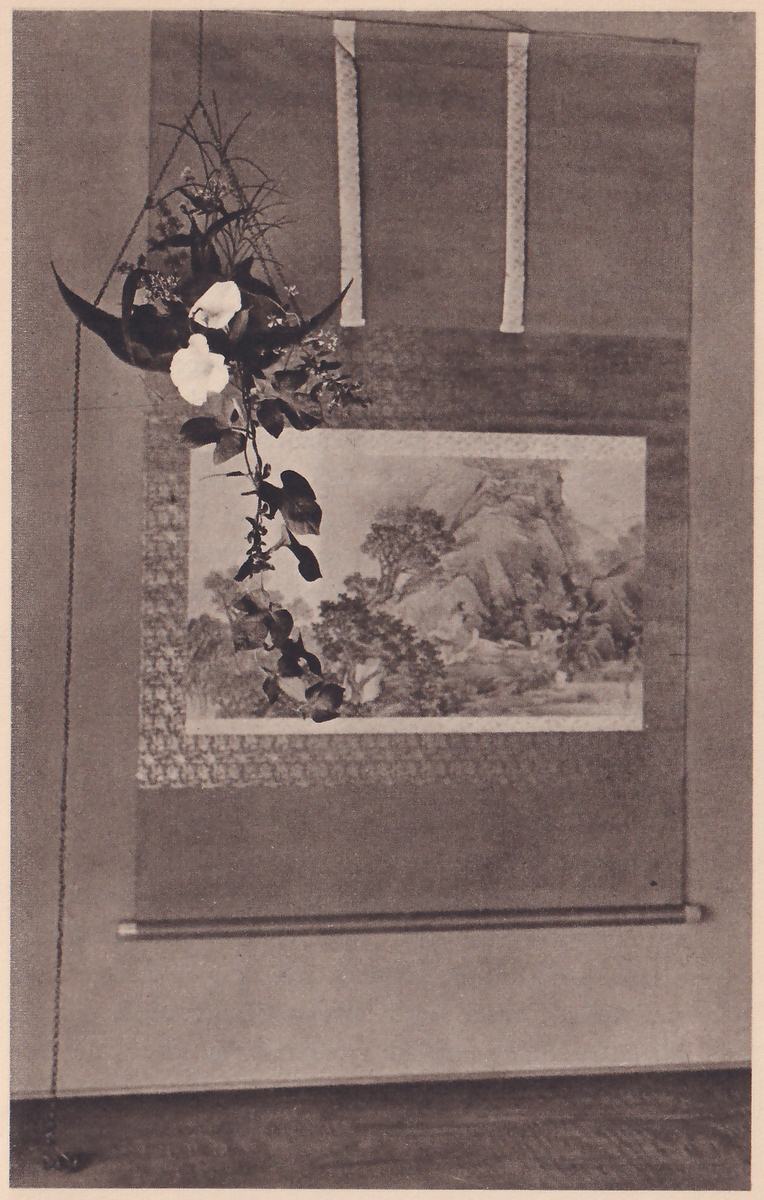
and colourful as those which grow in the torrid zone; but even imported flowers, such as roses and lilies, the Japanese prefer to see in their natural growth, that is, among leaves and long stems, rather than cut short and with very few leaves, as they are often found in the flower markets of the West.
In this respect, the Chinese, though they are very near neighbours and are likewise Orientals, differ very much from the Japanese in their taste for flowers. The Chinese, as a rule, love tree peonies, herbaceous peonies, roses, and orchids—all strongly perfumed and clearly outlined flowers. Their taste is much the same as that of Western peoples, while the Japanese are fond of such flowers as the cherry (which, because it is clearly outlined, is not unattractive even to the Western eye), the bell-flower, the miscanthus, rough-leafed patrinia, bush clover, and pampas grass, some of which are hardly to be called flowers, and others which are only weeds. But even these have been the subject of beautiful poetry and art in Japan.
“To count the flowers blooming in the autumnal field,
There are as many as seven of them.”
So sings the famous tanka, which was composed during the Nara Period (the 6th and 7th centuries), of the seven flowers of autumn, one of which is ominaeshi, or patrinia. This flower, as it has a disagreeable odour, has been called “petrified vinegar” by the Chinese, but it has been sung by many of the Japanese poets who, having been charmed by the beauty of its form, have called it ominaeshi, or the “maiden flower,” and
counted it among the most beautiful flowers of autumn.
It is, then, but natural that the Japanese who, having been attracted by the forms of nature rather than by its colours, have so far endeavoured to represent the beauty of form in nature through their flower arrangement.
The drama and the novel, which represent certain aspects of human life, are the common property of mankind, and can be found in every civilized country, but the art of flower arrangement and of gardening, which aim at the representation of life in nature as it centres around human life, by means of trees and plants, are peculiar to Japan. The birth of this peculiar art in this country is attributable to the special regard which the people have for nature. The Japanese treat nature as respectfully as they treat their fellow men, and are moved by the beauty of nature just as they are moved by the beautiful deeds of men. This intimate relationship with nature may be accounted for by the fact that nature in this island country is so gentle and beautiful. Nature seems to the Japanese to enwrap all living creatures with her love and beauty; she has a healing and comforting effect upon the heart which turns to her with sincerity and love. From such union of man with nature, I think, was born the art of flower arrangement and the art of gardening in Japan.
As in the drama or novel a foil is necessary to set the leading character in high relief, so in Japanese flower arrangement a foil is employed in order to emphasize the characteristic form of nature. This is represented by the method of grouping or combination.
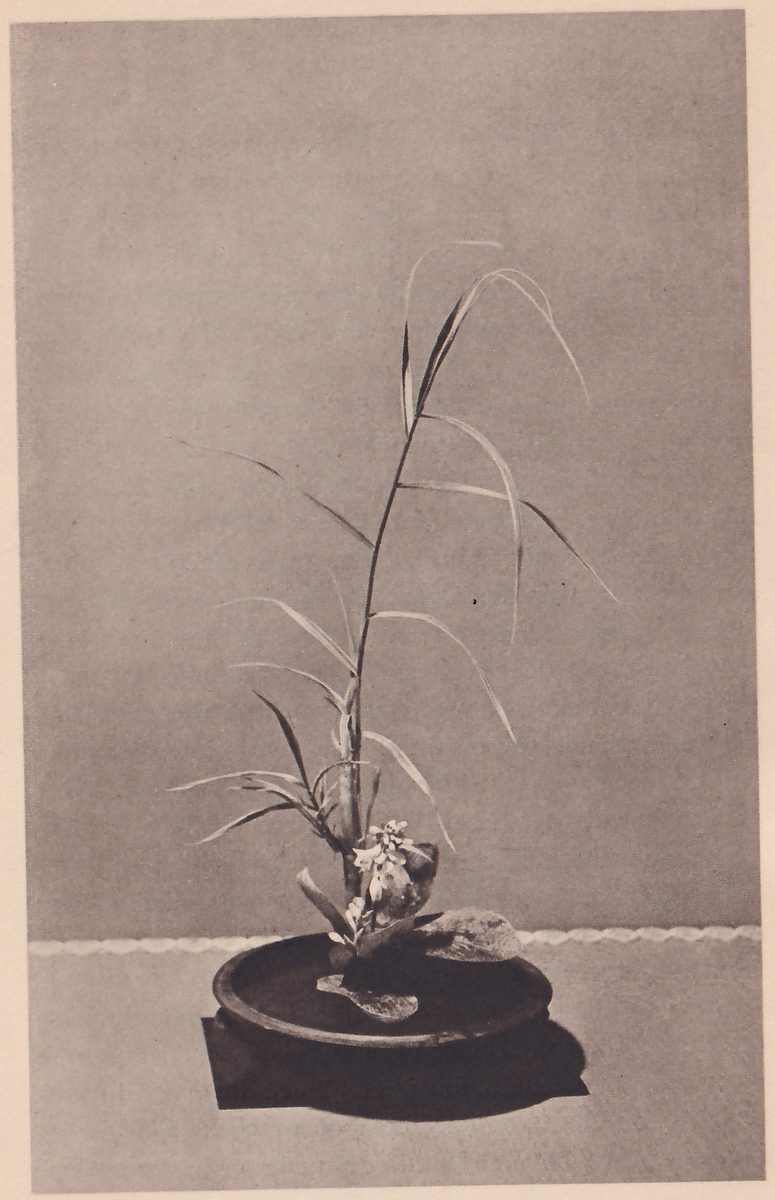
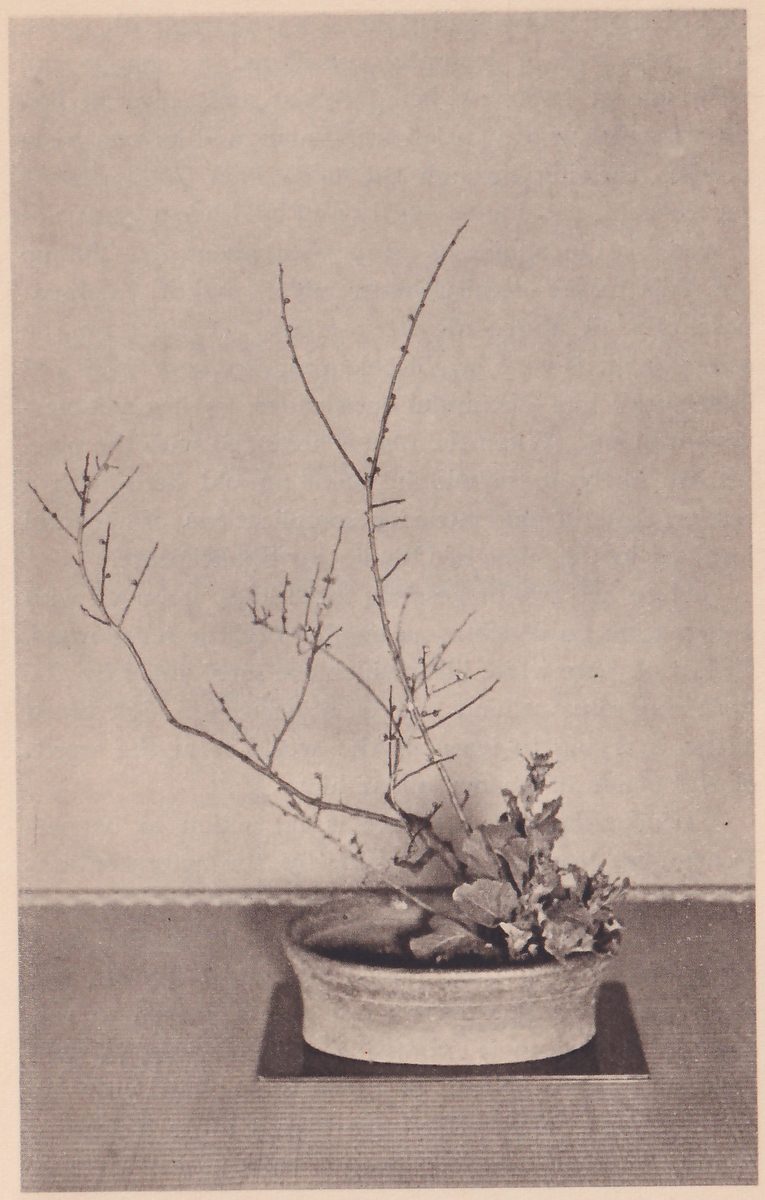
One of these groupings is that of a pine tree with roses. The pine tree is generally considered as manly and very strong, its trunk being robust and powerful like the muscular arms of a labouring man, and its evergreen needles thriving through summer’s heat and winter’s severe cold. It stands sturdy and bold like a giant unmoved by the affairs of puny men about it. Yet no one fails to see dignity in it, which makes the Japanese prize it above all other trees. A rose, on the other hand, is very bright-coloured, but very frail and ephemeral, like a beautiful but slender, a witty yet nervous woman. When the rose is arranged with the pine, we are likely to behold in them an old hero with a tender lady in the intricate complications of life and love, as in the play of Othello by Shakespeare.
Here are two or possibly three lilies arranged with a rose vine on which are a number of little red flowers. The cool, pure white lilies which are surrounded by the little red roses remind one of a prince of high blood as he is trying to learn of the world from the words of the maids of honour about him.
Unlike the drama, there is no action to be performed, no word to be spoken, by the actors or actresses of flower arrangement—the plants or trees set in a vase. They all sit or stand quietly in the vase. They are to keep their poses unchanged forever, just as in pictures. But even so, if one has eyes to see, one can discern their expressions as manifested in their delicate figures. Some of them are aglow with joy and gladness, while others are buried in dark sorrow. Again, some are feeling lonely, while others are gay
with love and life. And if one fails to see these various expressions, Japanese flower arrangement will remain forever a sealed art to him.
The illustrations
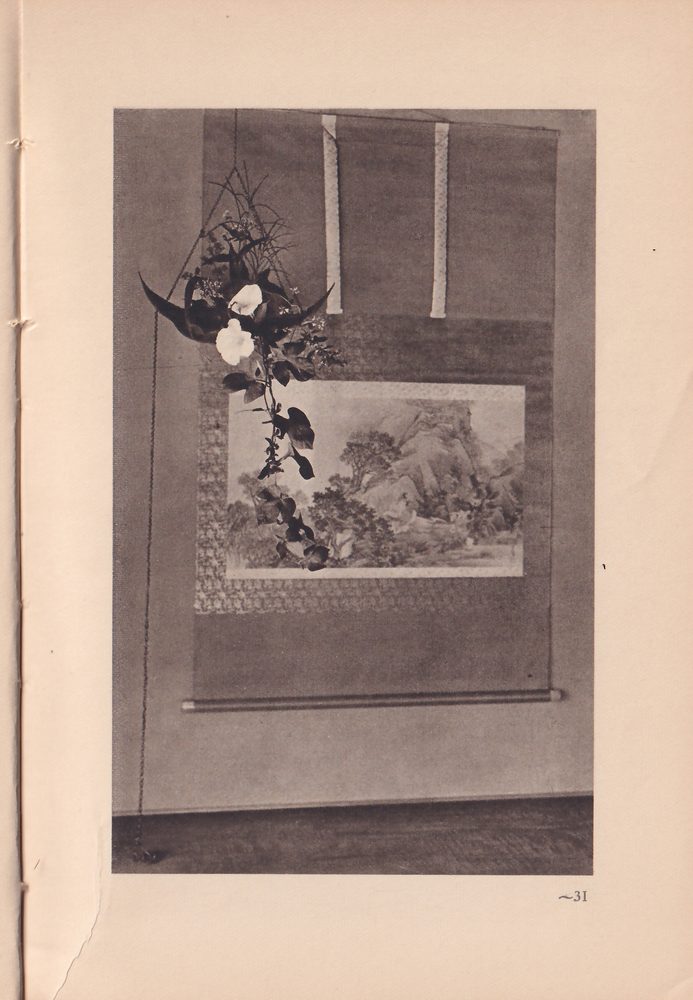
Flowers arranged in the tokonoma. (Facing page 31)
Vase—Boat-shaped hanging vase
Asagao (morning glory),
Hagi (lespedeza),
Oijiwa (weeds)
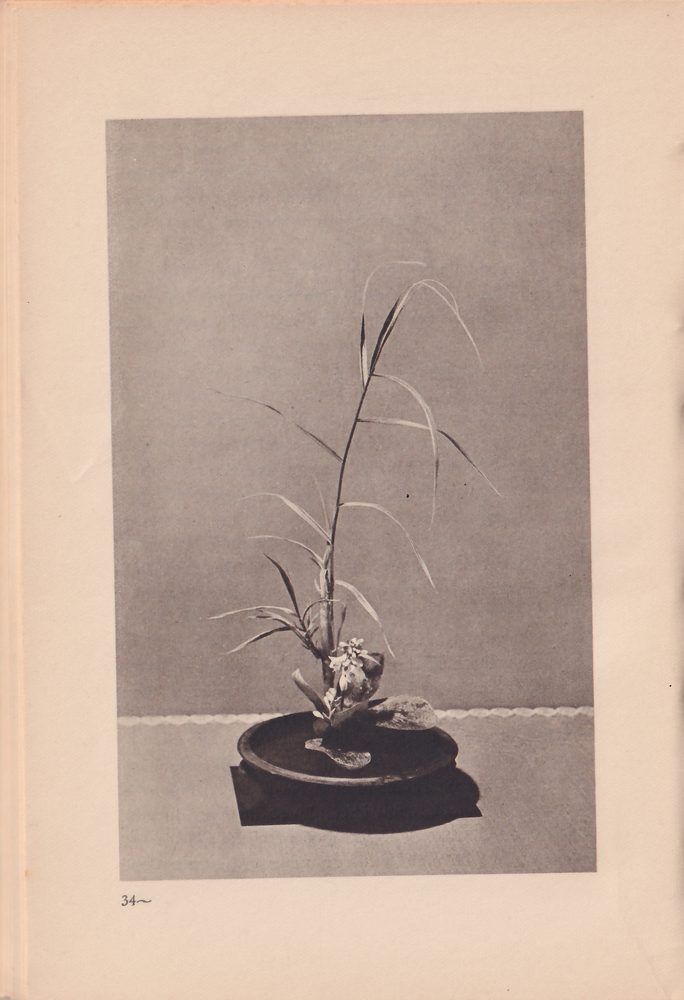
Flowers arranged in a flower dish. (Facing page 34)
Vase—flower dish
Flowers—Reeds and giboshu (plantain-lilies)
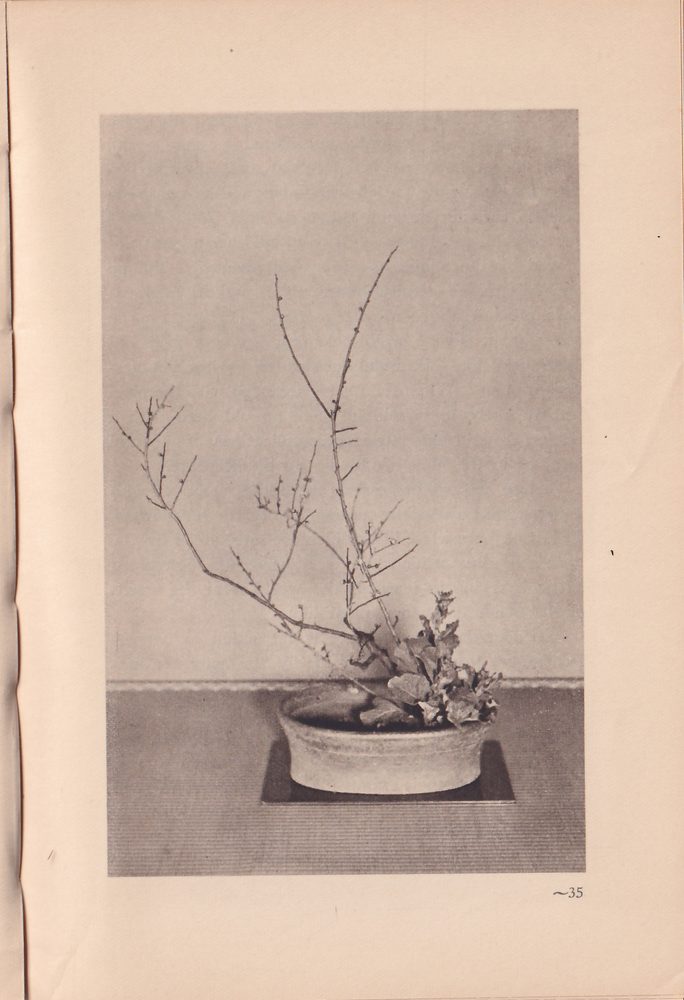
Flowers arranged in a Nanban dish. (Facing page 35)
Vase—Nanban (Spanish) dish
Flowers—Plum and the rape