
Japanese Architecture
Tourist Library 7
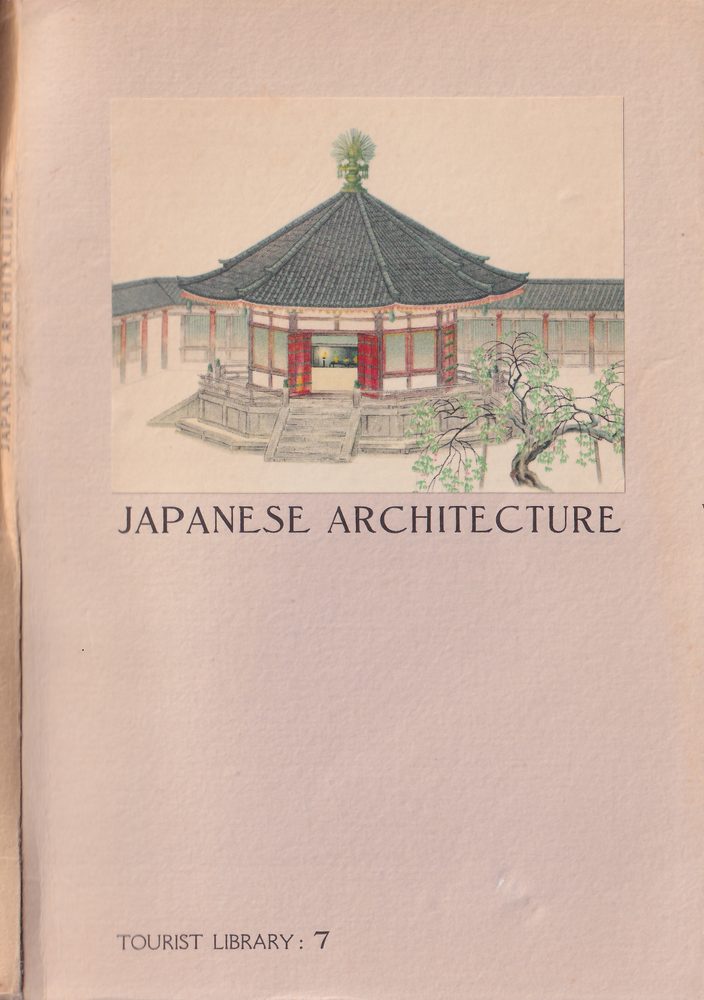
Japanese Architecture
by Prof. Hideto Kisida, D. Sc.
Tourist Library 7
Board of Tourist Industry, Japanese Government Railways, 1940
TOURIST LIBRARY
Volumes Already Published
1. TEA CULT OF JAPAN By Y. Hukukita, B. A.
2. JAPANESE NOH PLAYS By Prof. T. Nogami, D. Litt.
3. SAKURA (Japanese Cherry) By M. Miyosi, D. Sc.
4. JAPANESE GARDENS By Prof. M. Tatui
5. HIROSIGE AND JAPANESE
LANDSCAPES By Prof. Yone Noguti, D. Litt.
6. JAPANESE DRAMA By B. T. I.
7. JAPANESE ARCHITECTURE By Prof. H. Kisida, D. Sc.
8. WHAT IS SINTO? By Prof. G. Katō, D. Litt.
9. CASTLES IN JAPAN By Prof. S. Ōrui, D. Litt.
and Masao Toba
10. HOT SPRINGS IN JAPAN By Prof. K. Huzinami, M. D.
11. FLORAL ART OF JAPAN By Issōtei Nisikawa
12. CHILDREN’S DAYS IN JAPAN By Z. T. Iwadō
13. KIMONO (Japanese Dress) By Ken-iti Kawakatu
14. JAPANESE FOOD By Prof. Kaneko Tezuka
15. JAPANESE MUSIC By Katumi Sunaga
16. ZYUDO (ZYUZYUTU) By Zigorō Kanō
17. FAMILY LIFE IN JAPAN By Syunkiti Akimoto
18. SCENERY OF JAPAN By T. Tamura, D. Sc.
19. JAPANESE EDUCATION By Prof. K. Yosida, D. Litt.
and Prof. T. Kaigo
20. FLORAL CALENDAR OF JAPAN By T. Makino, D. Sc.
and Genzirō Oka
21. JAPANESE BUDDHISM By Prof. D. T. Suzuki, D. Litt.
22. ODORI (Japanese Dance) By Kasyō Matida
23. KABUKI DRAMA By Syūtarō Miyake
24. JAPANESE WOOD-BLOCK PRINTS By Prof. S. Huzikake, D. Litt.
25. HISTORY OF JAPAN By Prof. K. Nakamura, D. Litt.
26. JAPANESE FOLK-TOYS By Tekiho Nisizawa
27. JAPANESE GAME OF “GO” By Hukumensi Mihori
28. JAPANESE COIFFURE By R. Saitō, D. Litt.
29. JAPANESE SCULPTURE By Seiroku Noma
30. JAPANESE POSTAGE STAMPS By Yokiti Yamamoto
31. JAPAN’S ANCIENT ARMOUR By Hatirō Yamagami
32. ANGLING IN JAPAN By Meizi Matuzaki
Volumes in preparation
JAPANESE PROVERBS By Otoo Huzii, D. Litt.
SUMO (Japanese Wrestling) By Kōzō Hikoyama
AINU LIFE AND LEGENDS By Kyōsuke Kindaiti, D. Litt.
HISTORY OF JAPANESE COMMUNICATIONS By Baron Takaharu Mitui
JAPANESE ARCHITECTURE
(THIRD EDITION)
BY
Prof. HIDETO KISIDA, D. Sc.
BOARD OF TOURIST INDUSTRY
JAPANESE GOVERNMENT RAILWAYS
COPYRIGHT 1940
It is a common desire among tourists to learn something of the culture of the countries they visit, as well as to see their beautiful scenery. To see is naturally easier than to learn, but flying visits merely for sightseeing furnish neither the time nor opportunity for more than a passing acquaintance with the culture of any foreign people. This is specially true of Japan and her people.
The Board of Tourist Industry recognizes both the obligation and the difficulty of providing foreign tourists with accurate information regarding the various phases of Japan’s culture. It is, therefore, endeavouring to meet this obligation, as far as possible, by publishing this series of brochures.
The present series will, when completed, consist of more than a hundred volumes, each dealing with a different subject, but all co-ordinated. By studying the entire series, the foreign student of Japan will gain an adequate knowledge of the unique culture that has evolved in this country through the ages.
For those who wish to follow up these studies with a closer investigation of more erudite works, we sometimes append bibliographies, which we can recommend as authoritative guides for study.
BOARD OF TOURIST INDUSTRY,
JAPANESE GOVERNMENT RAILWAYS.
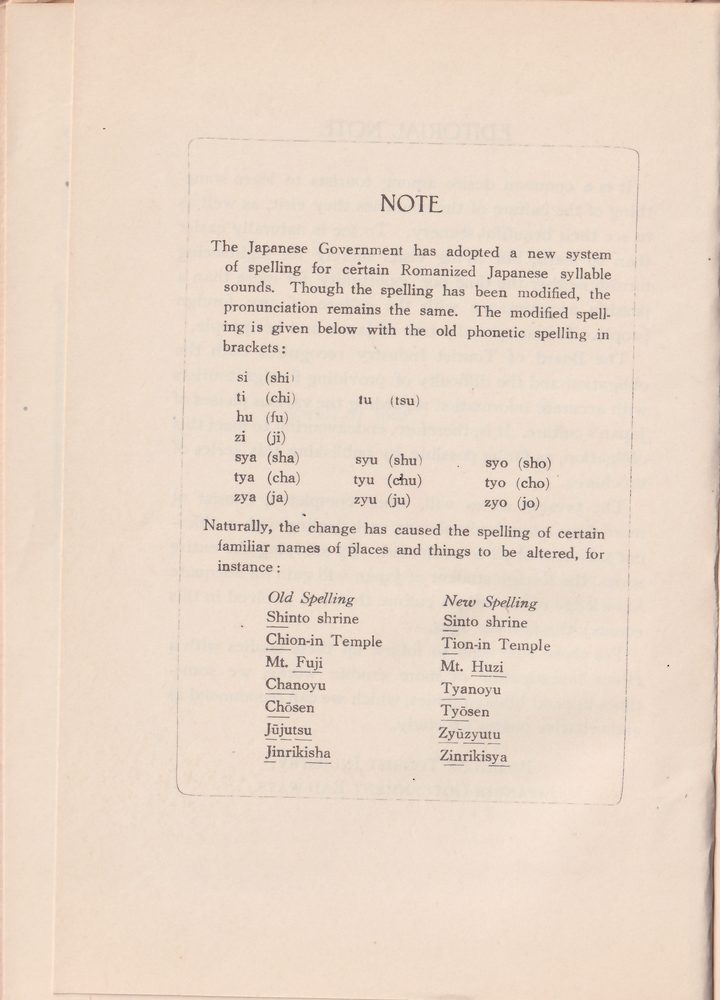
NOTE
The Japanese Government has adopted a new system of spelling for certain Romanized Japanese syllable sounds. Though the spelling has been modified, the pronunciation remains the same. The modified spelling is given below with the old phonetic spelling in brackets:
| si (shi) | ||
| ti (chi) | tu (tsu) | |
| hu (fu) | ||
| zi (ji) | ||
| sya (sha) | syu (shu) | syo (sho) |
| tya (cha) | tyu (chu) | tyo (cho) |
| zya (ja) | zyu (ju) | zyo (jo) |
Naturally, the change has caused the spelling of certain familiar names of places and things to be altered, for instance:
| Old Spelling | New Spelling |
|---|---|
| Shinto shrine | Sinto shrine |
| Chion-in Temple | Tion-in Temple |
| Mt. Fuji | Mt. Huzi |
| Chanoyu | Tyanoyu |
| Chōsen | Tyōsen |
| Jūjutsu | Zyūzyutu |
| Jinrikisha | Zinrikisya |
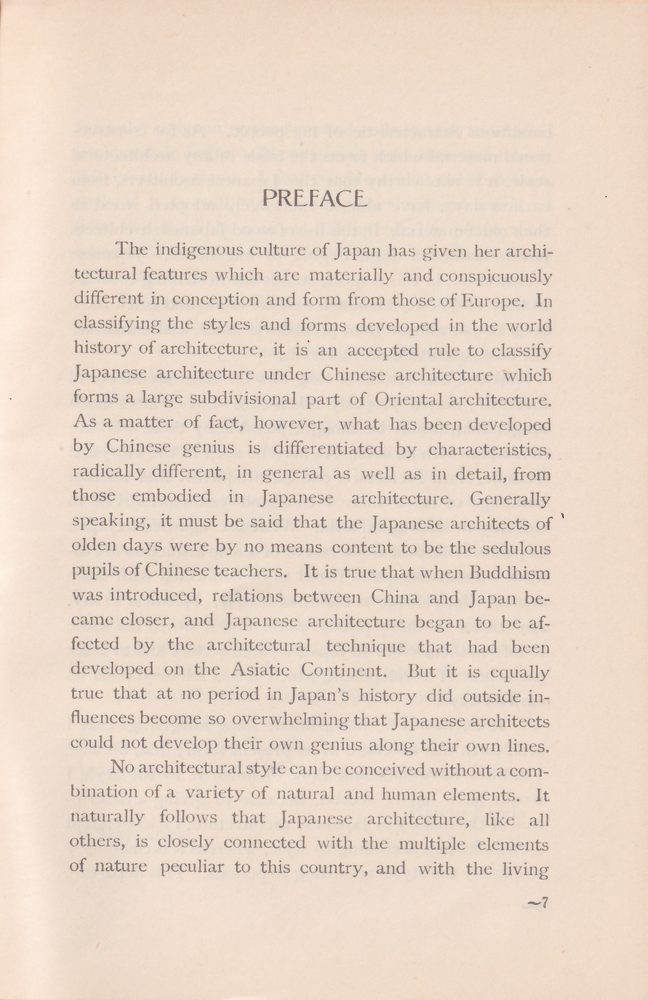
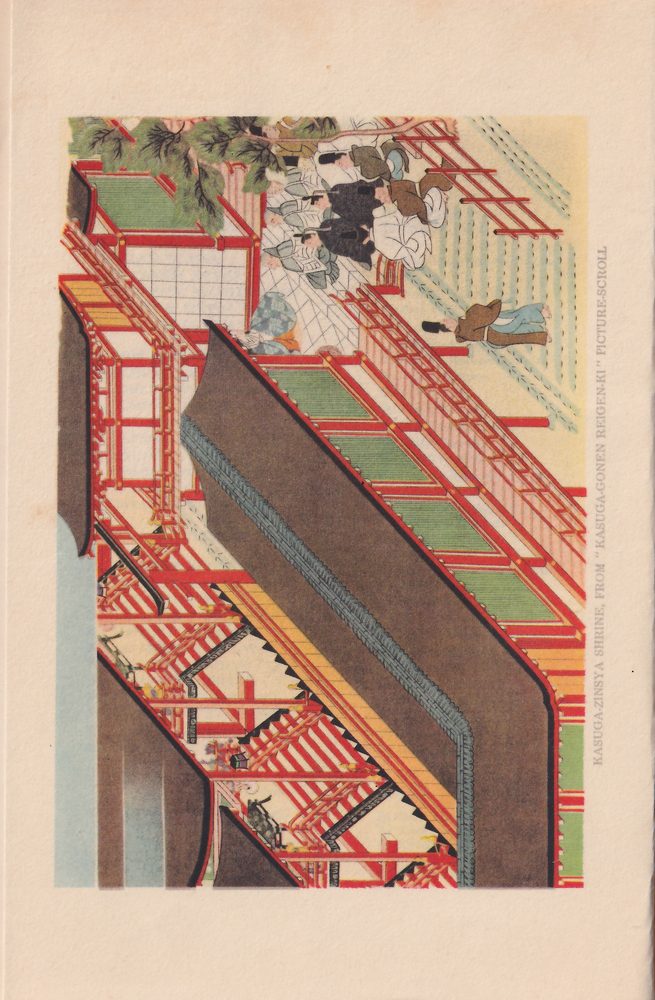
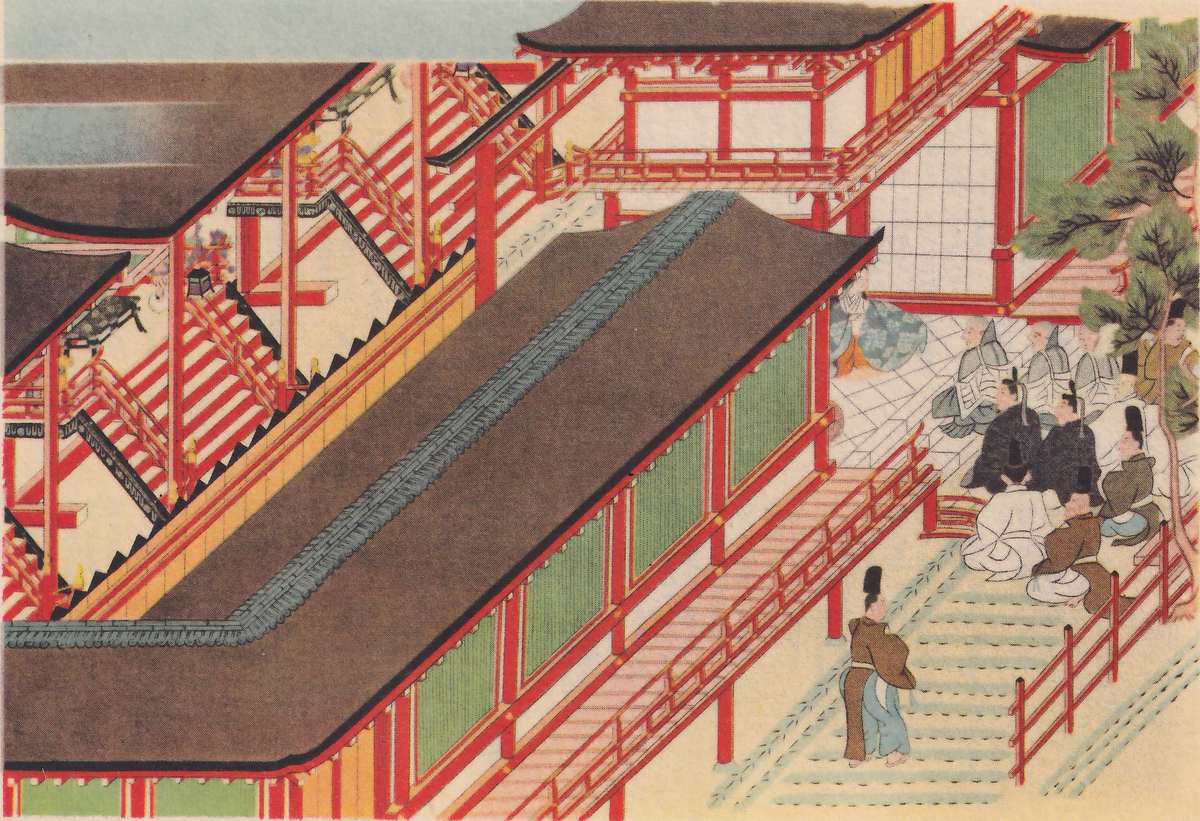
The indigenous culture of Japan has given her architectural features which are materially and conspicuously different in conception and form from those of Europe. In classifying the styles and forms developed in the world history of architecture, it is an accepted rule to classify Japanese architecture under Chinese architecture which forms a large subdivisional part of Oriental architecture. As a matter of fact, however, what has been developed by Chinese genius is differentiated by characteristics, radically different, in general as well as in detail, from those embodied in Japanese architecture. Generally speaking, it must be said that the Japanese architects of olden days were by no means content to be the sedulous pupils of Chinese teachers. It is true that when Buddhism was introduced, relations between China and Japan became closer, and Japanese architecture began to be affected by the architectural technique that had been developed on the Asiatic Continent. But it is equally true that at no period in Japan’s history did outside influences become so overwhelming that Japanese architects could not develop their own genius along their own lines.
No architectural style can be conceived without a combination of a variety of natural and human elements. It naturally follows that Japanese architecture, like all others, is closely connected with the multiple elements of nature peculiar to this country, and with the living
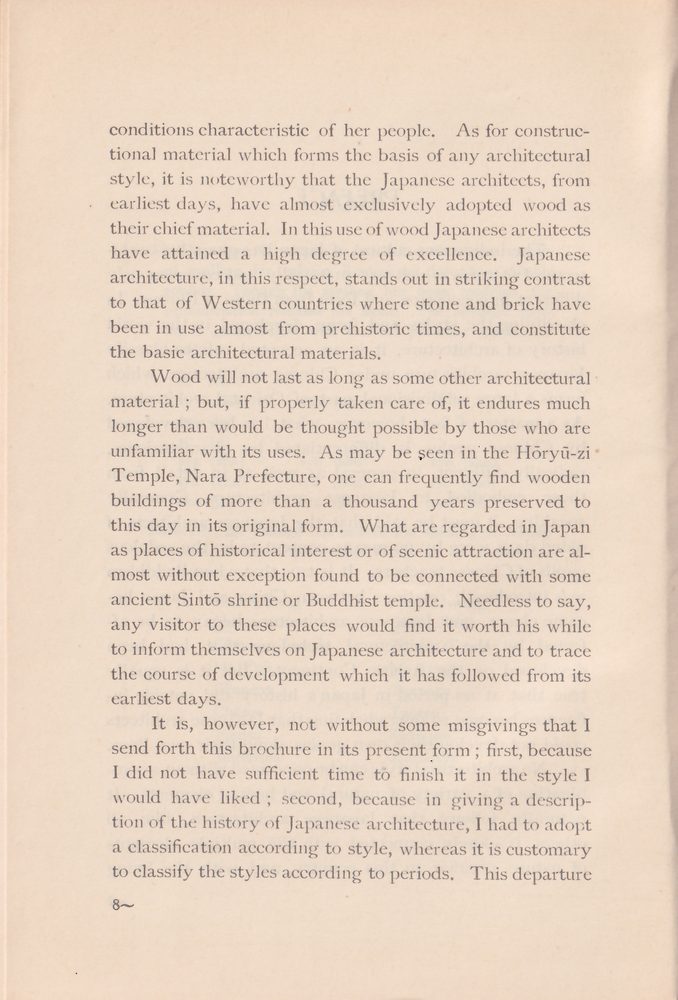
conditions characteristic of her people. As for constructional material which forms the basis of any architectural style, it is noteworthy that the Japanese architects, from earliest days, have almost exclusively adopted wood as their chief material. In this use of wood Japanese architects have attained a high degree of excellence. Japanese architecture, in this respect, stands out in striking contrast to that of Western countries where stone and brick have been in use almost from prehistoric times, and constitute the basic architectural materials.
Wood will not last as long as some other architectural material; but, if properly taken care of, it endures much longer than would be thought possible by those who are unfamiliar with its uses. As may be seen in the Hōryū-zi Temple, Nara Prefecture, one can frequently find wooden buildings of more than a thousand years preserved to this day in its original form. What are regarded in Japan as places of historical interest or of scenic attraction are almost without exception found to be connected with some ancient Sintō shrine or Buddhist temple. Needless to say, any visitor to these places would find it worth his while to inform themselves on Japanese architecture and to trace the course of development which it has followed from its earliest days.
It is, however, not without some misgivings that I send forth this brochure in its present form; first, because I did not have sufficient time to finish it in the style I would have liked; second, because in giving a description of the history of Japanese architecture, I had to adopt a classification according to style, whereas it is customary to classify the styles according to periods. This departure
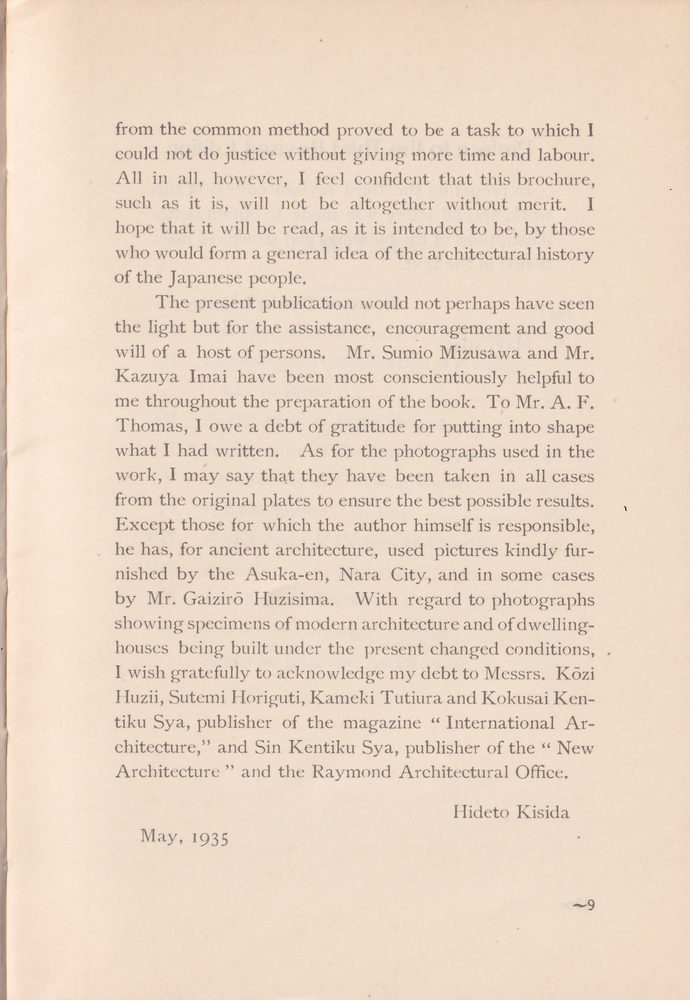
from the common method proved to be a task to which I could not do justice without giving more time and labour. All in all, however, I feel confident that this brochure, such as it is, will not be altogether without merit. I hope that it will be read, as it is intended to be, by those who would form a general idea of the architectural history of the Japanese people.
The present publication would not perhaps have seen the light but for the assistance, encouragement and good will of a host of persons. Mr. Sumio Mizusawa and Mr. Kazuya Imai have been most conscientiously helpful to me throughout the preparation of the book. To Mr. A. F. Thomas, I owe a debt of gratitude for putting into shape what I had written. As for the photographs used in the work, I may say that they have been taken in all cases from the original plates to ensure the best possible results. Except those for which the author himself is responsible, he has, for ancient architecture, used pictures kindly furnished by the Asuka-en, Nara City, and in some cases by Mr. Gaizirō Huzisima. With regard to photographs showing specimens of modern architecture and of dwelling-houses being built under the present changed conditions, I wish gratefully to acknowledge my debt to Messrs. Kōzi Huzii, Sutemi Horiguti, Kameki Tutiura and Kokusai Kentiku Sya, publisher of the magazine “International Architecture,” and Sin Kentiku Sya, publisher of the “New Architecture” and the Raymond Architectural Office.
Hideto Kisida
May, 1935
In preparing the third revised edition of this work, special effort was made to obtain better illustrations of the buildings and structures mentioned in the text.
Board of Tourist Industry.
May, 1940
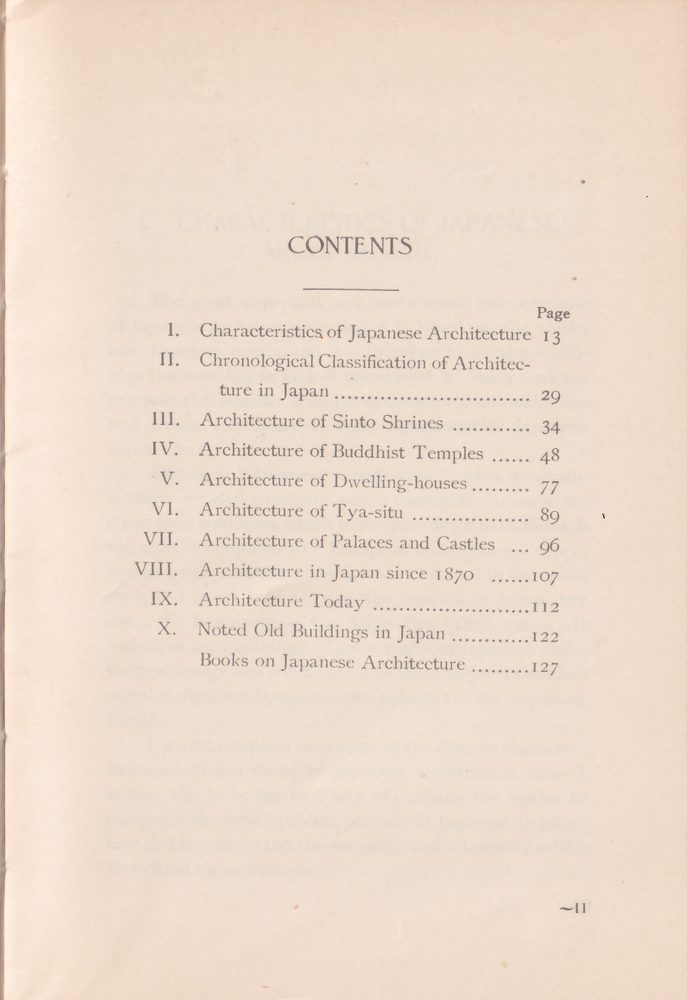
CONTENTS
Page
I. Characteristics of Japanese Architecture 13
II. Chronological Classification of Architecture in Japan ................................. 29
III. Architecture of Sinto Shrines ............ 34
IV. Architecture of Buddhist Temples ...... 48
V. Architecture of Dwelling-houses ........ 77
VI. Architecture of Tya-situ ..................... 89
VII. Architecture of Palaces and Castles ... 96
VIII. Architecture in Japan since 1870 ......107
IX. Architecture Today ...........................112
X. Noted Old Buildings in Japan ............122
Books on Japanese Architecture .........127