
Japanese Noh Plays: How to See Them
Tourist Library 2
Japanese Noh Plays: How to See Them
by Toyoitirō Nogami (野上豊一郎)
Tourist Library 2
Board of Tourist Industry, Japanese Government Railways, 1938
TOURIST LIBRARY
Volumes already published
1. TEA CULT OF JAPAN By Y. Hukukita, A. B.
2. JAPANESE NOH PLAYS By Prof. T. Nogami
3. SAKURA (Japanese Cherry) By M. Miyosi, D. Sc.
4. JAPANESE GARDENS By Prof. M. Tatui
5. HIROSIGE AND JAPANESE LANDSCAPES By Prof. Yone Noguti
6. JAPANESE DRAMA By B. T. I.
7. JAPANESE ARCHITECTURE By Prof. H. Kisida, D. Sc.
8. WHAT IS SINTO? By Prof. G. Katō, D. Litt.
9. CASTLES IN JAPAN By Prof. S. Ōrui, D. Litt.
and Prof. M. Toba
10. HOT SPRINGS IN JAPAN By Prof. K. Huzinami, M. D.
11. FLORAL ART OF JAPAN By Issōtei Nisikawa
12. CHILDREN’S DAYS IN JAPAN By T. Iwadō, M. A.
13. KIMONO (Japanese Dress) By Keniti Kawakatu
14. JAPANESE FOOD By Prof. Kaneko Tezuka
15. JAPANESE MUSIC By Katumi Sunaga
16. ZYUDO (ZYUZYUTU) By Prof. Zigorō Kanō
17. FAMILY LIFE IN JAPAN By Syunkiti Akimoto
18. SCENERY OF JAPAN By T. Tamura, D. Sc.
19. JAPANESE EDUCATION By Prof. K. Yosida, D. Litt.
and Prof. T. Kaigo
20. FLORAL CALENDAR OF JAPAN By T. Makino, D. Sc.
and Genzirō Oka
21. JAPANESE BUDDHISM By Prof. D. T. Suzuki, D. Litt.
22. ODORI (Japanese Dance) By Kasyō Matida
23. KABUKI DRAMA By Syūtarō Miyake
Volumes in preparation
JAPANESE WOOD-BLOCK PRINTS By Prof. S. Huzikake, D. Litt.
JAPANESE FOLK-TOYS By Tekiho Nisizawa
JAPANESE HISTORY By Prof. T. Nakamura, D. Litt.
JAPANESE GAME OF “GO” By Hukumensi Mihori
JAPANESE NOH PLAYS
HOW TO SEE THEM
BY
Prof. TOYOITIRO NOGAMI
(THIRD EDITION)
BOARD OF TOURIST INDUSTRY
JAPANESE GOVERNMENT RAILWAYS
EDITORIAL NOTE
It is a common desire among tourists to learn something of the culture of the countries they visit, as well as to see their beautiful scenery. To see is naturally easier than to learn, but flying visits merely for sightseeing furnish neither the time nor opportunity for more than a passing acquaintance with the culture of any foreign people. This is specially true of Japan and her people.
The Board of Tourist Industry recognizes both the obligation and the difficulty of providing foreign tourists with accurate information regarding the various phases of Japan’s culture. It is, therefore, endeavouring to meet this obligation, as far as possible, by publishing this series of brochures.
The present series will, when completed, consist of more than a hundred volumes, each dealing with a different subject, but all co-ordinated. By studying the entire series, the foreign student of Japan will gain an adequate knowledge of the unique culture that has evolved in this country through the ages.
For those who wish to follow up these studies with a closer investigation, bibliographies are appended, which we trust may be found reliable and authoritative guides in their study.
Board of Tourist Industry,
Japanese Government Railways.
NOTE
The Japanese Government has adopted a new system of spelling for certain Romanized Japanese syllable sounds. Though the spelling has been modified, the pronunciation remains the same. The modified spelling is given below with the old phonetic spelling in brackets:
| si (shi) | ||
| ti (chi) | tu (tsu) | |
| hu (fu) | ||
| zi (ji) | ||
| sya (sha) | syu (shu) | syo (sho) |
| tya (cha) | tyu (chu) | tyo (cho) |
| zya (ja) | zyu (ju) | zyo (jo) |
Naturally, the change has caused the spelling of certain familiar names of places and things to be altered, for instance:
| Old Spelling | New Spelling |
|---|---|
| Shinto shrine | Sinto shrine |
| Chion-in temple | Tion-in temple |
| Mt. Fuji | Mt. Huzi |
| Chanoyu | Tyanoyu |
| Chosen | Tyosen |
| Jujutsu | Zyuzyutu |
| Jinrikisha | Zinrikisya |
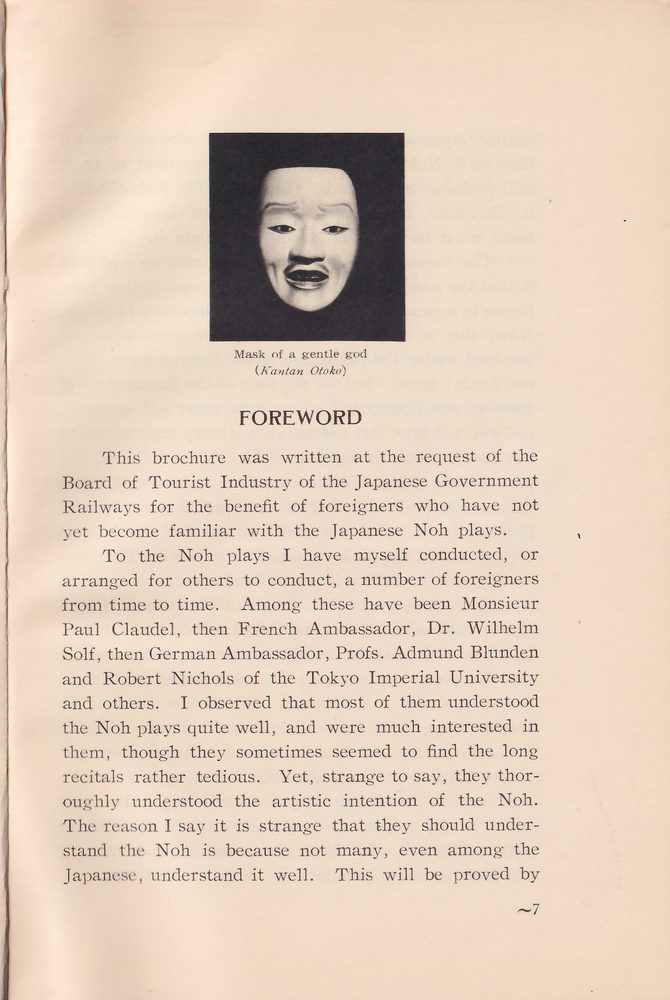
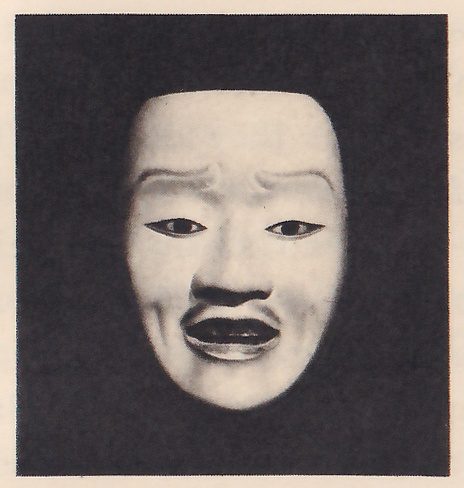
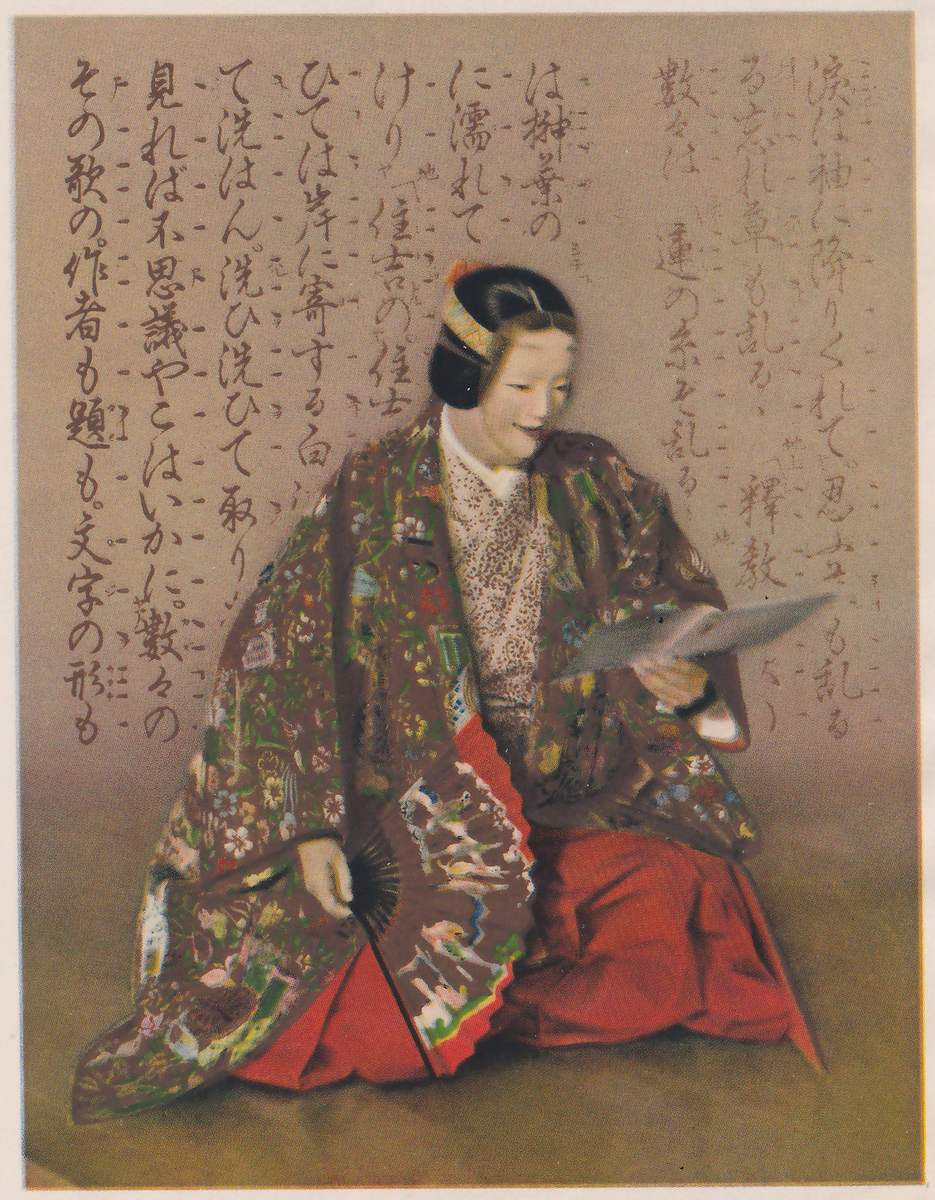
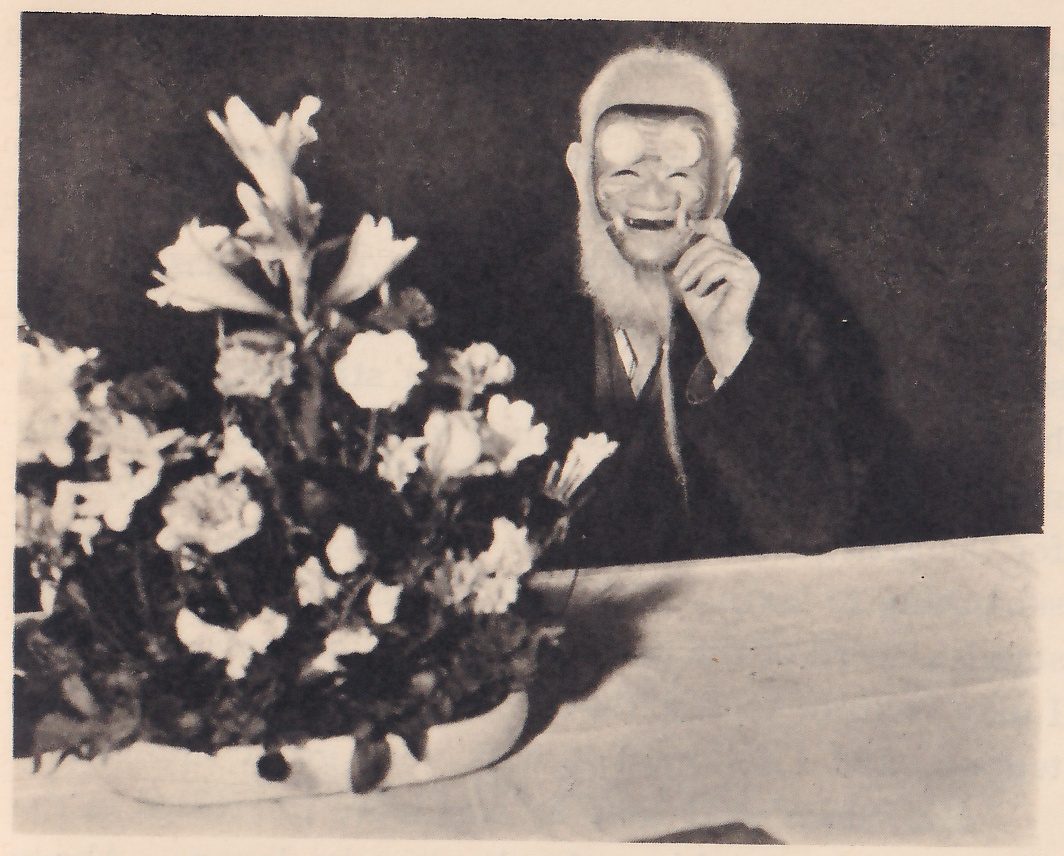
(Kantan Otoko)
FOREWORD
This brochure was written at the request of the Board of Tourist Industry of the Japanese Government Railways for the benefit of foreigners who have not yet become familiar with the Japanese Noh plays.
To the Noh plays I have myself conducted, or arranged for others to conduct, a number of foreigners from time to time. Among these have been Monsieur Paul Claudel, then French Ambassador, Dr. Wilhelm Solf, then German Ambassador, Profs. EdmundPrinted: Admund Blunden and Robert Nichols of the Tokyo Imperial University and others. I observed that most of them understood the Noh plays quite well, and were much interested in them, though they sometimes seemed to find the long recitals rather tedious. Yet, strange to say, they thoroughly understood the artistic intention of the Noh. The reason I say it is strange that they should understand the Noh is because not many, even among the Japanese, understand it well. This will be proved by
asking Japanese ladies and gentlemen who you meet if they go to Noh performancesPrinted: preformances. I am sure most of them will probably say that they do not. The Noh of today is, therefore, far from the life of most Japanese, and there must be few who really appreciate it.
The reason why the Noh has become so neglected is that the speech and manner of its representation have begun to appear too antiquated to the Japanese of today. Now, this is an art founded five centuries ago and retained under the patronage of the Syōgun throughout the feudal ages. But at the time of the Restoration of 1868 it was abandoned along with other old customs, and revived later on, not as an ordinary entertainment but as a curious literary survival. Then followed the period when things Western were overvalued and native things undervalued. During this period artistic forms peculiar to us were to a great extent lost, but it was fortunate that the Noh survived this doom. This was mainly due to Prince Tomomi Iwakura who patronized it, and to three great Noh actors of the period, Hōsyō-Kurō, Umewaka-Minori and Sakurama-Sazin. In any case the Noh may be considered popular today, seeing that at every performance in most Noh theatres in Tokyo it draws a full house. But if you go to a Noh theatre, you will be surprised to find some of the audience gazing at a libretto open on their knees, and rarely looking at the stage, but following the actor’s recitation so that it may improve their own. In olden times hardly any of the audience went to the theatre with a libretto. In these circumstances I wonder if the Noh is really popular.
Foreigners accordingly, as they are unable to follow the libretto, never attempt to follow uselessly the meaning of every word and phrase in the utai, but merely watch the movements of the actors and listen with a very incomplete understanding to the chorus and musicians. Though this is their only method of appreciation, it happens to be a wise one. This is why the Noh appeals to intelligent foreigners.
Moreover, the Japanese of today are more used to the Kabuki plays, which appear to be, but are not really, truer to life than is the Noh despite its archaic and delicate representation. Therefore those Japanese who are ignorant of the symbolism in the production of the Noh may feel it rather hard to understand. Foreigners, on the contrary, looking at it through unprejudiced eyes, will be able to grasp its essence. Most foreigners I know say that the Noh appeals to them more than the Kabuki, and well may they say so. In the Kabuki plays, if the actor’s speech is not understood, it is difficult to follow the development of the action, but in the Noh plays, the plot is simple, and a spectator may easily grasp the theme with a few words of explanation beforehand, and leave the rest to his eyes and ears.
What the Noh is proud of is the perfection of absolute beauty which may also be found in the spirit of the tea ceremony. This, Monsieur Claudel expresses by saying “l’idée d’une action si exactement réglée qu’elle soit parfaite,” and it can never be overlooked by anybody, either a foreigner or a Japanese, whose consciousness of beauty is developed. But as the author
of the “Turezure-gusa” (written in the early part of the 14th century by the Monk Kenkō) wisely said, “we cannot do well without a reliable Sendati (leader) in doing anything.” In fact, in order to appreciate the Noh rightly you must have a good guide, and I hope this brochure may serve that purpose.
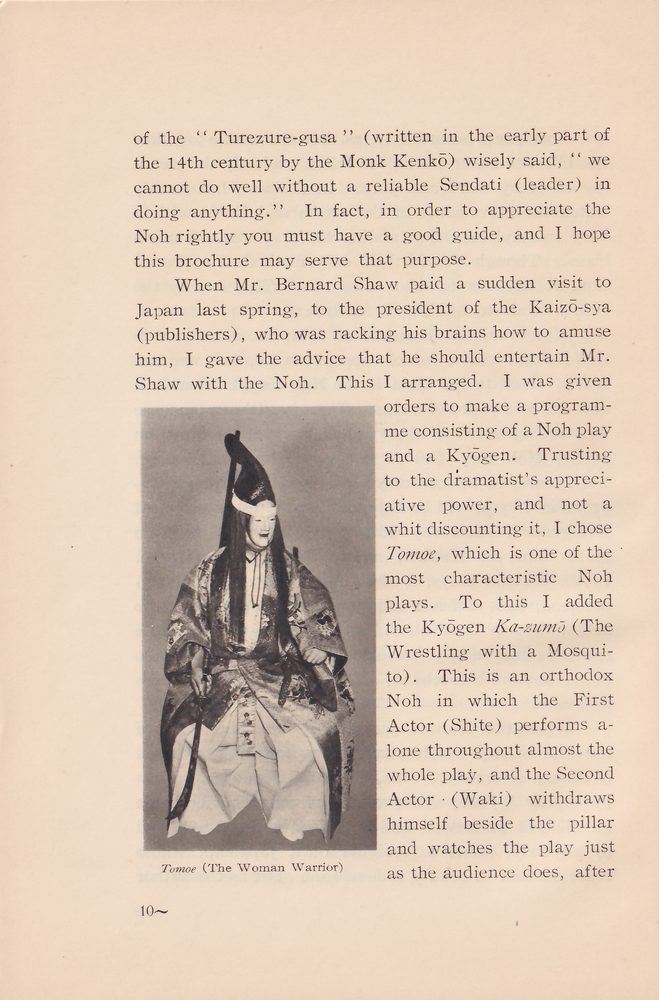
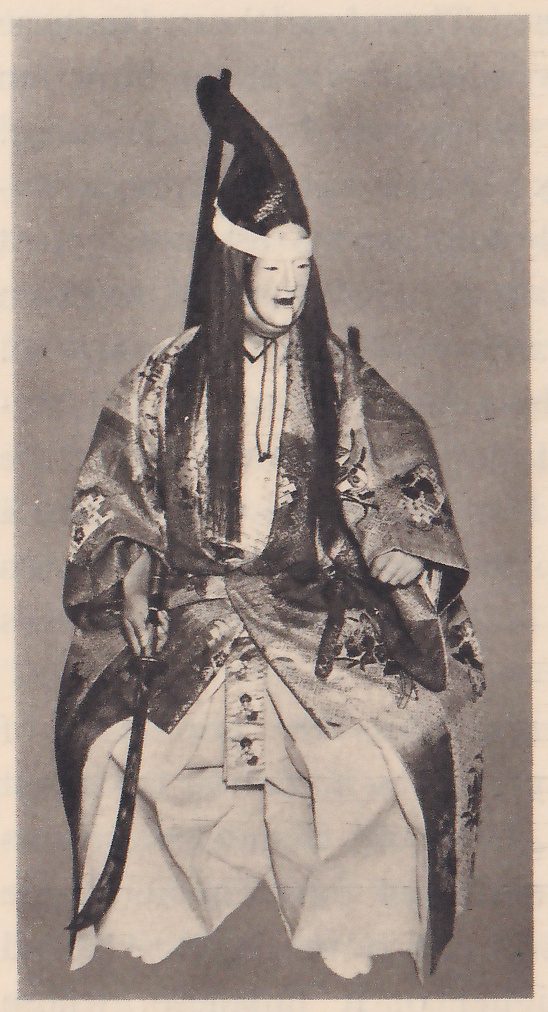
When Mr. Bernard Shaw paid a sudden visit to Japan last spring, to the president of the Kaizō-sya (publishers), who was racking his brains how to amuse him, I gave the advice that he should entertain Mr. Shaw with the Noh. This I arranged. I was given orders to make a programme consisting of a Noh play and a Kyōgen. Trusting to the dramatist’s appreciative power, and not a whit discounting it, I chose Tomoe, which is one of the most characteristic Noh plays. To this I added the Kyōgen Ka-zumō (The Wrestling with a Mosquito). This is an orthodox Noh in which the First Actor (Shite) performs alone throughout almost the whole play, and the Second Actor (Waki) withdraws himself beside the pillar and watches the play just as the audience does, after
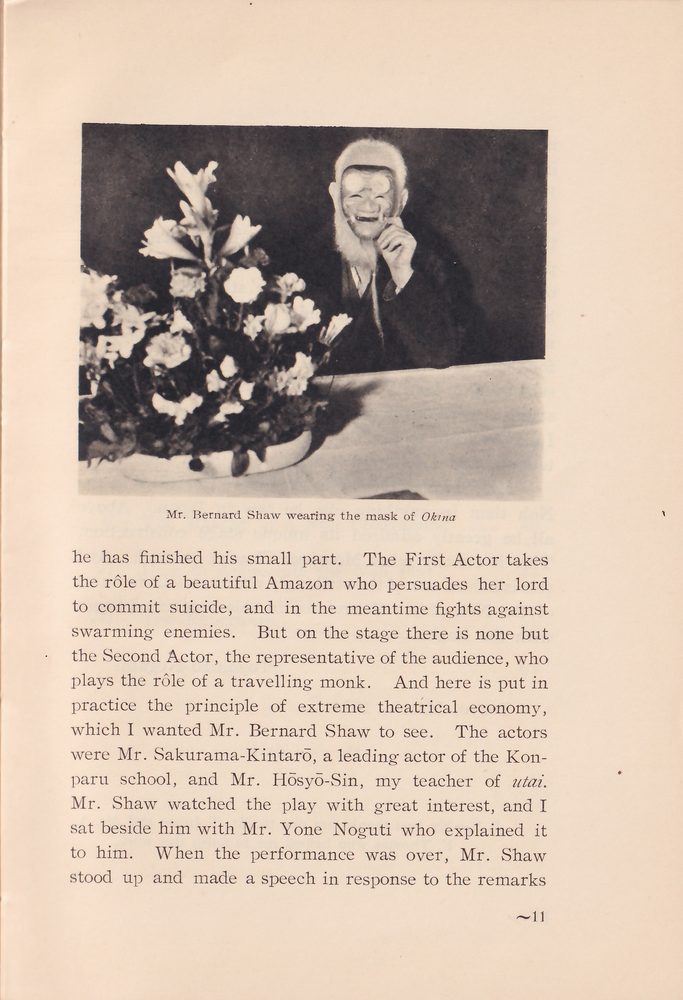
he has finished his small part. The First Actor takes the rôle of a beautiful Amazon who persuades her lord to commit suicide, and in the meantime fights against swarming enemies. But on the stage there is none but the Second Actor, the representative of the audience, who plays the rôle of a travelling monk. And here is put in practice the principle of extreme theatrical economy, which I wanted Mr. Bernard Shaw to see. The actors were Mr. Sakurama-Kintarō, a leading actor of the Konparu school, and Mr. Hōsyō-Sin, my teacher of utai. Mr. Shaw watched the play with great interest, and I sat beside him with Mr. Yone Noguti who explained it to him. When the performance was over, Mr. Shaw stood up and made a speech in response to the remarks
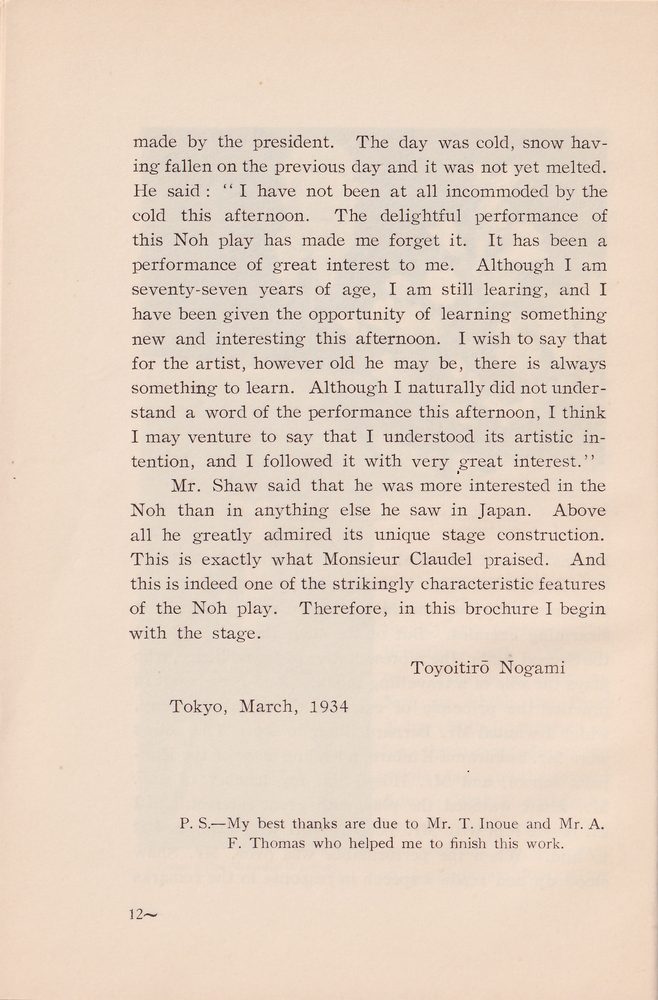
made by the president. The day was cold, snow having fallen on the previous day and it was not yet melted. He said: “I have not been at all incommoded by the cold this afternoon. The delightful performance of this Noh play has made me forget it. It has been a performance of great interest to me. Although I am seventy-seven years of age, I am still learningPrinted: learing, and I have been given the opportunity of learning something new and interesting this afternoon. I wish to say that for the artist, however old he may be, there is always something to learn. Although I naturally did not understand a word of the performance this afternoon, I think I may venture to say that I understood its artistic intention, and I followed it with very great interest.”
Mr. Shaw said that he was more interested in the Noh than in anything else he saw in Japan. Above all he greatly admired its unique stage construction. This is exactly what Monsieur Claudel praised. And this is indeed one of the strikingly characteristic features of the Noh play. Therefore, in this brochure I begin with the stage.
Toyoitirō Nogami
Tokyo, March, 1934
P. S.—My best thanks are due to Mr. T. Inoue and Mr. A. F. Thomas who helped me to finish this work.
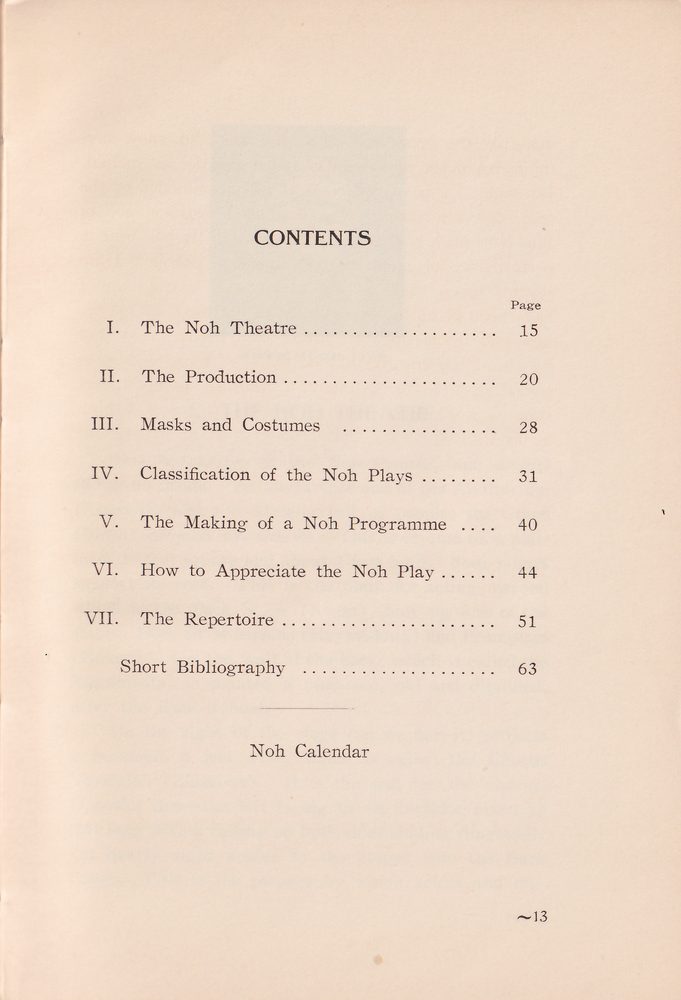
CONTENTS
Page
I. The Noh Theatre .............. 15
II. The Production .............. 20
III. Masks and Costumes .............. 28
IV. Classification of the Noh Plays .............. 31
V. The Making of a Noh Programme .............. 40
VI. How to Appreciate the Noh Play .............. 44
VII. The Repertoire .............. 51
Short Bibliography .............. 63