
V. THE MAKING OF A NOH PROGRAMME
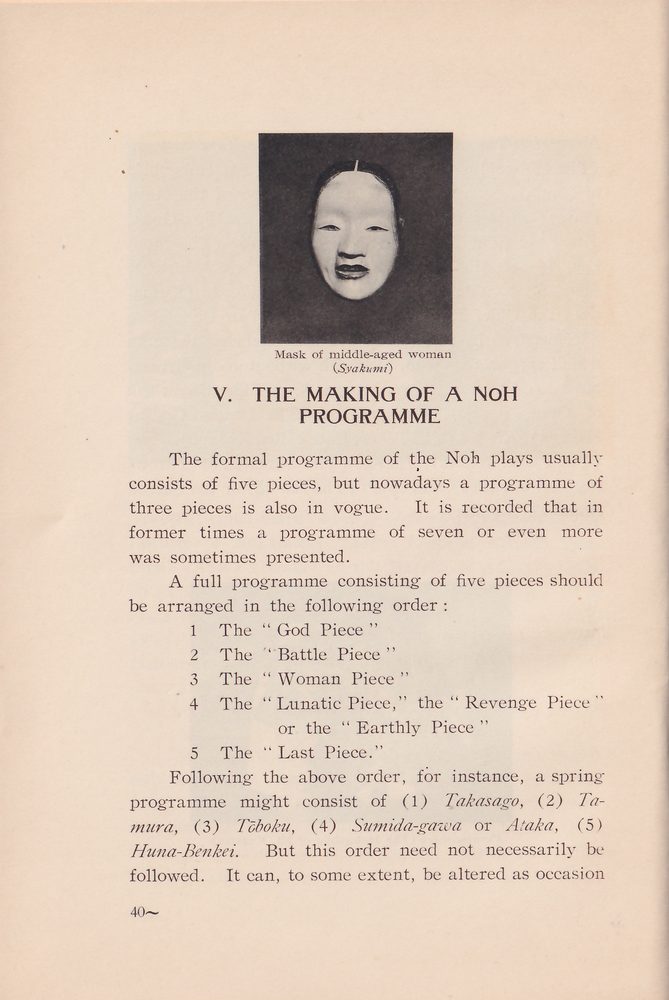
(Syakumi)
The formal programme of the Noh plays usually consists of five pieces, but nowadays a programme of three pieces is also in vogue. It is recorded that in former times a programme of seven or even more was sometimes presented.
A full programme consisting of five pieces should be arranged in the following order:
1 The “God Piece”
2 The “Battle Piece”
3 The “Woman Piece”
4 The “Lunatic Piece,” the “Revenge Piece” or the “Earthly Piece”
5 The “Last Piece.”
Following the above order, for instance, a spring programme might consist of (1) Takasago, (2) Tamura, (3) Tōboku, (4) Sumida-gawa or Ataka, (5) Huna-Benkei. But this order need not necessarily be followed. It can, to some extent, be altered as occasion
demands. For example, Sumida-gawa being originally a play about a mad woman should be in the fourth group, but because her part must be performed with a measure of grace, it may be regarded as a kind of the “Woman Piece” and put in the third group. Again, Ataka, being a realistic Noh, should be placed in the fourth group, but it could also be placed in the second in place of a “Battle Piece.” However, the order of the plays in the programme is governed by a fundamental rule, that is the “Theory of Jo, Ha and Kyū.” “Jo” means the initial part, “Ha” the middle part, and “Kyū” the final part. The initial part is to be represented solemnly and powerfully; the middle part finely and delicately; the final part briefly and rapidly. The middle part is the substance of the programme and the longest. The following is a programme consisting of
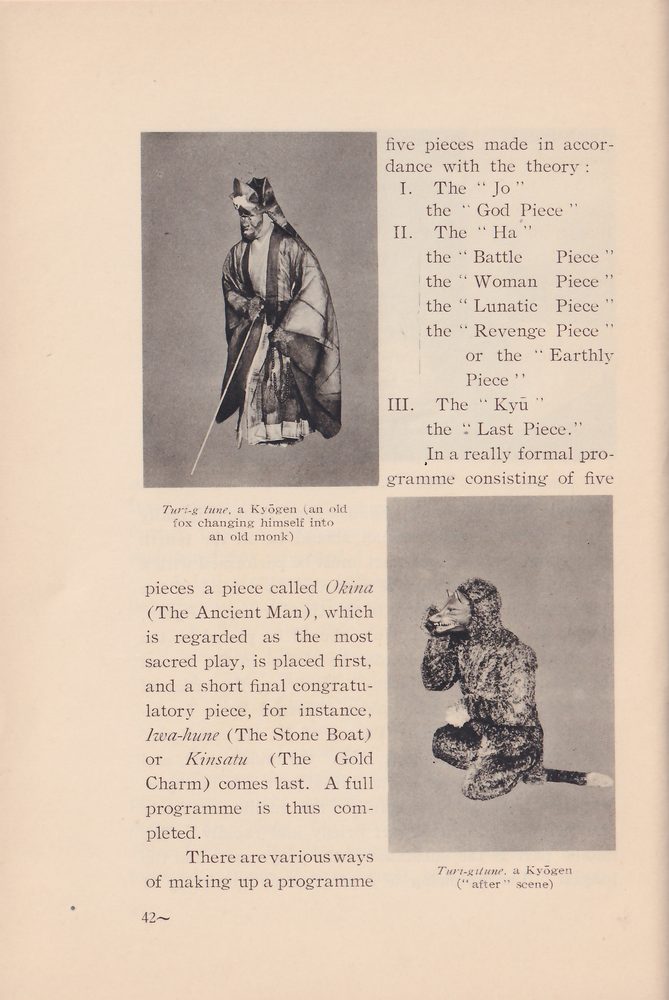
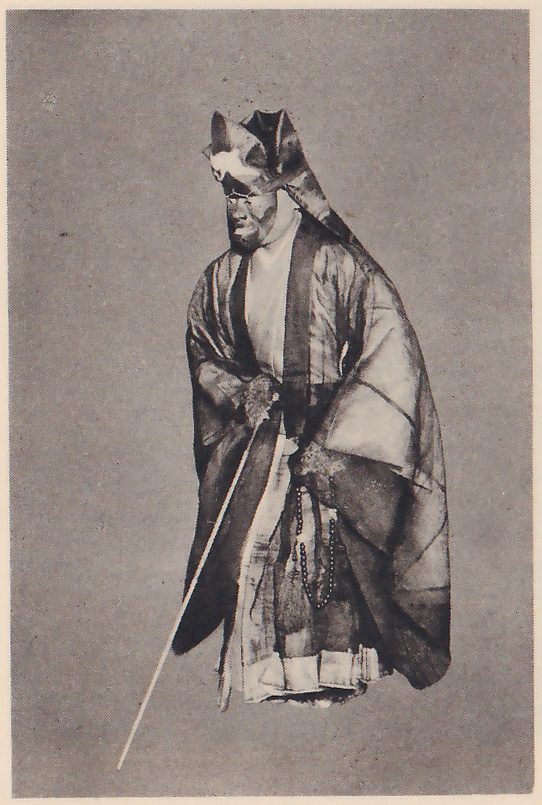
fox changing himself into
an old monk)
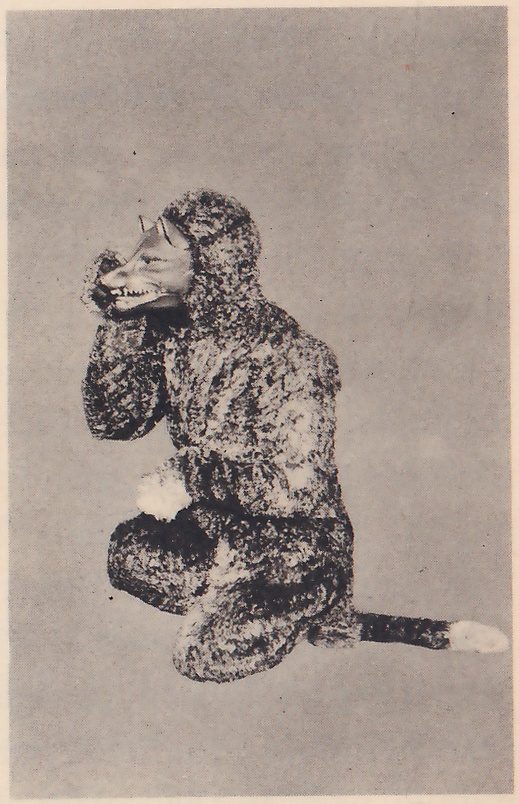
(“after” scene)
five pieces made in accordance with the theory:
I. The “Jo”
the “God Piece”
II. The “Ha”
the “Battle Piece”
the “Woman Piece”
the “Lunatic Piece”
the “Revenge Piece”
or the “Earthly Piece”
III. The “Kyū”
the “Last Piece.”
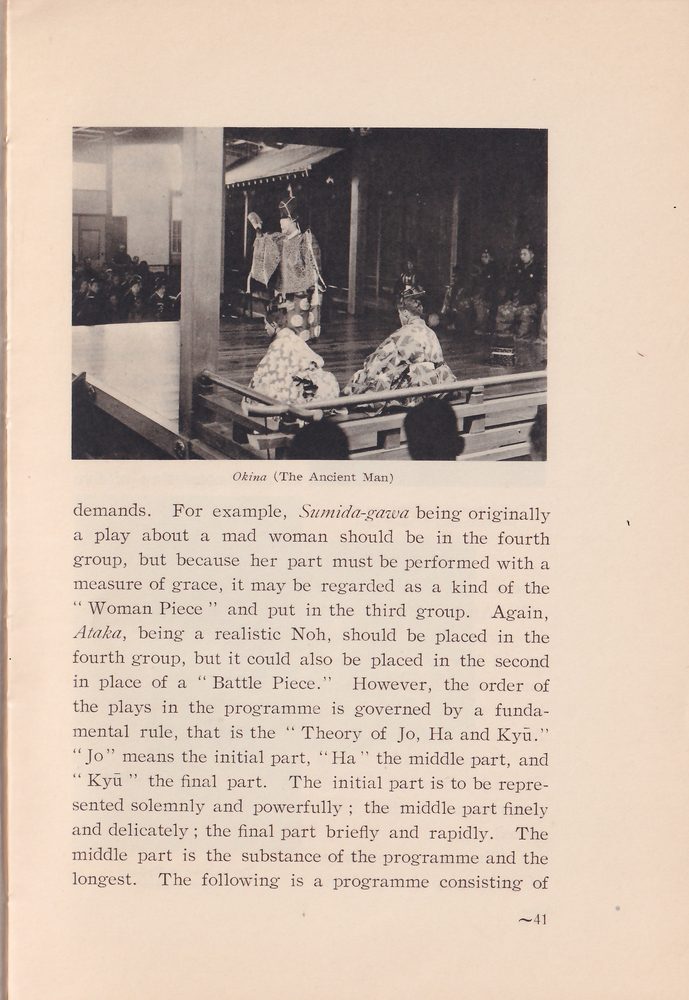
In a really formal programme consisting of five pieces a piece called Okina (The Ancient Man), which is regarded as the most sacred play, is placed first, and a short final congratulatory piece, for instance, Iwa-hune (The Stone Boat) or Kinsatu (The Gold Charm) comes last. A full programme is thus completed.
There are various ways of making up a programme
consisting of three pieces, but the programme most commonly adopted consists of either (1) the “Battle Piece,” (2) the “Woman Piece,” (3) the “Last Piece,” excluding the “God Piece,” and the “Lunatic Piece,” or (1) the “Earthly Piece,” (2) the “Woman Piece,” (3) the “Last Piece.” But there are many other ways of programme building.
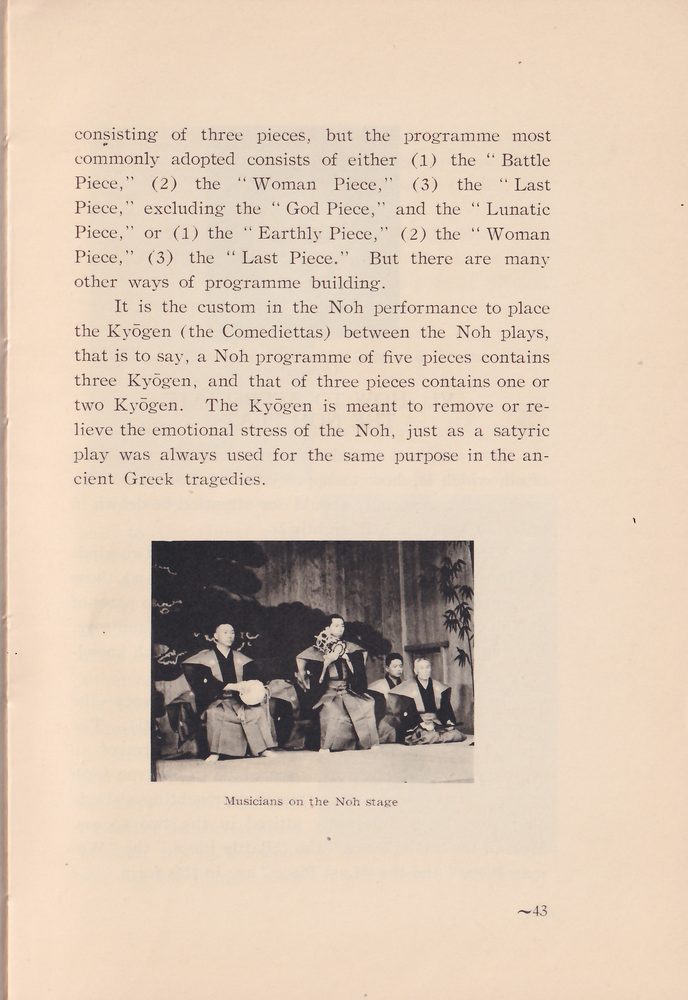
It is the custom in the Noh performance to place the Kyōgen (the Comediettas) between the Noh plays, that is to say, a Noh programme of five pieces contains three Kyōgen, and that of three pieces contains one or two Kyōgen. The Kyōgen is meant to remove or relieve the emotional stress of the Noh, just as a satyric play was always used for the same purpose in the ancient Greek tragedies.