
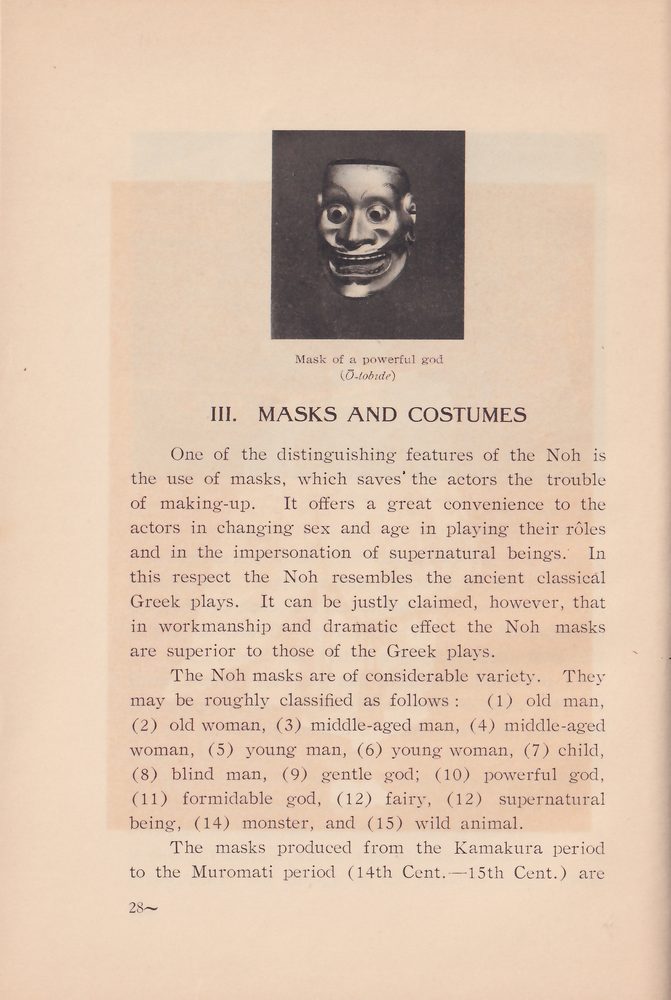
III. MASKS AND COSTUMES
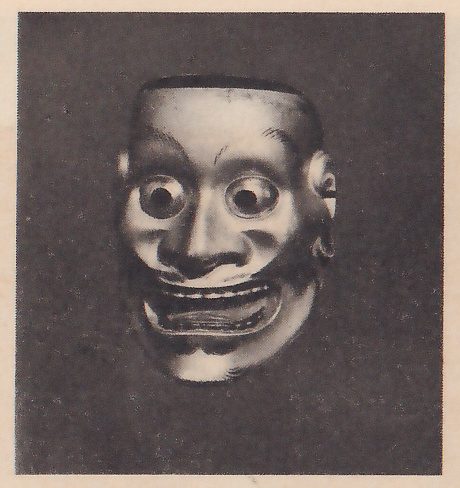
(Ō-tobide)
One of the distinguishing features of the Noh is the use of masks, which saves the actors the trouble of making-up. It offers a great convenience to the actors in changing sex and age in playing their rôles and in the impersonation of supernatural beings. In this respect the Noh resembles the ancient classical Greek plays. It can be justly claimed, however, that in workmanship and dramatic effect the Noh masks are superior to those of the Greek plays.
The Noh masks are of considerable variety. They may be roughly classified as follows: (1) old man, (2) old woman, (3) middle-aged man, (4) middle-aged woman, (5) young man, (6) young woman, (7) child, (8) blind man, (9) gentle god; (10) powerful god, (11) formidable god, (12) fairy, (12) supernatural being, (14) monster, and (15) wild animal.
The masks produced from the Kamakura period to the Muromati period (14th Cent.—15th Cent.) are
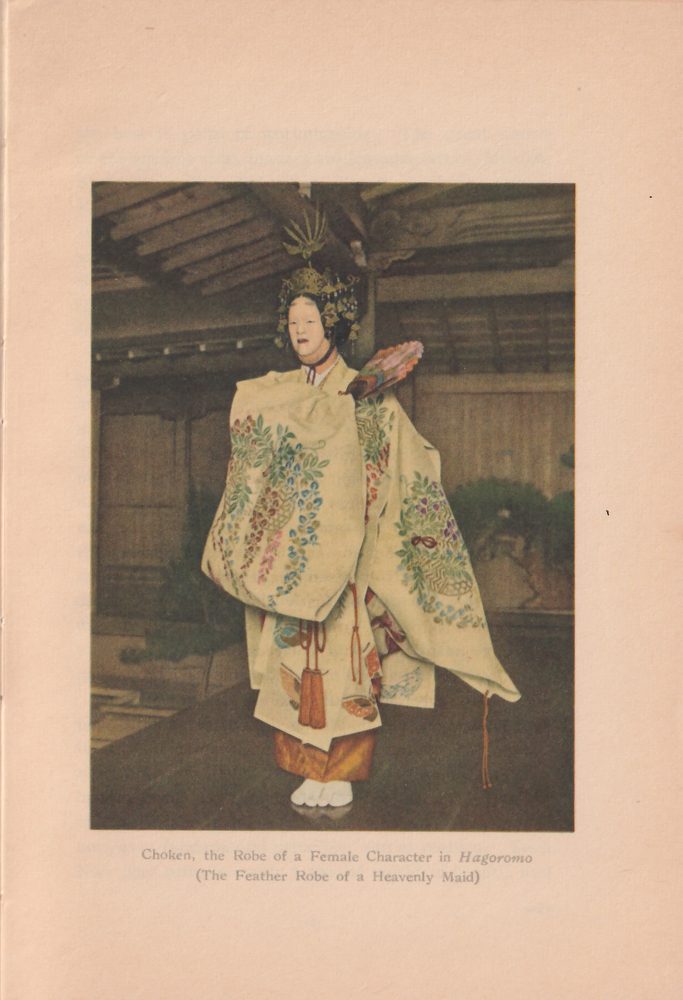
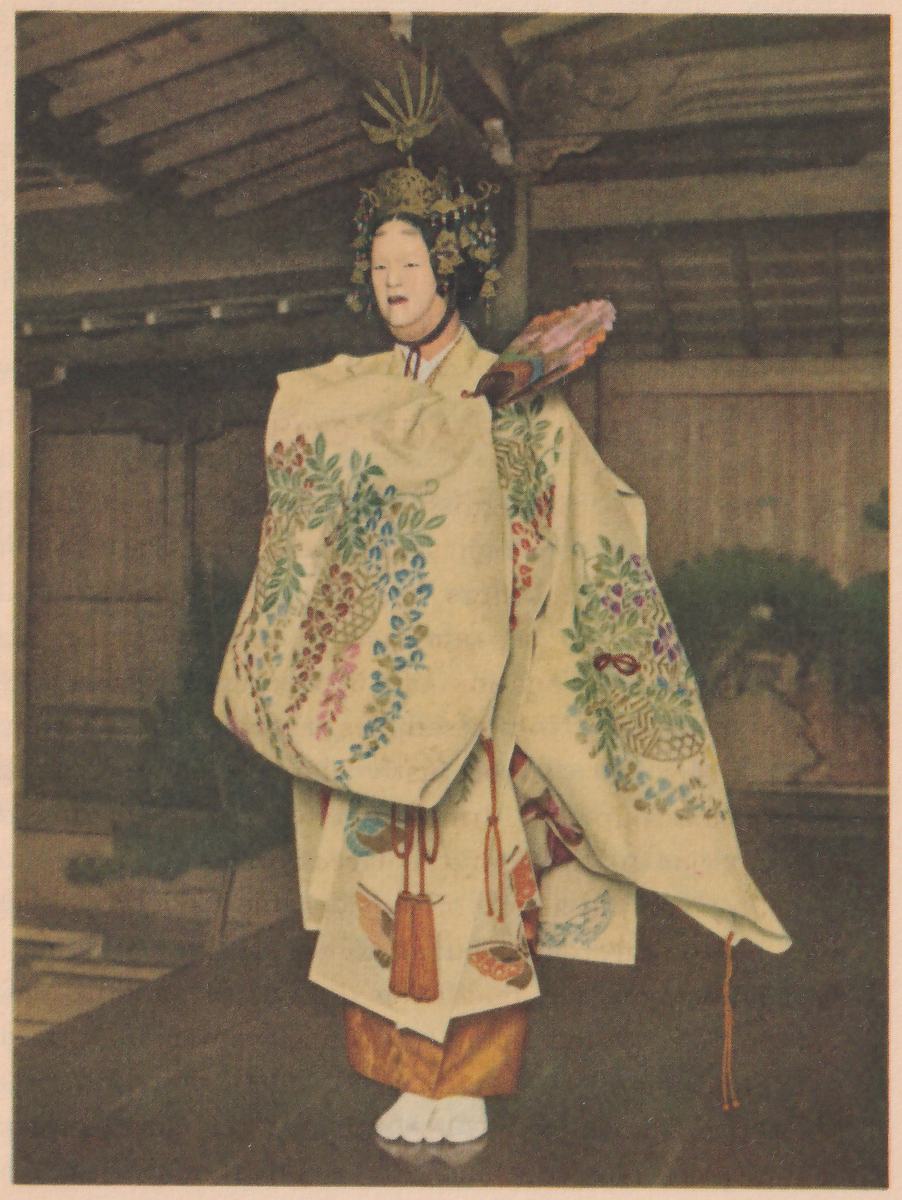
(The Feather Robe of a Heavenly Maid)
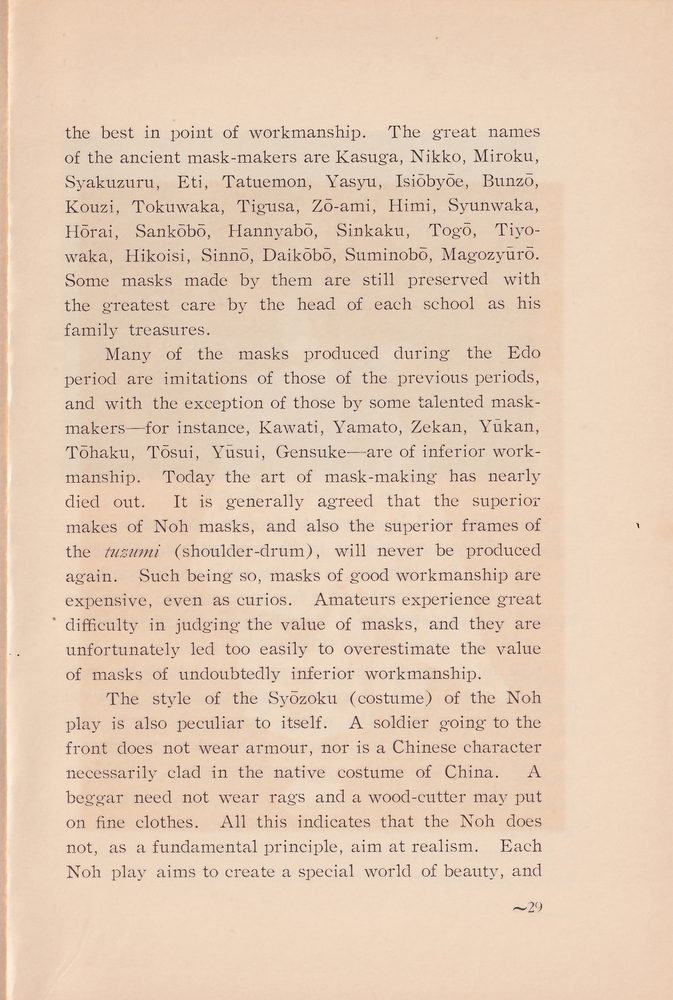
the best in point of workmanship. The great names of the ancient mask-makers are Kasuga, Nikko, Miroku, Syakuzuru, Eti, Tatuemon, Yasyu, Isiōbyōe, Bunzō, Kouzi, Tokuwaka, Tigusa, Zō-ami, Himi, Syunwaka, Hōrai, Sankōbō, Hannyabō, Sinkaku, Togō, Tiyowaka, Hikoisi, Sinnō, Daikōbō, Suminobō, Magozyūrō. Some masks made by them are still preserved with the greatest care by the head of each school as his family treasures.
Many of the masks produced during the Edo period are imitations of those of the previous periods, and with the exception of those by some talented mask-makers—for instance, Kawati, Yamato, Zekan, Yūkan, Tōhaku, Tōsui, Yūsui, Gensuke—are of inferior workmanship. Today the art of mask-making has nearly died out. It is generally agreed that the superior makes of Noh masks, and also the superior frames of the tuzumi (shoulder-drum), will never be produced again. Such being so, masks of good workmanship are expensive, even as curios. Amateurs experience great difficulty in judging the value of masks, and they are unfortunately led too easily to overestimate the value of masks of undoubtedly inferior workmanship.
The style of the Syōzoku (costume) of the Noh play is also peculiar to itself. A soldier going to the front does not wear armour, nor is a Chinese character necessarily clad in the native costume of China. A beggar need not wear rags and a wood-cutter may put on fine clothes. All this indicates that the Noh does not, as a fundamental principle, aim at realism. Each Noh play aims to create a special world of beauty, and
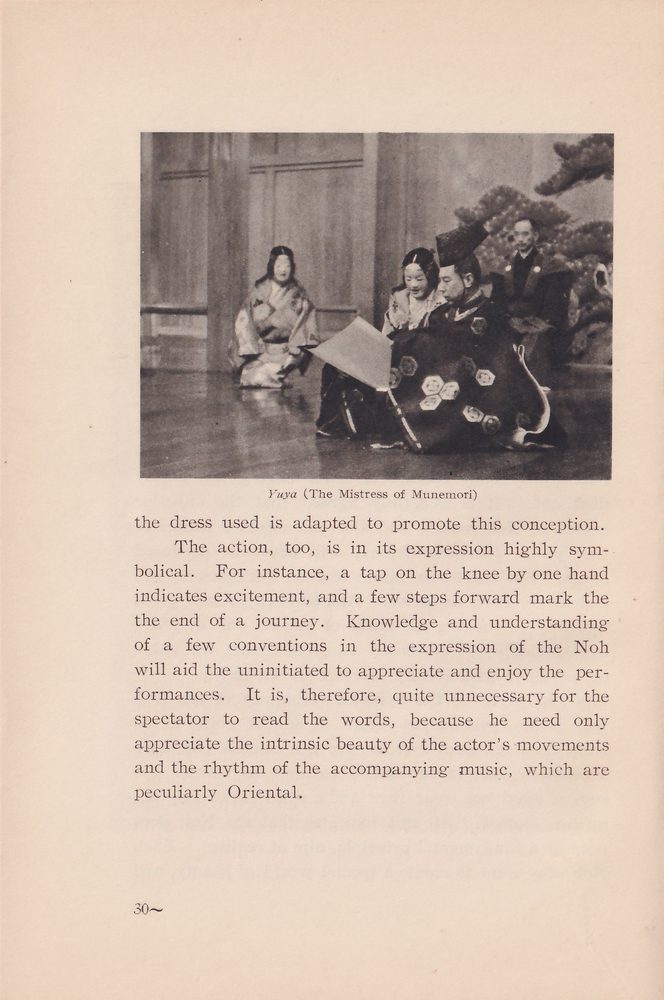
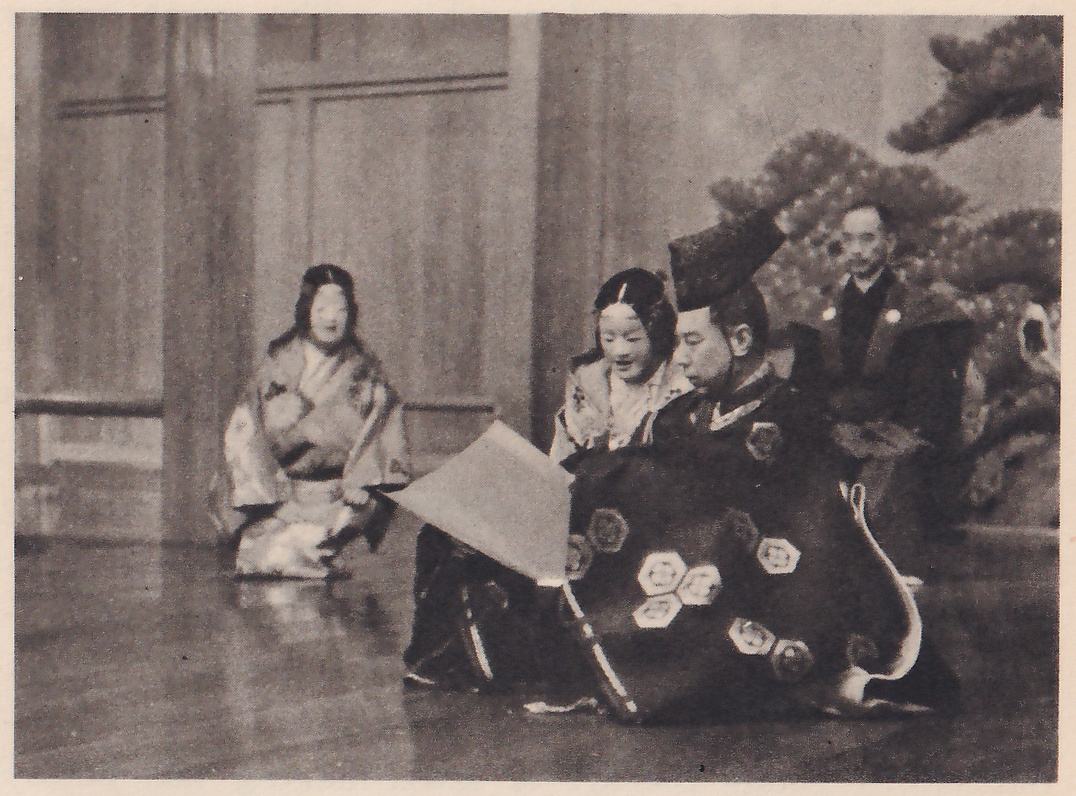
the dress used is adapted to promote this conception.
The action, too, is in its expression highly symbolical. For instance, a tap on the knee by one hand indicates excitement, and a few steps forward mark thePrinted: the the end of a journey. Knowledge and understanding of a few conventions in the expression of the Noh will aid the uninitiated to appreciate and enjoy the performances. It is, therefore, quite unnecessary for the spectator to read the words, because he need only appreciate the intrinsic beauty of the actor’s movements and the rhythm of the accompanying music, which are peculiarly Oriental.