
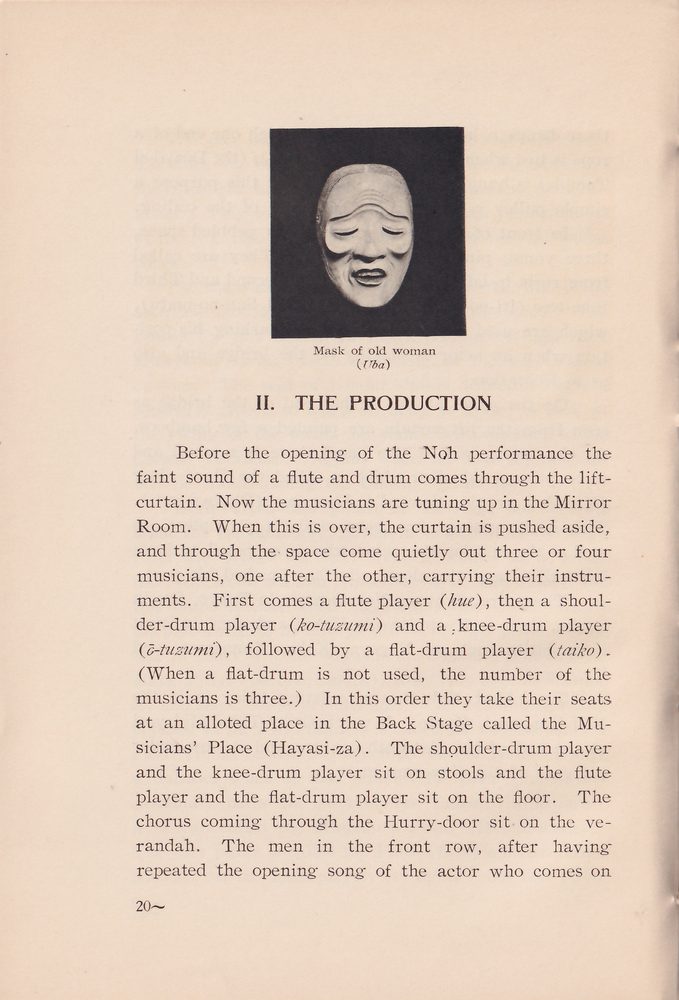
II. THE PRODUCTION
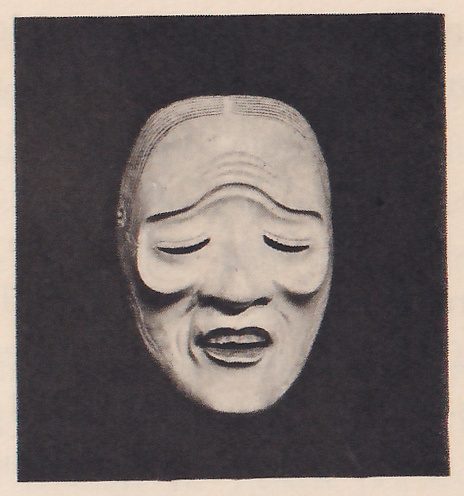
(Uba)
Before the opening of the Noh performance the faint sound of a flute and drum comes through the lift-curtain. Now the musicians are tuning up in the Mirror Room. When this is over, the curtain is pushed aside, and through the space come quietly out three or four musicians, one after the other, carrying their instruments. First comes a flute player (hue), then a shoulder-drum player (ko-tuzumi) and a knee-drum player (ō-tuzumi), followed by a flat-drum player (taiko). (When a flat-drum is not used, the number of the musicians is three.) In this order they take their seats at an allottedPrinted: alloted place in the Back Stage called the Musicians’ Place (Hayasi-za). The shoulder-drum player and the knee-drum player sit on stools and the flute player and the flat-drum player sit on the floor. The chorus coming through the Hurry-door sit on the verandah. The men in the front row, after having repeated the opening song of the actor who comes on
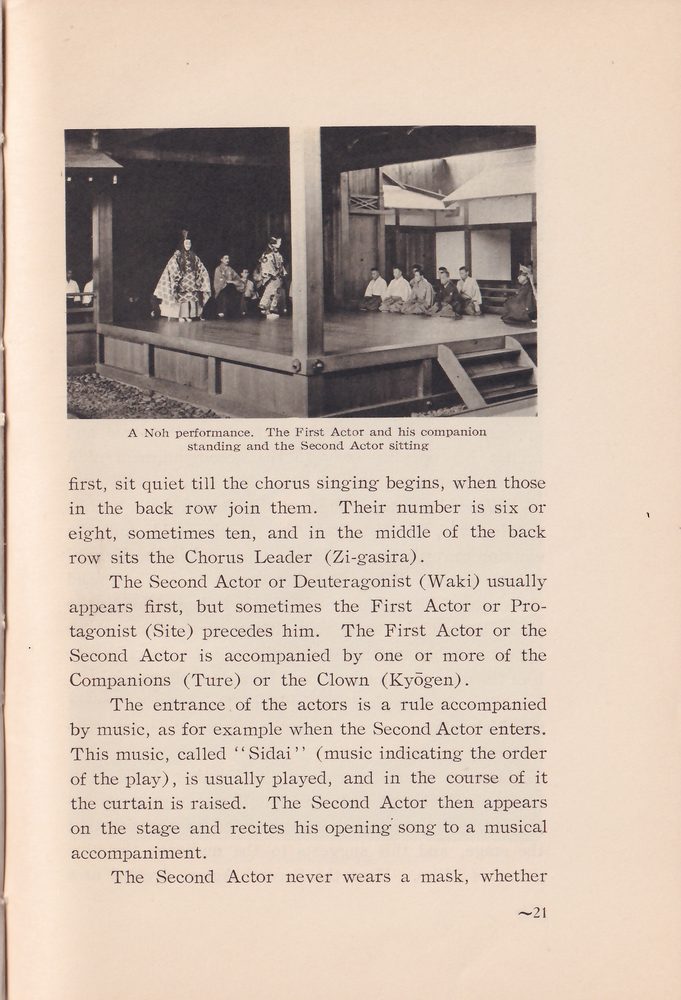
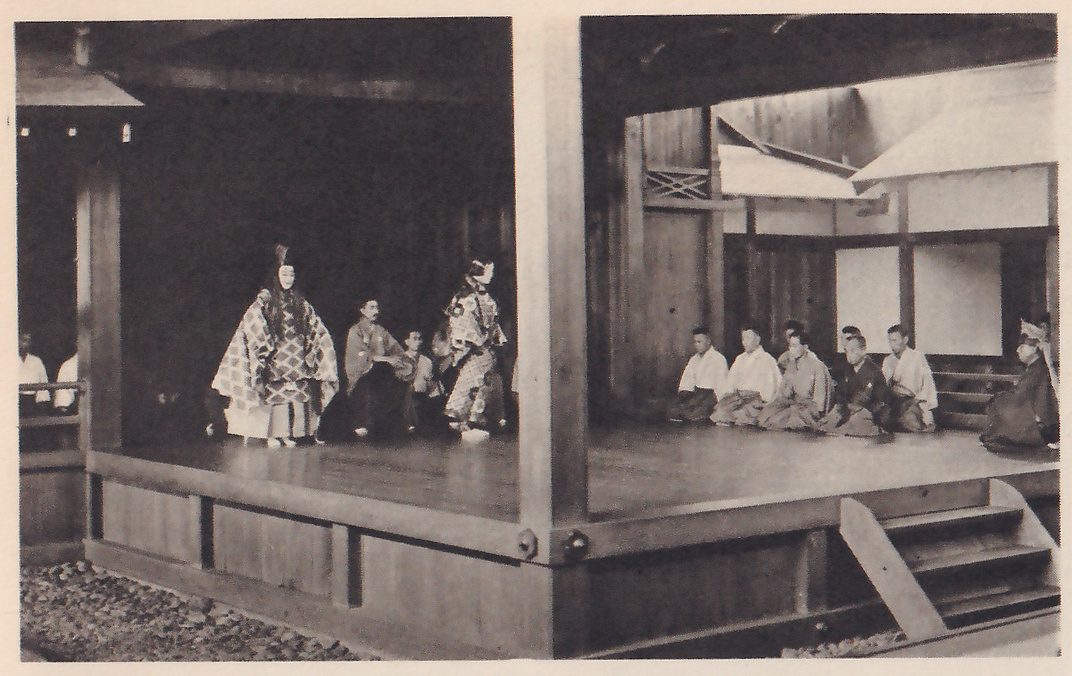
standing and the Second Actor sitting
first, sit quiet till the chorus singing begins, when those in the back row join them. Their number is six or eight, sometimes ten, and in the middle of the back row sits the Chorus Leader (Zi-gasira).
The Second Actor or Deuteragonist (Waki) usually appears first, but sometimes the First Actor or Protagonist (Site) precedes him. The First Actor or the Second Actor is accompanied by one or more of the Companions (Ture) or the Clown (Kyōgen).
The entrance of the actors is a rule accompanied by music, as for example when the Second Actor enters. This music, called “Sidai” (music indicating the order of the play), is usually played, and in the course of it the curtain is raised. The Second Actor then appears on the stage and recites his opening song to a musical accompaniment.
The Second Actor never wears a mask, whether
he plays the rôle of priest, monk, minister, samurai, or citizen, for he represents the audience. When he has finished the Sidai, the chorus recite it in a low voice. Then he declares his name and the reason for his appearance, which is called the Declaration (Nanori). When he is supposed to be travelling, he tells about his progress in a song called the Travelling Song (Mitiyuki) and at the end of the song he is supposed to have reached his destination.
The representative music which accompanies the First Actor is “Issei” (music indicating the subject of the play). At about the middle of this music he appears on the bridge behind the First Pine-tree and recites his opening song to the accompaniment of a musical instrument.
When he enters the stage the Second Actor speaks to him, and the history of the place is told, and the emotion towards bygone days is expressed in the form of a lyric poem. When the day draws to a close, and the visitor (Second Actor) is unable to bear leaving the place, and while he is still sitting there alone, there appears in his vision a noble figure who describes to him the days of splendour, and then dances gracefully.
This is a typical example of the construction of the Noh play, but some of the plays are more dramatically treated.
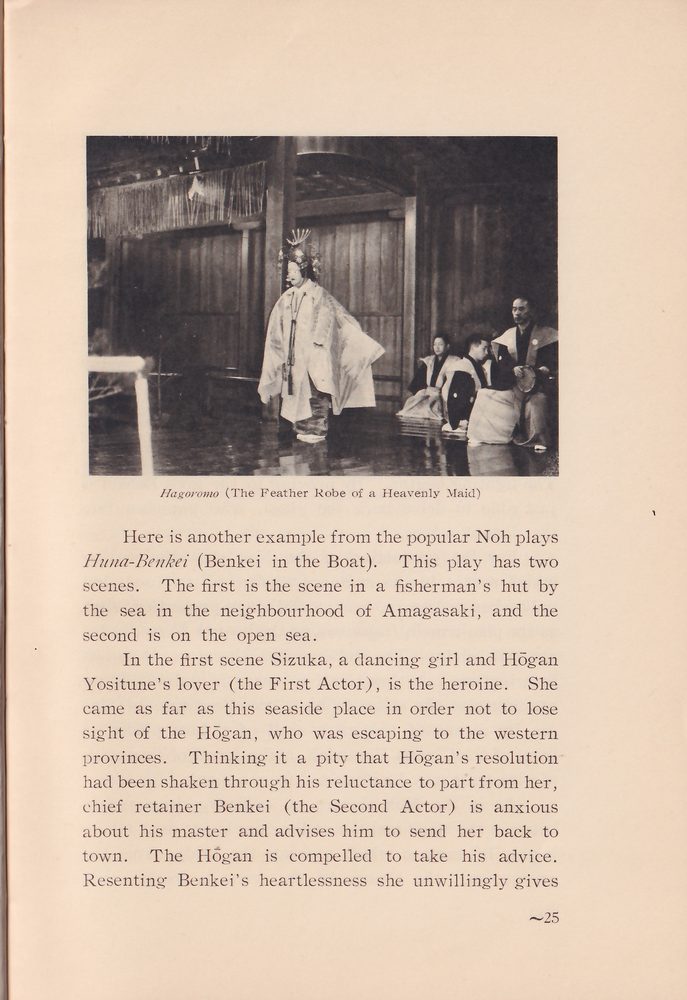
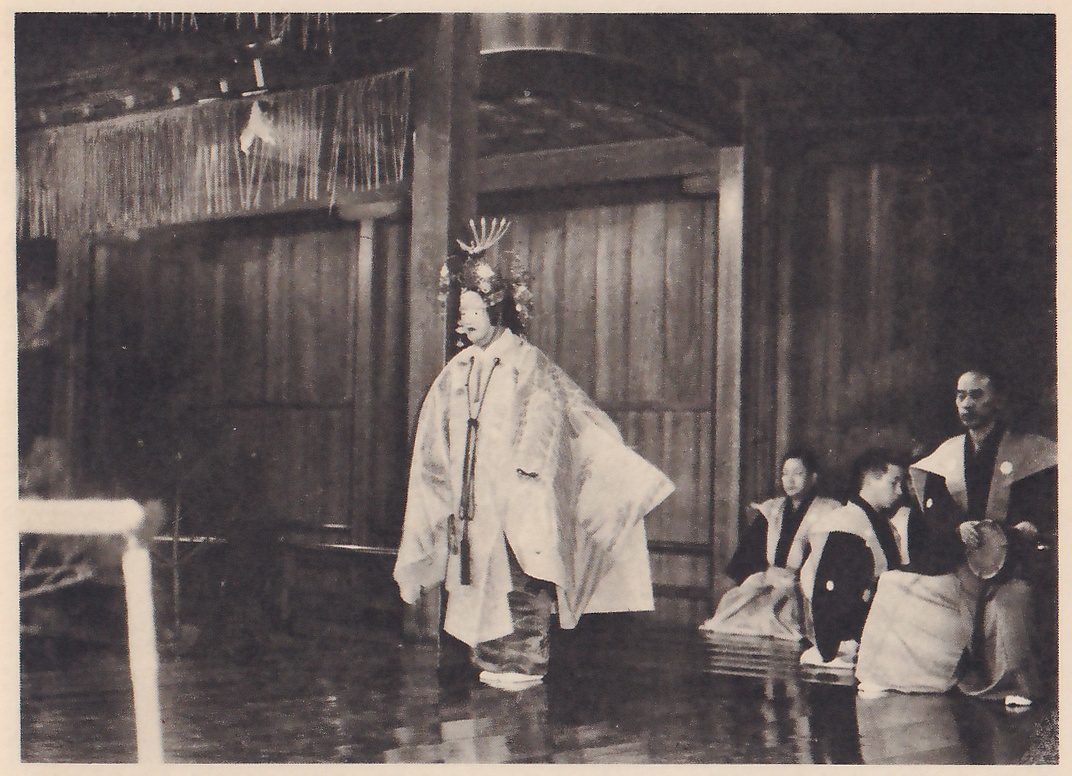
Let us take Hagoromo (The Feather Robe of a Heavenly Maid) as an example. A stage property representing a pine-tree is first carried to the front of the stage, and this suggests to the audience the pine grove of Miho. Here the Second Actor, dressed as a
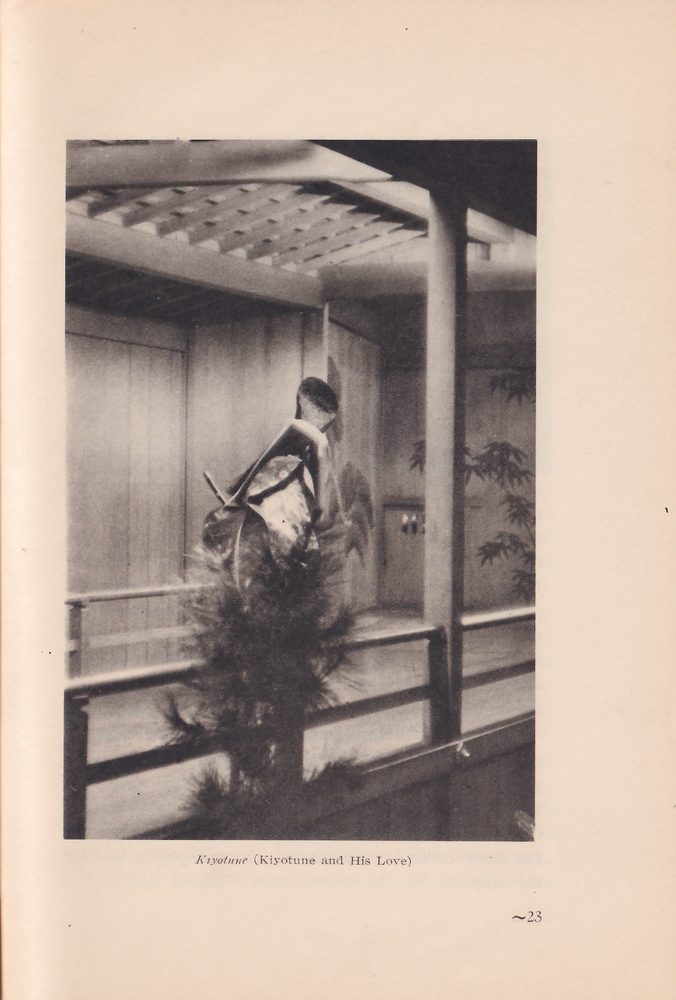
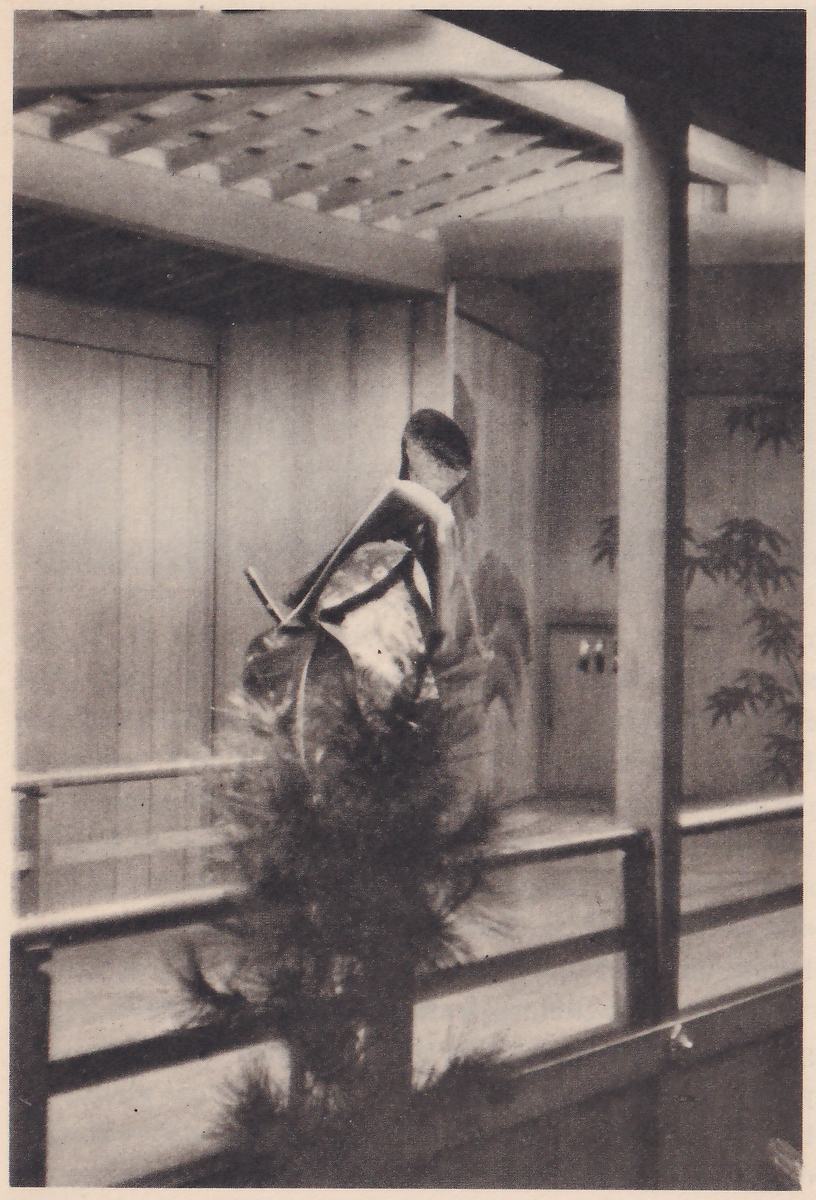
fisherman and accompanied by his two companions, enters and recites a song which praises the peaceful seaside scene. Suddenly he discovers a beautiful robe hanging on a branch of the pine-tree. He is gladly going to carry it home when the First Actor dressed as a Heavenly Maid calls him from the other side of the curtain and entreats him not to carry it away, saying that if she loses it she will never be able to return to heaven. After some discourse he promises her to give it back to her if she will dance for him the famous Heavenly Dance. The fisherman still fears that she may fly away to the sky if he gives the robe back to her before she dances, but being told that suspicion exists only on earth, not in heaven, he is ashamed of his fears and at last gives her back the robe. The maid puts it on and dance. She goes high up in the sky while dancing, and gradually goes farther and farther looking down upon Mt. Asitaka and Suruga Bay till she comes to the end of the bridge, when the performance ends. The actor indicates the end of his performance by tapping the floor with his foot. But sometimes he disappears into the curtain still dancing, and in this case the Second Actor drawing near to the First Actor’s Pillar taps the floor with his foot.
When the actors leave the stage the First Actor goes off first, then the Second Actor and the companions. They go back to the greenroom along the bridge, while the chorus retires through the Hurry-door. The musicians go out last along the bridge in the same order as they entered, the flute player leading the way.
Here is another example from the popular Noh plays Huna-Benkei (Benkei in the Boat). This play has two scenes. The first is the scene in a fisherman’s hut by the sea in the neighbourhood of Amagasaki, and the second is on the open sea.
In the first scene Sizuka, a dancing girl and Hōgan Yositune’s lover (the First Actor), is the heroine. She came as far as this seaside place in order not to lose sight of the Hōgan, who was escaping to the western provinces. Thinking it a pity that Hōgan’s resolution had been shaken through his reluctance to part from her, chief retainer Benkei (the Second Actor) is anxious about his master and advises him to send her back to town. The Hōgan is compelled to take his advice. Resenting Benkei’s heartlessness she unwillingly gives
her consent to part from the Hōgan. At the farewell feast Sizuka dances sorrowfully, and then makes her exit.
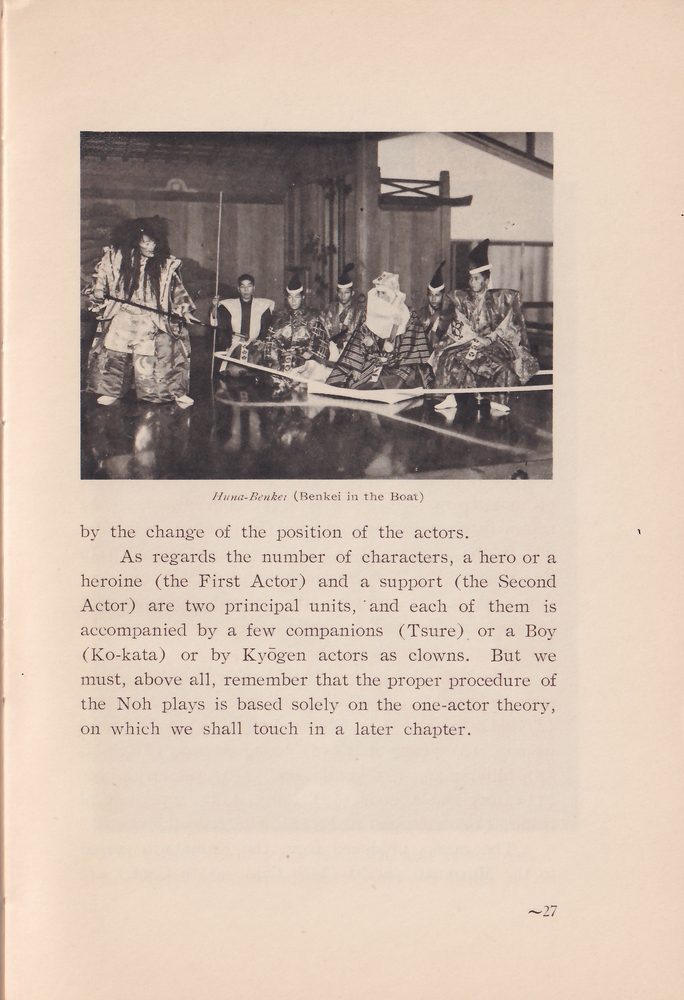
When the dance is over, Benkei, encouraging his fellow samurai, enters a boat (a stage property is used) and they choose the Hōgan (a boy actor plays this rôle) as their captain. Suddenly the weather becomes bad. The wind blows hard and the waves rise. All pray to the gods for help. Just then the ghosts of the people of the Heike clan who have been ruined by the Hōgan, advance from the open sea to fall upon the boat. The ghost of Taira-no-Tomomori (the First Actor again plays this rôle) is at their head brandishing a halberd in the air, and comes to assault the Hōgan. The fighting begins. By praying to the gods Benkei is just able to drive back the ghost, who vanishes into the distant waves.
For the production of the Noh play the setting which serves in the ordinary theatre is not used, but only when necessary, ornamental stage properties, such as the pine-tree in Hagoromo, or the boat in Huna-Benkei, are carried in. The audience has, therefore, to use its imagination. As imaginative power is unlimited, we can imagine the stage to be a broad expanse of blue sea by means of the mere shell of a boat placed in front of the Chorus Verandah, and a forest of thousands of pine-trees may be imagined from a single pine-tree.
As in the Noh theatre an ordinary drop-curtain between the stage and the auditorium is not used (there is only lift-curtain which separate the bridge from the greenroom), the change of the scene is freely made
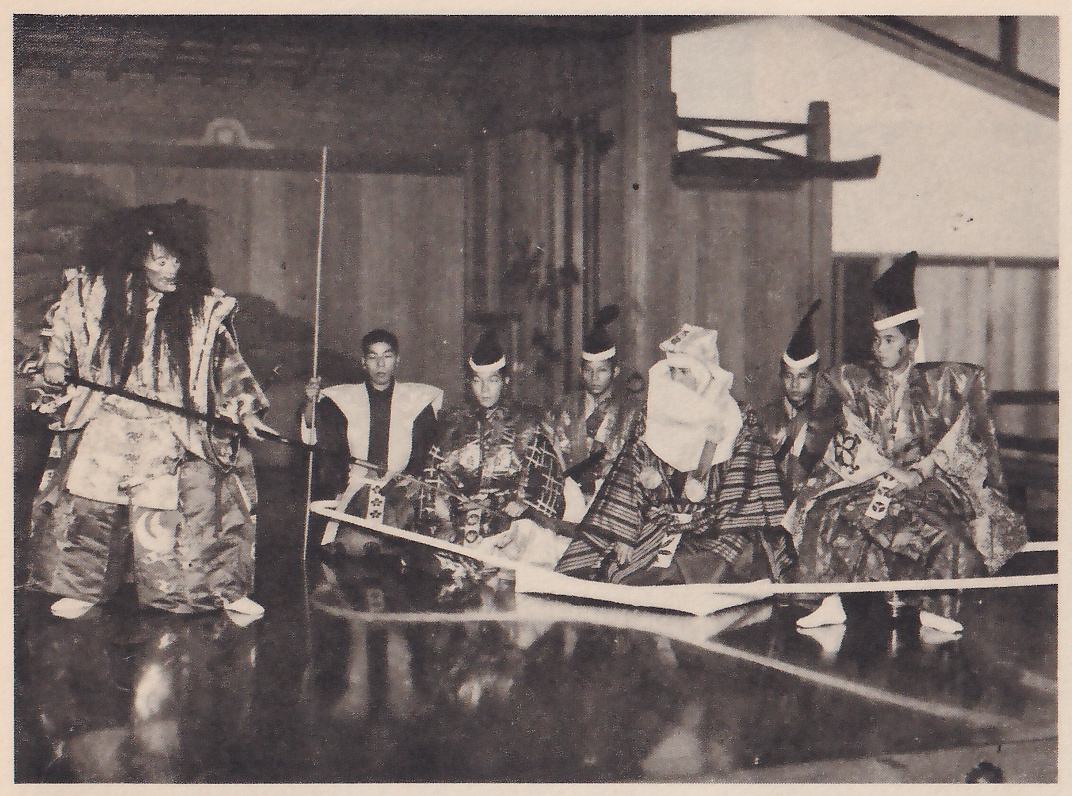
by the change of the position of the actors.
As regards the number of characters, a hero or a heroine (the First Actor) and a support (the Second Actor) are two principal units, and each of them is accompanied by a few companions (Tsure) or a Boy (Ko-kata) or by Kyōgen actors as clowns. But we must, above all, remember that the proper procedure of the Noh plays is based solely on the one-actor theory, on which we shall touch in a later chapter.