
VII. THE REPERTOIRE
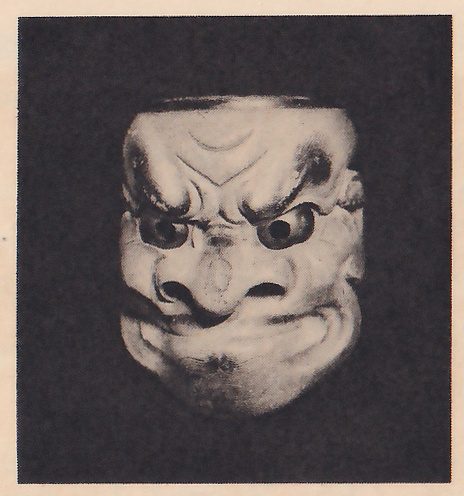
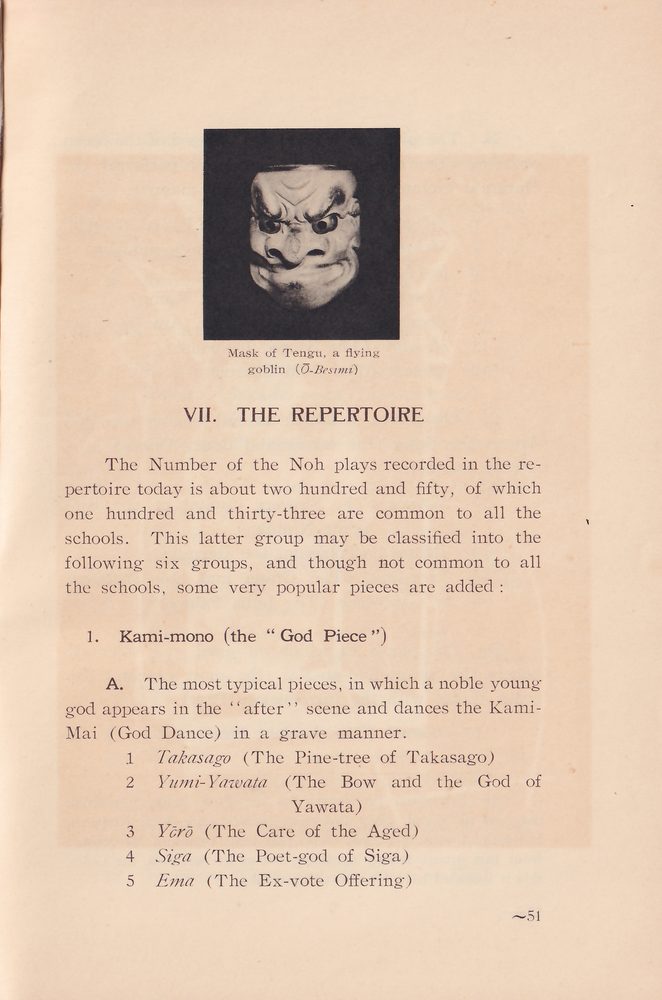
goblin (Ō-Besimi)
The Number of the Noh plays recorded in the repertoire today is about two hundred and fifty, of which one hundred and thirty-three are common to all the schools. This latter group may be classified into the following six groups, and though not common to all the schools, some very popular pieces are added:
1. Kami-mono (the “God Piece”)
A. The most typical pieces, in which a noble young god appears in the “after” scene and dances the Kami-Mai (God Dance) in a grave manner.
1 Takasago (The Pine-tree of Takasago)
2 Yumi-Yawata (The Bow and the God of Yawata)
3 Yōrō (The Care of the Aged)
4 Siga (The Poet-god of Siga)
5 Ema (The Ex-vote Offering)
B. The piece in which a dragon-god of the ocean or some other fierce god appears and performs the Hataraki (jumping about) in a lively manner.
6 Tikubu-sima (The God of the Isle of Tikubu)
7 Mekari (The Festival of Tangle-mowing)
8 Iwa-hune (The Stone-boat)
9 Kamo (The Thunder-God of Kamo)
10 Arasi-yama (The God of Mt. Arasi)
11 Hi-muro (The Sacred Ice-house)
12 Kinsatu (The Gold Charm)
C. The pieces in which an evil-looking aged god dances the Gaku (the ceremonial Court Dance) in a solemn manner.
13 Naniwa (The Flowery Capital of the Emperor Nintoku)
14 Tōbōsaku (Tōbōsaku the Hermit)
15 Turu-kame (The Crane and the Tortoise) or Gekkyūden (The Luna Palace)*
D. The pieces in which an aged god solemnly dances the Sin-no-Zyo-no-Mai (the most graceful Regular Dance with the Introductory Part).
16 Oi-matu (The Ancient Pine-tree)
* In Turu-kame or Gekkyū-den the First Actor, not acting the part of a god, plays the more realistic part of an Emperor, but without wearing a mask. This play may, therefore, be omitted from this group, strictly speaking, but as he performs, the Gaku, this is included here for convenience sake.
17 Hōzyō-gawa (The River Hōzyō)
18 Hakurakuten (Pai-lo-t’ien the Poet Expelled)
E. The pieces in which a female god gracefully dances the Tyū-no-Mai (the Ordinary Dance).
19 Seiōbo (Seiōbo the Fairy Queen)
20 Kureha (Kurehatori the Weaver)
II. The Syura-mono (the “Battle Piece”)
A. The pieces in which a great victory is told.
1 Tamura (Saka-no-ue-no-Tamura-maro)
2 Yasima (Hōgan Yositune at Yasima)
3 Ebira (A Plum-branch in the Quiver)
B. The pieces in which the sad death in battle of a young prince is told.
4 Tadanori (Warrior-poet of the Heike)
5 Mitimori (A Noble Warrior of the Heike)
6 Tunemasa (A Noble Biwa-player of the Heike)
7 Kiyotune (Kiyotune and His Love)
8 Atumori (A Young Flute-player of the Heike)
9 Syunzei Tadanori (Court Poet Syunzei and Tadanori)
10 Ikuta-Atumori (Atumori at Ikuta)
11 Tomonaga (The Death of Tomonaga, the Young Prince of the Genzi)
C. The pieces in which the tragic death of an old warrior is told.
12 Yorimasa (Genzanmi Yorimasa at Uzi)
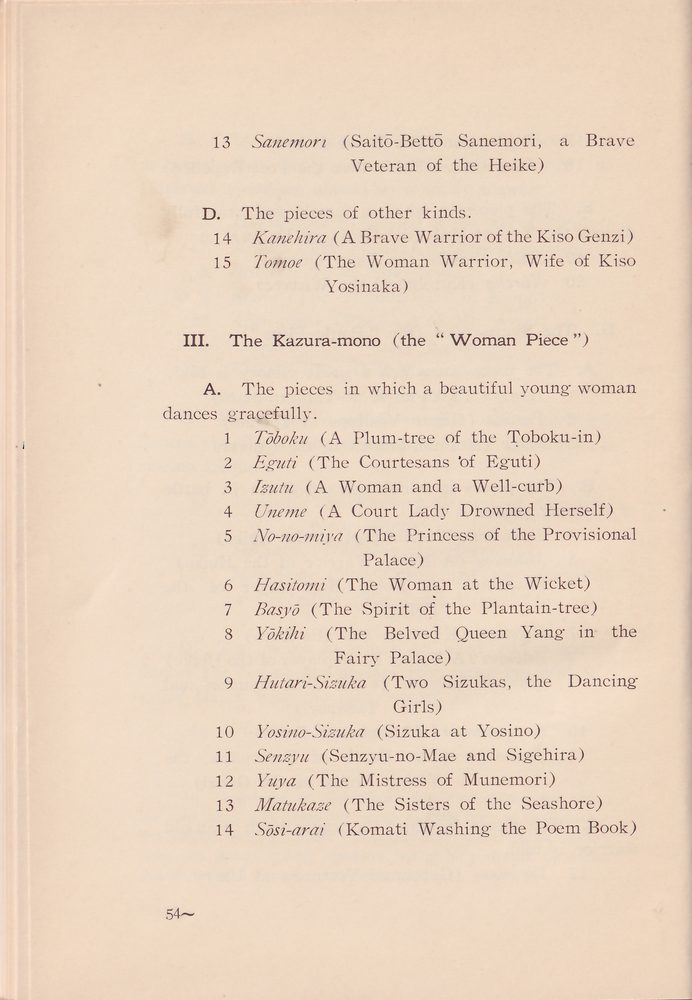
13 Sanemori (Saitō-Bettō Sanemori, a Brave Veteran of the Heike)
D. The pieces of other kinds.
14 Kanehira (A Brave Warrior of the Kiso Genzi)
15 Tomoe (The Woman Warrior, Wife of Kiso Yosinaka)
III. The Kazura-mono (the “Woman Piece”)
A. The pieces in which a beautiful young woman dances gracefully.
1 Tōboku (A Plum-tree of the Tōboku-in)
2 Eguti (The Courtesans of Eguti)
3 Izutu (A Woman and a Well-curb)
4 Uneme (A Court Lady Drowned Herself)
5 No-no-miya (The Princess of the Provisional Palace)
6 Hasitomi (The Woman at the Wicket)
7 Basyō (The Spirit of the Plantain-tree)
8 Yōkihi (The BelovedPrinted: Belved Queen Yang in the Fairy Palace)
9 Hutari-Sizuka (Two Sizukas, the Dancing Girls)
10 Yosino-Sizuka (Sizuka at Yosino)
11 Senzyu (Senzyu-no-Mae and Sigehira)
12 Yuya (The Mistress of Munemori)
13 Matukaze (The Sisters of the Seashore)
14 Sōsi-arai (Komati Washing the Poem Book)
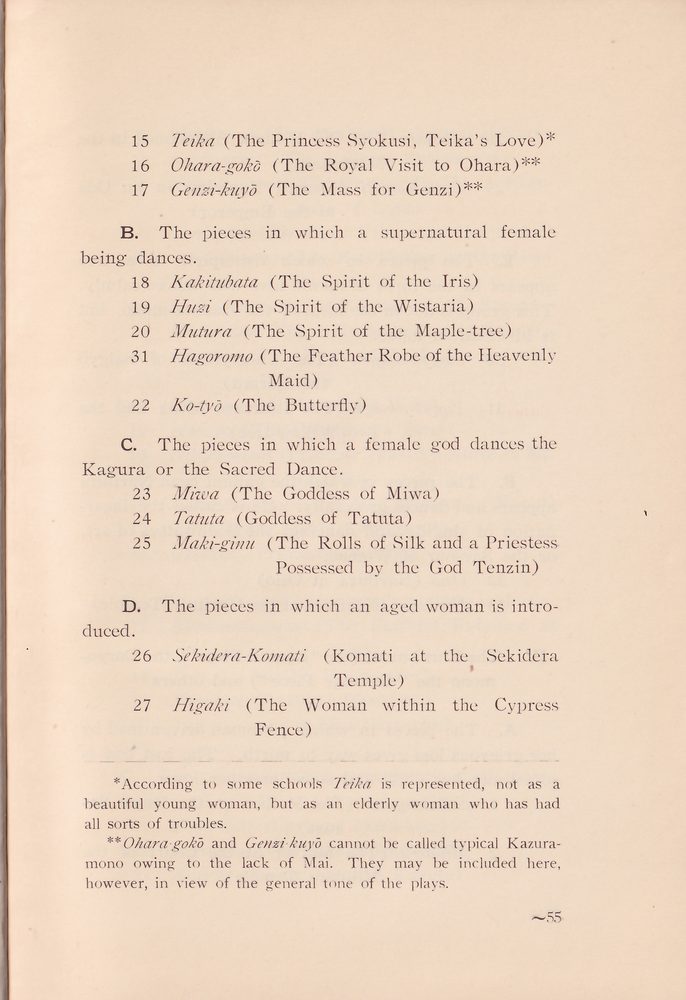
15 Teika (The Princess Syokusi, Teika’s Love)*
16 Ohara-gokō (The Royal Visit to Ohara)**
17 Genzi-kuyō (The Mass for Genzi)**
B. The pieces in which a supernatural female being dances.
18 Kakitubata (The Spirit of the Iris)
19 Huzi (The Spirit of the Wistaria)
20 Mutura (The Spirit of the Maple-tree)
21Printed: 31 Hagoromo (The Feather Robe of the Heavenly Maid)
22 Ko-tyō (The Butterfly)
C. The pieces in which a female god dances the Kagura or the Sacred Dance.
23 Miwa (The Goddess of Miwa)
24 Tatuta (Goddess of Tatuta)
25 Maki-ginu (The Rolls of Silk and a Priestess Possessed by the God Tenzin)
D. The pieces in which an aged woman is introduced.
26 Sekidera-Komati (Komati at the Sekidera Temple)
27 Higaki (The Woman within the Cypress Fence)
*According to some schools Teika is represented, not as a beautiful young woman, but as an elderly woman who has had all sorts of troubles.
**Ohara-gokō and Genzi-kuyō cannot be called typical Kazura-mono owing to the lack of Mai. They may be included here, however, in view of the general tone of the plays.
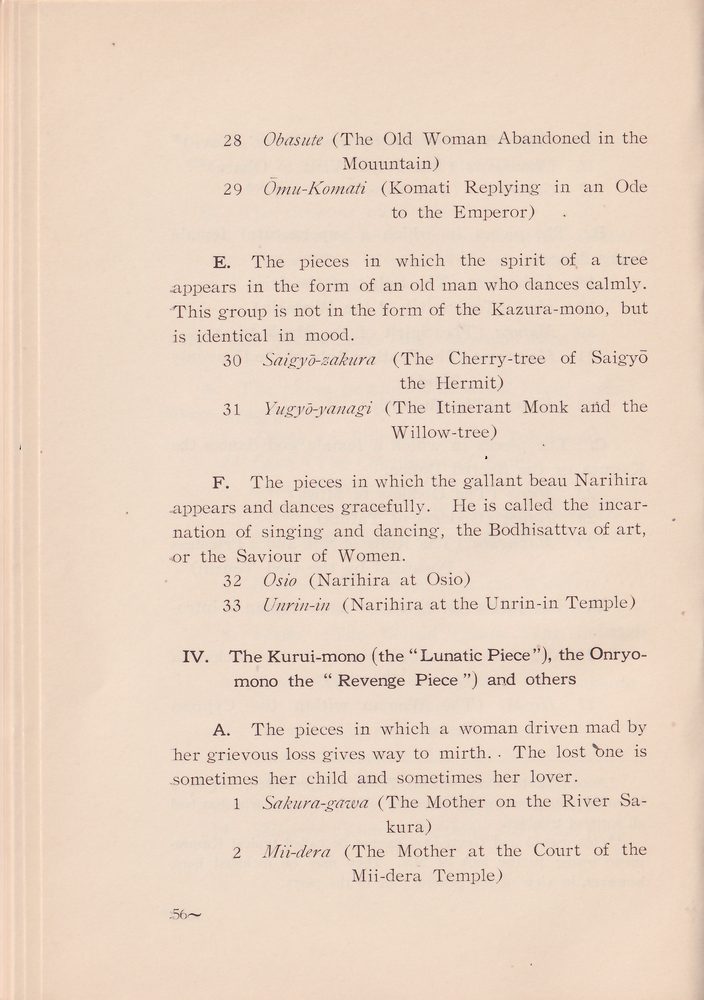
28 Obasute (The Old Woman Abandoned in the MountainPrinted: Mouuntain)
29 Ōmu-Komati (Komati Replying in an Ode to the Emperor)
E. The pieces in which the spirit of a tree appears in the form of an old man who dances calmly. This group is not in the form of the Kazura-mono, but is identical in mood.
30 Saigyō-zakura (The Cherry-tree of Saigyō the Hermit)
31 Yugyō-yanagi (The Itinerant Monk and the Willow-tree)
F. The pieces in which the gallant beau Narihira appears and dances gracefully. He is called the incarnation of singing and dancing, the Bodhisattva of art, or the Saviour of Women.
32 Osio (Narihira at Osio)
33 Unrin-in (Narihira at the Unrin-in Temple)
IV. The Kurui-mono (the “Lunatic Piece”), the Onryo-mono the “Revenge Piece”) and others
A. The pieces in which a woman driven mad by her grievous loss gives way to mirth. The lost one is sometimes her child and sometimes her lover.
1 Sakura-gawa (The Mother on the River Sakura)
2 Mii-dera (The Mother at the Court of the Mii-dera Temple)
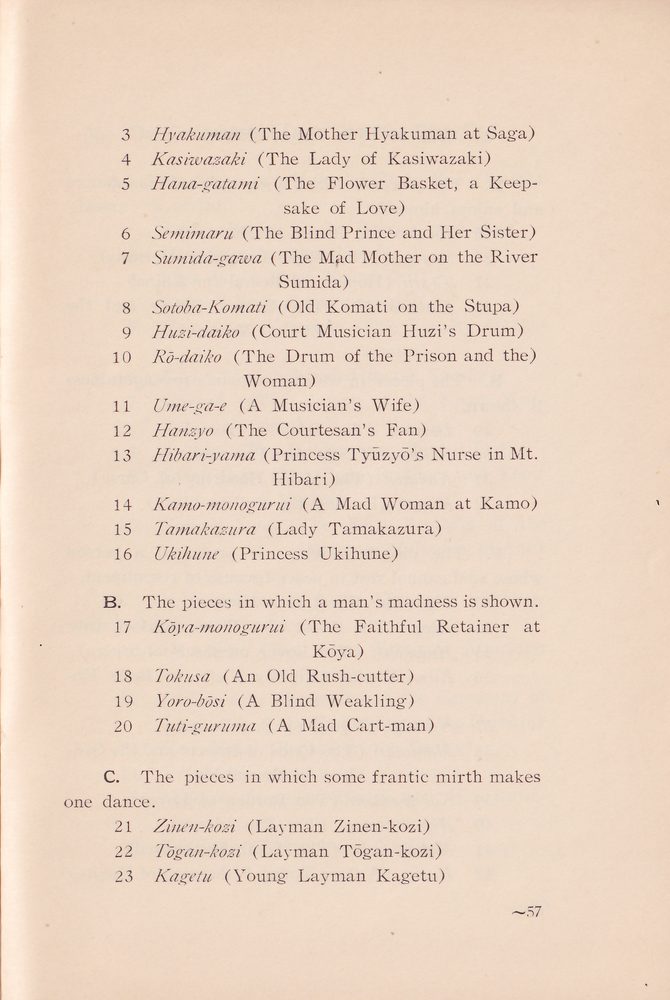
3 Hyakuman (The Mother Hyakuman at Saga)
4 Kasiwazaki (The Lady of Kasiwazaki)
5 Hana-gatami (The Flower Basket, a Keepsake of Love)
6 Semimaru (The Blind Prince and Her Sister)
7 Sumida-gawa (The Mad Mother on the River Sumida)
8 Sotoba-Komati (Old Komati on the Stupa)
9 Huzi-daiko (Court Musician Huzi’s Drum)
10 Rō-daiko (The Drum of the Prison and the Woman)
11 Ume-ga-e (A Musician’s Wife)
12 Hanzyo (The Courtesan’s Fan)
13 Hibari-yama (Princess Tyūzyō’s Nurse in Mt. Hibari)
14 Kamo-monogurui (A Mad Woman at Kamo)
15 Tamakazura (Lady Tamakazura)
16 Ukihune (Princess Ukihune)
B. The pieces in which a man’s madness is shown.
17 Kōya-monogurui (The Faithful Retainer at Kōya)
18 Tokusa (An Old Rush-cutter)
19 Yoro-bōsi (A Blind Weakling)
20 Tuti-guruma (A Mad Cart-man)
C. The pieces in which some frantic mirth makes one dance.
21 Zinen-kozi (Layman Zinen-kozi)
22 Tōgan-kozi (Layman Tōgan-kozi)
23 Kagetu (Young Layman Kagetu)
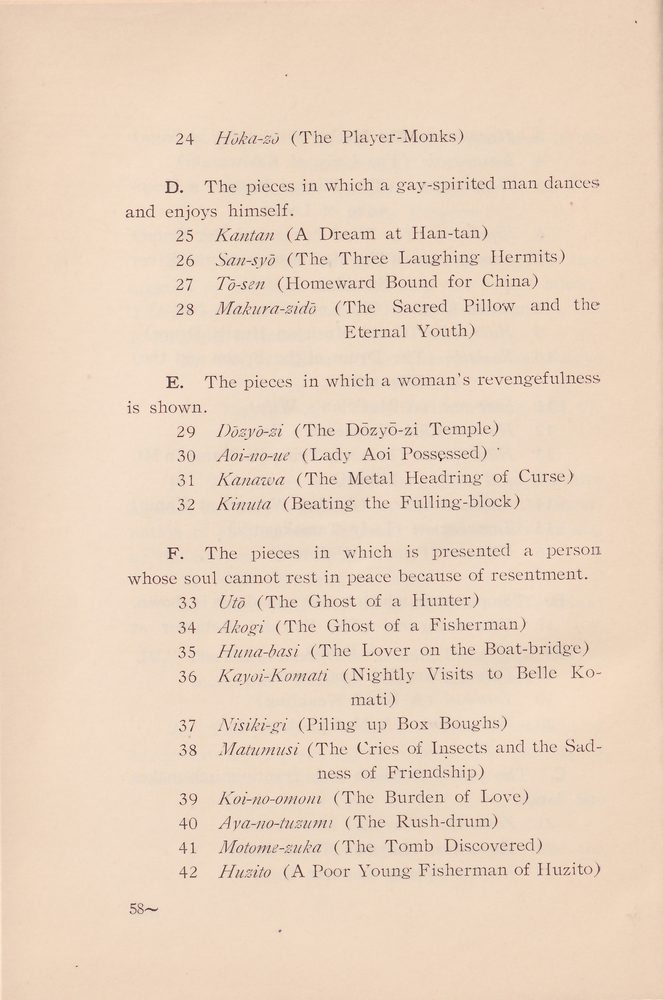
24 Hōka-zō (The Player-Monks)
D. The pieces in which a gay-spirited man dances and enjoys himself.
25 Kantan (A Dream at Han-tan)
26 San-syō (The Three Laughing Hermits)
27 Tō-sen (Homeward Bound for China)
28 Makura-zidō (The Sacred Pillow and the Eternal Youth)
E. The pieces in which a woman’s revengefulness is shown.
29 Dōzyō-zi (The Dōzyō-zi Temple)
30 Aoi-no-ue (Lady Aoi Possessed)
31 Kanawa (The Metal Headring of Curse)
32 Kinuta (Beating the Fulling-block)
F. The pieces in which is presented a person whose soul cannot rest in peace because of resentment.
33 Utō (The Ghost of a Hunter)
34 Akogi (The Ghost of a Fisherman)
35 Huna-basi (The Lover on the Boat-bridge)
36 Kayoi-Komati (Nightly Visits to Belle Komati)
37 Nisiki-gi (Piling up Box Boughs)
38 Matumusi (The Cries of Insects and the Sadness of Friendship)
39 Koi-no-omoni (The Burden of Love)
40 Aya-no-tuzumi (The Rush-drum)
41 Motome-zuka (The Tomb Discovered)
42 Huzito (A Poor Young Fisherman of Huzito)
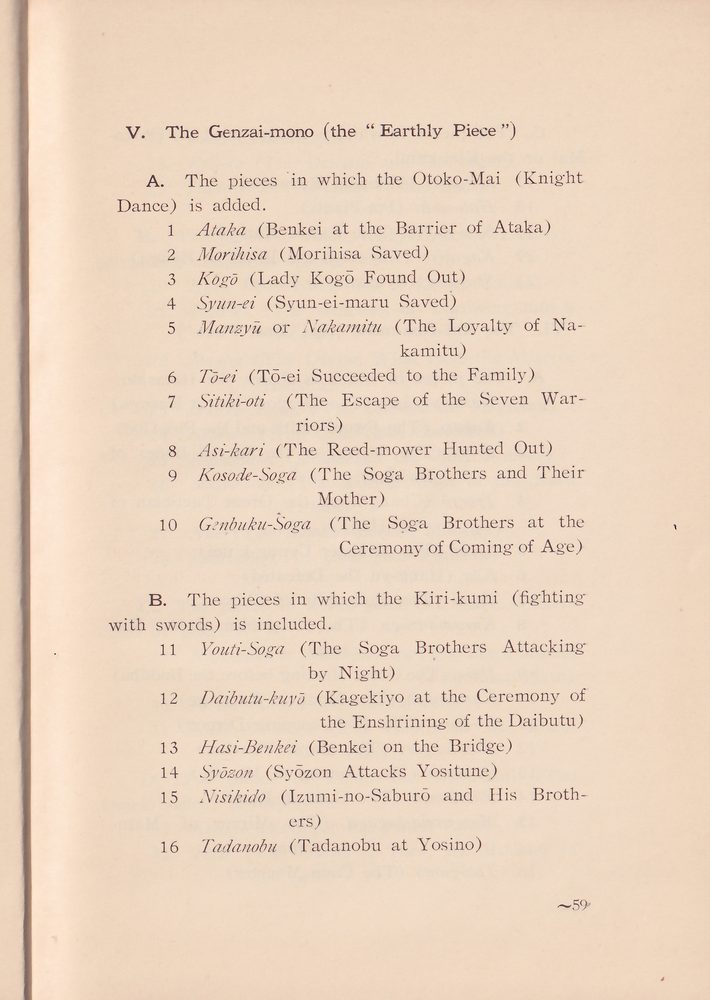
V. The Genzai-mono (the “Earthly Piece”)
A. The pieces in which the Otoko-Mai (Knight Dance) is added.
1 Ataka (Benkei at the Barrier of Ataka)
2 Morihisa (Morihisa Saved)
3 Kogō (Lady Kogō Found Out)
4 Syun-ei (Syun-ei-maru Saved)
5 Manzyū or Nakamitu (The Loyalty of Nakamitu)
6 Tō-ei (Tō-ei Succeeded to the Family)
7 Sitiki-oti (The Escape of the Seven Warriors)
8 Asi-kari (The Reed-mower Hunted Out)
9 Kosode-Soga (The Soga Brothers and Their Mother)
10 Genbuku-Soga (The Soga Brothers at the Ceremony of Coming of Age)
B. The pieces in which the Kiri-kumi (fighting with swords) is included.
11 Youti-Soga (The Soga Brothers Attacking by Night)
12 Daibutu-kuyō (Kagekiyo at the Ceremony of the Enshrining of the Daibutu)
13 Hasi-Benkei (Benkei on the Bridge)
14 Syōzon (Syōzon Attacks Yositune)
15 Nisikido (Izumi-no-Saburō and His Brothers)
16 Tadanobu (Tadanobu at Yosino)
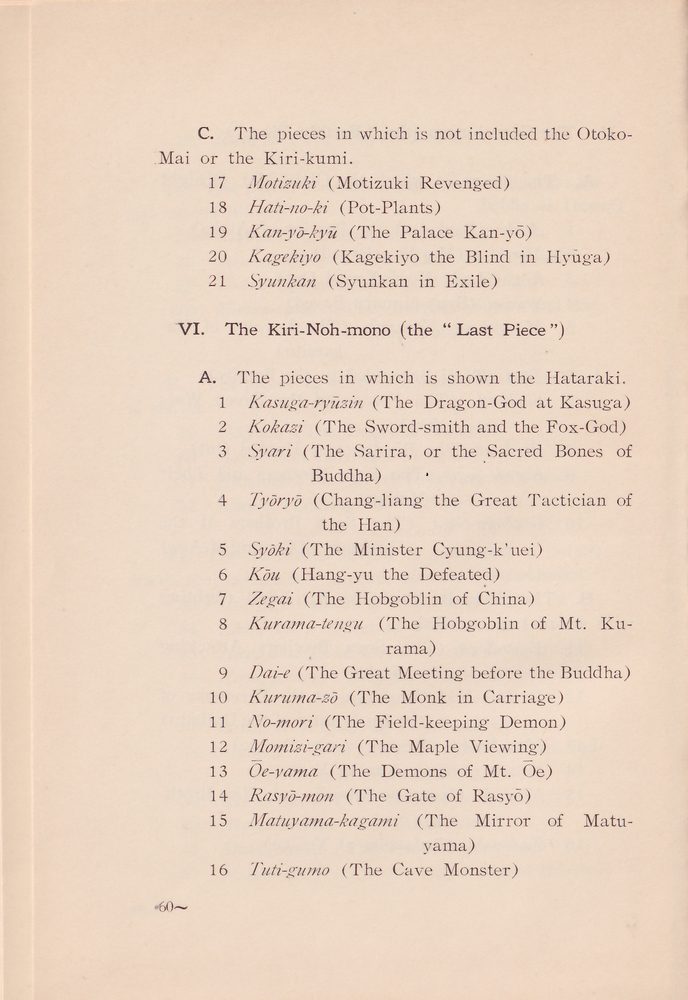
C. The pieces in which is not included the Otoko-Mai or the Kiri-kumi.
17 Motizuki (Motizuki Revenged)
18 Hati-no-ki (Pot-Plants)
19 Kan-yō-kyū (The Palace Kan-yō)
20 Kagekiyo (Kagekiyo the Blind in Hyūga)
21 Syunkan (Syunkan in Exile)
VI. The Kiri-Noh-mono (the “Last Piece”)
A. The pieces in which is shown the Hataraki.
1 Kasuga-ryūzin (The Dragon-God at Kasuga)
2 Kokazi (The Sword-smith and the Fox-God)
3 Syari (The Sarira, or the Sacred Bones of Buddha)
4 Tyōryō (Chang-liang the Great Tactician of the Han)
5 Syōki (The Minister Cyung-k’uei)
6 Kōu (Hang-yu the Defeated)
7 Zegai (The Hobgoblin of China)
8 Kurama-tengu (The Hobgoblin of Mt. Kurama)
9 Dai-e (The Great Meeting before the Buddha)
10 Kuruma-zō (The Monk in Carriage)
11 No-mori (The Field-keeping Demon)
12 Momizi-gari (The Maple Viewing)
13 Ōe-yama (The Demons of Mt. Ōe)
14 Rasyō-mon (The Gate of Rasyō)
15 Matuyama-kagami (The Mirror of Matuyama)
16 Tuti-gumo (The Cave Monster)
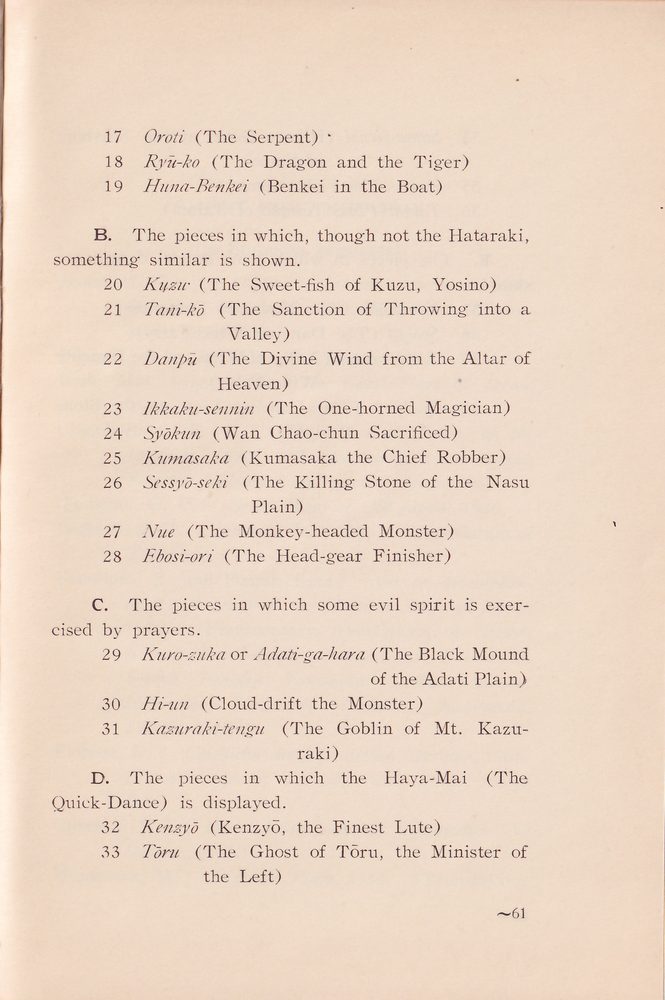
17 Oroti (The Serpent)
18 Ryū-ko (The Dragon and the Tiger)
19 Huna-Benkei (Benkei in the Boat)
B. The pieces in which, though not the Hataraki, something similar is shown.
20 Kuzu (The Sweet-fish of Kuzu, Yosino)
21 Tani-kō (The Sanction of Throwing into a Valley)
22 Danpū (The Divine Wind from the Altar of Heaven)
23 Ikkaku-sennin (The One-horned Magician)
24 Syōkun (Wan Chao-chun Sacrificed)
25 Kumasaka (Kumasaka the Chief Robber)
26 Sessyō-seki (The Killing Stone of the Nasu Plain)
27 Nue (The Monkey-headed Monster)
28 Ebosi-ori (The Head-gear Finisher)
C. The pieces in which some evil spirit is exercised by prayers.
29 Kuro-zuka or Adati-ga-hara (The Black Mound of the Adati Plain)
30 Hi-un (Cloud-drift the Monster)
31 Kazuraki-tengu (The Goblin of Mt. Kazuraki)
D. The pieces in which the Haya-Mai (The Quick-Dance) is displayed.
32 Kenzyō (Kenzyō, the Finest Lute)
33 Tōru (The Ghost of Tōru, the Minister of the Left)
34 Suma-Genzi (Hikaru Genzi at the Seashore of Suma)
35 Ama (The Fisherwoman)
36 Taima (The Temple of Taima)
E. The pieces in which some special dances are shown.
37 Yama-uba (The Mountain Demoness)
38 Syōzyō (The Dancing Wine Fairy)
39 Taihei-syōzyō (A Big of Wine and the Dancing Wine Fairy)
40 Syakkyō (The Dancing Lion on the Stone Bridge).