
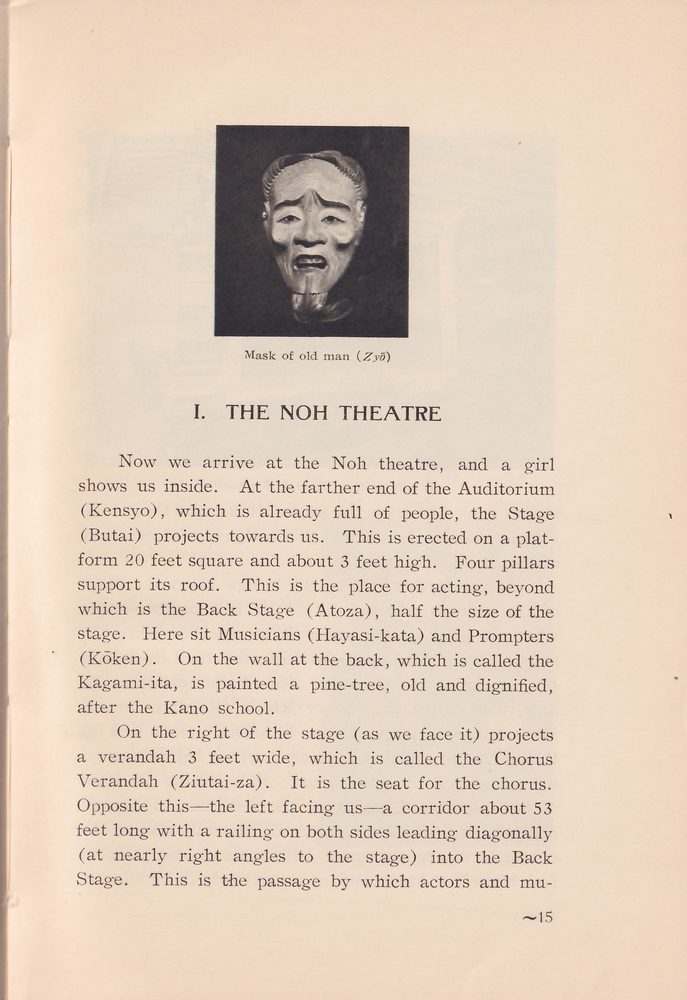
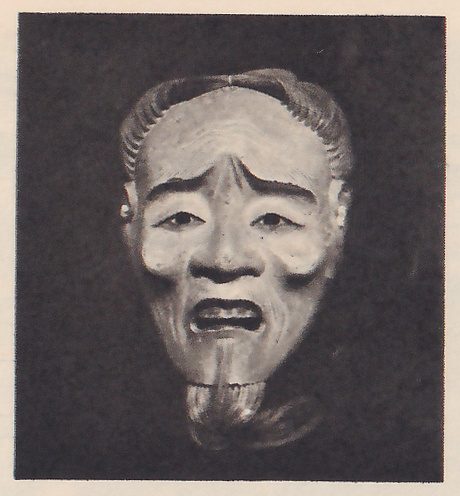
I. THE NOH THEATRE
Now we arrive at the Noh theatre, and a girl shows us inside. At the farther end of the Auditorium (Kensyo), which is already full of people, the Stage (Butai) projects towards us. This is erected on a platform 20 feet square and about 3 feet high. Four pillars support its roof. This is the place for acting, beyond which is the Back Stage (Atoza), half the size of the stage. Here sit Musicians (Hayasi-kata) and Prompters (Kōken). On the wall at the back, which is called the Kagami-ita, is painted a pine-tree, old and dignified, after the Kano school.
On the right of the stage (as we face it) projects a verandah 3 feet wide, which is called the Chorus Verandah (Ziutai-za). It is the seat for the chorus. Opposite this—the left facing us—a corridor about 53 feet long with a railing on both sides leading diagonally (at nearly right angles to the stage) into the Back Stage. This is the passage by which actors and mu-
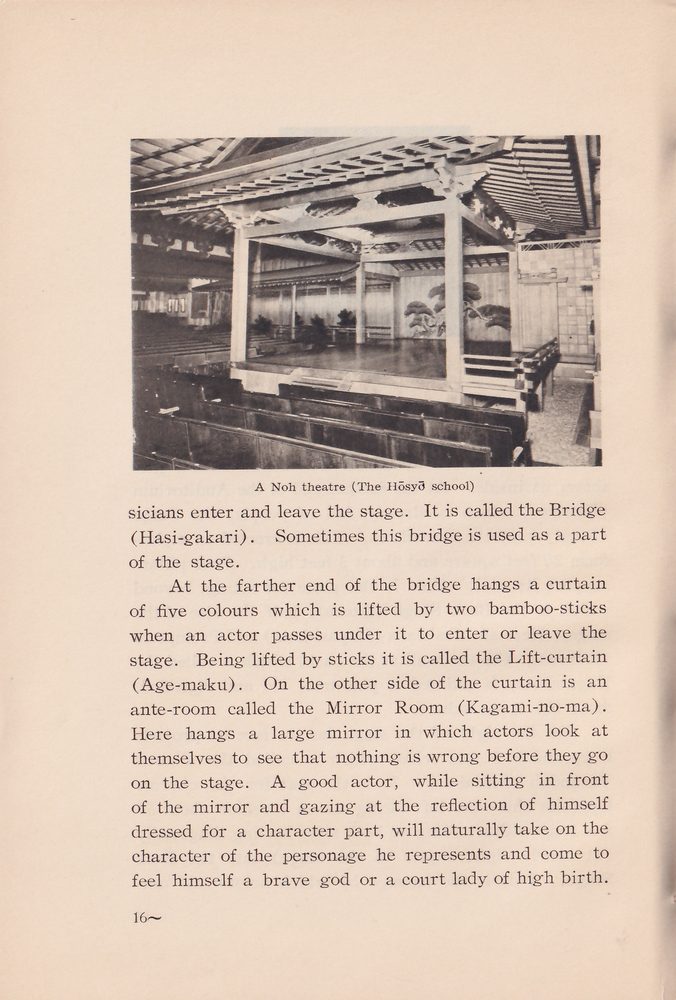
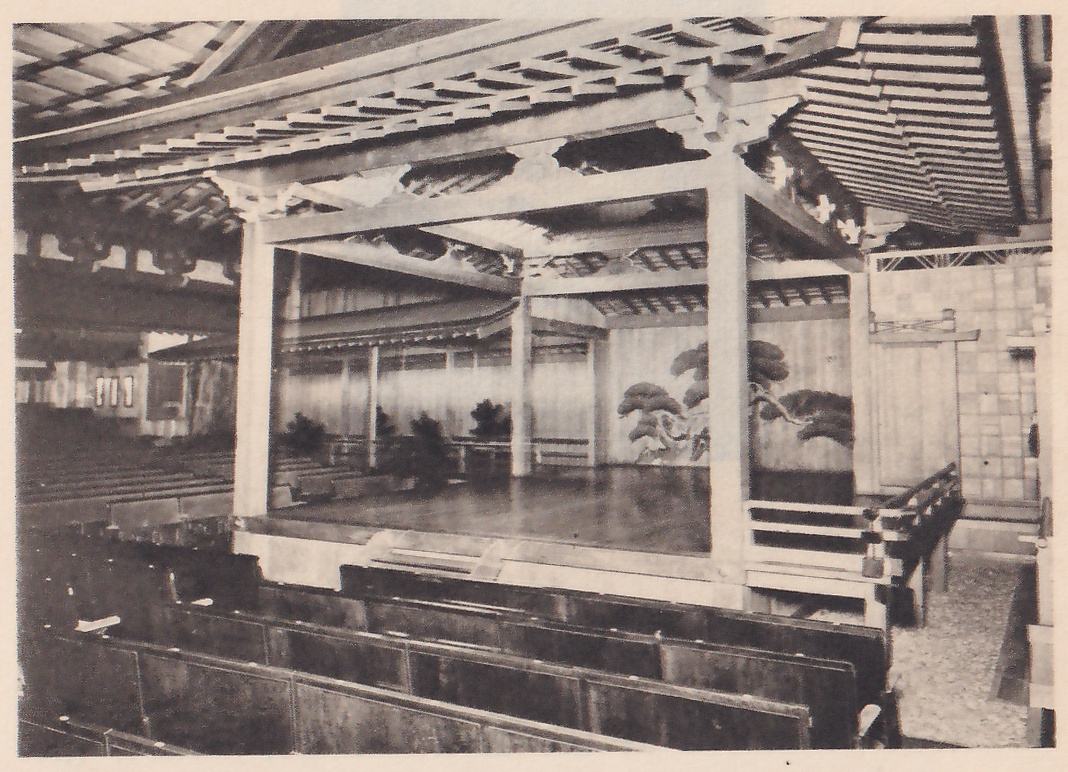
sicians enter and leave the stage. It is called the Bridge (Hasi-gakari). Sometimes this bridge is used as a part of the stage.
At the farther end of the bridge hangs a curtain of five colours which is lifted by two bamboo-sticks when an actor passes under it to enter or leave the stage. Being lifted by sticks it is called the Lift-curtain (Age-maku). On the other side of the curtain is an ante-room called the Mirror Room (Kagami-no-ma). Here hangs a large mirror in which actors look at themselves to see that nothing is wrong before they go on the stage. A good actor, while sitting in front of the mirror and gazing at the reflection of himself dressed for a character part, will naturally take on the character of the personage he represents and come to feel himself a brave god or a court lady of high birth.
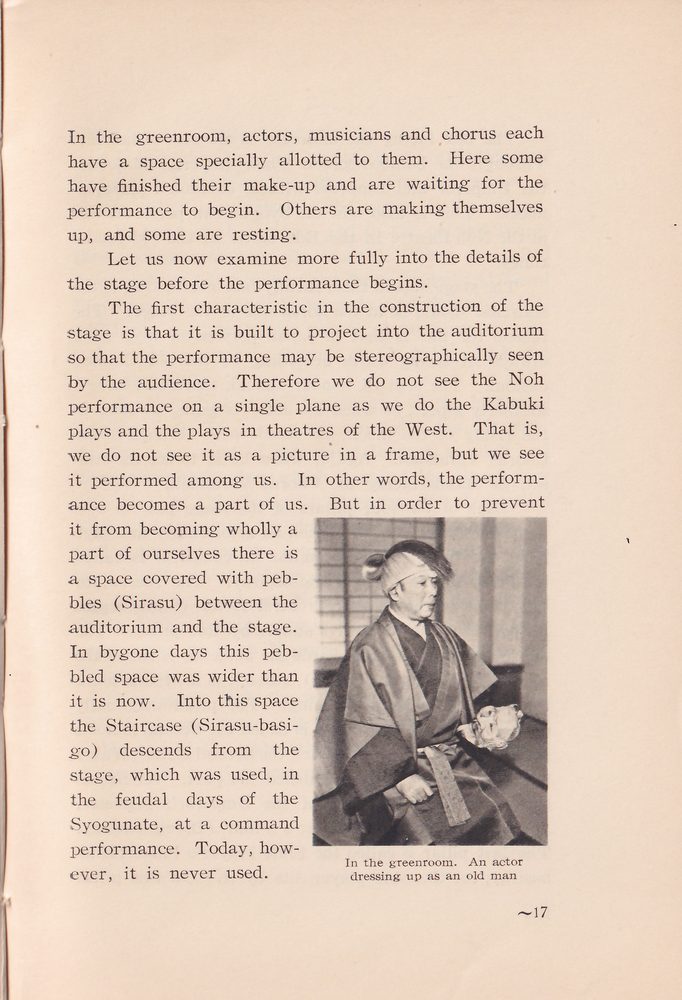
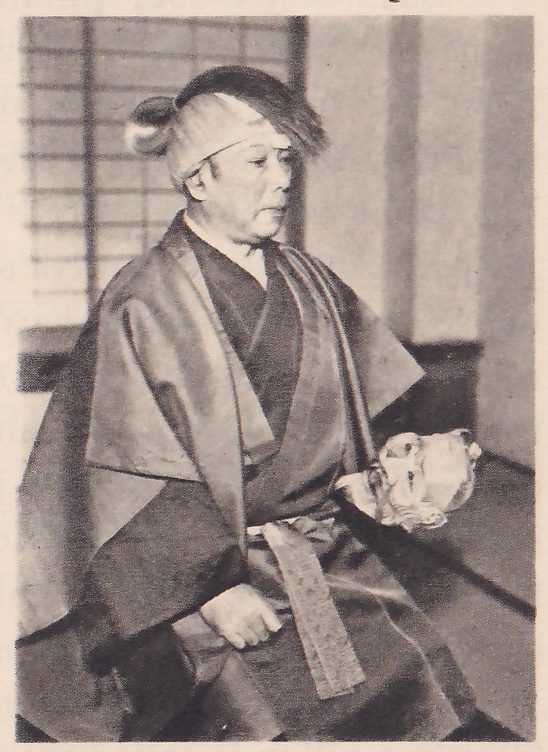
dressing up as an old man
In the greenroom, actors, musicians and chorus each have a space specially allotted to them. Here some have finished their make-up and are waiting for the performance to begin. Others are making themselves up, and some are resting.
Let us now examine more fully into the details of the stage before the performance begins.
The first characteristic in the construction of the stage is that it is built to project into the auditorium so that the performance may be stereographically seen by the audience. Therefore we do not see the Noh performance on a single plane as we do the Kabuki plays and the plays in theatres of the West. That is, we do not see it as a picture in a frame, but we see it performed among us. In other words, the performance becomes a part of us. But in order to prevent it from becoming wholly a part of ourselves there is a space covered with pebbles (Sirasu) between the auditorium and the stage. In bygone days this pebbled space was wider than it is now. Into this space the Staircase (Sirasu-basigo) descends from the stage, which was used, in the feudal days of the Syogunate, at a command performance. Today, however, it is never used.
The box facing the staircase is the seat of honour. Through its bamboo-screen Their Imperial Majesties the Emperor and Empress witness command performances. This is also how the Syōgun saw performances at the Noh theatre in the Edo castle in the old feudal times.
The stage should theoretically face north, that is the staircase should be at the north side of the stage. The reason for this is that in Japan persons of high rank always sit facing south according to the old Chinese custom. The seat of honour should, therefore, have a southerly aspect, so when an actor is going to look at the rising of the moon, he stands with his back to the Chorus Verandah. Again, when he is to see the sunset, he stands facing the Chorus Verandah.
Each of the four pillars of the stage has its own name for convenience. When an actor enters the stage from the bridge the first pillar he comes to is called the First Actor’s Pillar (Site-basira). The reason for this name is that when the First Actor (Site) begins his performance, he always stands by this pillar. The one in front of it and towards the audience is called the Mark Pillar (Metuke-basira), since it is used as a mark for the actor while performing. The pillar diagonally opposed to the First Actor’s is called the Second Actor’s Pillar (Waki-basira), to which the Second Actor (Waki) withdraws when he has finished his part. As he occasionally takes the part of the Emperor’s Minister, it is also called the Minister’s Pillar (Daizin-basira). The last pillar is called the Flute Player’s Pillar (Hue-basira), for the flute player sits by it. On this pillar
there hangs a large metal ring to which one end of a rope is tied when the large bell of Dōzyō-zi (the Dōzyō-zi Temple) is hung from the ceiling. For this purpose a simple pulley is attached to the centre of the ceiling.
In front of the bridge, and in the pebbled space, three young pine-trees are planted. They are called from right to left facing us the First, Second and Third Pine-tree (Iti-no-matu, Ni-no-matu and San-no-matu), which are used both as a means of marking his position when an actor is playing on the bridge and also as a decoration.
On the panel at the farther end of the bridge as seen from the lift-curtain are painted a few bamboos. At the lower part of this panel there is a small and inconspicuous side-door which is called the Hurry-door (Kiri-do) or the Coward’s Doorway (Okubyō-guti). This is the passage for chorus and the prompters, as well as the exit for the actor who is supposed to have been killed and the clown who has finished his part.
There are eighteen Noh theatres in Tokyo, five in Osaka, three in Kyoto, two in Hukui and some in most large cities such as Nagoya, Kobe, Kanazawa, and Kumamoto.
The oldest Noh theatre existing today is in the Nisi-Honganzi, Kyoto. It was built by Taikō Hideyosi at the end of the sixteenth century and is now under the care of the Government.