VI. HOW TO APPRECIATE THE NOH PLAY
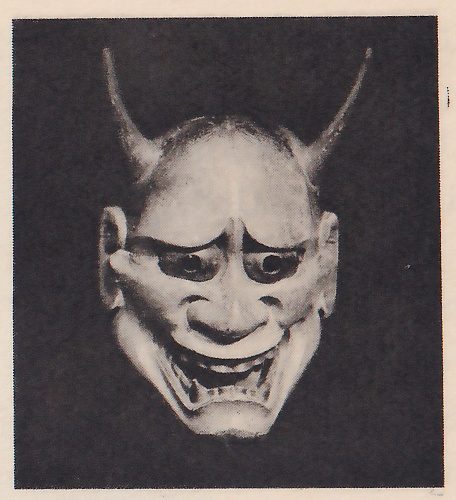
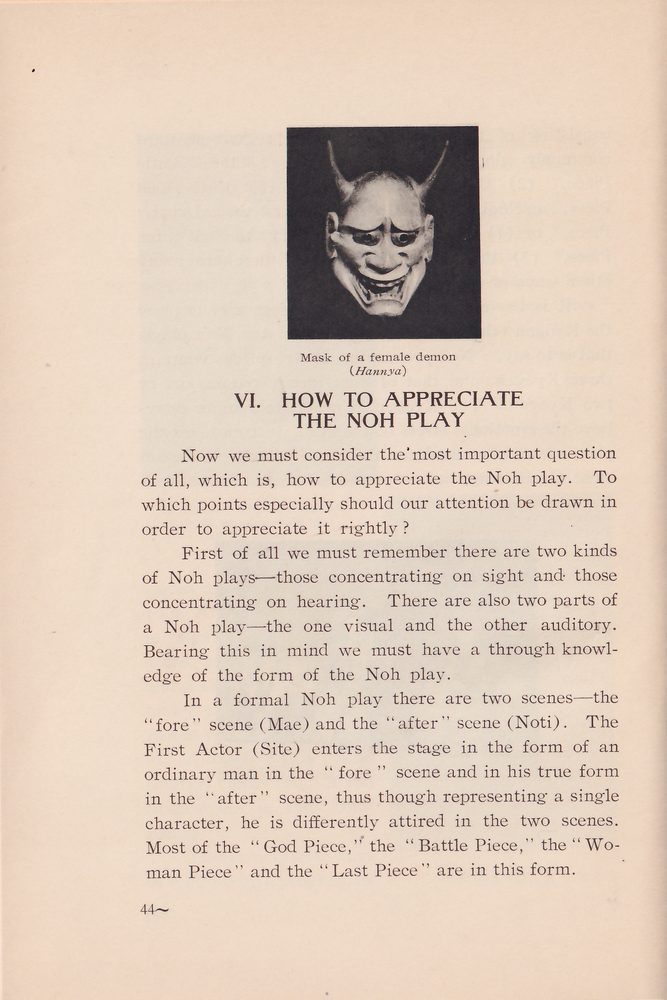
(Hannya)
Now we must consider the most important question of all, which is, how to appreciate the Noh play. To which points especially should our attention be drawn in order to appreciate it rightly?
First of all we must remember there are two kinds of Noh plays—those concentrating on sight and those concentrating on hearing. There are also two parts of a Noh play—the one visual and the other auditory. Bearing this in mind we must have a thoroughPrinted: through knowledge of the form of the Noh play.
In a formal Noh play there are two scenes—the “fore” scene (Mae) and the “after” scene (Noti). The First Actor (Site) enters the stage in the form of an ordinary man in the “fore” scene and in his true form in the “after” scene, thus though representing a single character, he is differently attired in the two scenes. Most of the “God Piece,” the “Battle Piece,” the “Woman Piece” and the “Last Piece” are in this form.
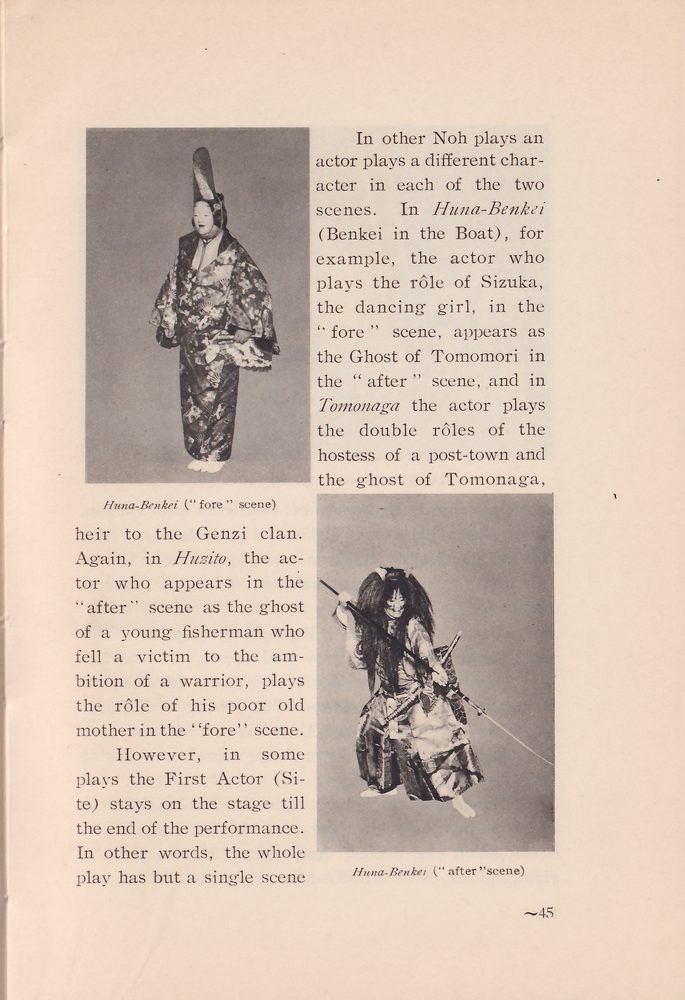
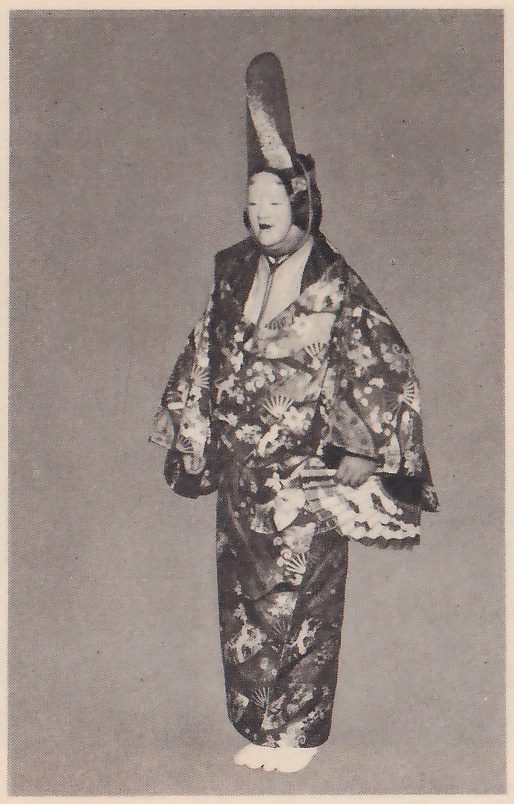
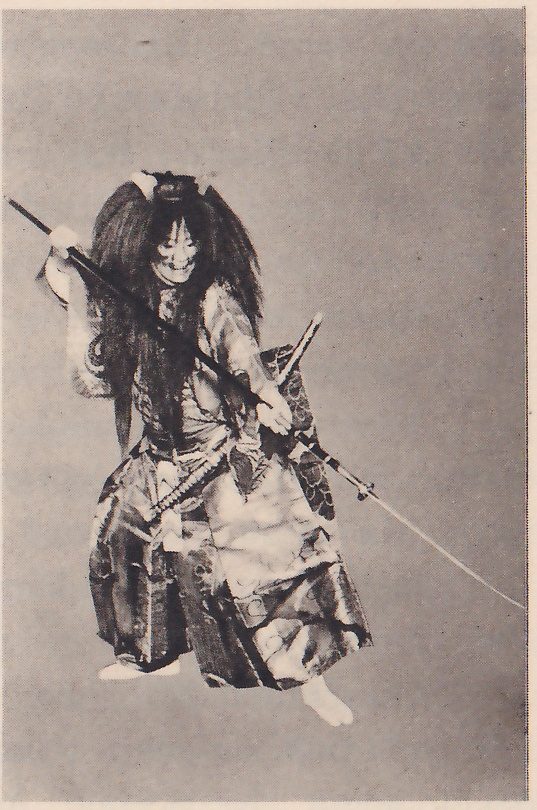
In other Noh plays an actor plays a different character in each of the two scenes. In Huna-Benkei (Benkei in the Boat), for example, the actor who plays the rôle of Sizuka, the dancing girl, in the “fore” scene, appears as the Ghost of Tomomori in the “after” scene, and in Tomonaga the actor plays the double rôles of the hostess of a post-town and the ghost of Tomonaga, heir to the Genzi clan. Again, in Huzito, the actor who appears in the “after” scene as the ghost of a young fisherman who fell a victim to the ambition of a warrior, plays the rôle of his poor old mother in the “fore” scene.
However, in some plays the First Actor (Site) stays on the stage till the end of the performance. In other words, the whole play has but a single scene
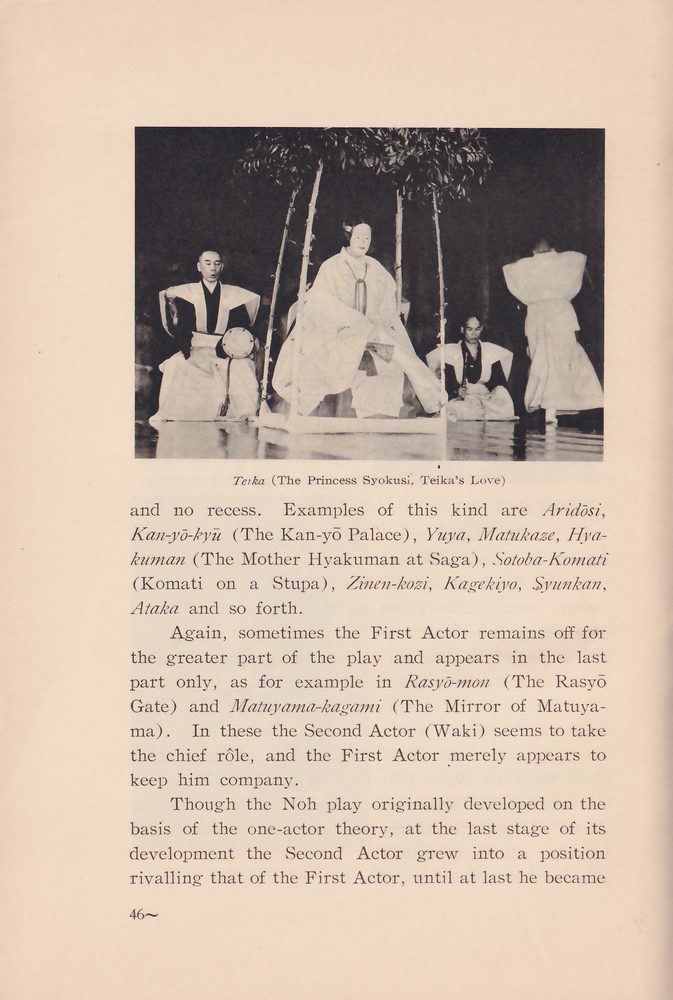
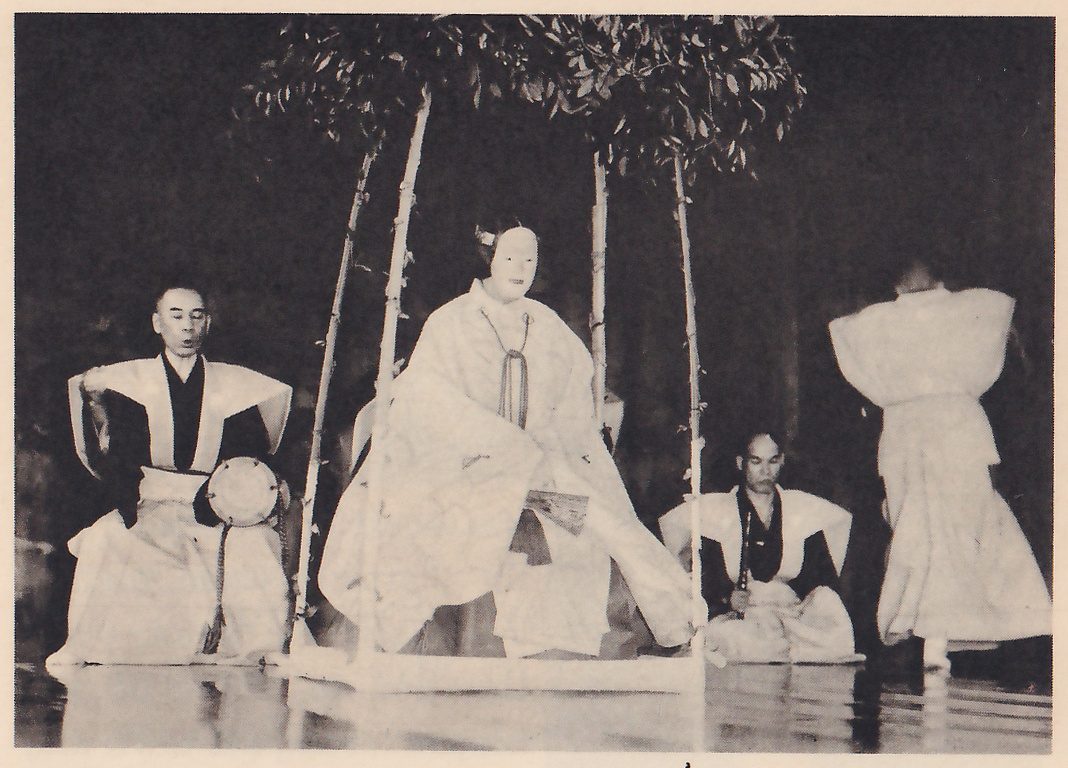
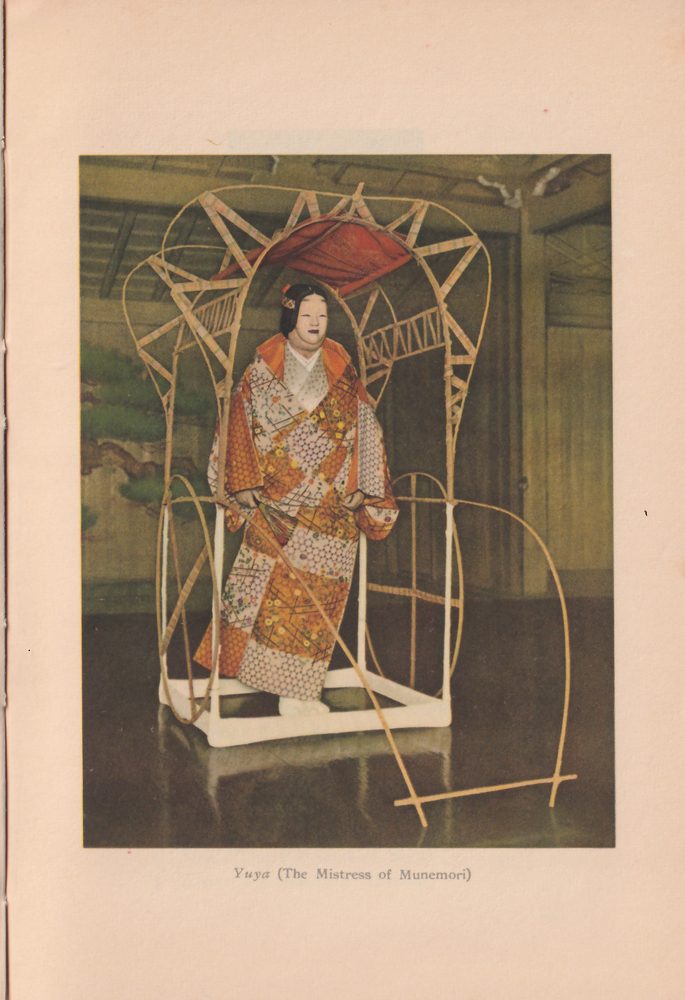
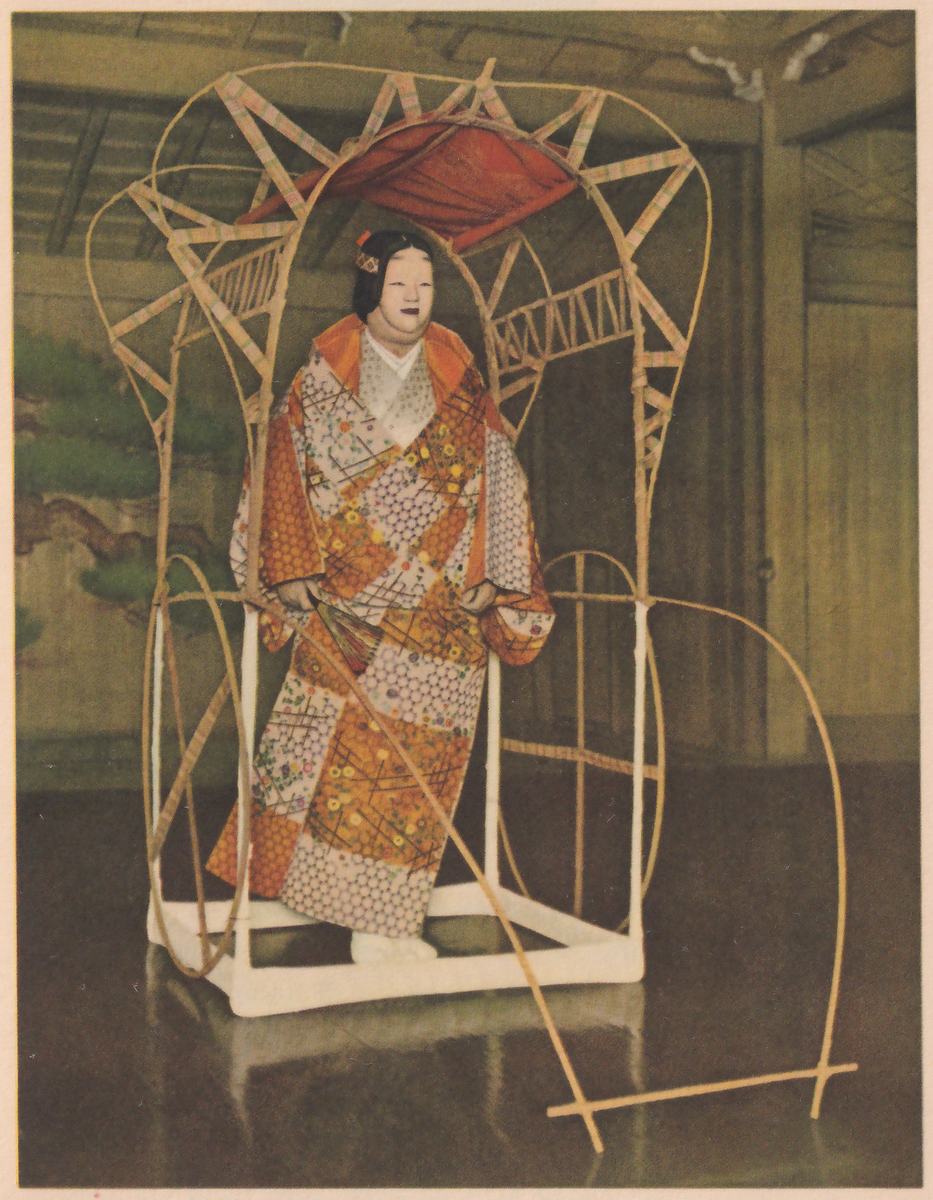
and no recess. Examples of this kind are Aridōsi, Kan-yō-kyū (The Kan-yō Palace), Yuya, Matukaze, Hyakuman (The Mother Hyakuman at Saga), Sotoba-Komati (Komati on a Stupa), Zinen-kozi, Kagekiyo, Syunkan, Ataka and so forth.
Again, sometimes the First Actor remains off for the greater part of the play and appears in the last part only, as for example in Rasyō-mon (The Rasyō Gate) and Matuyama-kagami (The Mirror of Matuyama). In these the Second Actor (Waki) seems to take the chief rôle, and the First Actor merely appears to keep him company.
Though the Noh play originally developed on the basis of the one-actor theory, at the last stage of its development the Second Actor grew into a position rivalling that of the First Actor, until at last he became
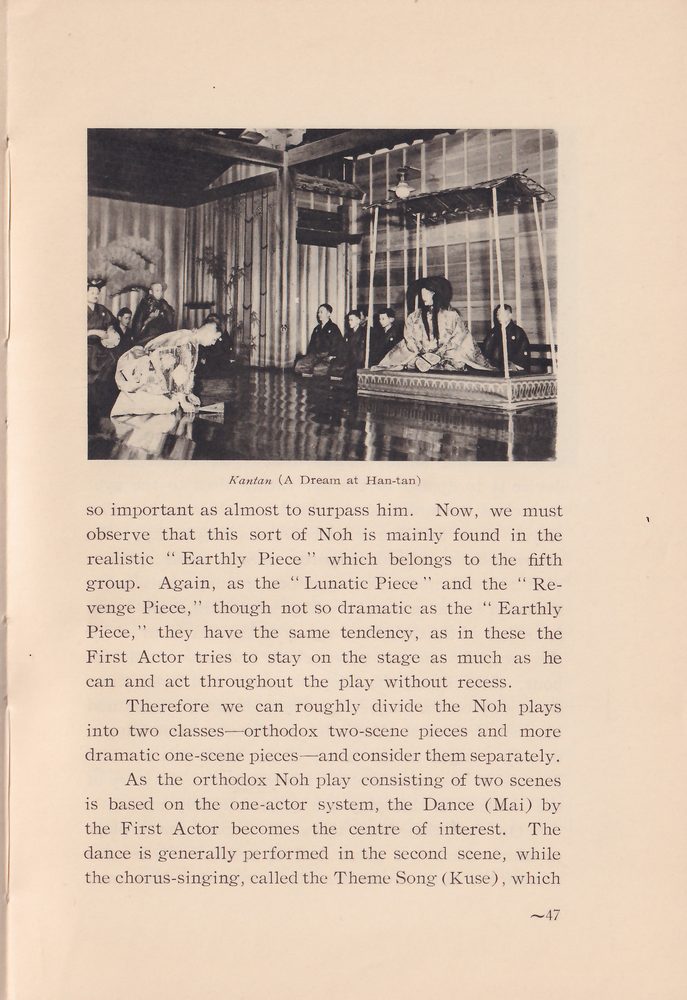
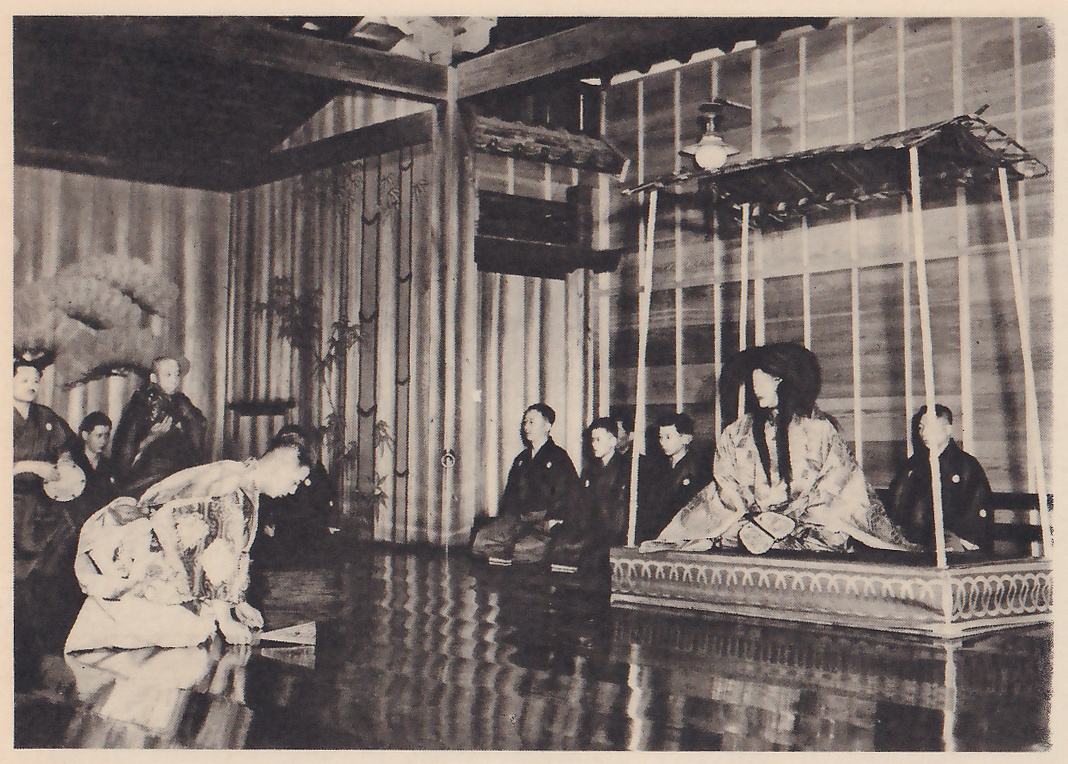
so important as almost to surpass him. Now, we must observe that this sort of Noh is mainly found in the realistic “Earthly Piece” which belongs to the fifth group. Again, as the “Lunatic Piece” and the “Revenge Piece,” though not so dramatic as the “Earthly Piece,” they have the same tendency, as in these the First Actor tries to stay on the stage as much as he can and act throughout the play without recess.
Therefore we can roughly divide the Noh plays into two classes—orthodox two-scene pieces and more dramatic one-scene pieces—and consider them separately.
As the orthodox Noh play consisting of two scenes is based on the one-actor system, the Dance (Mai) by the First Actor becomes the centre of interest. The dance is generally performed in the second scene, while the chorus-singing, called the Theme Song (Kuse), which
is considered as important as the dance, is, as a rule, placed in the second half of the first scene.
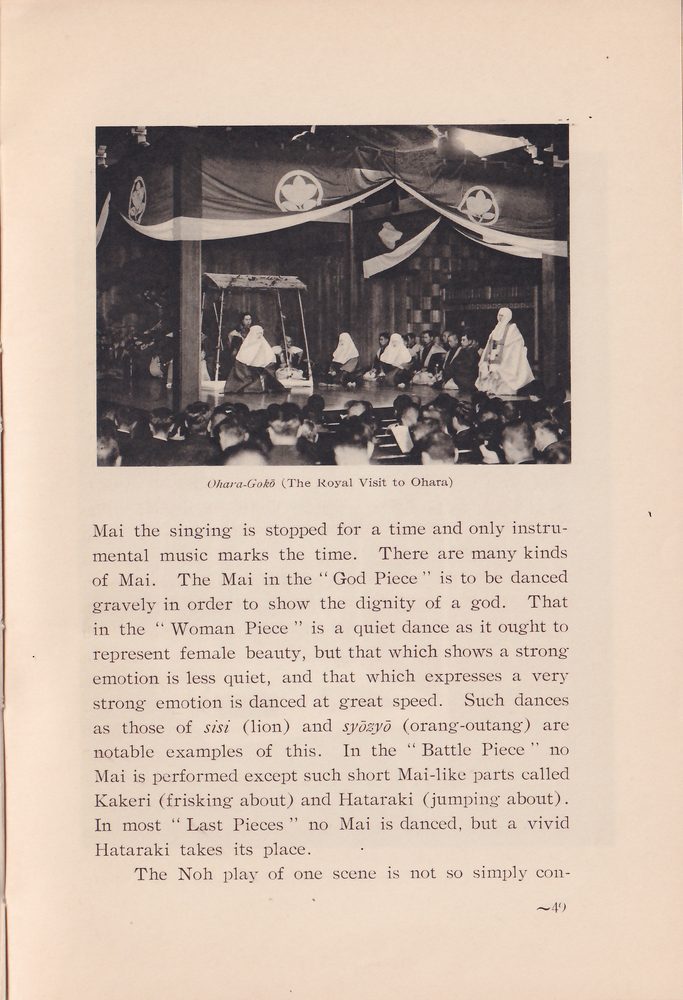
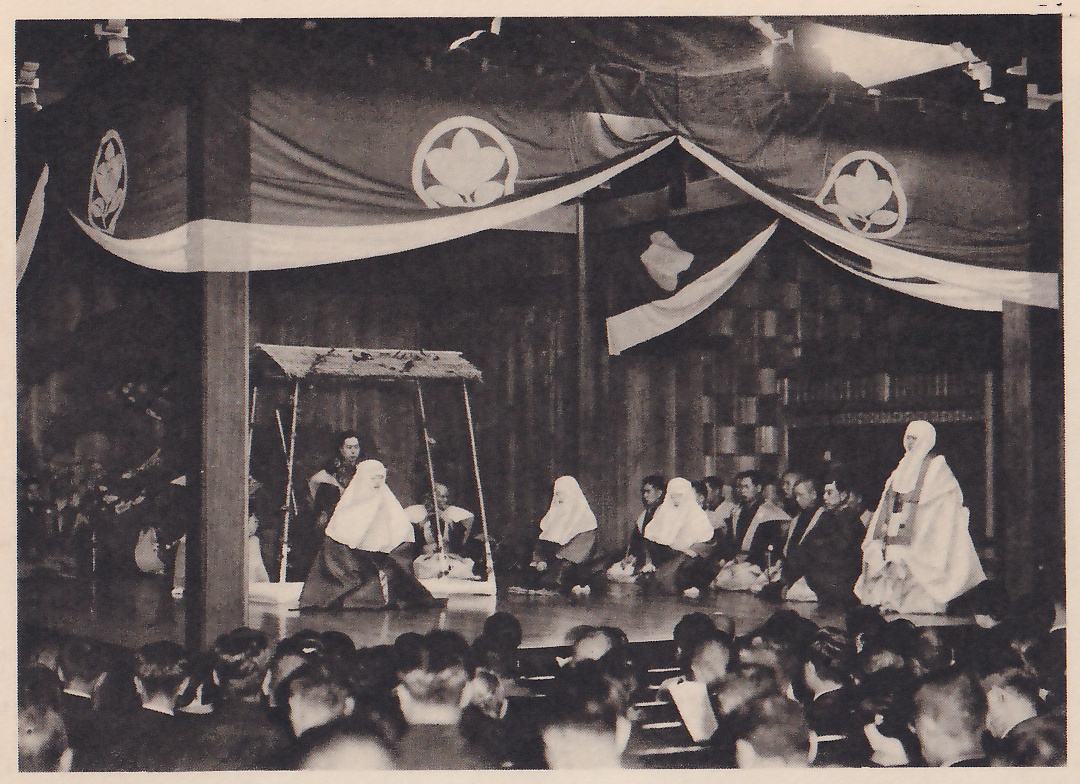
If the Kuse is considered as the central part, a Noh may be thought of as something to hear. If, however, stress is put on the Mai, it will surely be felt to be a thing to look at. The Kuse may be divided into two kinds—the Mai-guse (the Kuse sung while dancing) and the I-guse (the Kuse sung while sitting). Especially in the I-guse the actor sits in the middle of the stage without stirring. This clearly shows that the audience is intended to listen, and not a few Noh plays are of this type. Again, there are those in which not only in the Kuse part but also throughout the performance the actor hardly moves, that is, the object of this device is to appeal to the ear rather than to the eye. The chief examples of this kind are Ohara-gokō (The Royal Visit to Ohara) and Settai (Hospitality). In Ohara-gokō, a retired Emperor, now a monk, pays a visit to an Empress Dowager, now a nun, who lives in seclusion in the mountain village of Ohara. He hears from her of the dread and agony of the war from which she escaped. In this play, which lasts more than an hour, three nuns, the Emperor-abbot and his retinue sit quietly on the stage. In Settai, Hōgan Yositune and his men dressed as Yamabusi (strolling priests) happen to stay a night at the house of his dead retainer and narrate to his aged mother and young son the story of the battle. In this play the actors scarcely move.
On the other hand there are a good many plays in which there is a great deal of action. Those containing the most action are Mai (dances). In a pure
Mai the singing is stopped for a time and only instrumental music marks the time. There are many kinds of Mai. The Mai in the “God Piece” is to be danced gravely in order to show the dignity of a god. That in the “Woman Piece” is a quiet dance as it ought to represent female beauty, but that which shows a strong emotion is less quiet, and that which expresses a very strong emotion is danced at great speed. Such dances as those of sisi (lion) and syōzyō (orang-outang) are notable examples of this. In the “Battle Piece” no Mai is performed except such short Mai-like parts called Kakeri (frisking about) and Hataraki (jumping about). In most “Last Pieces” no Mai is danced, but a vivid Hataraki takes its place.
The Noh play of one scene is not so simply con-
structed as to appeal to either eyes or ears only. Its theme is more dramatically treated, and dialogues occupy a fairly important part, that is to say, the development of the action proceeds by dialogue. To some of these a Mai is added, but it cannot be considered a principal part of the play. For example, in the last scene of Ataka the First Actor (Benkei) dances an Otoko Mai (Knight Dance), but it is designed to throw barrier keeper Togasi off his guard in order to let his companions pass the barrier. Again, in Syōzon, though a Mai is danced, not by the First Actor, but by the boy actor, it is not intended to be the centre of interest, but is merely inserted to give interest to the action. Therefore we may expect dramatic interest in a Noh play of one scene, the representative example of which is the “Earthly Piece,” and we might be disappointed were we to expect the same in an orthodox Noh play of two scenes.
In the next chapter the comparatively popular Noh plays will be classified into the six groups above-mentioned in order to help the spectator.