What is Shintō?
Tourist Library 8
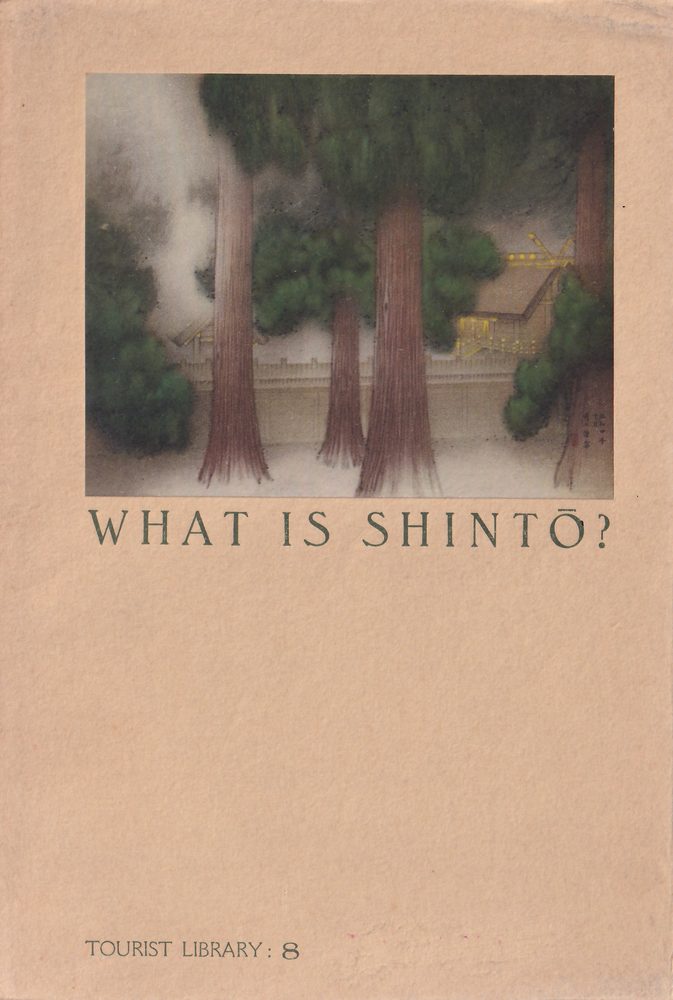
What is Shintō?
by Genchi Katō (加藤玄智)
Tourist Library 8
Board of Tourist Industry, Japanese Government Railways, 1935
TOURIST LIBRARY
Volumes already published
1. TEA CULT OF JAPAN By Y. Fukukita, A. B.
2. JAPANESE NOH PLAYS By Prof. T. Nogami
3. SAKURA (Japanese Cherry) By M. Miyoshi, D. Sc.
4. JAPANESE GARDENS By Prof. M. Tatsui
5 HIROSHIGE AND JAPANESE LANDSCAPES By Yone Noguchi
6. JAPANESE DRAMA By B. T. I.
7. JAPANESE ARCHITECTURE By Prof. H. Kishida, D. Sc.
8. WHAT IS SHINTŌ? By G. Katō, D. Litt.
Volumes in preparation
CASTLES IN JAPAN By Prof. N. Ōrui, D. Litt.
and Prof. M. Toba
JAPAN, LAND OF HOT SPRINGS By Prof. K Fujinami, M. D.
CHILDREN’S DAYS IN JAPAN By T. Iwadō, M. A.
FLORAL ART OF JAPAN By Issōtei Nishikawa
KIMONO (Japanese Dress) By Kenichi Kawakatsu
WHAT IS SHINTŌ?
BY
GENCHI KATŌ, D. Litt.
Author of “A Study of Shintō, the Religion of the Japanese Nation”
BOARD OF TOURIST INDUSTRY
JAPANESE GOVERNMENT RAILWAYS
COPYRIGHT 1935
EDITORIAL NOTE
It is a common desire among tourists to learn something of the culture of the countries they visit as well as to see their beautiful scenery. To see is naturally easier than to learn, but flying visits merely for sightseeing hardly furnish the time or opportunity for more than a casual glimpse of the culture of any foreign people. This is specially true of Japan.
The Board of Tourist Industry recognizes the difficulty of attaining this high purpose, viz. to provide foreign tourists with accurate information regarding the various phases of Japan’s characteristic culture. It is endeavouring therefore to meet this obligation, as far as possible, by publishing this series of brochures.
The present series will, when completed, consist of more than a hundred volumes, each dealing with a different subject, but all co-ordinated. By reading therefore the entire series the foreign student of Japan may gain an adequate knowledge of the unique culture that has developed in this country through the ages.
For those who wish to follow up these studies with a closer investigation, bibliographies are appended, which we trust may be found reliable and authoritative guides in their study.
Board of Tourist Industry,
Japanese Government Railways
PREFACE
I highly appreciate the privilege and honour of being asked by the Board of Tourist Industry of the Japanese Government Railways to contribute a short sketch of Shintō, though in the barest outline, as one of the series of brochures for the Tourist Library.
Unquestionably, Shintō was and is one of the most important and fundamental essentials in the cultural life of the Japanese people. It is the spiritual blood or bone, so to speak, by and through which the nation has her being. Without a knowledge of what Shintō is, no one can understand what is Japanese Confucianism or Japanese Buddhism, because, accepting them the Japanese greatly modified and naturalized them for adaptation to the Land of the Rising Sun by the influence of the indigenous Shintō belief, the innermost spiritual vital force of the people. The knowledge of a foreign tourist who visits Buddhist temples and Shintō shrines here and there in Japan, and who studies Japanese religion, Japanese art and architecture, and Japanese literature, will be comparatively valueless if he lacks an adequate knowledge of Shintō. In this country there goes a homely saying, “Never say Kekkō (beautiful and splendid) before you see Nikkō (the magnificent Shintō shrine of Nikkō).” In the same way, I would remark, “Don’t say that you know Japan, until you have gained some knowledge of Shintō”—so important, even so indispensable is the knowledge of
Shintō for a foreigner to understand the spiritual culture of the Japanese.
My thanks are due to my friend Mr. James Stewart for his suggestive hints and valuable helpfulness shown to me in the preparation of this brochure.
If this brief sketch of mine serves as a little guide to the foreign visitor to Japan in studying Shintō, I shall feel more than satisfied.
Genchi Katō
Tokyo, August, 1935
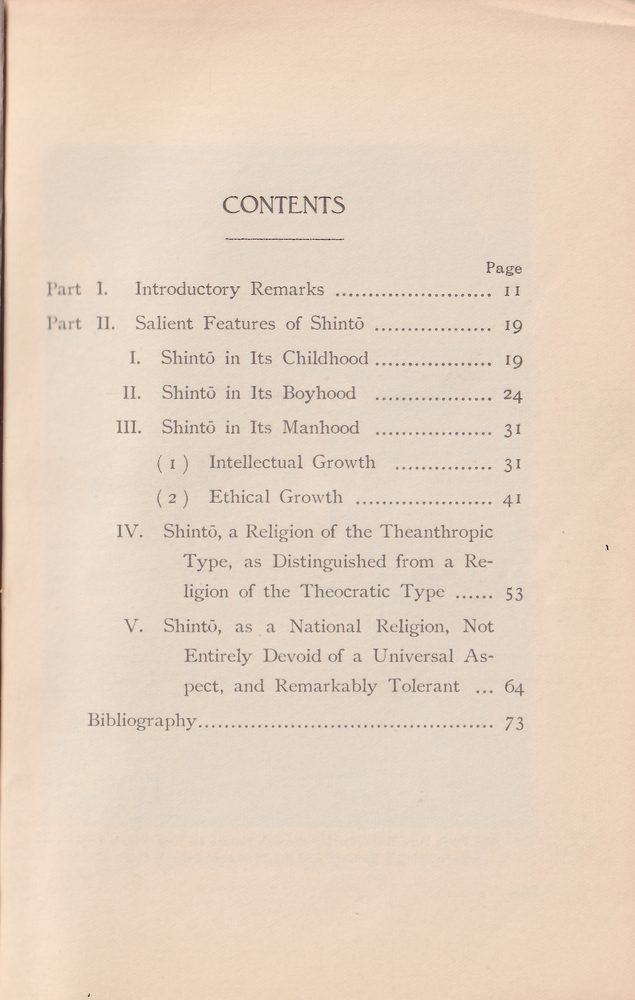
CONTENTS
Page
Part I. Introductory Remarks .............. 11
Part II. Salient Features of Shintō .............. 19
I. Shintō in Its Childhood .............. 19
II. Shintō in Its Boyhood .............. 24
III. Shintō in Its Manhood .............. 31
(1) Intellectual Growth .............. 31
(2) Ethical Growth .............. 41
IV. Shintō, a Religion of the Theanthropic Type, as Distinguished from a Religion of the Theocratic Type .............. 53
V. Shintō, as a National Religion, Not Entirely Devoid of a Universal Aspect, and Remarkably Tolerant .............. 64
Bibliography .............. 73