
IV. SHINTŌ, A RELIGION OF THE THEANTHROPIC TYPE, AS DISTINGUISHED FROM A RELIGION OF THE THEOCRATIC TYPE
As a comparative study of religions now shows, there are two main trends of the world’s religious thought, that is to say, there are two fundamentally different ways of conceiving Divinity. One is, Westerners might say, a mode of the Near-Eastern type and the other that of the Far-Eastern type. The former may be styled as belonging to the theocratic type or creative type of religion and the latter as of the theanthropic or genealogical or generative type. The religion of the Hebrews (Judaism), Islam or Mohammedanism, and Christianity, born of the practical mind of the Semites, belong as a rule to the theocratic type; while Buddhism or the Indian religions in general, and the ancient Greek religion, along with the Roman religion, all of which perhaps with the exception of the last-named are products of the speculative mind of the Aryan or Indo-European race, and the religious consciousness of the Japanese, and that of the Chinese also, belong to the theanthropic category. In theocratic religion Divinity stands high above man and nature; with its formula “God is above us,” it is transcendent of man and the world. Theanthropic religion, contrarily, sees Divinity in man and nature; it is immanent or inherent in man and the universe, and its language proclaims “God is in us.” According to the religious
consciousness of the theanthropic type it is a matter of course that man ascends to God, and God descends to man. The philosophy of theocratic religion is monotheism, rising from monolatry, while pantheism is the natural outcome of theanthropic religion originated from nature-worship in its primitive stage. In theocratic religion, there is creation of man and nature by the One Supreme God; and in theanthropic religion, not creation but emanation of the world from the Divine. According to the theanthropic religious consciousness, Heaven and Earth, man and nature, or, broadly speaking, organic and inorganic objects of the universe are begotten by God or gods just as men are born of their parents. Nature-worship, ancestor-worship, necrolatry, hero-worship, Emperor-worship, generally speaking, are religious expressions of the theanthropic type. Hero-worship of the ancient Greeks, Emperor-worship among the Romans of old, the deification of the Gautama Buddha, the founder of Buddhism, all appear in the history of religions of the theanthropic type.
Now, I am going to consider Shintō, with the distinction of both types of religion, theocratic and theanthropic, in view. Throughout both stages of religious development, natural and cultural or ethico-intellectualistic, Shintō in its salient features is theanthropic; it does not belong to the theocratic type. In Shintō at the stage of nature religion, we have several personages deified, as, for instance, Emperors, Empresses, Imperial princes, heroes, one’s ancestors, and so on. The Emperor Jimmu was called “Ame-no-Oshigami” or “Heaven-Conquering God,” according to the
“Nihongi,” and in documents of olden times each Emperor is described as a visible deity or a god incarnate. Minamoto-no-Yoshiie, a brave warrior and skilful archer of the 11th century, is revered as a god because in the skill of his archery he had no equal, he stood aloof above any man, in short, he is superhuman, i. e., he is a deity in flesh and blood, according to the “Fusōryakki,” an old Japanese history. The Empress Jingō was also a deity, according to the “Kojiki.” Therefore, Moto-ori-Norinaga of the 18th century, a famous commentator of the “Kojiki,” says:
“True household gods we in our parents see;
Revere and honour them whole-heartedly!”
In a Buddhist canon, entitled the “Forty-two Chapter Sutra,” anthropolatry of the same kind is taught as regards one’s parents, thus:
“To be obedient to one’s parents with filial piety is better than to worship all the deities in Heaven and Earth: for one’s parents are for him the supreme deities.”
The development of Shintō did not stop here; theanthropic Shintō has grown into a religion of a higher order, i. e., a religion of the ethico-intellectualistic stage. In 718, when a high government official, kind-hearted towards his people, Michi-no-Kimi-no-Obina by name, died, he was at once deified and a shrine was erected to his memory, because he did his utmost to promote the people’s welfare by means of improving their mode of life and making them happy: in short, he was indeed a man of a godlike character, and the result was his apotheosis after death, in the religious
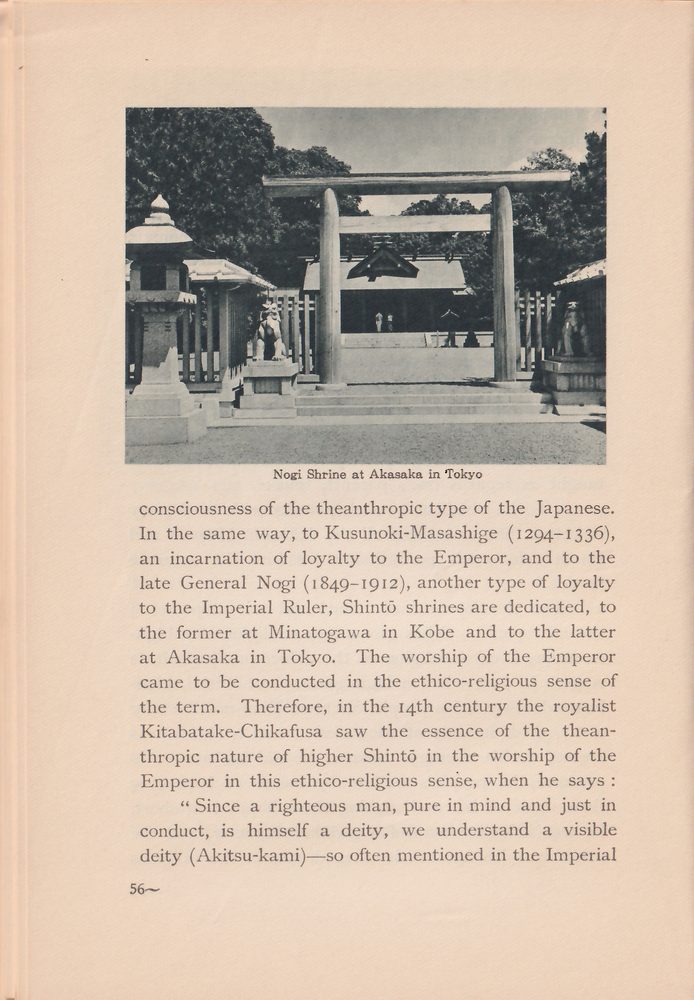
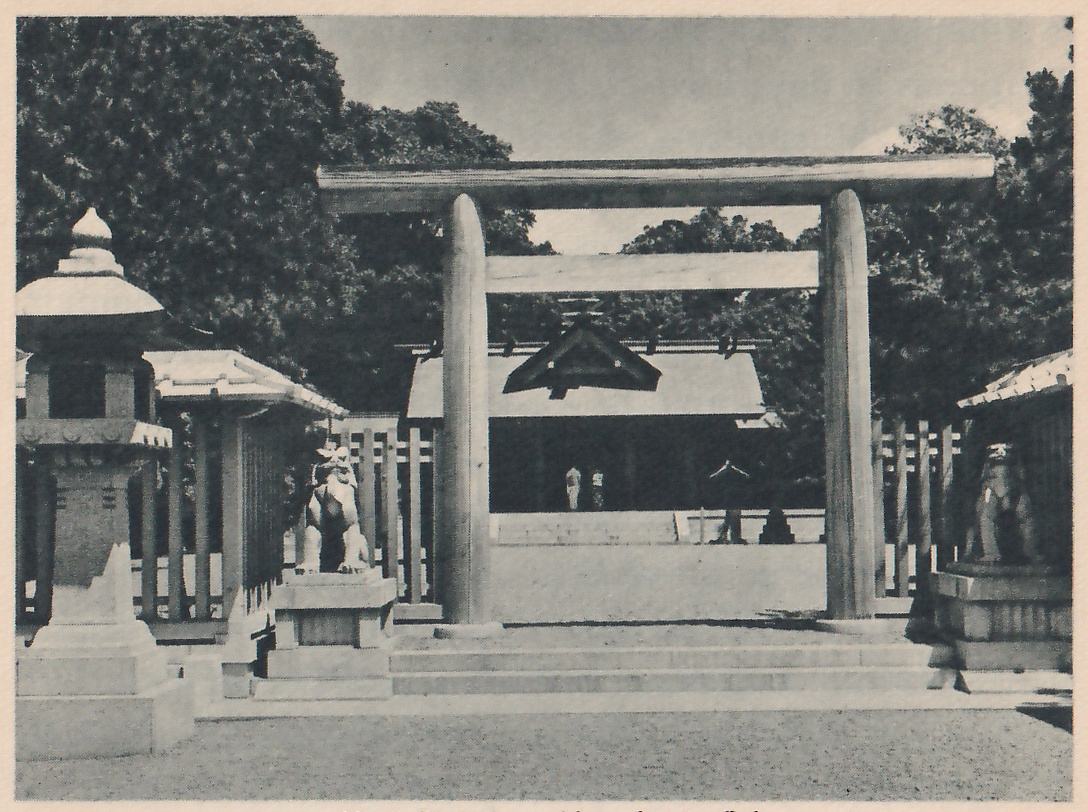
consciousness of the theanthropic type of the Japanese. In the same way, to Kusunoki-Masashige (1294–1336), an incarnation of loyalty to the Emperor, and to the late General Nogi (1849–1912), another type of loyalty to the Imperial Ruler, Shintō shrines are dedicated, to the former at Minatogawa in Kobe and to the latter at Akasaka in Tokyo. The worship of the Emperor came to be conducted in the ethico-religious sense of the term. Therefore, in the 14th century the royalist Kitabatake-Chikafusa saw the essence of the theanthropic nature of higher Shintō in the worship of the Emperor in this ethico-religious sense, when he says:
“Since a righteous man, pure in mind and just in conduct, is himself a deity, we understand a visible deity (Akitsu-kami)—so often mentioned in the Imperial
Edicts—in this ethico-religious meaning of the words.”
—Nijū-issha-no-ki
In the same spirit the Buddhist priest Jihen* of the 14th century says:
“Heaven’s grace enlivens different grasses in an impartial manner, and Mother Earth justly and benevolently offers to all beings in her bosom equal opportunity to enjoy uninterrupted natural growth. The virtuous sovereign may well be compared to Heaven and Earth for his justice and equity, so that we call him not the son of man, but the son of Heaven or the son quite akin to Heaven, because of his righteous government.”
—Kujihongi-Gengi
According to the “Buke-Kandan,” Tokugawa-Hidetada (1579–1632), the second of the Tokugawa Shōguns, is quoted as saying that he could not consent to the project of the Buddhist Abbot Tenkai to worship him after death by erecting a Shintō shrine in his honour, because he was not conscious of having acted in the virtuous manner of a deity, and so he did not, like his father Ieyasu (1542–1616), deserve a shrine. Foreigners who have visited Nikkō may surely be aware of the beautiful shrine in which Ieyasu, the first of the Tokugawa Shōguns, was eventually canonised with the name of “Tōshōdaigongen” or “East-Shining-Great-Incarnate-Deity.”
* In order to understand the Japanese mind correctly foreigners must bear in mind the fact that a Japanese Buddhist is, because he is a Japanese, a Shintoist, meaning an inborn partaker of, or an unprofessed believer in, the national faith of Shintō. He knows nothing of inward discordance.
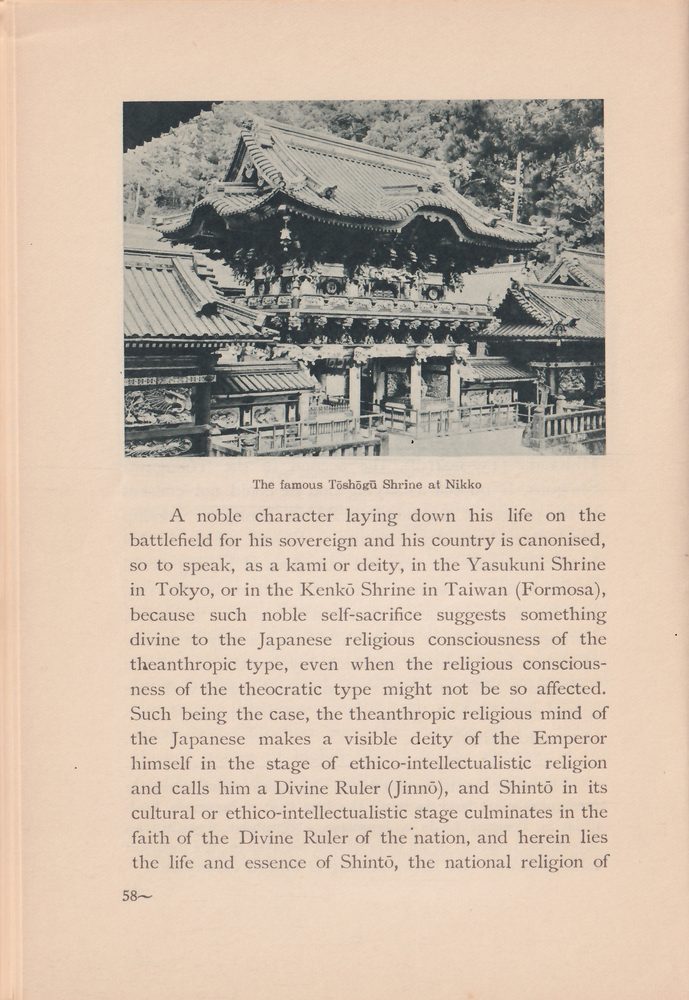
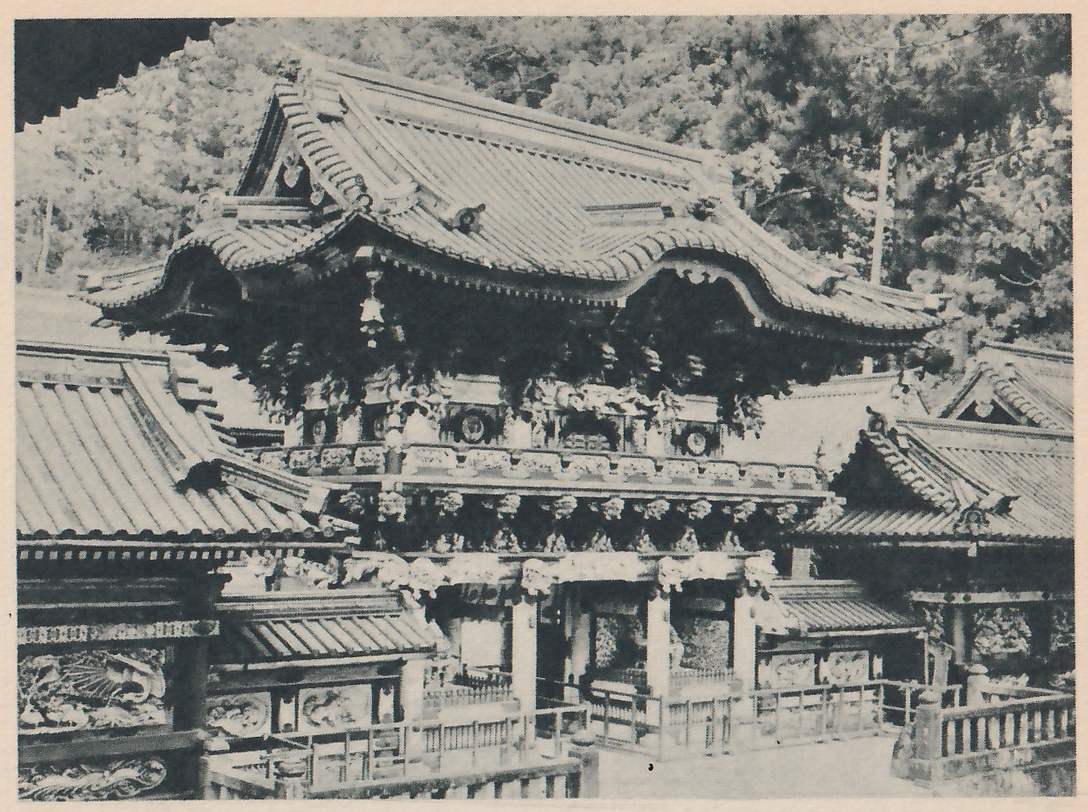
A noble character laying down his life on the battlefield for his sovereign and his country is canonised, so to speak, as a kami or deity, in the Yasukuni Shrine in Tokyo, or in the Kenkō Shrine in Taiwan (Formosa), because such noble self-sacrifice suggests something divine to the Japanese religious consciousness of the theanthropic type, even when the religious consciousness of the theocratic type might not be so affected. Such being the case, the theanthropic religious mind of the Japanese makes a visible deity of the Emperor himself in the stage of ethico-intellectualistic religion and calls him a Divine Ruler (Jinnō), and Shintō in its cultural or ethico-intellectualistic stage culminates in the faith of the Divine Ruler of the nation, and herein lies the life and essence of Shintō, the national religion of
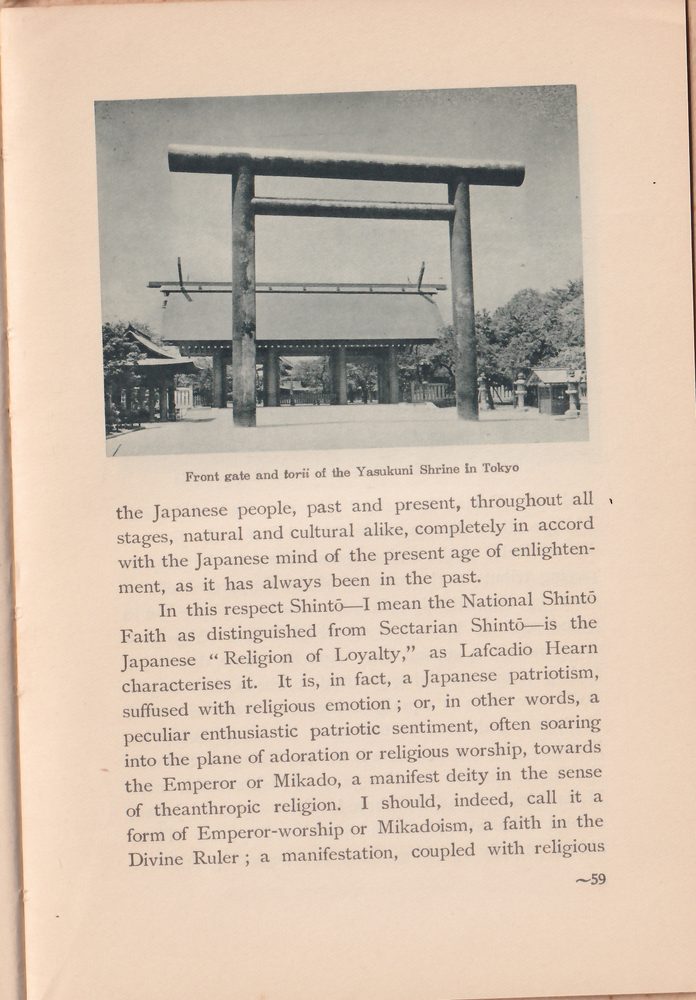
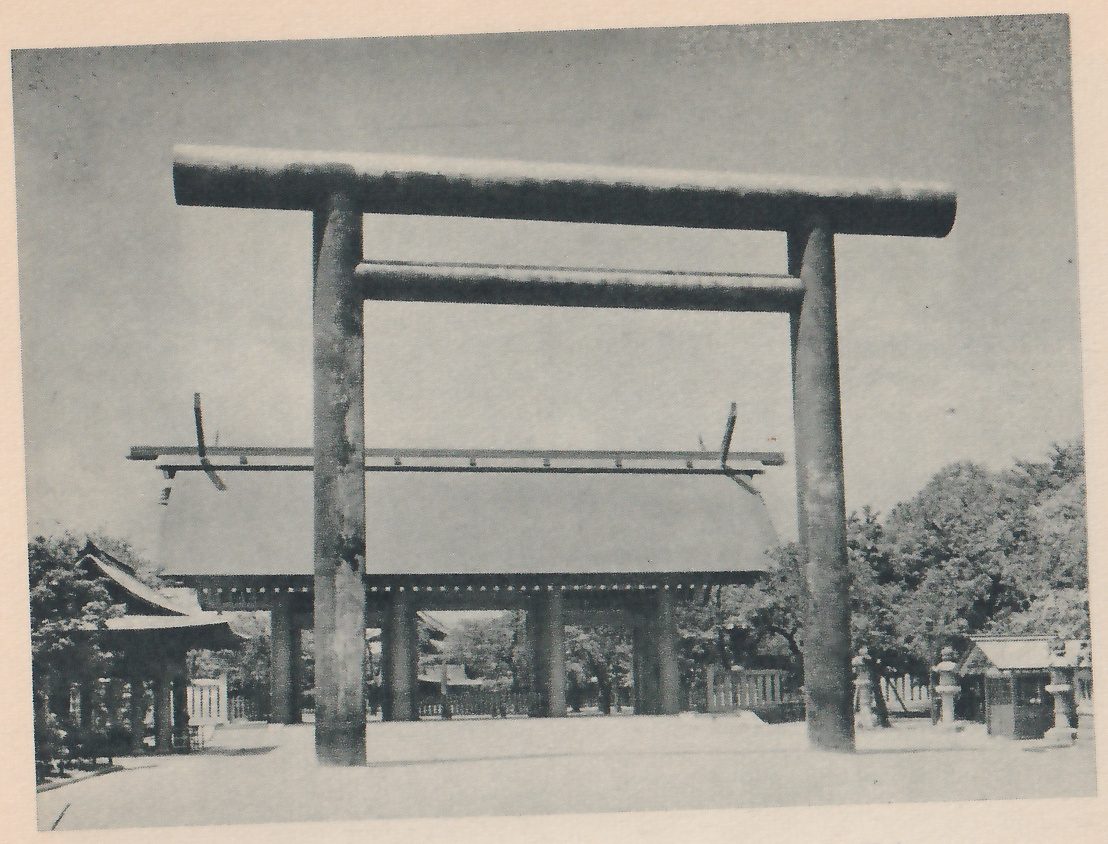
the Japanese people, past and present, throughout all stages, natural and cultural alike, completely in accord with the Japanese mind of the present age of enlightenment, as it has always been in the past.
In this respect Shintō—I mean the National Shintō Faith as distinguished from Sectarian Shintō—is the Japanese “Religion of Loyalty,” as Lafcadio Hearn characterises it. It is, in fact, a Japanese patriotism, suffused with religious emotion; or, in other words, a peculiar enthusiastic patriotic sentiment, often soaring into the plane of adoration or religious worship, towards the Emperor or Mikado, a manifest deity in the sense of theanthropic religion. I should, indeed, call it a form of Emperor-worship or Mikadoism, a faith in the Divine Ruler; a manifestation, coupled with religious
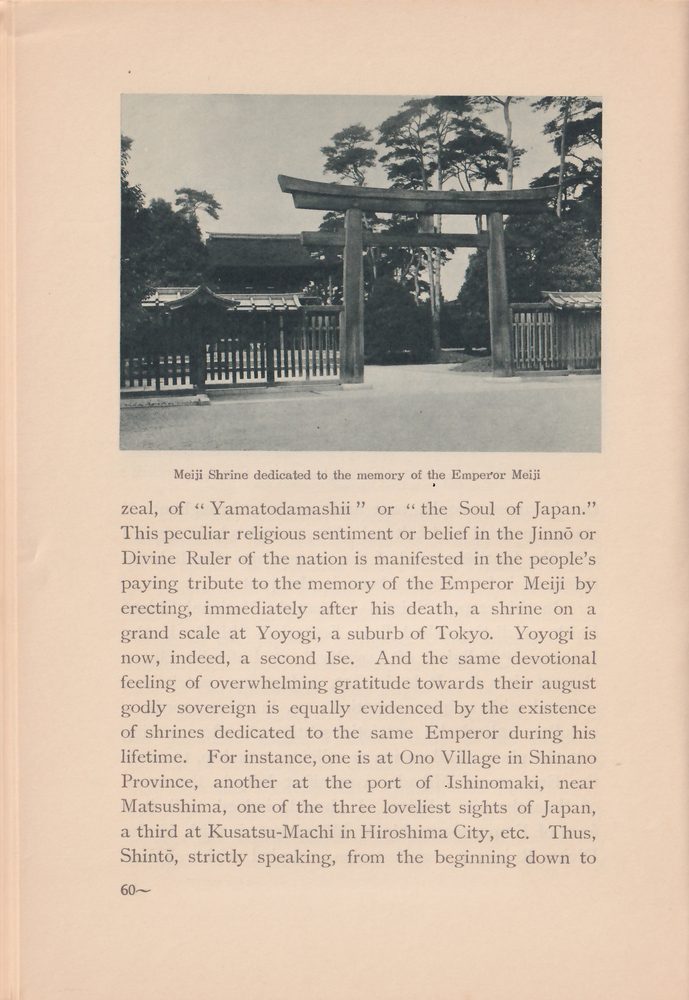
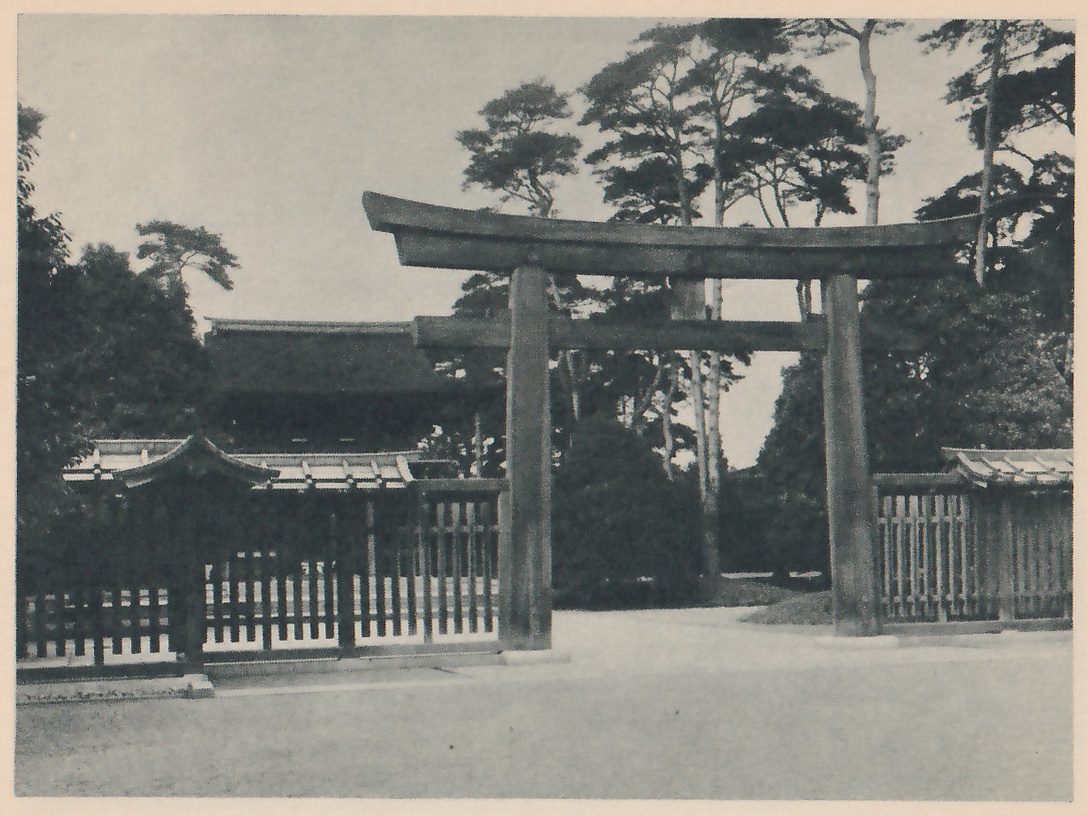
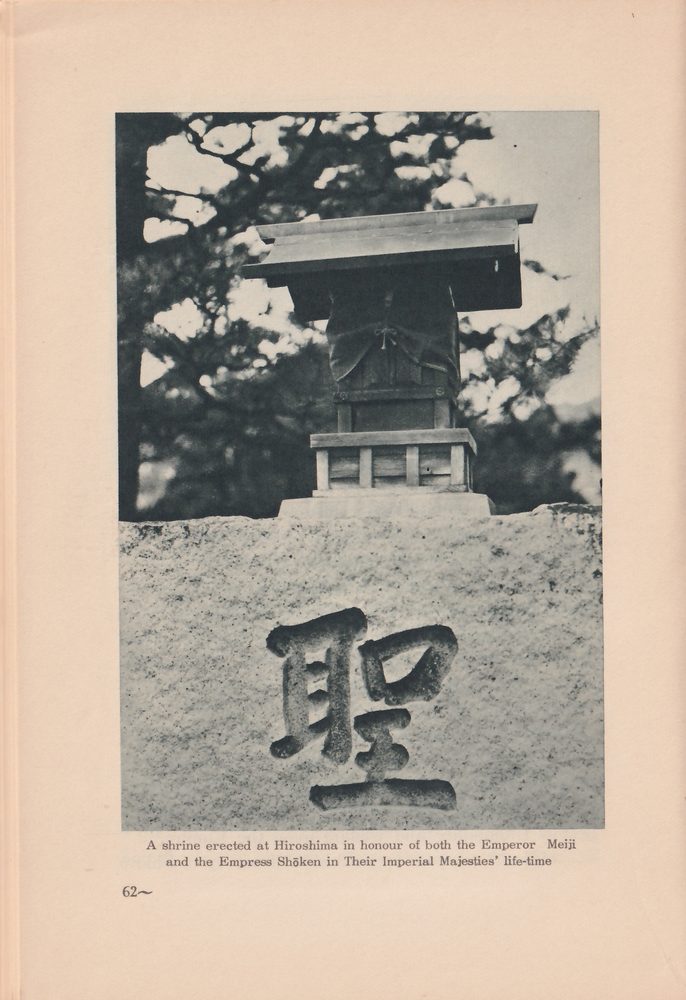
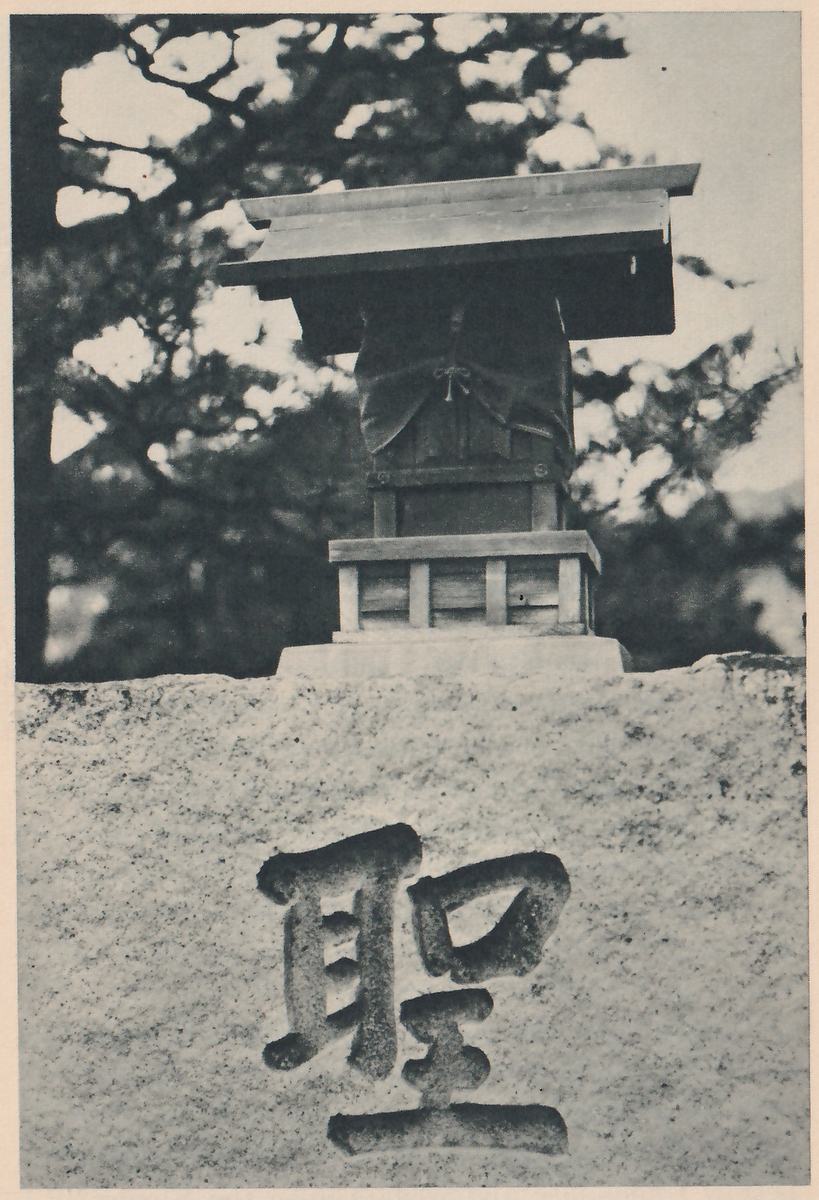
zeal, of “Yamatodamashii” or “the Soul of Japan.” This peculiar religious sentiment or belief in the Jinnō or Divine Ruler of the nation is manifested in the people’s paying tribute to the memory of the Emperor Meiji by erecting, immediately after his death, a shrine on a grand scale at Yoyogi, a suburb of Tokyo. Yoyogi is now, indeed, a second Ise. And the same devotional feeling of overwhelming gratitude towards their august godly sovereign is equally evidenced by the existence of shrines dedicated to the same Emperor during his lifetime. For instance, one is at Ono Village in Shinano Province, another at the port of Ishinomaki, near Matsushima, one of the three loveliest sights of Japan, a third at Kusatsu-Machi in Hiroshima City, etc. Thus, Shintō, strictly speaking, from the beginning down to
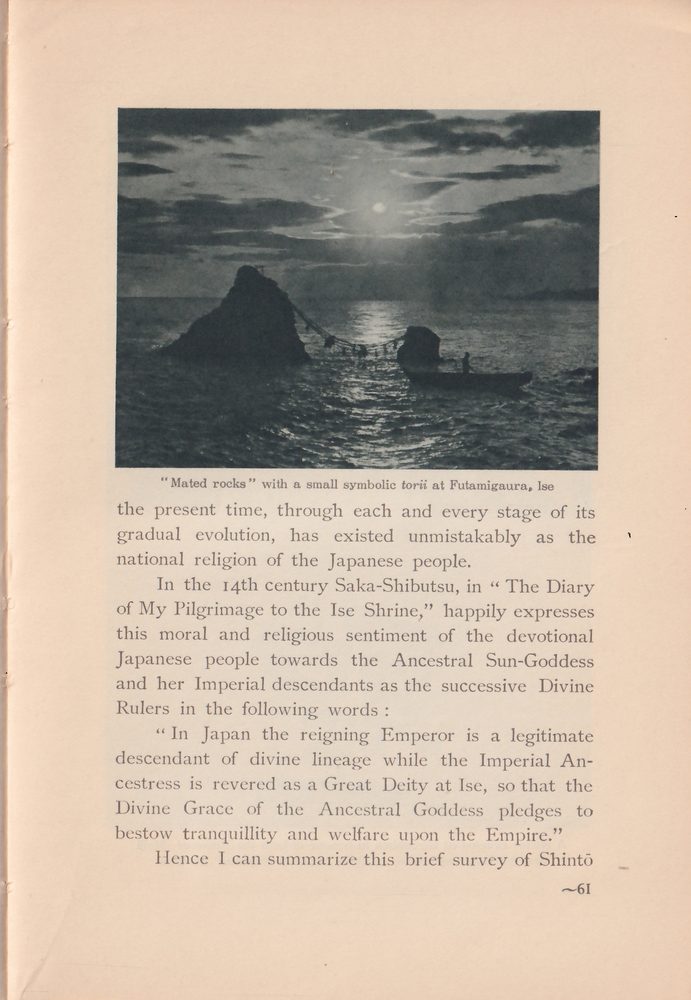
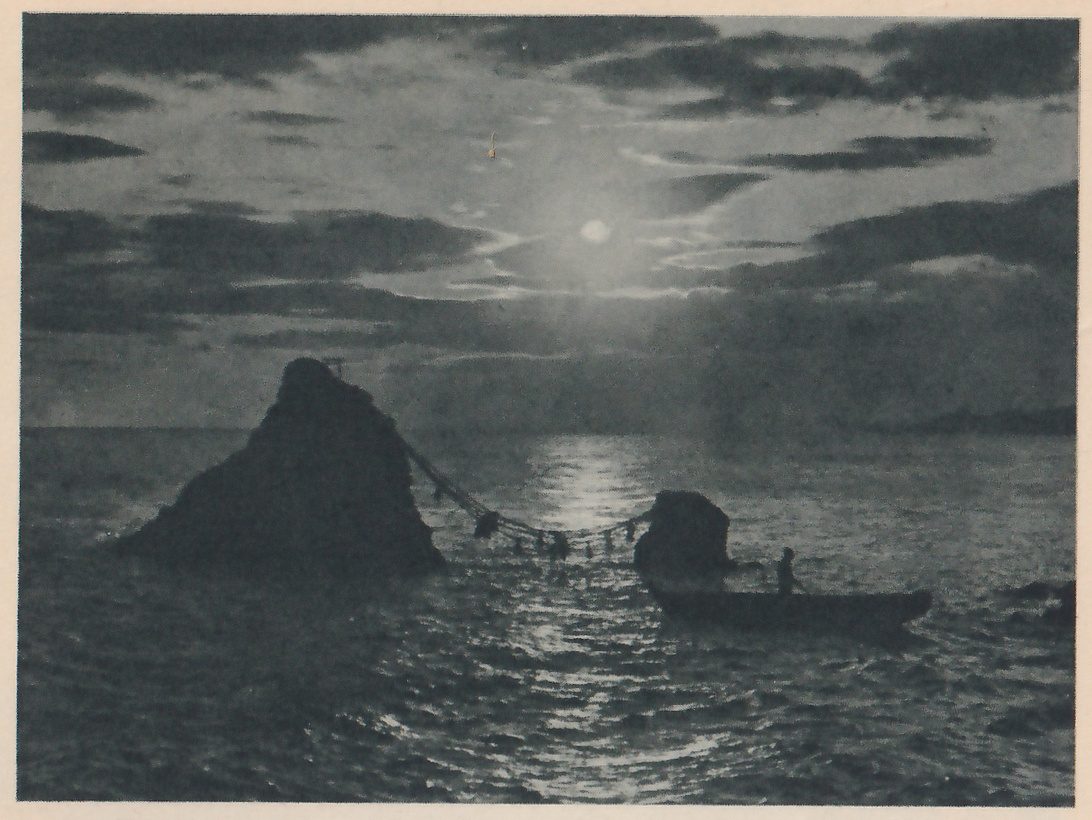
the present time, through each and every stage of its gradual evolution, has existed unmistakably as the national religion of the Japanese people.
In the 14th century Saka-Shibutsu, in “The Diary of My Pilgrimage to the Ise Shrine,” happily expresses this moral and religious sentiment of the devotional Japanese people towards the Ancestral Sun-Goddess and her Imperial descendants as the successive Divine Rulers in the following words:
“In Japan the reigning Emperor is a legitimate descendant of divine lineage while the Imperial Ancestress is revered as a Great Deity at Ise, so that the Divine Grace of the Ancestral Goddess pledges to bestow tranquillity and welfare upon the Empire.”
Hence I can summarize this brief survey of Shintō
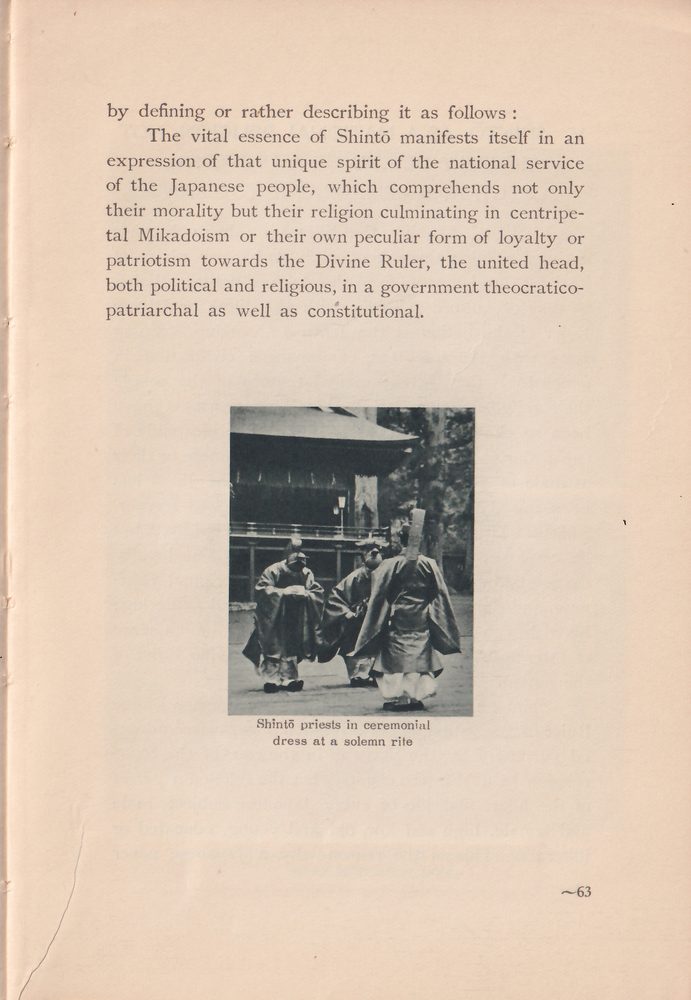
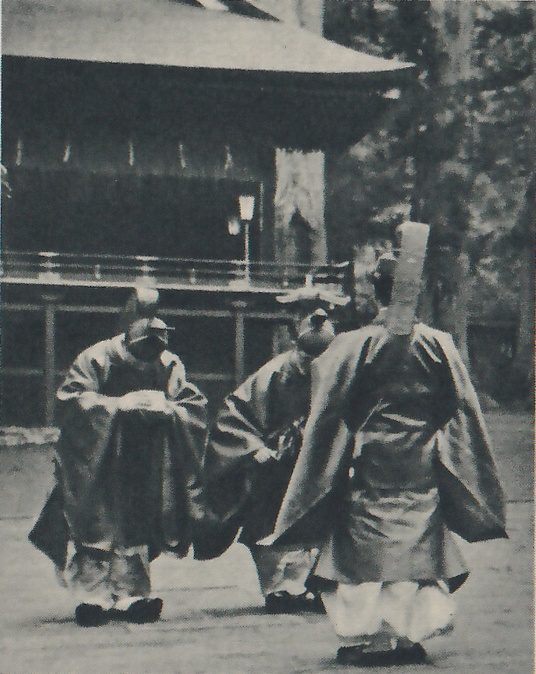
by defining or rather describing it as follows:
The vital essence of Shintō manifests itself in an expression of that unique spirit of the national service of the Japanese people, which comprehends not only their morality but their religion culminating in centripetal Mikadoism or their own peculiar form of loyalty or patriotism towards the Divine Ruler, the united head, both political and religious, in a government theocratico-patriarchal as well as constitutional.