
III. SHINTŌ IN ITS MANHOOD
As the history of religions shows us, when progress is made in the civilization of a nation her religion advances in the intellectual and ethical sense of the term, and thus from nature religion arises culture religion or ethico-intellectualistic religion. Such is the case with Shintō. From the Shintō of nature religion its cultural form develops, i. e., natural Shintō passes on to cultural or ethico-intellectualistic Shintō. Thus the boyhood of Shintō is superseded by its manhood. Shintō grows into a cultural religion in full bloom.
(1) Intellectual Growth
This tendency is seen even in the remote age dealt with by the “Nihongi.” As early as in the reign of the Emperor Nintoku, Japanese history indicates the fact that there were men who had already become mentally advanced enough to judge a god as true or false. Thus in the “Nihongi” we are informed that a certain intelligent man, Koromonoko by name, refused to be sacrificed to a false river-god or waterdemon, though at the Imperial command another person, named Kowakubi, consented to become a victim. The intelligent Koromonoko, however, plunged two calabashes into the turbulent stream, and exclaimed: “O thou River-God, if thou dost persist in thy desire to have me, sink these calabashes and let them not rise to the surface, then shall I know that thou art a true god, and will enter the water of my own accord. But if thou canst not sink the calabashes, I shall, of course, know that thou
art a false god, for whom, why should I spend my life in vain?” (Aston, “Nihongi,” Vol. I, p. 281).
Such being the case, the newly-awakened intellect of Koromonoko enabled him to discern and declare that this pretended river-god was false, since any really true god should be able to cause the sinking of the calabashes and so require a sacrifice, and in consequence Koromonoko was saved.
Severely criticizing the above-mentioned fact, Yamaga-Sokō (1622–1685), a great scholar and the founder of Bushidō or The Warrior’s Way, most frankly expresses himself:
“In my humble opinion, offering a human sacrifice to a demon is a custom of Chinese barbarians. It cannot please a true god, because he refuses to be worshipped with a false offering. It is a matter of great regret that the Emperor Nintoku gave the permission to offer a human sacrifice to the River-God, although such was required of him in a dream. While a wise and virtuous ruler, he could not judge of this matter like the sagacious Koromonoko, who could tell a true God from a false one.”
—Chūchō-Jijitsu
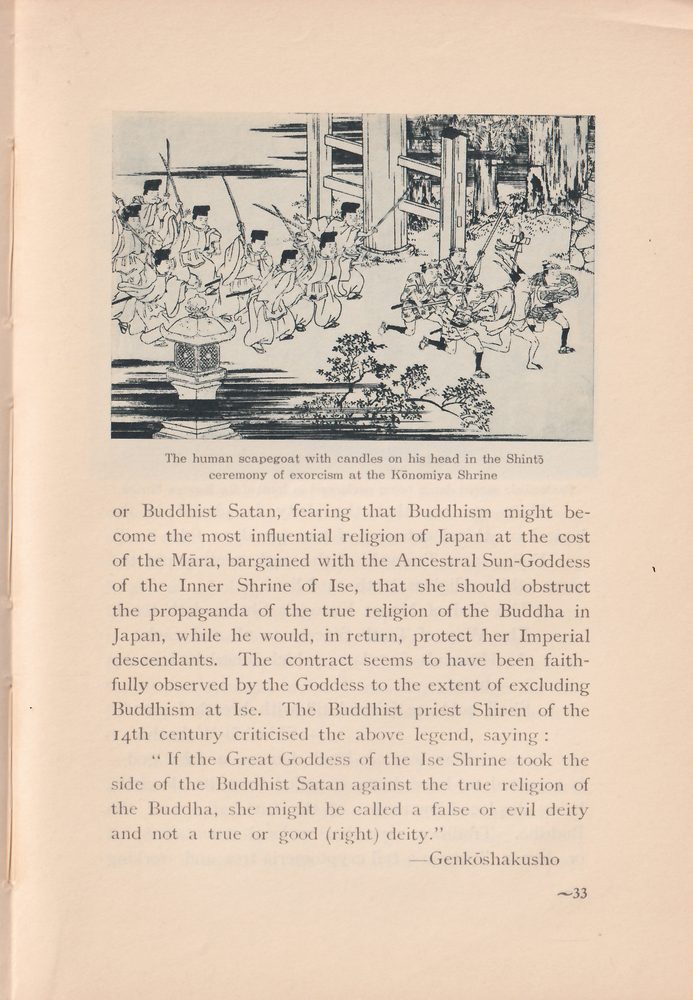
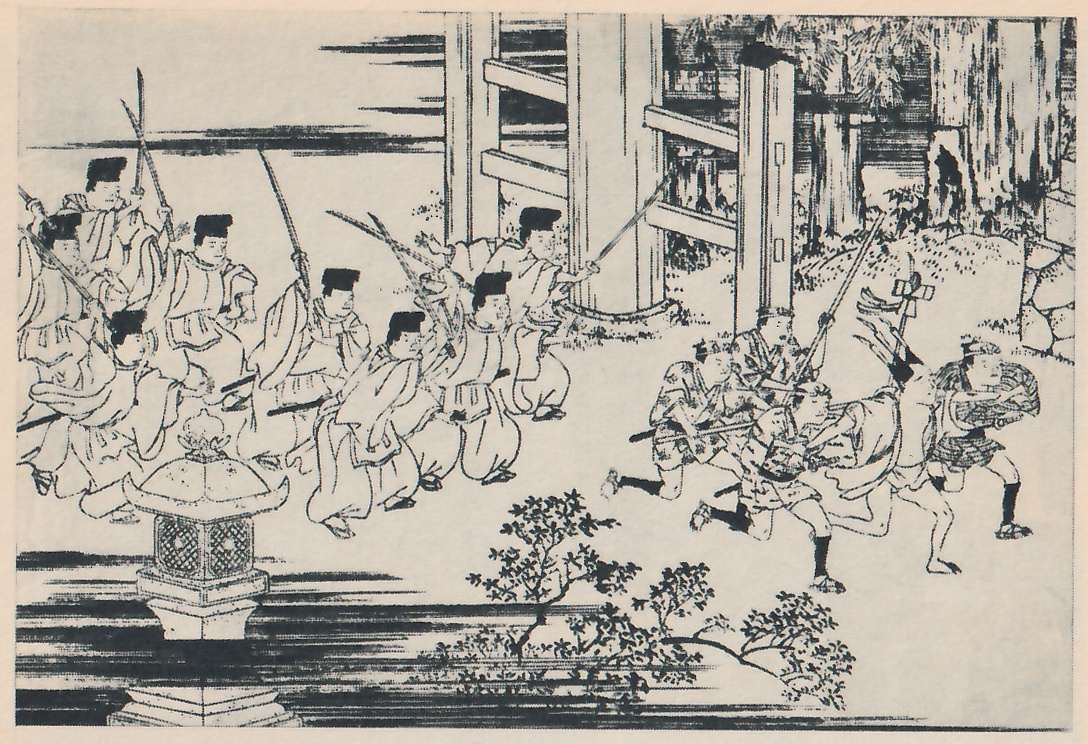
The annual festival still observed at the Kōnomiya Shrine some miles distant from the City of Nagoya, reminds us of a Shintō piacular rite of human sacrifice of olden times, and exorcism or a Shintō practice of expulsion of evil spirits or demons inseparably connected with it. Nowadays, however, not a real human victim, but a rice-cake offering symbolizing it, is used on the occasion. Another legend says that the Māra,
or Buddhist Satan, fearing that Buddhism might become the most influential religion of Japan at the cost of the Māra, bargained with the Ancestral Sun-Goddess of the Inner Shrine of Ise, that she should obstruct the propaganda of the true religion of the Buddha in Japan, while he would, in return, protect her Imperial descendants. The contract seems to have been faithfully observed by the Goddess to the extent of excluding Buddhism at Ise. The Buddhist priest Shiren of the 14th century criticised the above legend, saying:
“If the Great Goddess of the Ise Shrine took the side of the Buddhist Satan against the true religion of the Buddha, she might be called a false or evil deity and not a true or good (right) deity.”
—Genkōshakusho
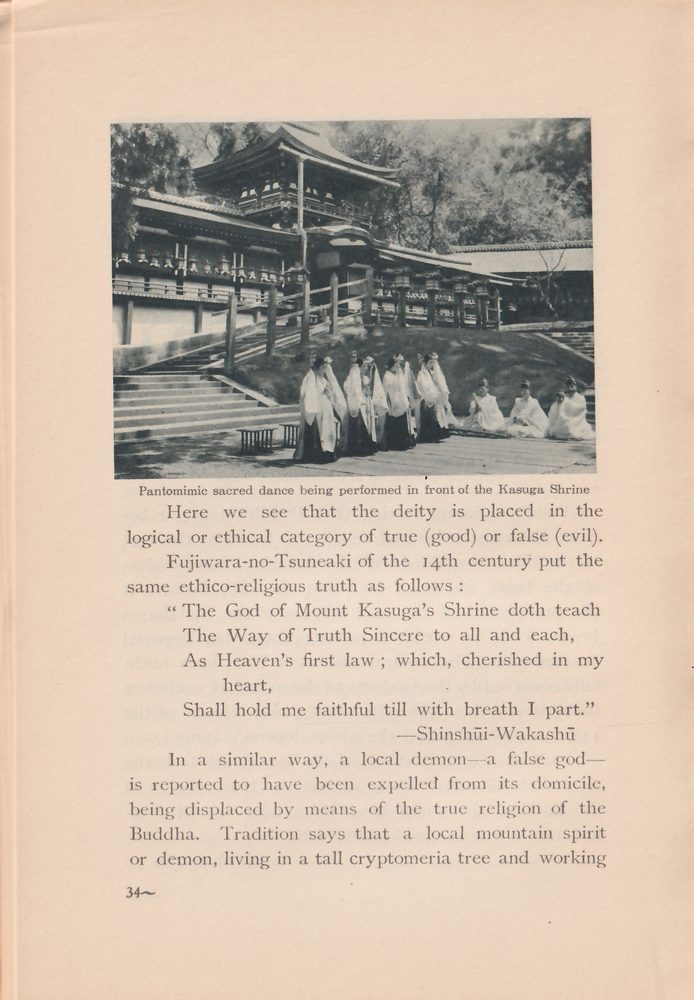
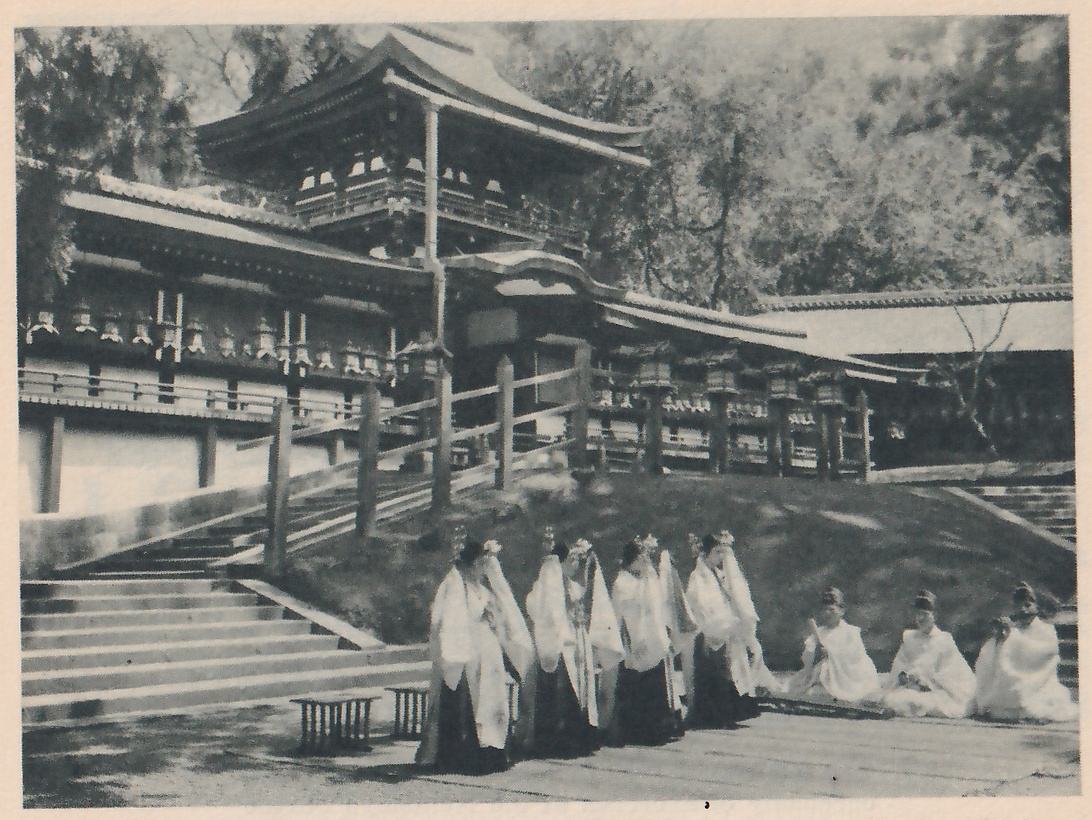
Here we see that the deity is placed in the logical or ethical category of true (good) or false (evil).
Fujiwara-no-Tsuneaki of the 14th century put the same ethico-religious truth as follows:
“The God of Mount Kasuga’s Shrine doth teach
The Way of Truth Sincere to all and each,
As Heaven’s first law; which, cherished in my heart,
Shall hold me faithful till with breath I part.”
—Shinshūi-Wakashū
In a similar way, a local demon—a false god—is reported to have been expelled from its domicile, being displaced by means of the true religion of the Buddha. Tradition says that a local mountain spirit or demon, living in a tall cryptomeria tree and working
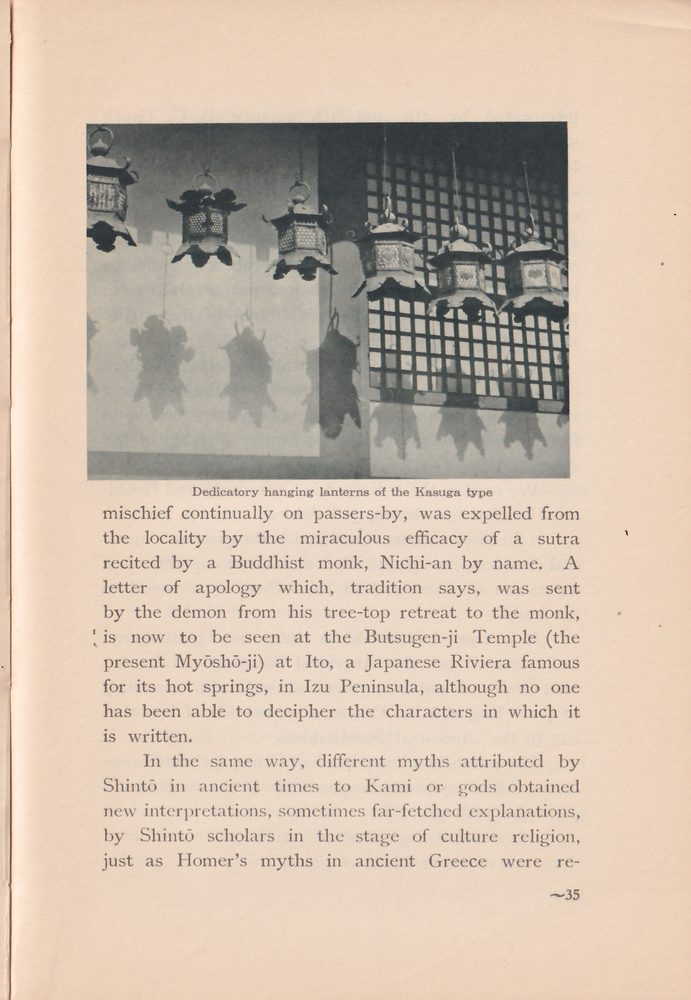
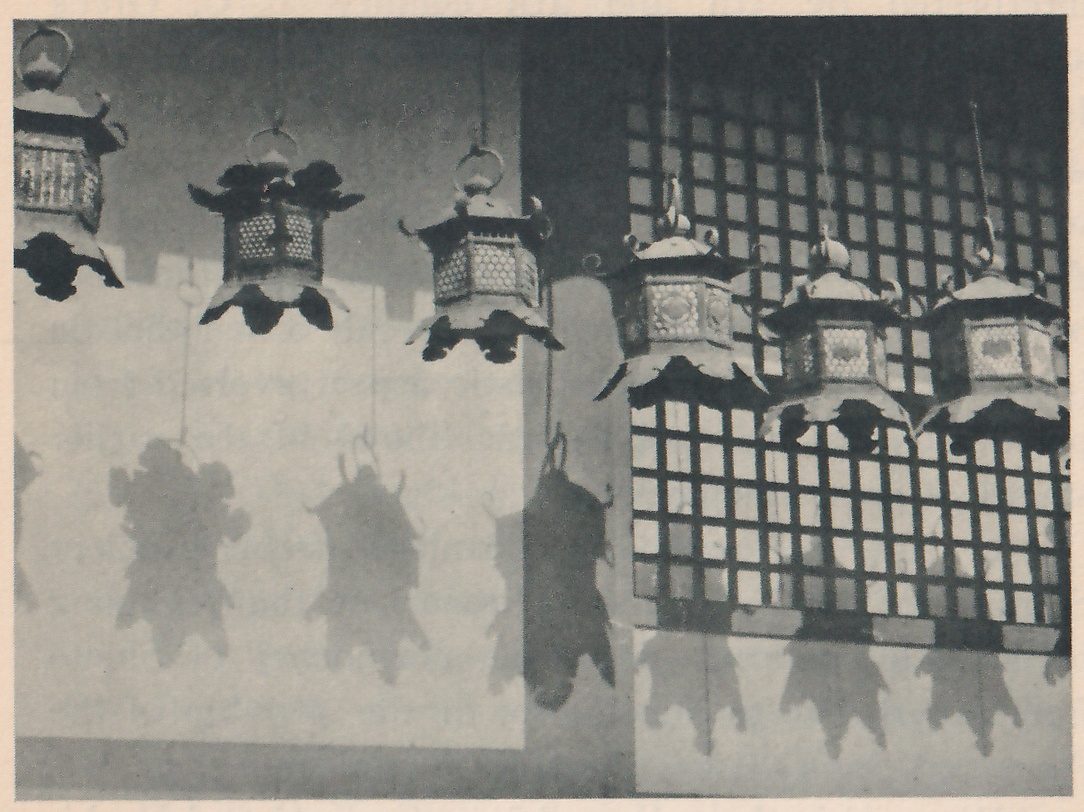
mischief continually on passers-by, was expelled from the locality by the miraculous efficacy of a sutra recited by a Buddhist monk, Nichi-an by name. A letter of apology which, tradition says, was sent by the demon from his tree-top retreat to the monk, is now to be seen at the Butsugen-ji Temple (the present Myōshō-ji) at Ito, a Japanese Riviera famous for its hot springs, in Izu Peninsula, although no one has been able to decipher the characters in which it is written.
In the same way, different myths attributed by Shintō in ancient times to Kami or gods obtained new interpretations, sometimes far-fetched explanations, by Shintō scholars in the stage of culture religion, just as Homer’s myths in ancient Greece were re-
interpreted by 5th and 4th century B. C. Greek savants, like Sophocles, Euripides and Empedocles. Ichijō-Kaneyoshi (1402–1481), Tanikawa-Kotosuga (1709–1776), Tachibana-no-Moribe (1781–1849) and many others are among the champions in this field in Japan. And thus, by degrees, Shintō, in the stage of culture or ethico-intellectualistic religion, reveals a henotheistic (even monotheistic) or pantheistic aspect evolved from polydemonistic and polytheistic Shintō in the earlier stages of its development.
In the “Kogoshūi,” Gleanings from Ancient Stories, written by Imbe-no-Hironari at the beginning of the 9th century, we notice a tendency of Shintō from polytheism to henotheism in the worship of the Ancestral Sun-Goddess Amaterasu-Ōmikami.
We read in the “Kogoshūi” (G. Katō and Hoshino’s English translation, 3rd edition, 1926, p. 46):
“Since Amaterasu-Ōmikami is the greatest Ancestral Goddess, no Shintō God can claim equality, just as no son is ever equal to his father, or a vassal to his lord.”
It is true that in Shintō there are “gods many, lords many,” but the Ancestral Sun-Goddess Amaterasu-Ōmikami stands supreme above them, according to the “Kogoshūi.” This is an expression of henotheism in the Ancestral Sun-Goddess.
The pantheistic expression of Shintō finds utterance in the following poem composed by Urabe-no-Kanekuni of the 15th century:
“E’en in a single leaf of a tree,
Or a tender blade of grass,
The awe-inspiring Deity
Manifests Itself.”
The same aspect of pantheism of Shintō is happily revealed by a Buddhist priest called Tada-Kōsen, of the 19th century, because he is a believer in the Shintō amalgamated with Buddhism, when he sings:
“Spring flowers and autumn leaves!
Emanations all are they
Of that bright light divine,
By Heaven’s radiant Goddess shed
Upon this earth to shine!”
The same religious truth can be discovered in the fragment of an unknown Gospel, the words of which are attributed to Jesus:
“Lift the stone, and thou shalt find me; cleave the wood, and there am I” (James B. Pratt, “Pilgrimage of Buddhism,” p. 669).
So, we have the beautiful language of naturalistic pantheism in the Oracle of the God of Awaka:
“Behold the azure sky,
The mighty vault above—
On earth, the gentle breeze
Rustling the pine-wood leaves
To nature’s own sweet tune—
In all God’s glory shines.”
From the standpoint of pantheism, everything in the universe is a divine manifestation. Divinity pervades and permeates the world. We find anything and everything fully illumined by divine light anywhere. There is no place, in heaven or on earth,
which is not flooded with divine effulgence. Therefore, Senge-Takazumi of the 19th century, a Shintō high priest of the Grand Shrine of Izumo, says:
“No spot on earth but is a shrine—
Be it the vast expanse of Ocean waste
Or highest mountain’s summit, sun-caressed—
In all resides the power divine.”
This religious song composed in pantheistic language at once reminds us of the well-known utterance of a pantheistic strain by the Greek Aratus (291–213 B. C.), when he says:
“Full of Zeus are all the streets,
All the gathering places of men; full is the sea,
Full the harbours.
For we are also His offspring.”
It goes without saying that no shrine made of wood or stone by human hands can contain such a Divinity. Therefore Shima-Shigeoyu (1793–1870), a Shintō priest of the Grand Shrine of Izumo, sees this everlasting truth and communicates it to us in the following pantheistic language:
“Deem not that only in this earthly shrine
The Deity doth reign;
The earth entire, and all the Heavens Divine,
His presence do proclaim.”
That the essence of such a god is not a material being but a purely spiritual existence is the final outcome of Shintō as a culture or ethico-intellectualistic religion, and such a divinity we must worship “in spirit and in truth.” With this verity in mind the Konkō Sect built a shrine in such a way as to enable
the believers to worship the Holy of Holies in the shrine from all sides.
Thus, like the Deutero-Isaiah, for nearly the same reason, that the Deity transcends all material things, Ise-Teijō (1715–1784), a famous Japanese historian of the Tokugawa Régime, forbade worshipping the Deity by means of statues or images. Therefore he admonishes the believer in a prophetic tone in his book entitled “Gunshin-Mondō”:
“Never make an image in order to represent the Deity. To worship a Deity is to directly establish a felt relation of our heart to the living Divinity through sincerity or truthfulness on our part. If we, however, try to establish a relation between Deity and man indirectly by means of an image, the image will itself stand in the way and prevent us from realizing our religious purpose to accomplish direct communion with the Deity. So an image made by mortal hands is of no use in Shintō worship” (Genchi Katō, “A Study of Shintō, the Religion of the Japanese Nation,” p. 185).
Shirai-Sōin of the Tokugawa Régime also says:
“The Deity is absolute. It transcends human words, which are of a relative nature. It is incomprehensible, and yet it permeates all things. It is everywhere. People as a rule, not knowing this truth, visit a hundred shrines day by day to worship there, and make valuable offerings month by month, and yet they are not sure to obtain any reward, though they may perchance suffer misfortunes in the world.”
—Jinja-Keimō
This is nothing but an idea of iconoclasm, with which the student of the religious history of Israel is very familiar, and whose quite unexpected appearance in the history of Shintō may amazingly surprise us like a bolt from the blue. Lastly, Izawa-Nagahide, a Japanese Shintō scholar of the 18th century, says in monotheistic language:
“The ‘Eight Hundred Myriads of Gods’ are nothing but different manifestations of one and the same Deity Kunitokotachi-no-Kami or the Eternally Standing Divine Being of the Earth, the Great Unity of all things in the Universe, the Primordial Being of Heaven and Earth, eternally existing from the beginning to the end of the universe.”
—Shintō-Ameno-Nuboko-no-Ki
Thus Shintō gives us a kaleidoscopic view of its henotheistic, pantheistic and monotheistic phases in the ethico-intellectualistic stage, though Shintō has always clearly betrayed its polytheistic colour, even in each of its henotheistic, pantheistic and monotheistic phases of gradual development. To such a degree, the polytheistic of polytheisms seems to constitute the very core of Shintō.
(2) Ethical Growth
Ethical growth in Shintō proceeding in company with its intellectual growth, is already hinted above. Now let us examine more minutely how the ethical growth of Shintō took place in the course of its history.
As is well known, purity is one of the fundamental
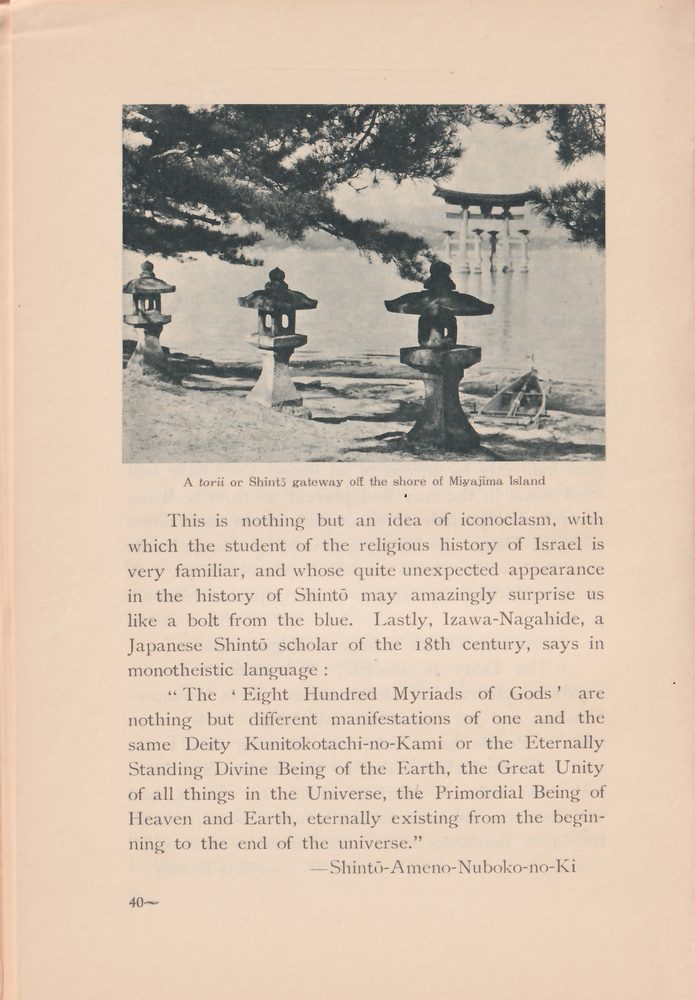
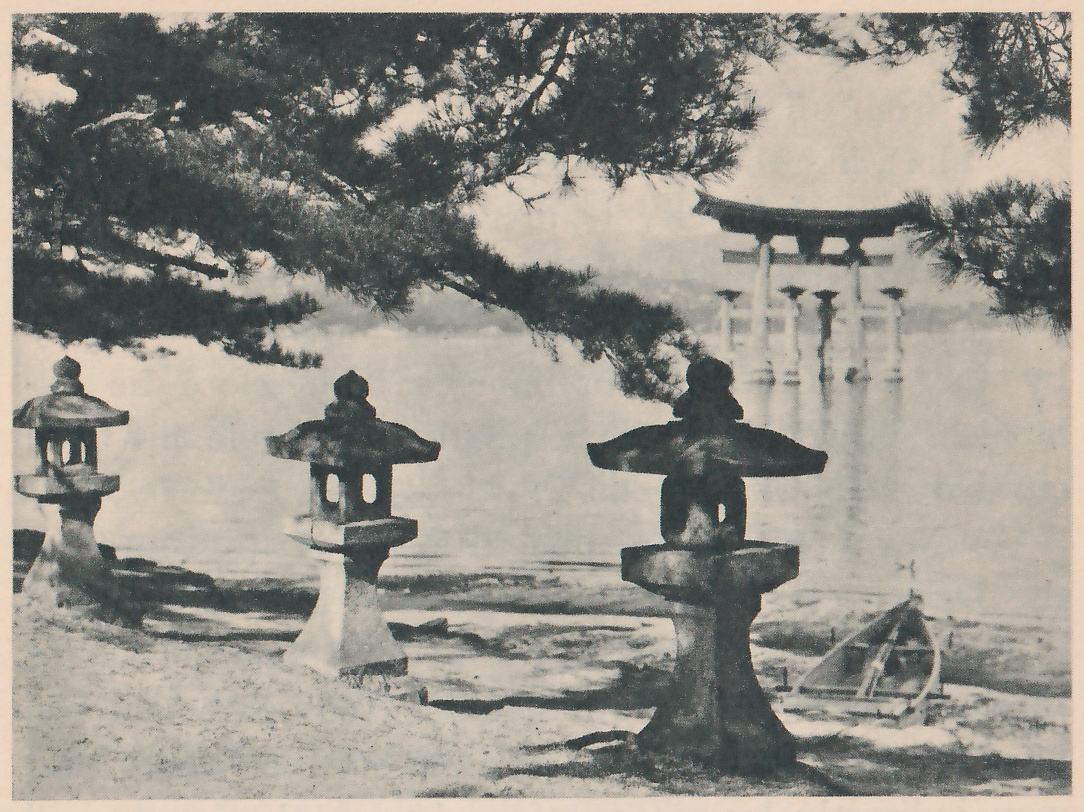
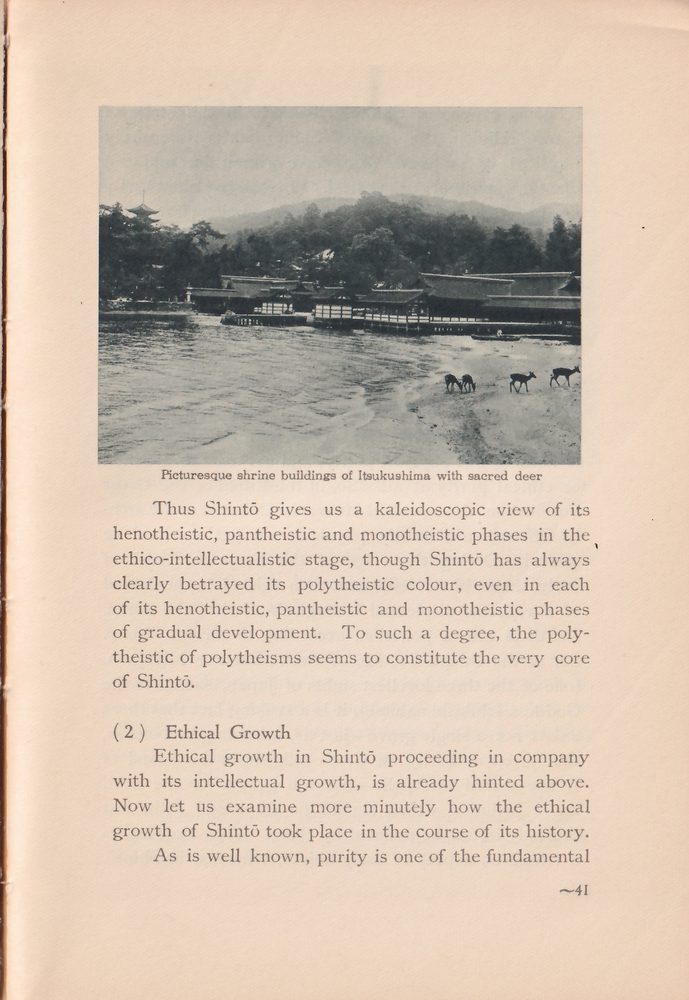
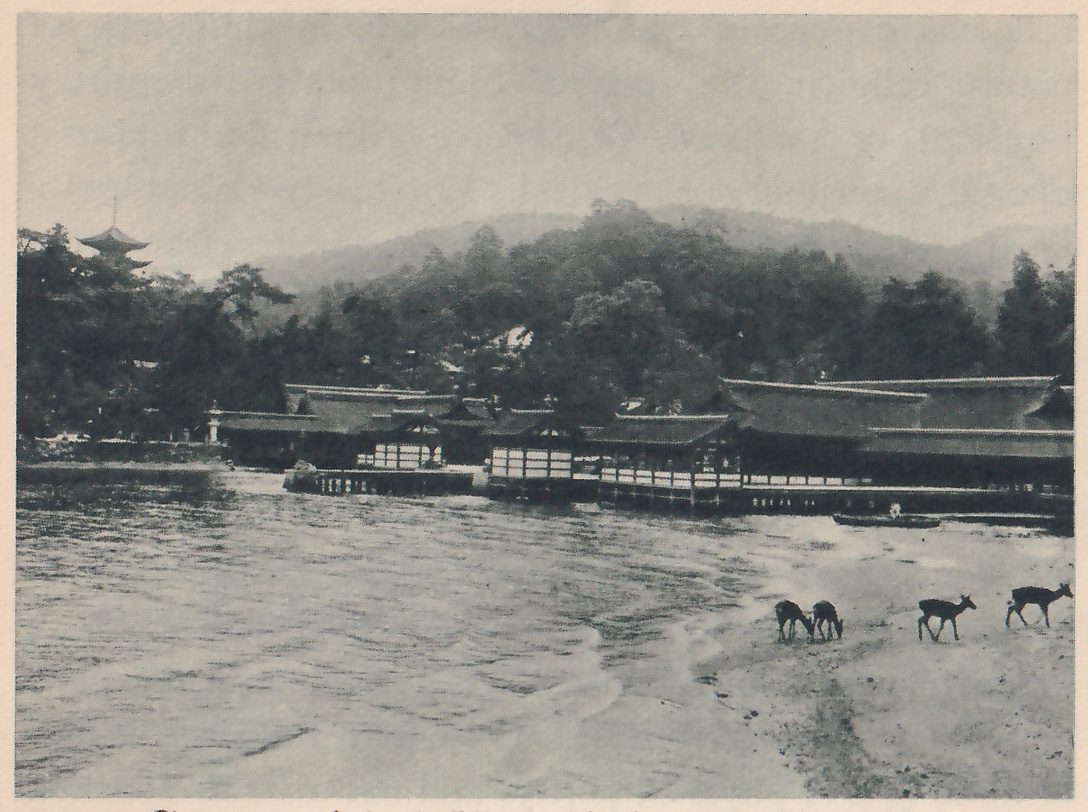
religious canons of Shintō. However, in the stage of nature religion, the idea of Shintō purity is entirely physical or material, ipso facto ritualistic, and not mental, spiritual or ethical. In early Shintō, by purity is meant bodily cleanliness, being free from physical pollution, and not purity of heart in the ethical or spiritual sense of the term. Therefore, Izanagi, after returning from his descent to Hades, the Dark Underworld, Yomi-no-Kuni by name, which means the land of darkness, where he was defiled by touch of the cursed filth of the polluted Land of Death, had to cleanse his body in a river at Ahagihara in Hyūga; in other words, he observed a physical or outer purification, by means of lustral water from the river. This is nothing but physical purity, and not mental, spiritual or ethical purity at all. So, in the Ritual of the Great Purification, the so-called Heavenly Offences and Earthly Offences are mostly physical, not yet spiritual or ethical. During the reign of the Emperor Richū of early times, blood defilement then existed in the Island of Awaji, and displeased Izanagi, the God of the island. Death is also a pollution, according to ancient Shintō. So, in the Inland Sea isle of Itsukushima or Miyajima, (one of the three loveliest sights of Japan, sacred to the Goddess Ichikishimahime), it is a striking fact that there exists not a single grave—just as, according to Nilsson, that great authority on Greek religion, in the Island of Delos, sacred to Apollo—because graves for the dead are a pollution which should be dispensed with, lest the holy island be polluted by them. This, likewise, is a ritualistic aspect of early Shintō, whereas, in Shintō,
in the stage of ethico-intellectualistic religion, not physical purity or bodily cleanliness, but inner purity or heart purity is forcibly emphasized. Thus purity and impurity have come to be expressed in the ethical or spiritual sense of the terms, when the compilers of the “Shintō Gobusho” or “Shintō-Pentateuch”* say:
“To do good is to be pure; to commit evil is to be impure. The deities dislike evil deeds, because they are impure.”
Tomobe-no-Yasutaka in the 18th century, Shintō scholar of the Tokugawa Régime, says:
“What is ablution? It is not merely the cleansing of one’s body solely with lustral water; it means one’s following the Right and Moral Way. Pollution means moral evil or vice. Though a man washes off his bodily filth, he will yet fail to please the god if he restrains not his evil desires.”
—Shintō-Shoden-Kuju
Ichijō-Kaneyoshi emphasizes the inner significance of purity, although he recognizes two kinds of purity, outer and inner, and says:
“There are two significations of purity in Shintō: one is outer purity or bodily purity and the other inner purity of heart. If a man is truly sincere in mind he will be sure to succeed in realizing a communion with the Divine. This is no other than inner purity or Sincerity, which means purity of heart or uprightness of heart.”
—Nihonshoki-Sanso
* Compiled in the 13th century by the Shintō priests of the Outer Shrine of Ise, which is dedicated to Toyouke-no-Ōmikami or the Food Goddess.
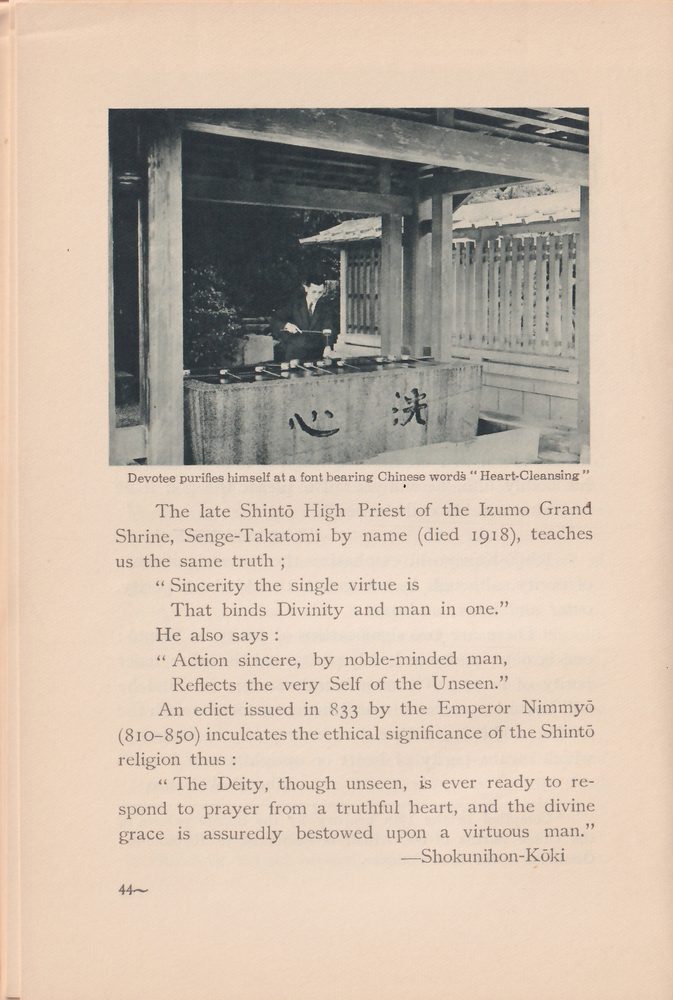
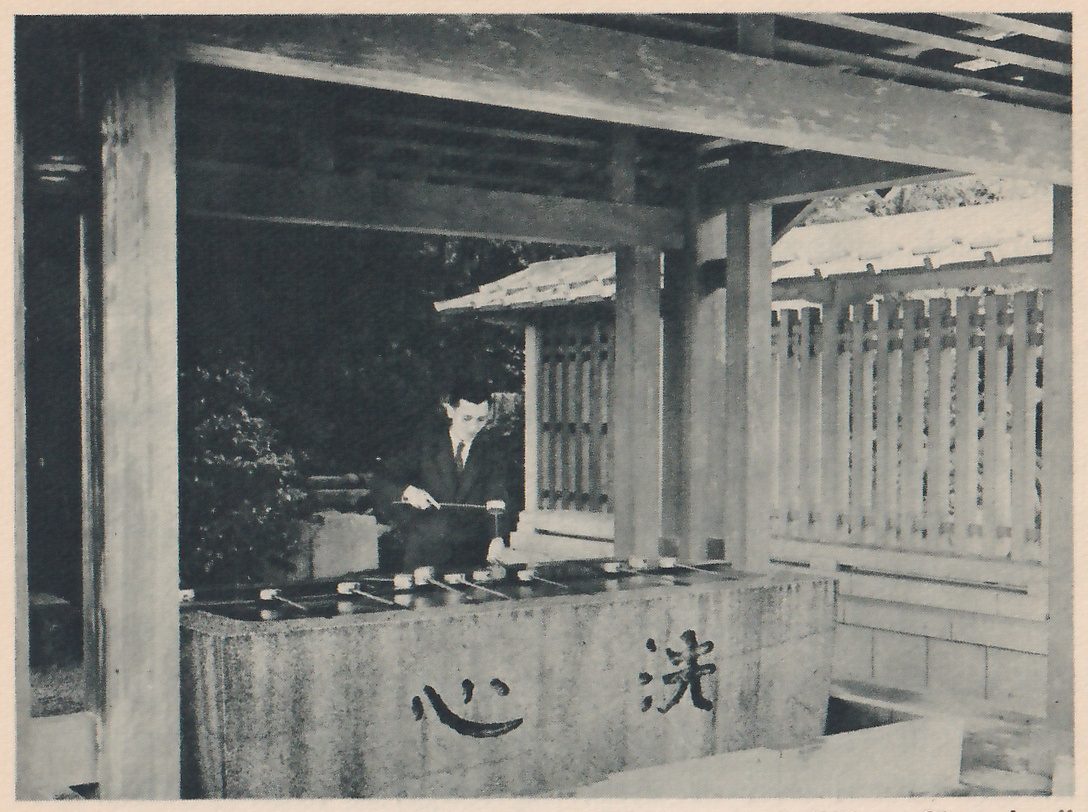
The late Shintō High Priest of the Izumo Grand Shrine, Senge-Takatomi by name (died 1918), teaches us the same truth;
“Sincerity the single virtue is
That binds Divinity and man in one.”
He also says:
“Action sincere, by noble-minded man,
Reflects the very Self of the Unseen.”
An edict issued in 833 by the Emperor Nimmyō (810–850) inculcates the ethical significance of the Shintō religion thus:
“The Deity, though unseen, is ever ready to respond to prayer from a truthful heart, and the divine grace is assuredly bestowed upon a virtuous man.”
—Shokunihon-Kōki
Thus we see that Sincerity or Uprightness, like the ethical principle of Universal Love in Christianity, or that of Unconditional Benevolence in Buddhism, has become a fundamental tenet or the guiding (regulative) ethical principle of Shintō in the ethico-intellectualistic stage of its development. In the third or highest stage of development of Shintō, they have become self-conscious of this noble fundamental ethical truth. Therefore the “Shintō-Gobusho” says:
“What pleases the Deity is virtue and sincerity, not any number of material offerings.”
And this is paralleled by the idea in Proverbs:
“To do justice and judgment is more acceptable to the Lord than sacrifice” (XXI, 3).
The Israelite prophet of the eighth century B. C. teaches the same truth, when he says:
“I desire mercy and not sacrifice” (Hosea, VI, 6).
The Imperial Prince Kaneakira (914–987) teaches:
“Gods or spirits are just and equable, only accepting a man’s religious piety. Go and pray to them with sincerity of heart, and you will be sure to please them.”
—Honchō-Monzui
Yamaga-Sokō, the well-known founder of Bushidō or The Warrior’s Way, says:
“The first and surest means to enter into communion with the Divine is by sincerity. If you pray to a deity with sincerity, you will surely feel the divine presence.”
—Chūchō-Jijitsu
And the Emperor Meiji wrote:
“With the unseen God,
Who seeth all secret things,
In the silence—
Communes from the earth below,
The heart of the man sincere.”#
Ichijō-Kaneyoshi, in his learned commentary on the “Nihongi” (Nihonshoki-Sanso), says:
“What deity does Amaterasu-Ōmikami worship in abstinence in the Plain of High Heaven? She worships her own Self within as a Deity, endeavouring to cultivate divine virtue in her own person by means of inner purity and thus becoming one with the Deity.”
This is only another way of expressing what Emerson says in his “Over-Soul”:
“The simplest person who in his integrity worships God, becomes God,......I, the imperfect, adore my own Perfect” (Collected Works, Vol. II, pp. 292–7).
The oracular utterance of the God of Wakasahiko runs as follows:
“What is the upright heart,
The guide of human life?
’Tis neither more, nor is it less,
Than the Divine Itself.”
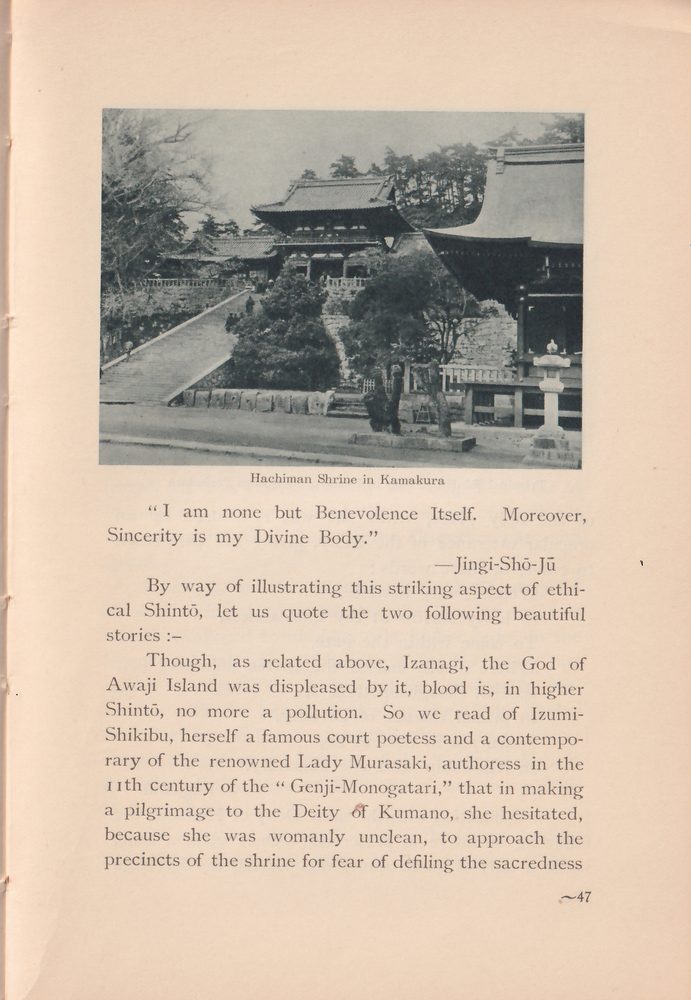
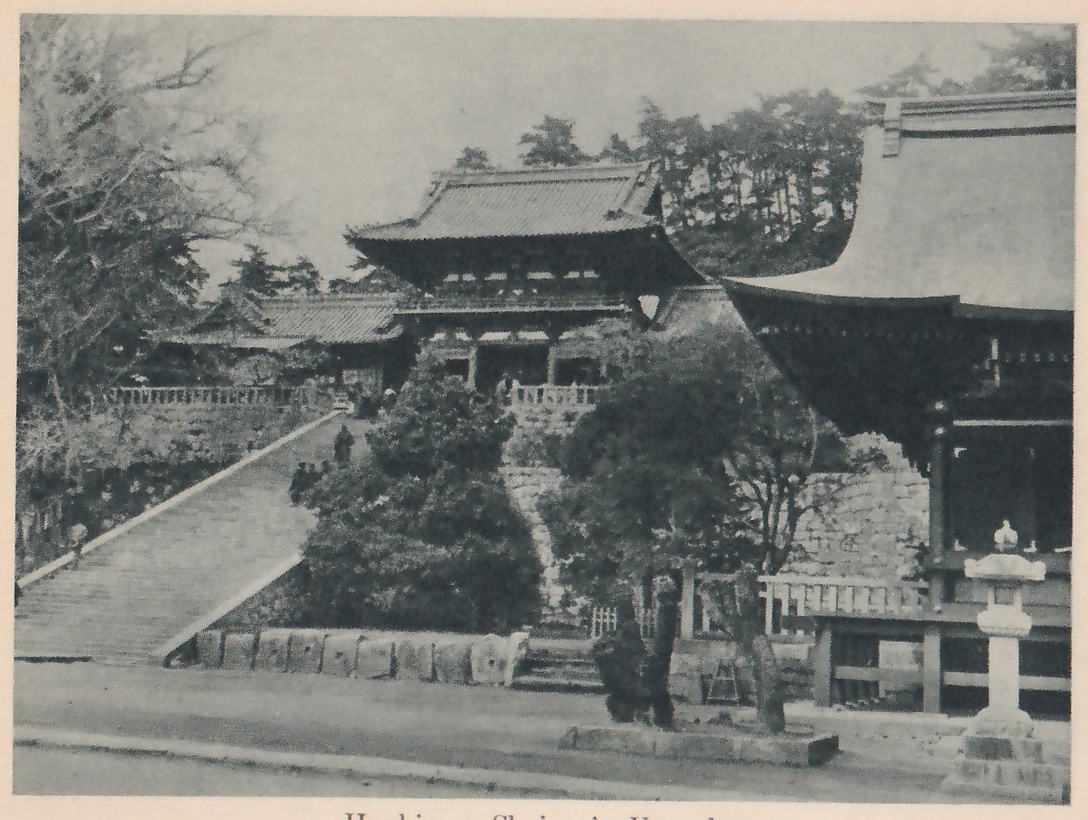
According to Urabe-no-Kanena, an oracle of the God Hachiman* says:
# I have taken the liberty of making use of Prof. F. A. Lombard’s English translation of the original Japanese poem. Vide F. A. Lombard, Imperial Poems of the Meiji Era.
* Hachiman is a war-god of whom it is believed the Emperor Ōjin is an Incarnation, as distinguished from Temmangū, the deified minister Sugawara-no-Michizane, who is a tutelary deity of literature and calligraphy, a Japanese masculine Athene.
“I am none but Benevolence Itself. Moreover, Sincerity is my Divine Body.”
—Jingi-Shō-Jū
By way of illustrating this striking aspect of ethical Shintō, let us quote the two following beautiful stories:–
Though, as related above, Izanagi, the God of Awaji Island was displeased by it, blood is, in higher Shintō, no more a pollution. So we read of Izumi-Shikibu, herself a famous court poetess and a contemporary of the renowned Lady Murasaki, authoress in the 11th century of the “Genji-Monogatari,” that in making a pilgrimage to the Deity of Kumano, she hesitated, because she was womanly unclean, to approach the precincts of the shrine for fear of defiling the sacredness
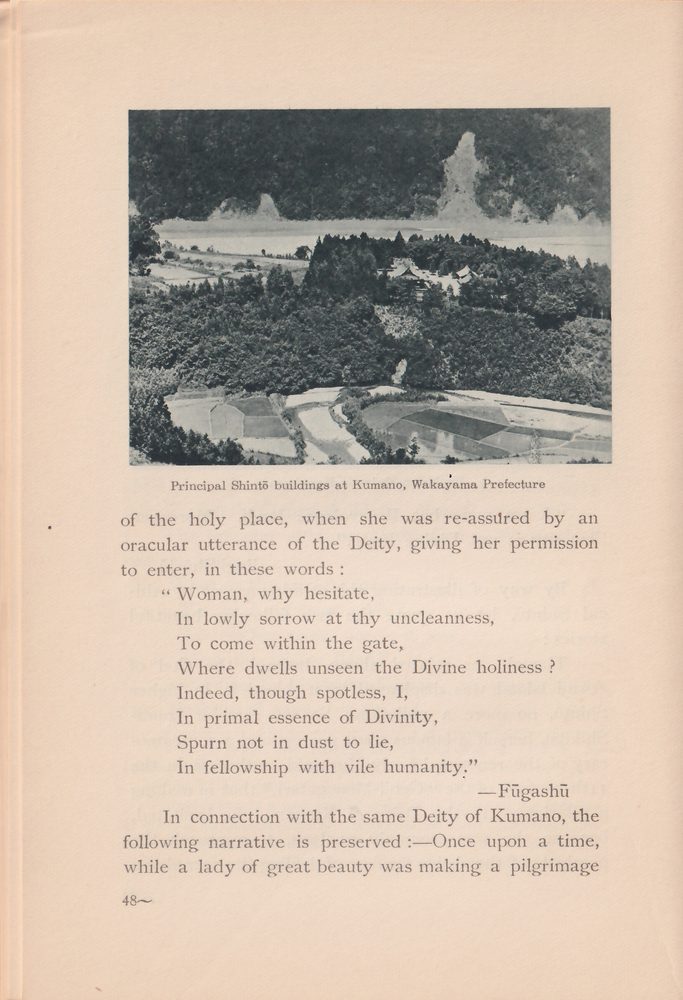
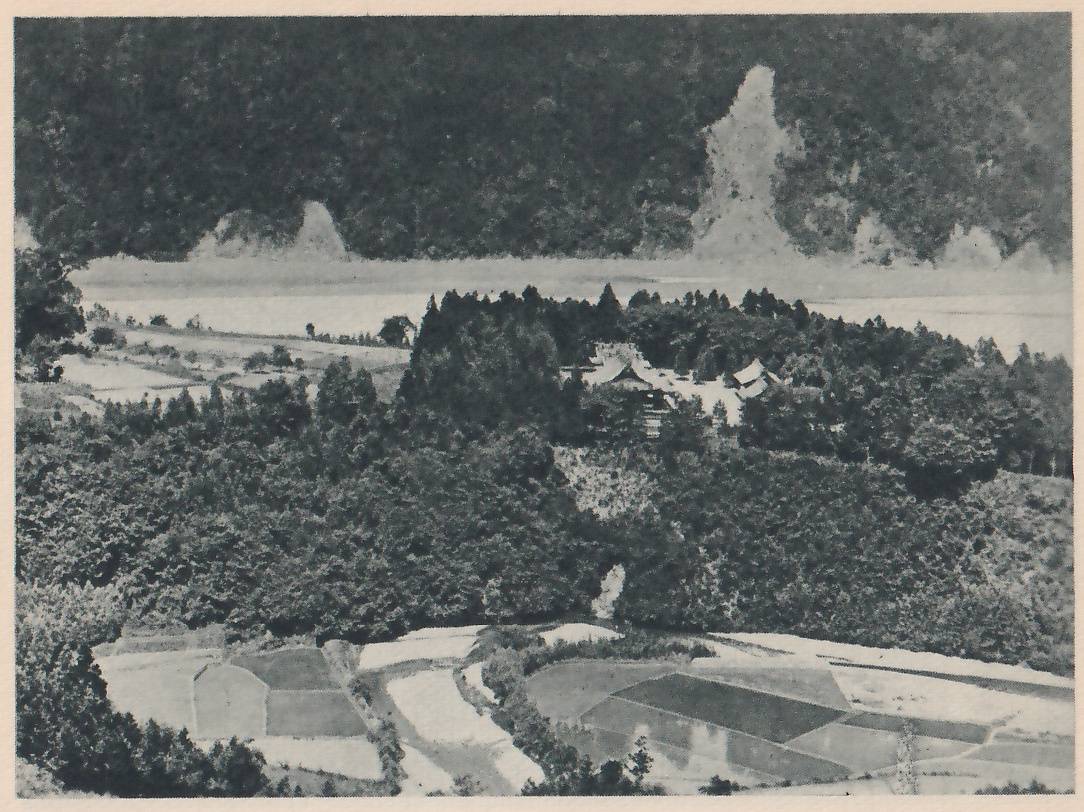
of the holy place, when she was re-assured by an oracular utterance of the Deity, giving her permission to enter, in these words:
“Woman, why hesitate,
In lowly sorrow at thy uncleanness,
To come within the gate,
Where dwells unseen the Divine holiness?
Indeed, though spotless, I,
In primal essence of Divinity,
Spurn not in dust to lie,
In fellowship with vile humanity.”
—Fūgashū
In connection with the same Deity of Kumano, the following narrative is preserved:—Once upon a time, while a lady of great beauty was making a pilgrimage
to Kumano, the religious leader of the party became smitten by her charms and made known to her his desire. Greatly perturbed, the lady took counsel of her attendant maid who loyally determined that in order to protect her lady’s honour she would sacrifice her own, and this, under cover of the darkness of night, she actually did. Whereupon the divine anger inflicted immediate death upon the apostate leader as punishment for his thus defiling the sacred neighbourhood of the shrine; while, on the other hand, the sin of the maid-servant, having been committed of pure intent and under compulsion, was divinely condoned (“Shasekishū”).
This story of man’s impiety and divine justice recalls the Greek legend of a similar nature, which tells how, mistaking him for a robber, a man killed his own friend, yet was pronounced by the Delphic Oracle to be innocent, on the ground that the act of homicide was committed through a motive altogether pure and spotless.
Likewise, in the ethico-intellectualistic stage of Shintō development, we see that the Japanese mind is widely awakened to morality of a higher order in the legends told about the following Shintō festivals: one legend as regards the curious religious custom in connection with the annual festival at the Usaka Shrine near the City of Toyama, and the other as to a similar religious usage at the festival of the Tsukuma Shrine, standing on the shore of Lake Biwa, not so far from Maibara Station.
On a festival day each year at the Usaka Shrine, the Shintō priest was wont, in the presence of the
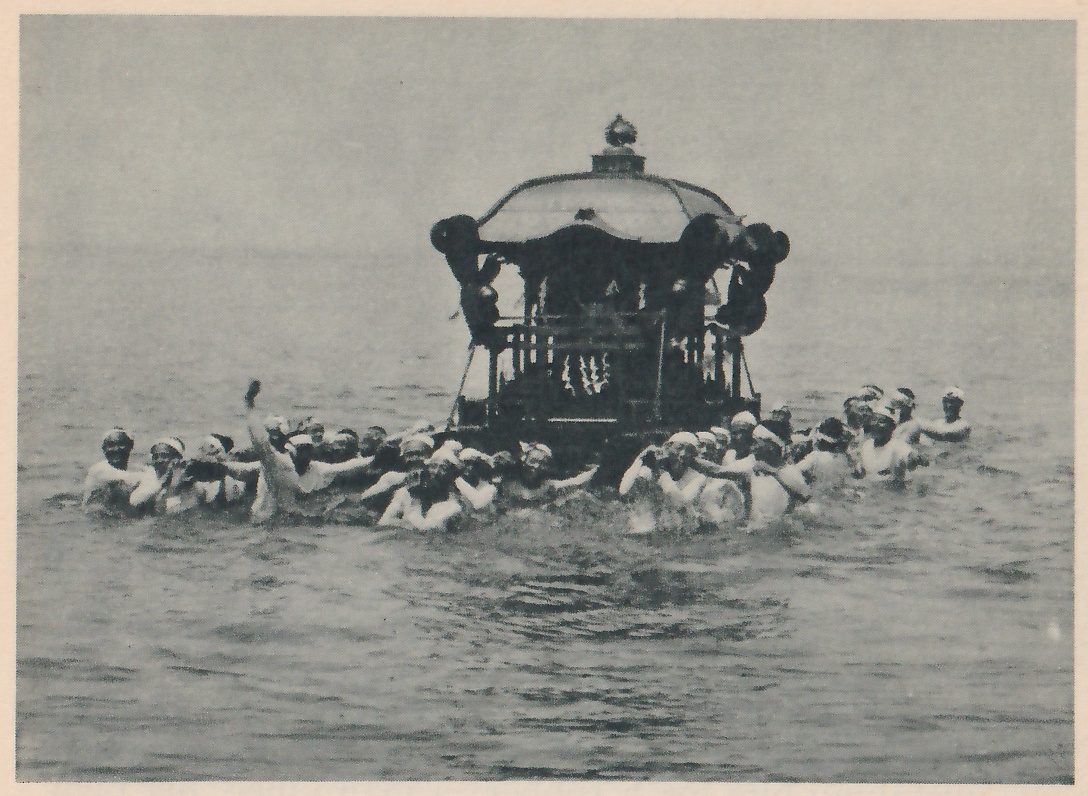
Deity, to strike with a stick any wanton woman often disloyal to her husband. This was considered as a divine punishment inflicted on her. And in the name of a Shintō Deity, such licentious vice was intended to be eradicated.
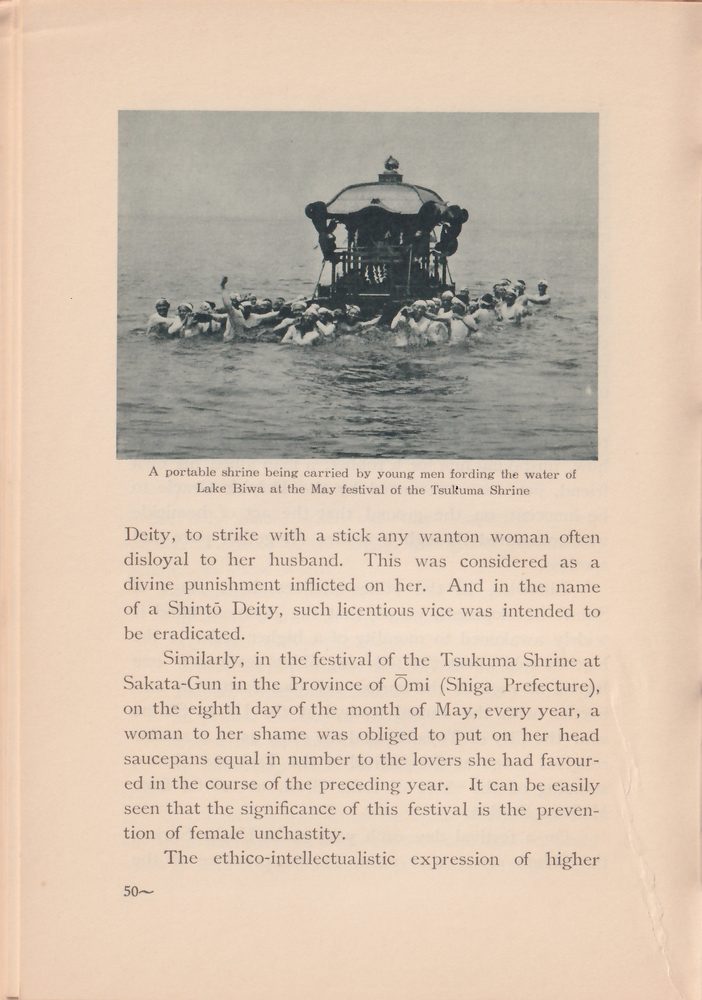
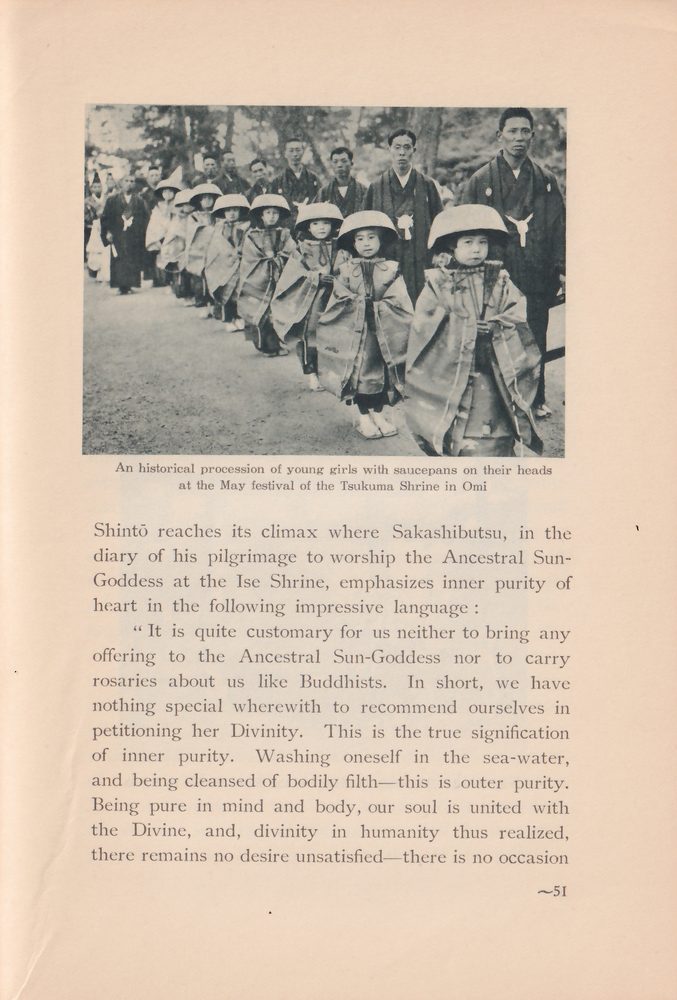
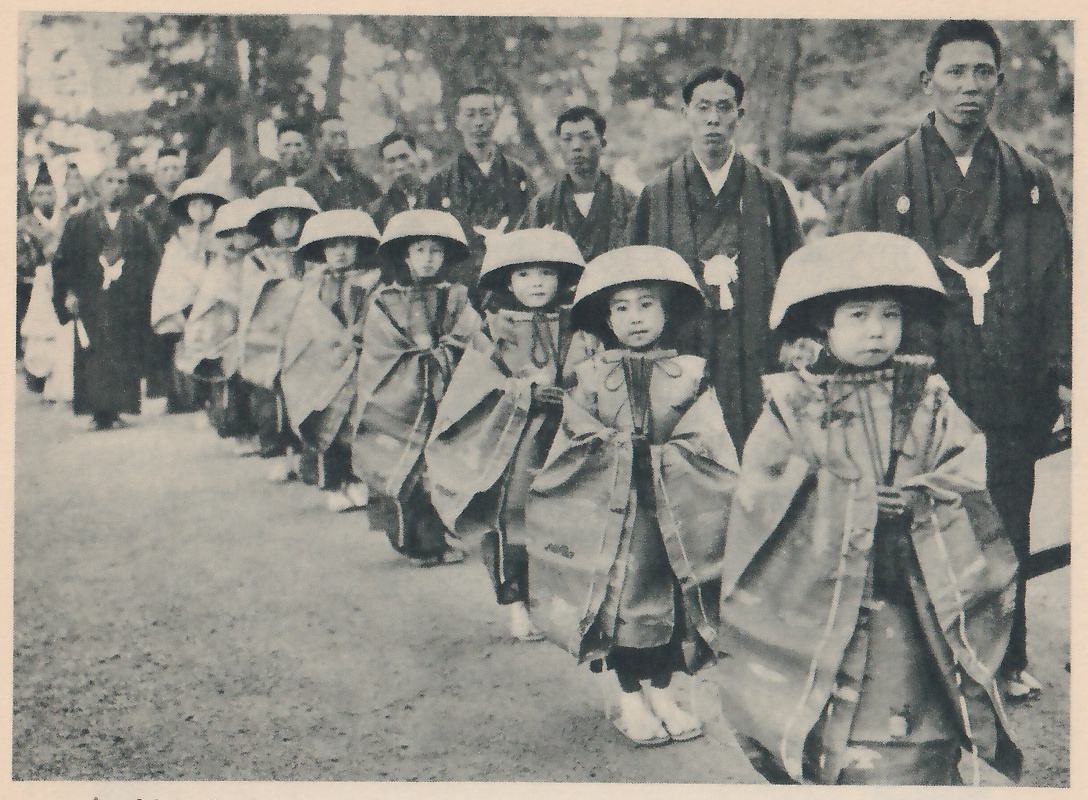
Similarly, in the festival of the Tsukuma Shrine at Sakata-Gun in the Province of Ōmi (Shiga Prefecture), on the eighth day of the month of May, every year, a woman to her shame was obliged to put on her head saucepans equal in number to the lovers she had favoured in the course of the preceding year. It can be easily seen that the significance of this festival is the prevention of female unchastity.
The ethico-intellectualistic expression of higher
Shintō reaches its climax where Sakashibutsu, in the diary of his pilgrimage to worship the Ancestral Sun-Goddess at the Ise Shrine, emphasizes inner purity of heart in the following impressive language:
“It is quite customary for us neither to bring any offering to the Ancestral Sun-Goddess nor to carry rosaries about us like Buddhists. In short, we have nothing special wherewith to recommend ourselves in petitioning her Divinity. This is the true signification of inner purity. Washing oneself in the sea-water, and being cleansed of bodily filth—this is outer purity. Being pure in mind and body, our soul is united with the Divine, and, divinity in humanity thus realized, there remains no desire unsatisfied—there is no occasion
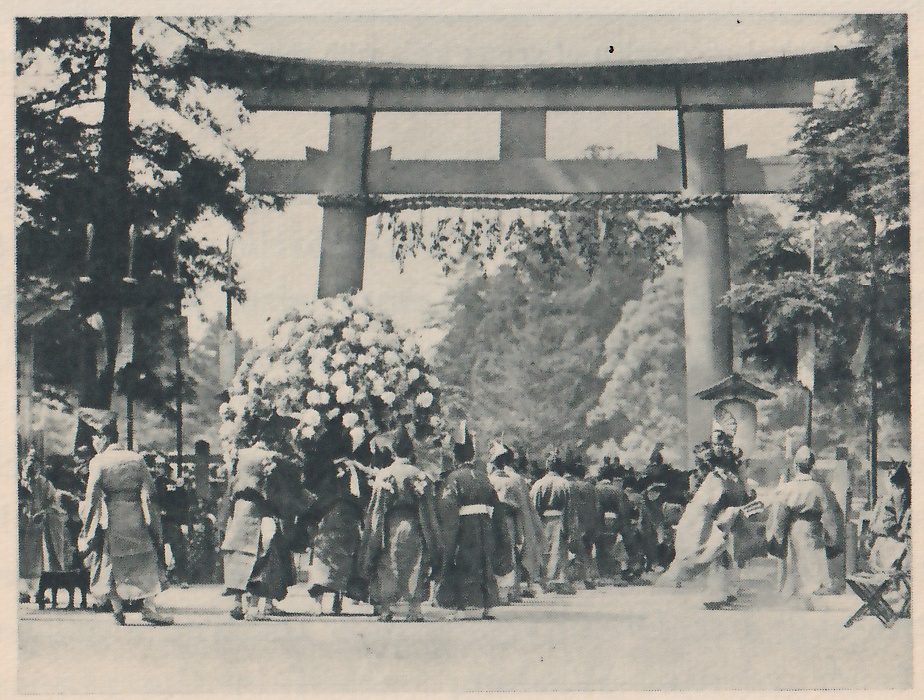
for further petition or prayer to the Goddess. This is the true esoteric meaning of worshipping the Goddess at the Ise Shrine. Being thus enlightened by the Shintō priest# of the shrine, I was overwhelmed with a sense of pious joy, and burst into tears of gratitude.”
—Daijingū-Sankei-ki*
# Watarai-Ieyuki (1254–1351) by name, a Shintō priest of the Outer Shrine of Ise.
* Some scholars hold the opinion that the writer of this diary is not Saka-Shibutsu in the 14th century but his father Jūbutsu. This view seems to be right in all probability.