
PART II. SALIENT FEATURES OF SHINTŌ
I. SHINTŌ IN ITS CHILDHOOD
By the expression “Shintō in Its Childhood” I mean the first or earliest stage of Shintō in the course of its development. Shintō in its first or earliest stage is in its infancy, so to speak. In this stage, Shintō reveals an aspect of lower nature religion. Its crude view of the world and life is, after all, animism, or animatism. The latter again is a most crude philosophy among nature peoples, in which they regard everything in nature as animated, as sentient beings, like themselves, although they are not sufficiently conscious yet of a common sense dualism of body and mind. So animatism may be called a spontaneous a-dualistic animism or pre-animism. Aston is right in seeing an animatism in the fire-worship of the ancient Japanese folk, referring to an old document, the “Ritual of Appeasing the Fire-God,” when he says that the ancient Japanese deified the visible physical fire itself, and not the agent or spirit of fire residing in the material fire. The crude philosophy of the ancient Japanese mind was first animatism; then followed animism, as is the case with other peoples in the same nature stage. In other words, in ancient Japan it seems to us that a simple nature-worship came first, and later a complex
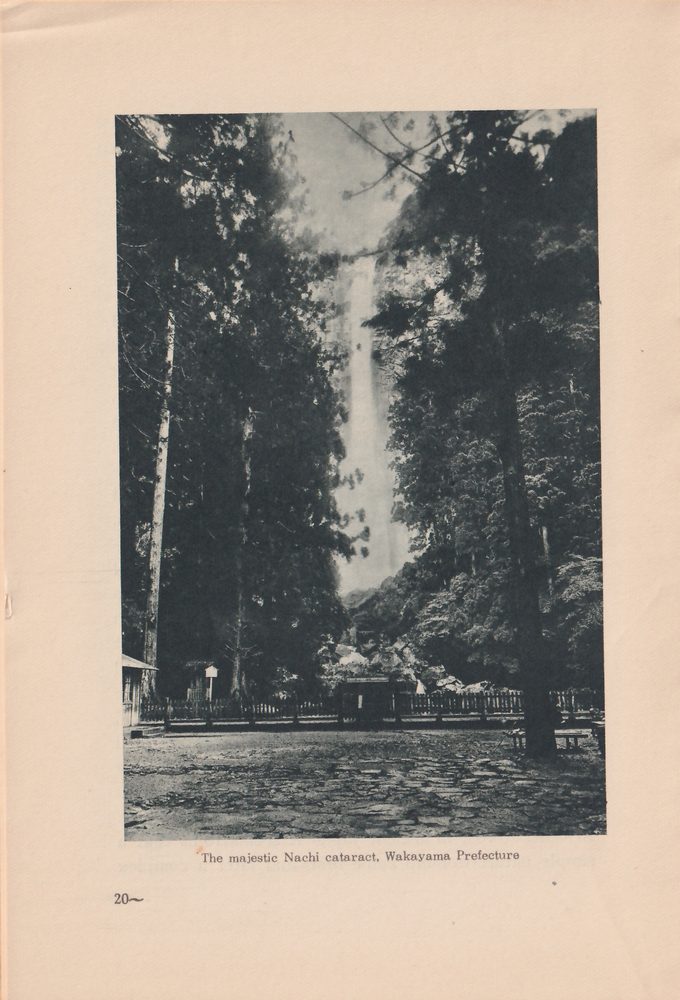
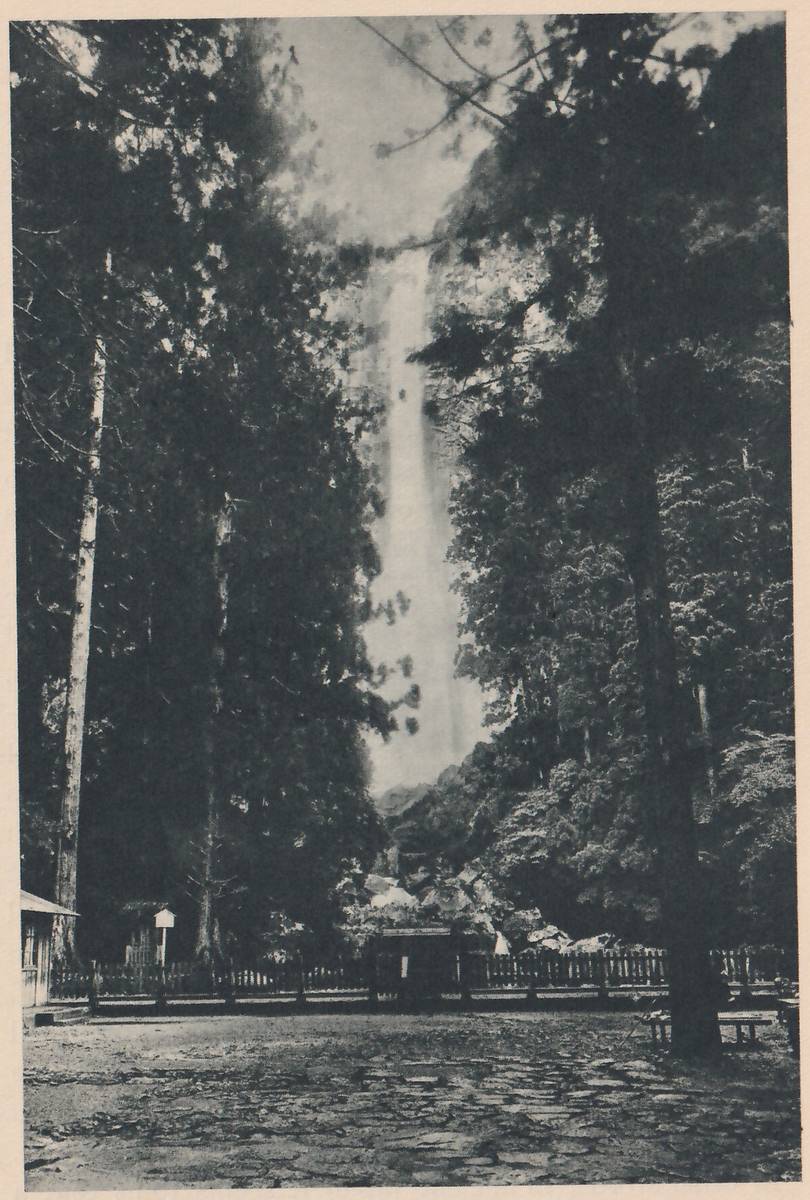
nature-worship ensued. Even now in Kumano, Ki-i Province (Wakayama Prefecture), we can easily trace that simple nature-worship or animatism once existed in the worship of the tremendous awe-inspiring Nachi Cataract itself, visible and semi-tangible, not the invisible water spirit or nymph residing in the waterfalls.
To the religious consciousness of the ancient Japanese, nature was all animated; it was sentient, just as they themselves were. Therefore some of the old Shintō texts tell that trees, herbs, and even rocks are all endowed with the power of speech. Nature-worship, simple or complex, is one of the most remarkable features of Shintō in its first or earliest stage. The ancient Japanese were surrounded on all sides by numberless superhuman, supernatural, divine objects, both organic and inorganic, whom they were accustomed to call the “Eight Hundred Myriads of Gods.” Hence, they perpetually lived in a religious atmosphere of mysticism and ritualism.
Among the inorganic objects deified, we find heavenly phenomena, e. g., the sun and the moon, regarded as chief deities. Thus appeared the Sun-Goddess Amaterasu-Ōmikami, and the Moon-God Tsuki-yomi-no-Mikoto, mythologically considered. Amongst atmospheric phenomena, the rainstorm, wind, thunder and lightning were also deified. Thus, Susa-no-o-no-Mikoto, brother of Amaterasu-Ōmikami, bears an aspect of the deification of the rainstorm, just as his divine sister Amaterasu-Ōmikami has that of the deification of the sun, according to the various passages of the old half-legendary and half-historical documents.
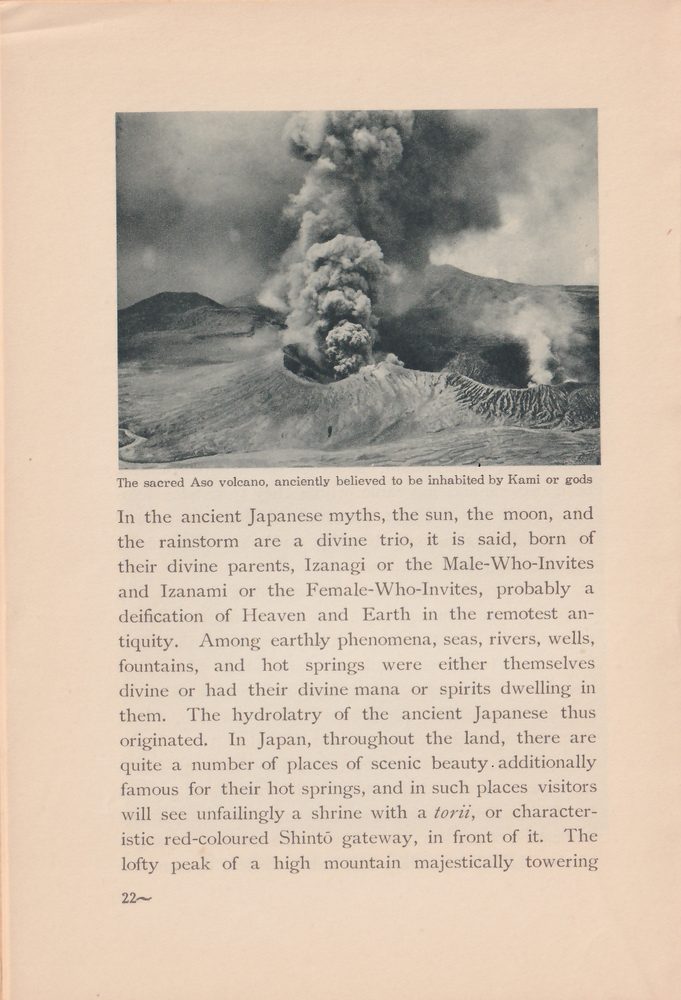
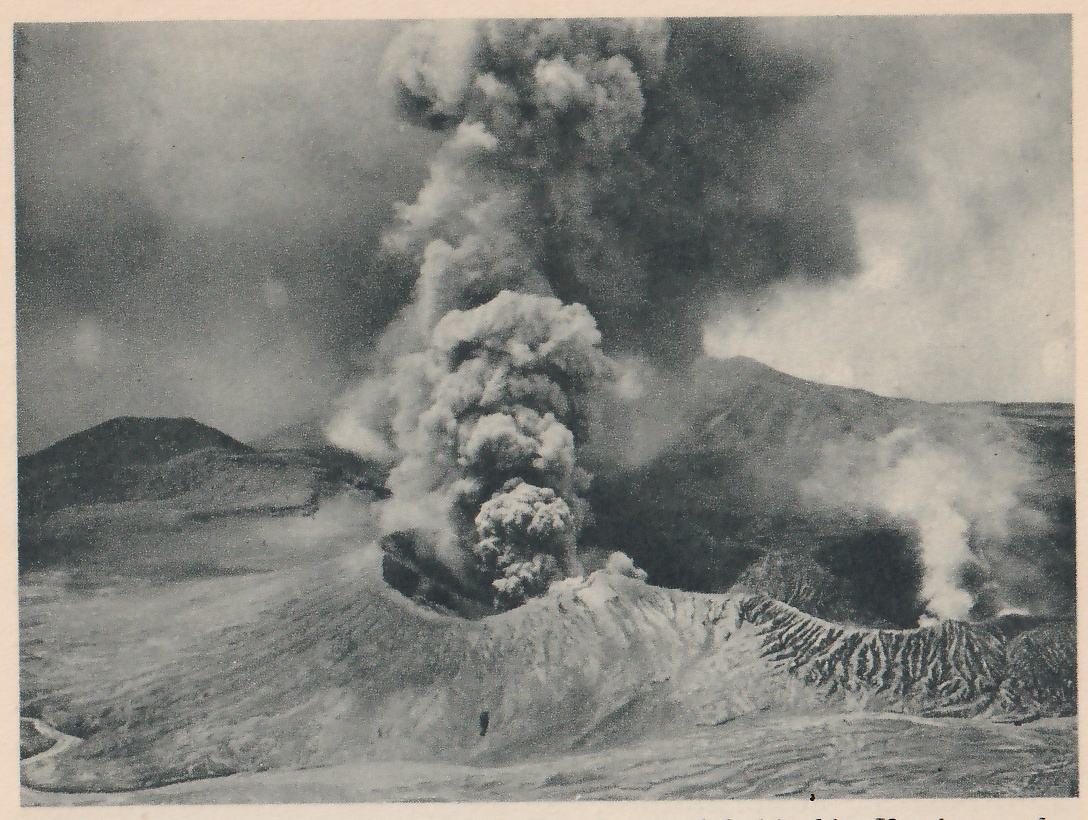
In the ancient Japanese myths, the sun, the moon, and the rainstorm are a divine trio, it is said, born of their divine parents, Izanagi or the Male-Who-Invites and Izanami or the Female-Who-Invites, probably a deification of Heaven and Earth in the remotest antiquity. Among earthly phenomena, seas, rivers, wells, fountains, and hot springs were either themselves divine or had their divine mana or spirits dwelling in them. The hydrolatry of the ancient Japanese thus originated. In Japan, throughout the land, there are quite a number of places of scenic beauty additionally famous for their hot springs, and in such places visitors will see unfailingly a shrine with a torii, or characteristic red-coloured Shintō gateway, in front of it. The lofty peak of a high mountain majestically towering
to the sky; rumbling cone-shaped volcanoes, sending forth destructive angry fire; terrible earthquakes, sure signs of the wrath of the Unseen—all these were, in primitive Shintō, regarded as divine agents. Rocks and stones, very often of phallic form, were revered as deities. Thus, stone-worship or litholatry in general and phallicism in particular stepped into early Shintō.
A great number of organic beings, likewise, were deified in ancient Japan. Serpents, tigers, crocodiles or sharks, wolves, wild boars, hares, crows, etc., were worshipped as deities—exemplifying animal-worship or zoolatry. There was also the worship of trees, grasses, and cereals, exemplifying tree-worship or dendrolatry. Peaches, too, were deified, as being endowed with miraculous virtue particularly in cases of exorcism—an example of nature-worship degrading into fetishism. There were various fetish objects in primitive Shintō. Jewels, mirrors, swords, scarfs, hire, as they were called in archaic Japanese, utensils of husbandry, even scarecrows, were fetish-gods. Anthropolatry or worship of man, as one might expect, was an outstanding feature in Shintō, Emperor-worship and hero-worship being its most prominent characteristics. Emperors, heroes, and certain other personages of high rank, were regarded as deities in life as well as after death, chiefly on account of their extraordinary, i. e., superhuman or supernatural physical prowess. Necrolatry or worship of the dead in general, and ancestor-worship in particular, is considered another aspect of anthropolatry, and appeared in primitive Shintō. And more generally speaking, spiritism, one might say animism,
is quite akin to worship of the dead or necrolatry and ancestor-worship. Animism was a crude philosophy among the ancient Japanese, although, as mentioned above, we can trace a dim existence of animatism, a more primitive form of animism, i. e., pre-animism, in the worship of the Fire-God Kagutsuchi in primitive Shintō, as mentioned by Aston in his “Shintō, the Way of the Gods.” Traces of totemism may possibly be found in primitive Shintō in the worship of the crow, crocodile or shark, though at this point Aston thinks differently. Ame-no-Minakanushi-no-Kami, the divine Lord-of-the-Very-Centre-of-Heaven, is probably an expression of the so-called primitive monotheism in ancient Japan, although some native scholars hold that it is a deity introduced into Japan from China—that it is nothing but a Japanese transformation of the Chinese Supreme God Shangti.
II. SHINTŌ IN ITS BOYHOOD
This is the second stage of Shintō in its development, i. e., Shintō in this stage appears as a Higher Nature Religion, a step further ahead of the Shintō of the lower nature religion stage, which has been briefly surveyed above.
Passing through the most primitive stage of nature religion, in which Shintō may be characterised as polydemonism, a belief in the existence of hazy homogeneous disembodied spirits, Shintō evolves into polytheism in the strict sense of the term. Here not a
daimon but a theos in the Greek sense of the terms has come into existence in the Japanese Pantheon.
A differentiation of gods and goddesses arose. Father and mother, husband and wife, brother and sister, master and servant, all appeared in divine circles, just as is the case with human society. A divine hierarchy came into being. And thus we see the natural growth of the Shintō Pantheon.
The myths in the “Kojiki” (Records of Ancient Matters) and the “Nihongi” (Chronicles of Japan), descriptive of the Age of the Gods, amply illustrate this aspect of Shintō. As with the Greek mythology of Homer, the religion of these Japanese myths represents unmixed polytheism with a divine hierarchy in it. Amaterasu-Ōmikami, the Ancestral Sun-Goddess,
her impetuous divine brother Susano-o-no-Mikoto, the deified rainstorm, and Tsukiyomi-no-Mikoto, the Moon-God, are born of the Divine Parents Izanagi and Izanami, and preside, respectively, over the Plain of High Heaven, the vast expanse of Ocean, and the realm of Night. In the “Kojiki” and the “Nihongi” the conflict between the sun and the rainstorm is mythically and dramatically described down to the final victory of the sun, resulting in the banishment of Susano-o-no-Mikoto, the God of the rainstorm, by the verdict of the divine council held by the “Eight Hundred Myriads of Gods” in the dry bed of the Heavenly-Eight-Sandbank-River (the Milky Way). Just so, in Greek mythology, divine councils were often held on the summit of Mount Olympus, presided over by Zeus, father and king of gods and men, with his divine consort Hera, his son Apollo, his daughter Athene, and many other divine potentates under him.
Afterwards the impetuous Susano-o-no-Mikoto was rude and violent of conduct toward his divine sister Amaterasu-Ōmikami. This violence on the part of the divine brother induced the gentle Ancestral Sun-Goddess to conceal herself in the Heavenly Rock Cave, which resulted in the leaving of heaven and earth in utter darkness. Then the “Eight Hundred Myriads of Gods” were perplexed, and took divine council on the shore of the Heavenly River, the Milky Way, and by elaborate devices they at last succeeded in persuading the Sun-Goddess to leave the Heavenly Rock Cave of concealment and again illumine the universe, while her brother Susano-o-no-Mikoto was
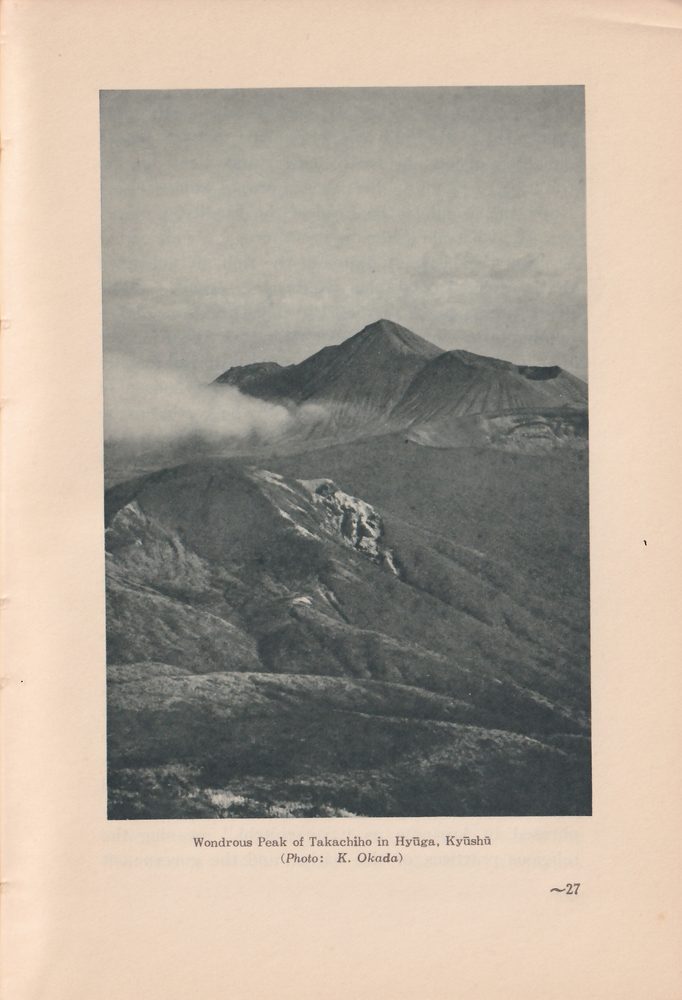
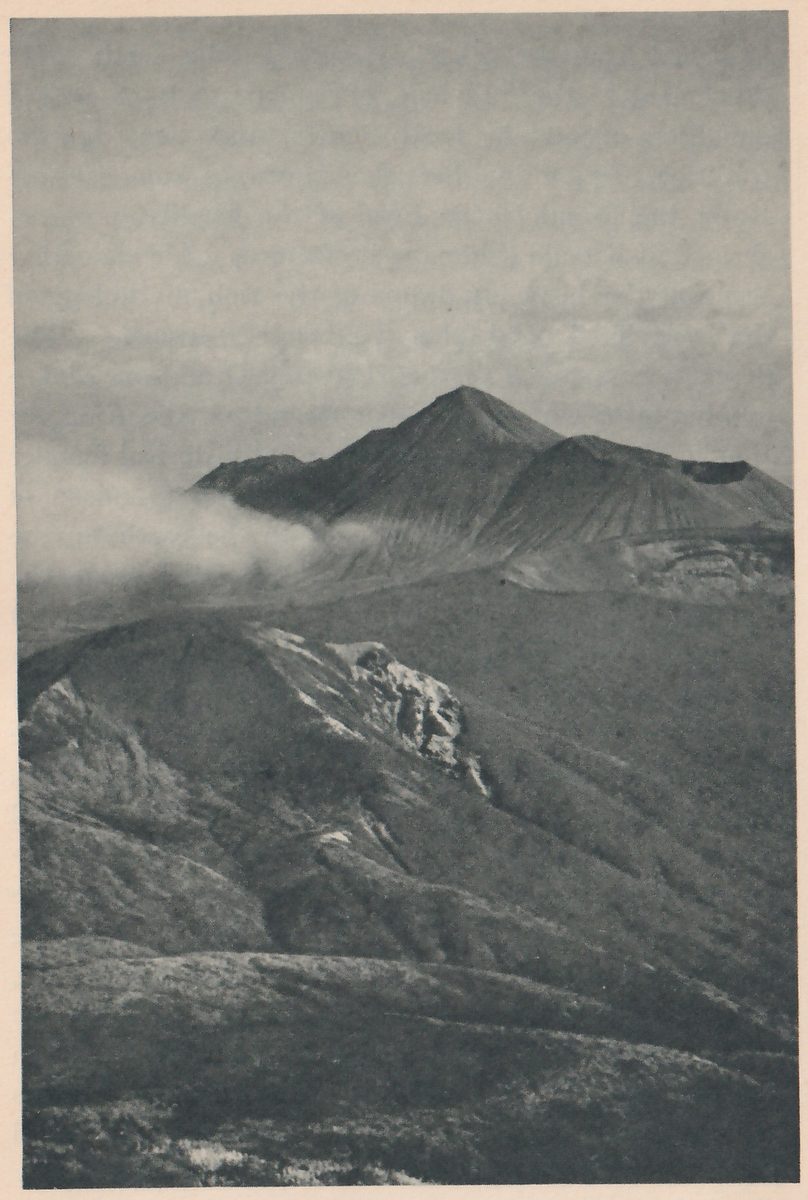
(Photo: K. Okada)
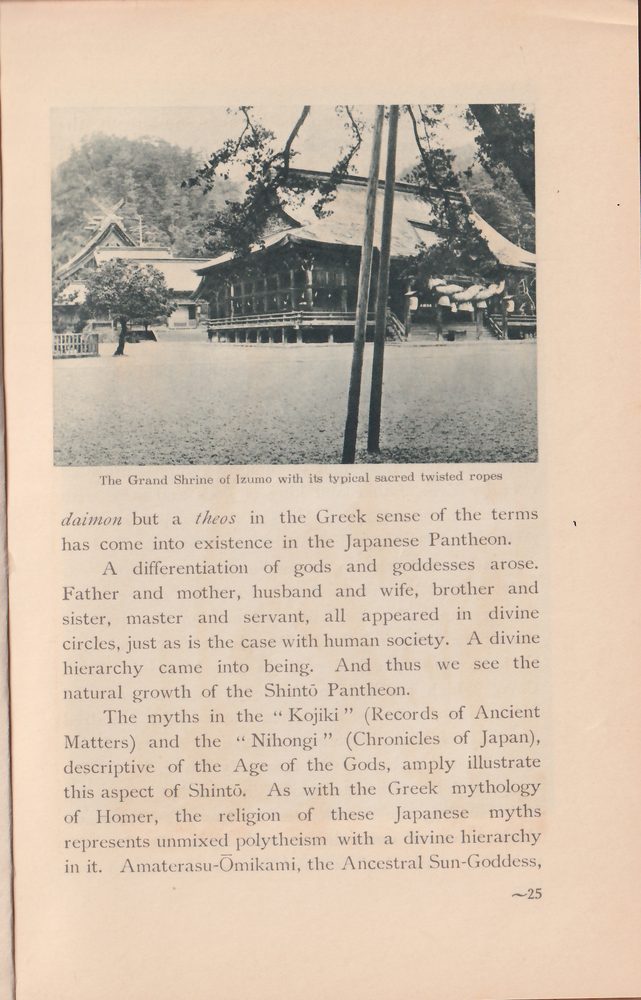
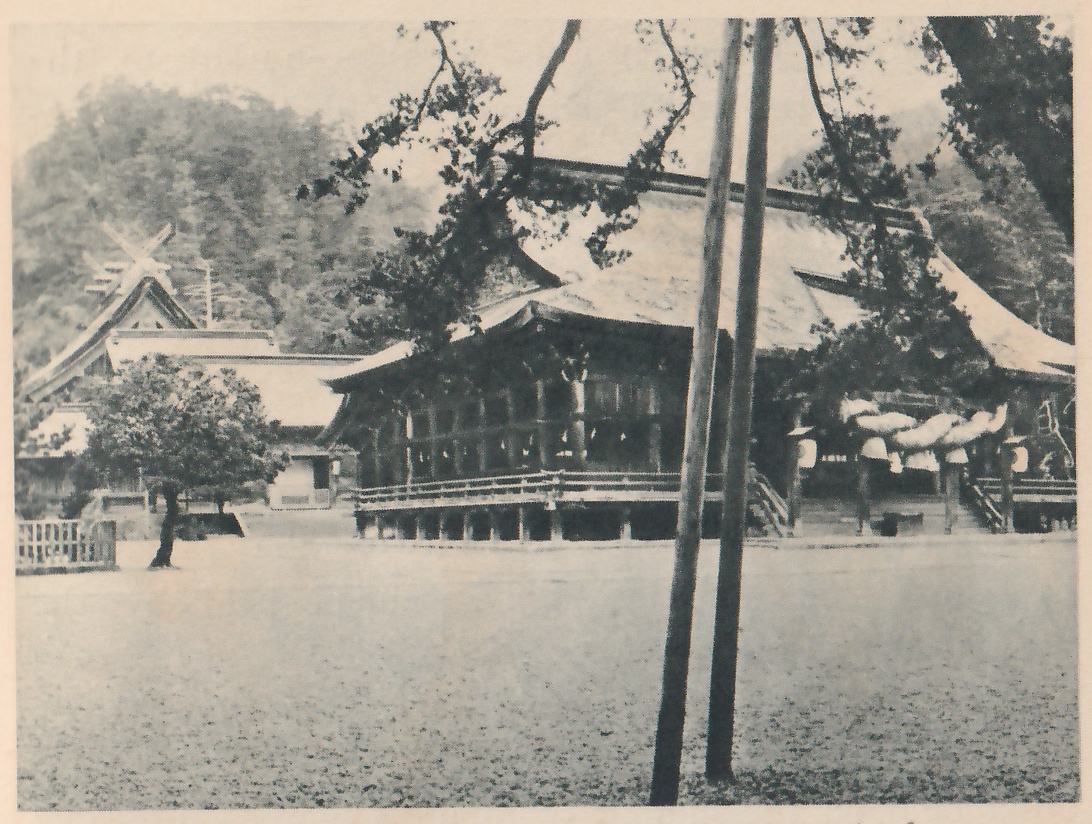
banished from the celestial region to the earth. He descended to the province of Izumo, took to wife a daughter of certain local deities, and, according to tradition, begot by her the famous Ōkuninushi-no-Kami, the Grand Divine Lord of the locality, now enshrined at Kitsuki (Shimane Prefecture). Then another scene of the heavenly drama of the rich mythology of the “Kojiki” and the “Nihongi” ensued. The descent was staged of the Heavenly Grandson Ninigi-no-Mikoto of whom, as Great Grandson, the Emperor Jimmu, the first human Emperor and historical founder of Japan, was born. Ninigi-no-Mikoto, grandson of the Ancestral Sun-Goddess, sent to the earth by the command of the Sun-Goddess, descended from the Plain of High Heaven upon the Wondrous Peak of Takachiho in Hyūga, Kyūshū, and the local guardian God Ōkuninushi-no-Kami of Izumo ceded his whole dominion to the Heavenly Grandson and legitimate sovereign Ninigi-no-Mikoto by a peaceful agreement, thus founding the Empire of Japan. So it is believed that the Japanese Imperial lineage has continued unbroken from the Ancestral Sun-Goddess down to the present Emperor who, like his successive divine predecessors, occupies the Throne by divine right, representing, even at the present day, after the manner of theanthropic belief, divinity in humanity in the hierarchy of his theocratico-patriarchal as well as constitutional government—a complete unity of political governance and religious observances, often technically phrased in Japanese as “Sai-sei-itchi,” meaning the religious practices of the nation and the government
administration indistinguishably and inseparably united and completely identified in one entire whole. Professor Hopkins of Harvard University pithily and characteristically styled the Mikado “The incorporate State as Divinity” (W. Hopkins, “Origin and Evolution of Religion,” p. 252). Thus we see that the National Shintō faith culminates in the form of Emperor-worship and patriotic loyalty to the Emperor—a sense of utmost devotion to the Jinnō or Divine Ruler, which is suffused with religious zeal and enthusiasm. Just herein lies the life and kernel of Shintō.
When the Heavenly Grandson was leaving the celestial region for this Central Land of Luxuriant Reed Plains, as the original name of Japan is rendered, the AncestralPrinted: Anscestral Sun-Goddess Amaterasu-Ōmikami expressed to him her wishes for his future prosperity and for the sacred mission of the Japanese nation in the following words:
“The Luxuriant Land of Reed Plains is a country which our descendants are to inherit. Go, therefore, Our Imperial Grandson, and rule over it! And may our Imperial lineage continue unbroken and prosperous, coeternal with Heaven and Earth!”
This inaugural address of the Ancestral Sun-Goddess must at once remind the Western reader of Jehovah’s (Yahweh) words of promise to his chosen people in sending them to the Land of Canaan (Genesis, XII). Here lies a parallel or similarity between the religious history of the Israelites and that of the Japanese people; and yet it is not difficult to discern the discordance which makes the essentially theocratic
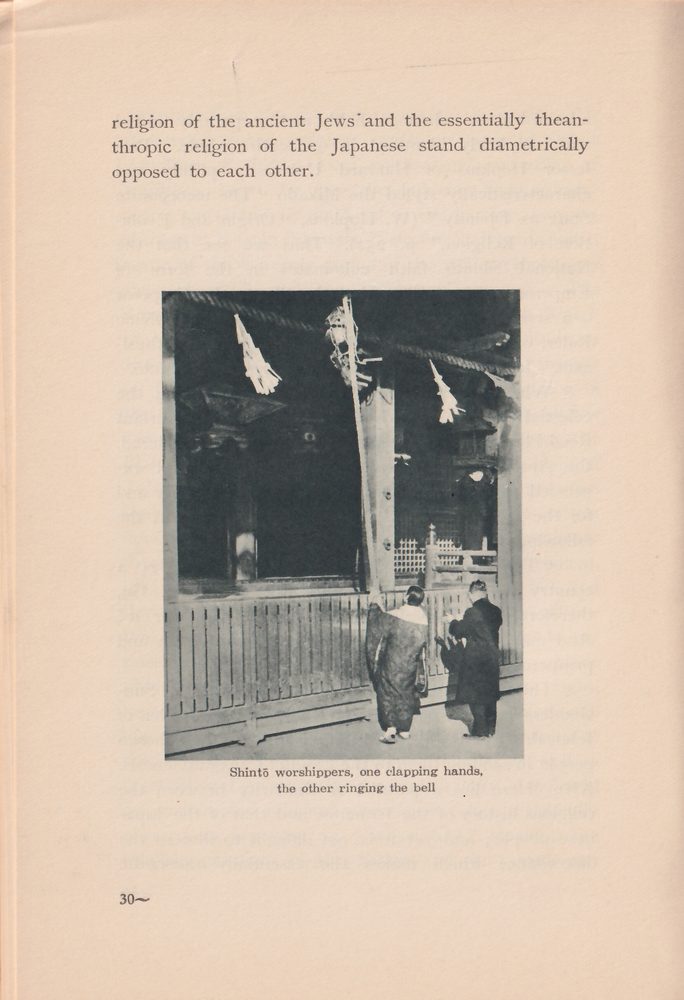
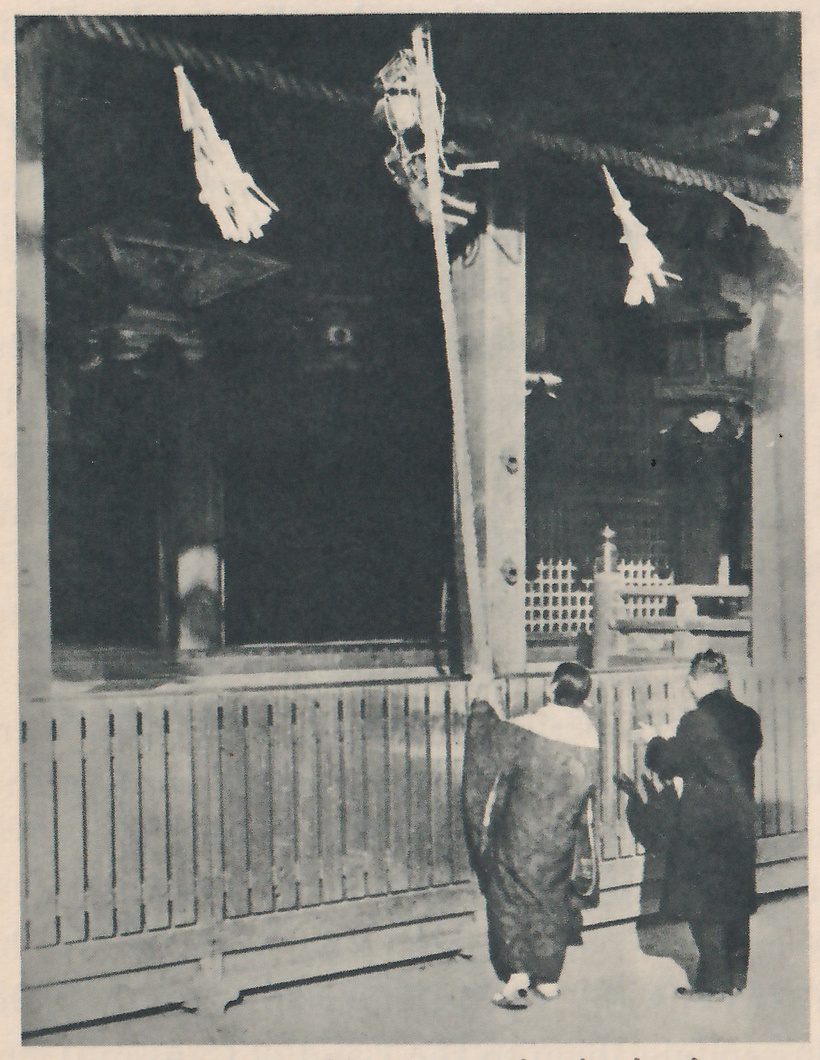
religion of the ancient Jews and the essentially theanthropic religion of the Japanese stand diametrically opposed to each other.