

順道制勝 · jundō seishō · Follow the Way and command victory
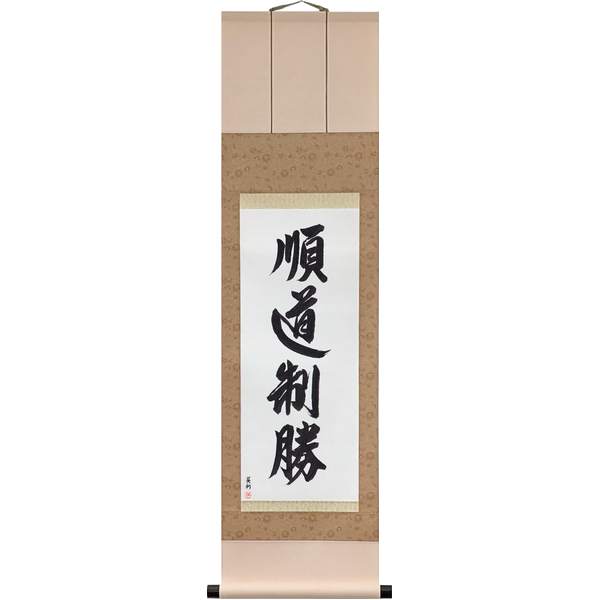
Sold as Jundo Seisho · Read jundō seishō; in Japanese order, 道に順って勝を制す · Oldest witness 嘉納治五郎's own phrase, in print under his name in 1913, a school motto by 1914, in his own words in 1922 · Sense the founding teaching of Kōdōkan judo: victory comes from following the Way, and a loss in accordance with the Way is worth more than a win against it.
The words
Two old words, joined new. 順道 is to follow the Way, 道に順う; the big dictionary has it from an eleventh-century letter-writing manual in the plain sense of the proper route, and its Chinese ground is the Book of Han, where the good emperors 承天順道, received Heaven and followed the Way. 制勝 is to command victory, 勝を制す, the strategists' word: Sunzi says the enemy may know the shape by which I won, but not the shape by which I commanded victory, 莫知吾所以制勝之形, and that an army commands victory according to the enemy as water shapes its course to the ground; the Japanese dictionary first cites it from a 1660 book of wisdom, to fight a hundred times and win a hundred times. Put together the four characters say follow the Way, command victory, and the join is the teaching: the second half is conditional on the first. 嘉納's readers in 1913 heard 順 as スナホ, pliant, straight, and called it judo's first principle: 順は柔道の第一原理である。柔道は順の道である. No Chinese text has the four together; this is a Japanese sentence of the 1890s or 1900s made from a moralist's word and a strategist's.
A history, from the earliest witness
嘉納治五郎, and the first print, 1913. The phrase is the founder's, and the earliest book found says so. 宗像逸郎's Judo (1913): 嘉納師範は身心自在と說かれる。又順道制勝とも說かれる … 道に順ふて勝を制すと云ふは、身體精神共に道に順ふて目的を達するの意味である、勝を制するは單に身體的に對手に勝つの意味のみにあらずして己れに克ち困難に打ち勝つの意味である。順道制勝と云ひ身心自在と云ふは皆柔道の要訣である — Master Kanō teaches body and mind at ease and also 順道制勝; to follow the Way and command victory means to reach one's aim, in body and mind alike, by following the Way; and to command victory is not only to beat an opponent bodily but to conquer oneself and overcome difficulty; these two are the whole secret of judo [3]. The same book, later: 柔道は道に順ひて勝を制する道である, judo is the way of commanding victory by following the Way [scan 116; OCR].
A school motto, 1914. 嘉納 was principal of the Tokyo Higher Normal School from 1893 to 1920, and chose a four-character spirit for each of its clubs. The Nara Prefectural Normal School adopted the whole set in rules effective from 1914, and printed them with the credit 嘉納東京高等師範學校長選句: 强弱時中 進退守地 攻守全局 順道制勝 正氣制先 擇善博覧 習言緝熙 浩氣習文 周約理平 [4]; its 1940 history assigns them, 劍道部 正氣制先, 柔道部 順道制勝, the kendo club upright spirit, seize the initiative, the judo club follow the Way, command victory [13]. A school judo textbook of 1920 makes it the teaching itself: 柔道に於ては、順道制勝を以て敎へとし、苟も、無謀に敵に向ひ、無益に精力を費やし、無理に相手を制せんとすることを戒め — in judo the teaching is 順道制勝, which forbids reckless attack, wasted strength and forcing the opponent [5].
In his own words, 1922. The Kōdōkan's page on the phrase quotes 嘉納 from an article of 1922 in the judo society's magazine: 勝つにしても道に順(したが)って勝ち、負けるにしても道に順(したが)って負けなければならぬ。負けても道に順(したが)って負ければ、道に背いて勝ったより価値があるのである — if you win, win by following the Way; if you lose, lose by following the Way; a loss in accordance with the Way is worth more than a win against it [kdkjudo.org/順道制勝とは/, fetched 2026-09-07, citing 「講道館柔道の文化的精神の発揮」『有効の活動』第8巻第2号, 大正11; the article itself not opened].
On the wall, in his hand. The phrase was 嘉納's favorite thing to brush for a dojo, and three pre-war school histories say where his brushwork hung. A private school in Ibaraki: 又其柔道室扁額『順道制勝』の如きは嘉納治五郞氏來館の時揮灑せられしものなりと云ふ, the judo room's plaque was brushed by Mr Kanō when he visited [6]. The Hiroshima Normal School hung a collotype print of his 順道制勝 among its plaques, commissioned through its old kendo master [9]. The Fifth Higher School in Kumamoto, where 嘉納 was principal from 1891 to 1893, records in its 1939 history that 勝海舟's plaque hangs before the kendo section of the dojo, facing 柔道部の正面にある嘉納校長の「順道制勝」の額面, Principal Kanō's 順道制勝 plaque before the judo section [11]; whether that plaque dates from his principalship or from a later gift the leaf read does not say. A newspaper essay of February 1931 by the writer 長田秀雄 was titled 「順道制勝」の額, the 順道制勝 plaque [8].
The longer form. On some of his calligraphy 嘉納 added four more characters. Kumamoto University's page on the 1965 monument to him reads: 第三代校長嘉納治五郎が揮毫した書の転刻。原本は五高記念館に展示されている。『順道制勝行不害人』(道にしたがえば勝を制し行いて人を害なわず)は自らが創始した講道館柔道の極意を表している — a carving of the calligraphy of the third principal, Kanō Jigorō, whose original is displayed in the Fifth Higher School memorial hall; 順道制勝行不害人, "follow the Way and command victory; in acting, harm no one," expresses the innermost teaching of the Kōdōkan judo he founded [museum.kumamoto-u.ac.jp, fetched 2026-09-07]. John Stevens (2013) calls it a second verse that Kano added on occasion. The eight characters appear in no pre-war print on the national index; the four do, nine times between 1913 and 1940.
The plain Japanese, 1930 to 1939. A youth-association handbook of 1930 explains a throw's set-up as 道に順つて勝を制する所以, the reason one commands victory by following the Way [7]; a 1937 company dojo's creed lists 道に順ひて勝を制するの術を學び among 武道の要諦, the essentials of the martial way [10], and a 1939 judo manual repeats it and adds that 道に順つて勝を制するのが最も立派な勝ち方で … 苟も卑怯未練な手段を弄することを許さぬ, winning by following the Way is the finest way to win; no cowardly or unworthy means are allowed [12]. A Niigata teacher who coached a middle school to national judo titles in the 1930s is remembered for making 嘉納治五郎の訓えである「順道制勝」 his creed, victory through the accumulation of rational training [ja.wikipedia 高橋秀山; text].
Today. Not in the general dictionaries, not in the standard Japanese-English dictionary, and not on the Japanese Wikipedia's pages for 嘉納, the Kōdōkan or judo, though a television drama, いだてん, had 嘉納's character carry it as his motto. A high-school judo club, the 新商高柔道会, titled its 2000 club history 順道制勝. The Kōdōkan keeps it among the Words of Kanō Shihan on its site.
The sense across time
One sense, held steady by its author and his readers for a century: winning is subordinate to the Way, and the Way means the rational, unforced, undamaging use of body and mind. 1913 adds that the victory is over oneself as much as an opponent; 1920 spells out what following the Way forbids; 1922, in 嘉納's words, ranks a loss on the Way above a win off it; the eight-character form adds that the winner harms no one. The catalogue's victory for 制勝 is right; what the page lacks is the condition that makes the phrase a teaching.
What is not a source
Not a Chinese classic, though both halves are classical: 順道 is the Book of Han's, 制勝 is Sunzi's, and the four together are 嘉納's. Not the Kōdōkan's better-known pair 精力善用 · 自他共栄, which are separate maxims of his with their own histories. Not Confucius on judo: Stevens's Confucian concept describes the word 順道, not a source for the phrase.
The text in English
The English is recent and the house already has the two renderings that count. 川村禎三, Kōdōkan New Japanese-English Dictionary of Judo (2000): jundō seisho ("Victory by following the true path") A phrase first mentioned by Jigoro … [archive.org kodokan-new-japanese-english-dictionary-of-judo-etc.; text snippet; the entry not read past its first line]. The Kōdōkan Judo Institute's site: Accordance with the Way Overcomes Winning, the English its Japanese page gives; its English page for the phrase answers 404 at the address the house page links, after a redirect from the older domain [kdkjudo.org, measured 2026-09-07]. John Stevens, The Way of Judo: A Portrait of Jigoro Kano and His Students (Shambhala, 2013): Following the Way Produces Victory, with a survey of the calligraphy on display in dojos across Japan in which 順道制勝 came first, by far the most common, and the note on the second verse [archive.org, in a Shambhala bundle; text snippets; page not derived]. Today: the house title keeps the romaji, Jundo Seisho, and its page credits the Kōdōkan and Stevens by name, which is right; the gloss this history would give is Follow the Way and command victory, keeping 制勝's force, which produces and overcomes soften.
A reading
This is one of the few texts in the catalogue with a named author, and the page should name him. 順道制勝 is 嘉納治五郎's sentence, made from a moralist's word and a strategist's, in print under his name by 1913, chosen by him as the judo club's spirit at the Tokyo Higher Normal School, brushed by him for dojos in Ibaraki, Hiroshima and Kumamoto, and glossed by him in 1922 in the sentence a buyer should read: a loss in accordance with the Way is worth more than a win against it. The scroll is right as brushed; the page should add his name, the Japanese order 道に順って勝を制す, his 1922 sentence, and the eight-character form for what it adds, in acting, harm no one. The one thing to mend is the dead link to the Kōdōkan's English page; the Japanese page is alive and carries the source. Signed, 典, 2026-09-07, s56.
How this was read
As text at the National Diet Library's next-generation digital library, the scan number part of each address and derived from the library's OCR bundle: 宗像逸郎『柔道』1913 (pid 936789, scans 82, 98, 116); 『奈良県師範学校』1916 (pid 909824, scan 87); 松岡辰三郎『学校柔道』1920 (pid 939760, scan 27); 『茨城人名辞書』1930 (pid 1187062, scan 356); 『文芸年鑑』1931 (pid 1077758, scan 52); 広島県師範学校『六十年回顧録』1935 (pid 1035991, scan 298); 『五高五十年史』1939 (pid 1462179, scans 237, 312); 『奈良県師範学校五十年史』1940 (pid 1453118, scan 311). A leaf named as pid P, scan N has its text at lab.ndl.go.jp/dl/api/page/P_N. Three more witnesses (1930, 1937, 1939) are cited from the library's index highlights without a scan number. By the library's full-text index on the phrase, its halves, its Japanese readings, the eight-character form and the sibling mottos, the classical facet read on each. As text at Chinese Wikisource: Sunzi and the Book of Han at the line, and the search for the four characters (none). As text: kotobank's entries for 順道 and 制勝 whole and the dead address for the phrase; JMdict; the national catalogue by title and any field, including the judo society's magazine from 1919; the Japanese Wikipedia's articles on 嘉納, the Kōdōkan, judo, 高橋秀山 and the 2019 drama, and its search; the Kōdōkan's Japanese page and the 404 of its English one; Kumamoto University's monument page. By the Internet Archive's full-text index on the romaji and the three English renderings, Stevens and the 2000 dictionary read as snippets. By eye: the template. Not opened: 嘉納's 1922 article; 『嘉納治五郎大系』; the Fifth Higher School history at the plaque's own page; 長田秀雄's 1931 essay; the 2000 club history; Stevens at the page. The full apparatus, with every address, is in the account.
References
- 孫子 虛實 · 地形 () — zh.wikisource 孫子兵法 (text)
- 漢書 谷永傳 () — zh.wikisource 漢書/卷085 (text)
- 宗像逸郎『柔道』 (1913) — NDL pid 936789 komas 82 · 98 · 116 (OCR) ↩
- 『奈良県師範学校』 (1916) — NDL pid 909824 koma 87 (OCR) ↩
- 松岡辰三郎『学校柔道』 (1920) — NDL pid 939760 koma 27 (OCR) ↩
- 『茨城人名辞書』 (1930 (1932)) — NDL pid 1187062 koma 356; pid 1187086 (OCR) ↩
- 東京市聯合青年団『青年団施設要綱』 (1930) — NDL pid 1130476 (Lab highlight; koma not derived) ↩
- 『文芸年鑑』 (1931) — NDL pid 1077758 koma 52 (OCR) ↩
- 広島県師範学校『六十年回顧録』 (1935) — NDL pid 1035991 koma 298 (OCR) ↩
- 『労務管理資料』 (1937) — NDL pid 1462963 (Lab highlight; koma not derived) ↩
- 『五高五十年史』 (1939) — NDL pid 1462179 komas 237 · 312 (OCR) ↩
- 柔道教育研究会『柔道上達法』 (1939) — NDL pid 1055778 (Lab highlight; koma not derived) ↩
- 『奈良県師範学校五十年史』 (1940) — NDL pid 1453118 koma 311 (OCR) ↩
- 嘉納治五郎, 有効の活動 8(2) (1922) — via https://kdkjudo.org/順道制勝とは/ (text; the article not opened)
- 嘉納治五郎先生の碑, Kumamoto University (1965 (stone)) — https://museum.kumamoto-u.ac.jp/facility_info/kanojigoro_monument/ (text)
- 川村禎三, Kōdōkan New Japanese-English Dictionary of Judo (2000) — archive.org kodokan-new-japanese-english-dictionary-of-judo-etc. (snippet)
- Stevens, The Way of Judo (2013) — archive.org livelikeasamuraibyhumblebundle2026 (snippets); ISBN not read
- kotobank 順道 · 制勝 () — https://kotobank.jp/word/順道 · /制勝 (text)
- ja.wikipedia 高橋秀山 · いだてん () — ja.wikipedia (text)
- Template M1011SSVC3A () — takase-images (by eye)