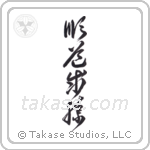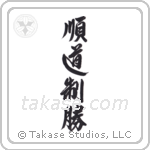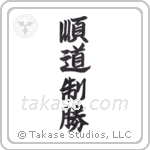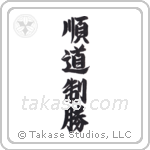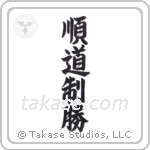

順道制勝, read
jundō seishō: follow the Way, and command victory. It is judo's founding teaching, and the second half depends on the first: the win that counts is reached by the right means, in body and mind alike, and it is a victory over oneself and over difficulty before it is a victory over an opponent. This is one of the few texts in this catalogue with a named author. The phrase is Kanō Jigorō's own, two old words joined new: 順道,
to follow the Way, a moralist's word with its ground in the
Book of Han, and 制勝,
to command victory, the strategist's word from
Sunzi. It appeared in print under his name in the first generation of judo manuals, which called it, with
body and mind at ease, the whole secret of the art; he chose it as the spirit of the judo club at the Tokyo Higher Normal School, where he was principal; and it was the phrase he most liked to brush for a dojo, and his plaques of it hung in Ibaraki, Hiroshima and Kumamoto. His own gloss is the sentence to read: if you win, win by following the Way; if you lose, lose by following the Way; a loss in accordance with the Way is worth more than a win against it. On some of his calligraphy he added four characters, 行不害人,
in acting, harm no one. The Kōdōkan renders the phrase
Accordance with the Way Overcomes Winning; John Stevens, in
The Way of Judo,
Following the Way Produces Victory. In Japanese order it reads 道に順って勝を制す. The Japanese phrase 順道制勝 (commonly written in English as "Jundo Seisho") is a Judo term composed of the
kanji 順 (read jun) meaning "right, order",
道 (read dō) meaning "path, teaching, way" and the word
制勝 (read seishō) meaning "victory".