

Glossary of Japanese Calligraphy Terms
Furigana
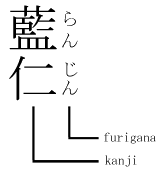
振り仮名 — small phonetic characters, often hiragana, written beside the kanji to give the correct reading. Furigana is used for difficult to read words or names, and in children's books furigana is used to teach the child to learn kanji. When the text is written vertically, the furigana is written to the right. When writing horizontally, the furigana is above the kanji.
Gairaigo
外来語 — a Japanese word of foreign origin. Most are written in katakana today.
Gyōsho
行書 (Semi-cursive Scripts) — a range of semi-cursive scripts that can go from almost block to almost cursive. Gyōsho is kaisho written faster and softer, the strokes running into one another, but not as abbreviated as the often difficult to read sōsho. It began as a faster way to write, and it is both a practical hand and an artistic one: one still sees older Japanese using it in everyday writing as a convenient form of shorthand, and it is one of the principal scripts of Japanese calligraphy.
Hentaigana
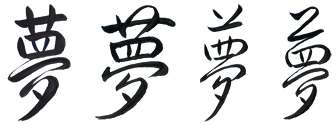
変体仮名 — hiragana in forms other than the standard ones. For most of their history each syllable could be written in several ways, from different source kanji or with the kanji simplified to different degrees. In 1900 the regulations of the Elementary School Order fixed one form for each sound, the hiragana taught today; the others are hentaigana. They are still used in calligraphy and in a few special displays.
Hiragana
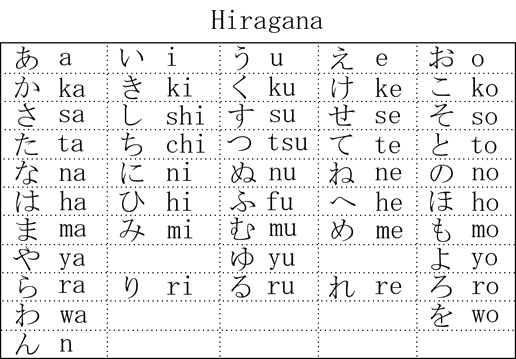
平仮名 — one of the two modern Japanese syllabaries, made by simplifying further the cursive forms of kanji used for their sound. It took shape in the early Heian period, first among courtiers and scholar-monks and then among women, who wrote their poems and letters in it, so that it was called 女手 onnade, "the women's hand." Its forms were fixed to one per sound in 1900. Today hiragana is used with kanji to write most of the Japanese language.
Jiun
自運 — writing from one's own invention, the calligrapher's opposite of rinsho (臨書), copying a model. On our scroll and design pages, this hand is called Eri's Choice: designs Master Takase creates in a hand of her own, drawing freely on the classic scripts.
Kaisho
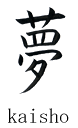
楷書 (Block Scripts) — an angular form of writing Chinese characters. Today, kaisho scripts are the most commonly used and most recognized.
Kana
仮名 — refers to both katakana and hiragana. Kana may also refer to the older man'yōgana (kanji used for their sound) and to hentaigana.
Kanji
漢字 — the characters of Chinese writing, used to write Japanese, many of them changed in form or use in Japan. A few began as pictures of things; most combine an element that gives the meaning with an element that gives the sound. Japan knew them by the first century, from Chinese coins; the oldest writing that survives on Japanese soil is fifth-century inscriptions on swords, and writing seems to have come largely by way of Korea. The chronicles tell that the scholar Wani of Paekche brought the Analects and the Thousand Character Classic. Over the centuries since, kanji have been adapted to the very different Japanese language.
The main styles of kanji writing are:
- Tensho 篆書 (Seal Scripts) are used for the name seals that Japanese use instead of a signature (these are the red stamps that appear on Japanese calligraphy).
- Kaisho 楷書 (Block Scripts) are the most typical form of the kanji and the form used in everyday life.
- Reisho 隷書 (Clerical Scripts) are a simplification of seal script dominated by horizontal and vertical lines. Today this style is used for newspaper mastheads and signboards, and in stone carving.
- Gyōsho 行書 (Semi-cursive Scripts) are kaisho written faster and softer, both a practical hand and one of the principal scripts of Japanese calligraphy. The gyōsho style can be read, for the most part, by all Japanese.
- Sōsho 草書 (Cursive Scripts) are the most abbreviated and, in my opinion, the most aesthetically pleasing. The 草 of sōsho is the 草 of 草稿, a rough draft: the script began in China as a quick way to write drafts. It is often translated "grass script," and its long, near-vertical strokes can indeed look like grass, but the word means draft writing. While very beautiful, this style is very difficult to read even for specialists.
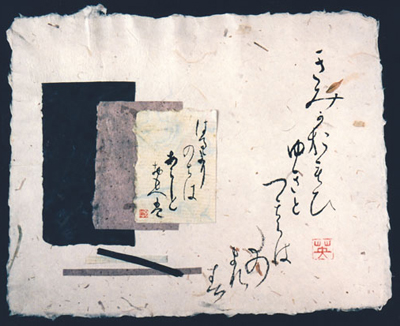
All of the above styles for kanji also appear in Chinese calligraphy. What distinguishes Japanese Calligraphy from Chinese Calligraphy is the use of kana, above all hiragana. Often it is the use of hiragana that makes Japanese Calligraphy unique and special and gives Japanese Calligraphy an artistic dimension not found in its Chinese counterpart.
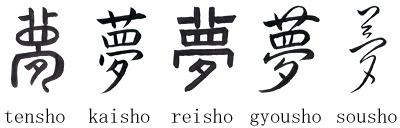
Note that each of the five scripts (tensho, kaisho, reisho, gyōsho, and sōsho) is a family of hands, not a single one. There is not one tensho, but many. The same is true for all the scripts. It is this range that makes Japanese Calligraphy both artistically appealing and intellectually challenging.
Kasure
掠れ — a type of stroke where it looks like the brush is running out of ink. In this stroke, there is much movement and one can see the subtle colors that are in the ink.
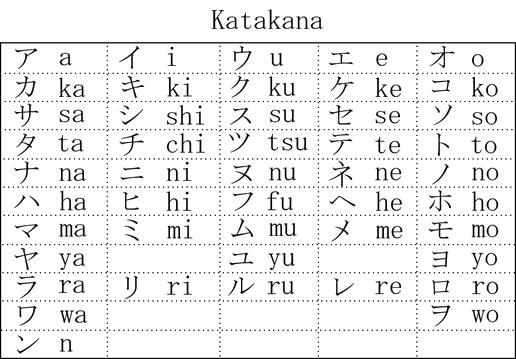
Katakana
片仮名 — one of the two modern Japanese syllabaries. Each symbol represents a syllable (not a letter) and the symbols have no meaning — they simply represent a sound.
Each katakana character is a part of a kanji character; 片, "partial," in the name says so. Katakana grew up in the early Heian period, in the ninth century, among the scholar-monks of the Nara temples, who wrote shortened kanji beside Buddhist scriptures and other Chinese texts as reading marks. Its invention was once credited to Kibi no Makibi (695–775), a Nara-period scholar and statesman who studied in Tang China; that attribution is no longer believed. Its forms were fixed to one per sound in 1900. Today katakana is used mainly to write foreign words and names, including non-Japanese names, and also for sound words and technical terms.
Kun'yomi
訓読み (Japanese Reading) — reading a kanji with the native Japanese word for its meaning. When Chinese characters were adopted to write Japanese, a character could be read with its Chinese sound (the on'yomi) or with the Japanese word that meant the same thing (the kun'yomi).
One common example is the kanji 山 which has the kun'yomi yama and the on'yomi san. So we hear Mt. Fuji called fujisan, the usual reading, and fujiyama, which the dictionaries also give; both are readings of 富士山.
Another example is the kanji 姉 which is read ane meaning "older sister". Ane is the kun'yomi. In contrast, the word sisters 姉妹 is read shimai. Here 姉 is read shi which is an on'yomi or Chinese reading of the character.
Because each kanji can have several different readings, this makes learning to read Japanese difficult.
On'yomi
音読み (Chinese Reading) — when Chinese characters were adopted to write Japanese sometimes the original Chinese pronunciation was used. As this adoption happened over hundreds of years and from different parts of China, a single kanji can have several different on'yomi depending on when and from where in China the word came from. In contrast, kun'yomi are words that retain the original Japanese word.
Reisho
隷書 (Clerical Scripts) — a simplification of the tensho script dominated by horizontal and vertical lines. It arose in the late Warring States period, grew through the Qin and the early Han, and was the official script of the Han Dynasty (206 BC – AD 220). The overall shape is wider than tall, with a height to width ratio of about two to three. Today this style is used for newspaper mastheads and signboards, and in stone carving.
Rice Paper
Rice paper is not made from rice, and it is not even, strictly speaking, paper. It is the pith of the rice-paper plant (Tetrapanax papyrifer, once classed as Fatsia papyrifera), pressed and shaved into thin sheets, and in China it was used as a paper for painting and writing and for making artificial flowers. The papers calligraphers brush on are something else. Japanese calligraphy uses washi (Japanese paper) and gasenshi (画仙紙), the Japanese name for the Chinese calligraphy paper, whether imported from China or made in Japan; some Japanese gasenshi does contain rice straw.
Romaji
ローマ字 — a system of writing Japanese in Roman letters. Romaji means "Roman characters": ローマ rōma is Rome and 字 ji is characters. The word itself has a long o, rōmaji; on this website we write it romaji, the form English readers know.
There are two systems in common use, kunrei-shiki and Hepburn. Kunrei-shiki writes Fuji as huzi; Hepburn writes it as fuji, the spelling English speakers recognize. This website uses Modified Hepburn. A macron marks a long vowel: kyō, ōkami, bashō. A long i written with い stays ii: 美しい utsukushii.
In a Japanese word, づ and ぢ sound the same as ず and じ, and we write them as Hepburn does, zu and ji: 千羽鶴 senbazuru, 三日月 mikazuki. The particles は, へ and を are written as they sound: wa, e and o.
Names are a gray area in romaji. A name written with づ or ぢ appears as zu, dzu or du, depending on the romanization system and on the family's own spelling. For names we write dzu and dzi, the choice we find the more consistent: the romaji of a name then always shows which kana it is written in.
Romaji has no capital letters. Hiragana, katakana and kanji have no capitals, so romaji has none either, not at the start of a sentence and not in a name: bashō no haiku. A Japanese name inside an English sentence is an English word and follows English capitalization: Bashō wrote the poem. The test is which language the sentence is in.
Shihan
師範 (Master) — the world of Japanese Calligraphy has ranks much like the Martial Arts. The first rank is the tenth kyu with the highest kyu rank being the first kyu. The next highest rank is shodan which is the Martial Arts equivalent of a first degree black belt. Unlike most Martial Arts ranking systems, the title of shihan can only be awarded after reaching and passing the 10th dan which is the highest dan ranking.
In the world of Japanese calligraphy, the rank of shihan is a rare and prestigious rank. Among the privileges of this rank is the right to open one's own school and teach one's own style of calligraphy. Throughout this website, one can see examples of Master Takase's unique style.
Shikishi
色紙 — Japanese paper mounted on a thick board with a gold border. Shikishi come in many different sizes. The standard size is 9 1/2" W x 10 3/4" H. Shikishi are about 1/8" thick. Another common size is the mini-shikishi which is 4" W x 5 7/8" H.
Shodō
書道 — Japanese Calligraphy; in Modified Hepburn, shodō. Literally the kanji mean "the way of writing".
Sōsho
草書 (Cursive Scripts) — the most abbreviated and flowing of the scripts, and to many the most aesthetically pleasing. The 草 in its name is the 草 of 草稿, a rough draft: cursive grew up in China in the Qin and early Han as a quick everyday way to write drafts, alongside clerical script, and not, as is often supposed, as a later loosening of gyōsho. The name is often translated "grass script," and its near-vertical strokes can look very much like grass, but the word means draft writing.
Syllabary
A set of characters where each character represents a syllable (as opposed to a single letter). Japanese is not written with letters as is English. Rather Japanese is a language of syllables and so hiragana and katakana characters each represent a syllable.
Tanzaku
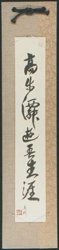
短冊 — Japanese paper mounted on thick board with a gold border. Tanzaku come in two standard sizes: 2 3/8" W x 14 1/4" H and 3" x 14 1/4".
Tensho
篆書 (Seal Scripts) — the name for the ancient scripts of Chinese writing that came before clerical script. The lesser seal (小篆), the form usually meant, was standardized under the Qin Dynasty (221 BC – 206 BC); the greater seal (大篆) is older, and older still are the oracle-bone inscriptions of about 1400–1150 BC, the oldest known Chinese characters. The tensho script uses a single stroke width, is taller than wide, with a height to width ratio of about three to two, and has a feeling of still, expressionless refinement. Today tensho script is used for seals that the Chinese and Japanese use instead of a signature (these are the red stamps that appear on Chinese and Japanese art and in everything from legal forms to routine business documents).
Washi
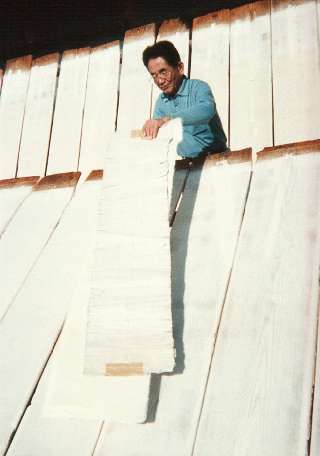
和紙 (Japanese paper) — made from the bark fibers of the Japanese 楮 kōzo, 三椏 mitsumata, and 雁皮 ganpi plants. It is a common misunderstanding that Japanese calligraphy is done on rice paper (see Rice Paper). Japanese calligraphy is done on washi and on gasenshi, the Japanese form of the Chinese calligraphy paper.
See these terms brought to life in Master Takase's hand-brushed calligraphy designs: words and phrases in multiple calligraphic styles.