

人生良好 · jinsei ryōkō · life, in good condition
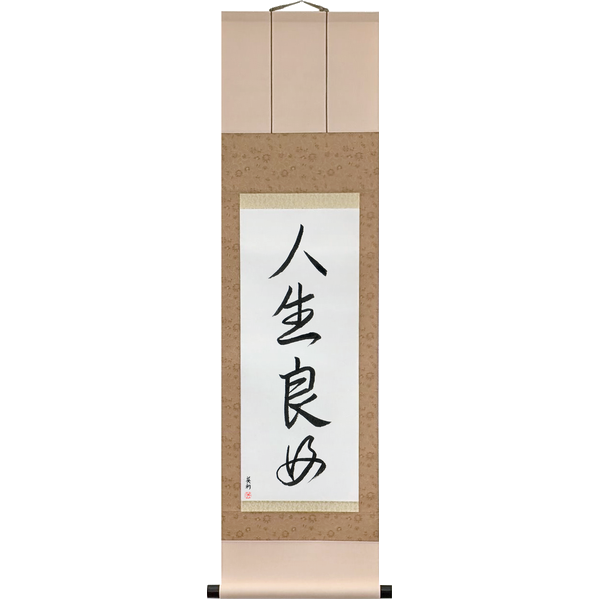
Sold as Life is Good · Read jinsei ryōkō · What it is house Japanese for an English sentence: 人生 life and 良好 good, in good condition, four characters with no witness in any Japanese book, dictionary or text outside this house · Oldest witness the house's own design, on its site by January 2011; for the parts, 人生 in a poem of 892 and 良好 in a travel book of 1833 · In the dictionaries neither Japanese nor bilingual · Not Chinese · Signed 典, 2026-09-07.
The words
人生 jinsei is a person's life in this world and the span of it, Chinese in the 史記, Japanese in a poem of 892 and in Kaibara Ekiken's 養生訓 of 1713, where caring for the body is 人生第一の大事, life's first business. 良好 ryōkō means good in the sense of in good condition. The 日本国語大辞典 first finds it in 1833, in the Japanese translation of a Dutch account of Nagasaki, where the climate, for damp and heat, is 最も良好和平ならざるなり, not at all good and mild; that manuscript leaf was read. Its next citation is Sōseki in 1906, 成績は良好だ, the results are good, and that is the word's home: the dictionaries illustrate it with reception, grades and a patient's progress, and the Diet Library's corpus has 成績良好 in more than ten thousand books, 経過良好 in over a thousand, 感度良好 from a 1920 wireless manual. In Chinese it is the same kind of word; Li Shizhen's materia medica uses it of a drug that improves with age. 良好 is what a grader writes, not what a poet says.
A history, from the earliest witness
There is none to write for the compound. 人生良好 appears in no book of the Diet Library's public-domain corpus, nor do 良好な人生 or 人生は良好; Chinese and Japanese Wikisource have it nowhere; no dictionary, Japanese or bilingual, lists it. It is this house's rendering of Life is Good, and the earliest record of it is the house's own: the design image was captured on takase.com on 8 January 2011.
What Japanese writers said when they meant the same thing the corpus does show. 人生は美しい, life is beautiful, is in thirty-six books from 1913 onward, and nearly all of them are translations or their echo: Kuprin's Duel in 1913 (Yes, life is beautiful), Dostoevsky's elder Zosima, Beethoven's letter (life is beautiful, but for me it is forever poisoned), Tolstoy's Family Happiness, Gorky, and then Nagai Kafū and Nagayo Yoshirō writing it for themselves. 人生は楽し, life is a joy, is in print from 1922; 人生は善い from 1906; 好い人生 from 1886. The subtitle phrase 人生は素晴らしい, which is what Weblio's film corpus gives for life is good, has no prewar book at all.
What is not a source
Not a proverb, not a classical phrase, not a dictionary word. Not Chinese. The 萬葉集 and the 史記 both appear in the index for 良好, and both are false: the one is 山上憶良 followed by 好去好来, the other 温良 followed by 好樂, the two characters meeting across a boundary.
The text in English
The English is ordinary and old. Wordsworth in 1815 has when evil men are strong no life is good; Swinburne, Ella Wheeler Wilcox, Edwin Arlington Robinson and William Carlos Williams (Come! Life is good—enjoy it!) all have it, as do Origen and Anselm in translation. Its frequency in English books is flat across two centuries and doubles after 2000, and the capitalized form appears only then: the Life is Good Company, a Boston apparel maker founded in 1994, registered Life is good. as its trademark and put it on a stick figure's T-shirt. Most people who ask for Life is Good in Japanese today are asking for that sentence in that spirit.
A reading
The page calls this a Japanese saying, and it is not; it should say the Japanese phrase, or better, say plainly that it is the house's rendering of the English. The rendering has a character worth naming for the buyer: because 良好 is the word of the report card and the ward chart, 人生良好 reads to a Japanese eye as a status line, Life: condition good, nearer to all systems go than to a contented sigh. That may be exactly the wit wanted, and a T-shirt slogan wears it well; no one will misread it. A buyer who wants what a Japanese writer would write has 人生は美しい, a century of translated joy, or 人生は楽し. Romaji as two words, jinsei ryōkō.
How this was read
By eye: the template; the 1833 manuscript leaf of 日本風俗備考. By text at the address: the Diet Library's full-text index on the phrase and its variants, on eighteen neighboring phrases by count, and the classical facet of 良好 read to its oldest real witness past two false ones; kotobank whole for 人生 and 良好; Weblio and jisho; Chinese, Japanese and English Wikisource; the Google Books ngram on five English phrases; Wikipedia on the brand; the Wayback index for the house's own pages; the store files, three routes. Not read: the 良い人生 hits at the page; Sōseki at the leaf; the brand beyond Wikipedia; the OED; the house's own record of when the scroll was brushed. Every address is in the account.
References
Each witness is cited in the account above, at the frame or entry where it was read. A linked list follows when the record for this text is completed.