

平常心 · heijōshin · The ordinary mind
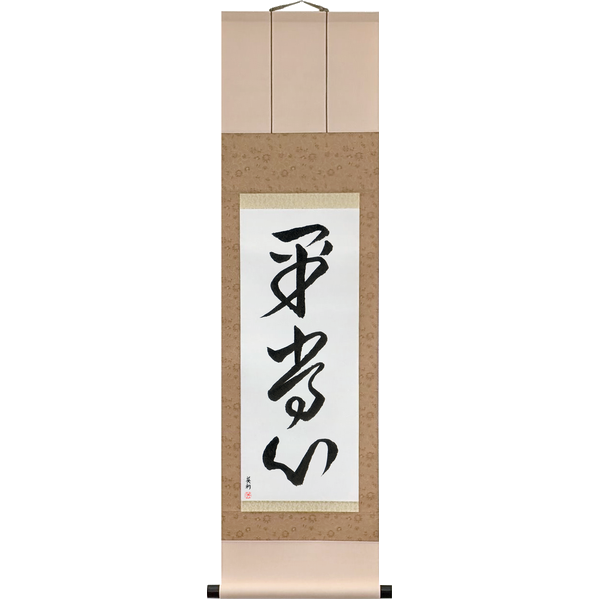
Sold as Presence of Mind · Read heijōshin in the martial arts and in modern Japanese; byōjōshin in Zen · Oldest witness the Tang master 馬祖道一 (709–788), as recorded in 1004: the ordinary mind is the Way; in Japan, 道元 in the 1230s · Sense in Zen, the mind without contrivance, which is the Way already; in the sword and in modern Japanese, the mind that stays as it always is, calm under pressure.
The words
平常 is as always, ordinary, the word for a pulse returning to normal and trains running to schedule, in Japanese since a poem of 818. 心 is mind, heart. So the three characters say the ordinary mind, and the whole history of this word is the question of which ordinary. The Zen answer is 馬祖's own definition: the ordinary mind is without contrivance, without right and wrong, without taking and rejecting, without the views of annihilation and permanence, without profane and holy, and walking, standing, sitting, lying down, meeting whatever comes, all of it is the Way. The modern answer is the dictionaries': the calm, ordinary mind, nothing special about it; the mind that does not waver; the composure one keeps or loses, 平常心を失う. When a monk asked 趙州 what the ordinary mind was, he answered foxes, wolves and jackals, and the modern word would not survive that answer, which is the distance between the two. The house's Presence of Mind is the standard Japanese-English dictionary's gloss of the modern word, and right for it; the ordinary mind is what the characters say and what the Zen books have written since 1947. The Rinzai monastery keeps the phrase in its own curriculum: Hori's Zen Sand (2003) lists 平常心是道 as capping phrase 5.331, read Byōjōshin kore dō, at no. 114 of Shibayama's 禅林句集 and absent from Tsuchiya's 禅語集, so the Zen reading byōjōshin is the one a monk answers a koan with, and heijōshin the one the dojo says.
A history, from the earliest witness
The Tang, and the koan. 馬祖道一, founder of the line from which most of later Zen descends, is recorded in the great lamp history of 1004 as teaching: The Way needs no cultivation; only do not defile it. What is defiling? Any mind of birth and death, any contriving, any aiming. If you would grasp the Way directly, the ordinary mind is the Way, and then the definition quoted above. His heir 南泉 gave the same four characters as his answer when the young 趙州 asked what the Way was; 趙州 pressed, can one aim at it?, and was told to aim at it is to miss it; pressed again, and was told the Way belongs neither to knowing nor to not-knowing; knowing is false perception, not-knowing is blankness, and if you truly reach the Way that is not aimed at, it is like vast space, open and empty; and on those words he awoke, in his teens by the tradition's count. 南泉 in his own sermons already speaks of every patriarch down to the master of Jiangxi teaching the two sayings this mind is Buddha and the ordinary mind is the Way. In 1228 無門 made the exchange the nineteenth case of his Gateless Barrier, with the verse that has carried it since: spring has its hundred flowers, autumn its moon, summer its cool wind, winter its snow; if nothing useless hangs on the mind, that is a good season in the human world. The two oldest records disagree in small words, to aim against to doubt, and both wordings came to Japan.
Japan, from 道元. 道元 uses the word in the 1230s, in the Body-and-Mind Study of the Way fascicle that the big dictionary cites first, and elsewhere in the Shōbōgenzō as the old Buddha mind, the mind of the three realms, the undefiled; his successor 懐奘 quotes the whole koan in 1278 in the older wording; 中巌円月 raises it in his recorded sayings in the fourteenth century; and 瑩山, the second founder of the Sōtō line, is said by all his Meiji biographers to have awakened on the phrase at his teacher's lecture on the twentieth day of the tenth month of 1294, so that it became the family style of the 総持寺 tradition. The printed Gateless Barrier of 1666 carries the case with reading marks, and the Edo Zen records print it many times.
The sword, 1632 and 1645. 柳生宗矩, the shogun's fencing master, quotes the koan in his Family Book of the Art of War: a monk asked an old worthy, What is the Way? The old worthy answered, The ordinary mind is the Way; and then turns it into plain Japanese, 常の心, the ordinary mind, and applies it: the archer must forget he is shooting and shoot with the mind of a moment when nothing is being done; so the swordsman, the rider, the writer, the koto player; when you do everything with the ordinary mind, having stopped everything and doing nothing, everything goes without difficulty. Musashi's Book of Five Rings says the same without the koan: in the way of strategy, let the bearing of your mind be no different from the ordinary mind; in daily life and in combat alike, keep the mind broad and straight. 沢庵, the Zen master who wrote to 宗矩 on the sword, uses 平常心 once, in a reflection on sitting. The sword's word in the seventeenth century, then, is つねの心 in Japanese, with the koan named as its source.
The modern word, 1891 on. The novelist 幸田露伴 writes 平常心 with the reading heijōshin in 1891, of a man's mind clearing like mist; that is the dictionaries' first citation for the everyday sense, and the 1892 printing shows the reading in small type. By 1915 to lose one's ordinary mind is an idiom; in 1920 a Zen lecturer explaining the koan glosses the word itself as the mind that does not waver under passion and delusion, the calm mind, the modern sense read back into the source; in 1923 the first kendo book found with the word praises Musashi as composed, never losing his ordinary mind, treating a real fight as if it were a game; in 1941 the teacher-training ethics textbook tells its readers to hold the so-called ordinary mind; a 1932 newspaper headline uses it of villagers unshaken by famine. After the war it is everyone's: a film titled with it in 1973, whose English title was Peace of Mind, and the self-help books from 1974.
Today. Two readings for one word, and the dictionaries keep both: byōjōshin, Buddhist, the ordinary everyday mind, the ordinary way of living, cited from 道元 and the Gateless Barrier; heijōshin, the calm ordinary mind with nothing special about it, cited from 露伴. A 1920 book records a third, heizeishin, as the Zen habit of its day. The kendo and karate books in Japanese use the word as the catalogue does, for the mind that stays as it is under attack.
The sense across time
One word, two registers, and the sword in between. 馬祖's ordinary mind is not calm as against agitation; it is the mind before any such pair, which needs no cultivation and is the Way already. 南泉's answer is a refusal to let 趙州 aim at it. 宗矩 takes exactly that and makes it practical: the mind of a moment when nothing is being done is the mind to shoot with, and the koan is his warrant. From 露伴 the same three characters name something narrower and more useful, composure, the mind one keeps or loses, and kendo made that its term. The catalogue's one's mind must remain calm and tranquil when under attack is the modern and martial sense and is true to the sword's own reading of the koan; the Zen sense underneath it is what makes it more than advice.
The English commentators, read whole rather than as search snippets on 2026-09-10, hold three readings of the koan side by side, and they are not the same reading. Shibayama (1974, p. 147) takes it as a paradox to be broken through: Literally it means, "Everyday mind as it is without any discrimination is Tao"… we have to transcend our ordinary mind to attain the true ordinary mind. Sekida (1977, case 19) takes it as samadhi: Children are in samadhi in their play, work, and daily routine… innocence is ordinary mind. Aitken (1991, case 19) glosses the word itself: The Chinese compound I translate as "ordinary" also means "usual" or "normal." The etymology is "constant" or "eternal." The everyday is the eternal, and he sets it beside 雲門's 日日是好日, every day is a good day, which this catalogue also sells. The reading signed below stands nearest Shibayama's; Aitken's constant is the bridge to the dojo's word, since composure is the mind that stays constant under attack.
What is not a source
No Chinese classic outside the Zen records; the word's home is the lamp histories and the koan collections. Not Musashi, whose word is 常の心, and not 沢庵, who uses it once in passing; the sword's named source is 宗矩. Not kendo's invention: the modern sense is a novelist's of 1891, and kendo's use of it is on record from 1923.
The text in English
The koan came first. Fung Yu-lan's history of Chinese philosophy, in E. R. Hughes's translation of 1947, has "The ordinary mind is the Tao", the earliest English found; D. T. Suzuki's Studies in Zen (1955) gives the romaji, heijo-shin kore michi, with "My everyday thought is the Tao"; Alan Watts's The Way of Zen (1957) made the ordinary mind is the Tao a phrase every reader of the 1960s knew. Suzuki's Zen and Japanese Culture (1959) is where the word meets the sword in English: "the everyday mind" (heijo-shin). The secret of swordsmanship consists in attaining… Then the Gateless Barrier in its English lives: Blyth (1966, Nansen's Ordinary Mind; "Your everyday mind — that is the Way!"), Shibayama (1974, Ordinary Mind Is Tao), Sekida (1977, Ordinary Mind Is the Way), Aitken (1990, Ordinary Mind Is the Tao), Hori's Zen Sand (2003, entry 5.331, Byōjōshin kore dō. Everyday mind is the Way), which also shows how a Rinzai monk meets the case: not as a motto but with its own capping phrases, three of which Hori sources to case 19, 瓦解氷消 The tiles shatter, the ice melts (4.82), 分疎不下 There's no explanation (4.553) and 更参三十年 Train more, another thirty years (5.141). Shigematsu's A Zen Forest (1981) carries it as saying 1054, Ordinary mind is the Way, with the same Go-on romaji and a note that it is a koan but no easy one. The sword texts followed: Harris's Musashi (1974, your spiritual bearing must not be any different from normal), Cleary's 宗矩 (the normal mind is the Way). The martial-arts English of the word itself begins about 1990 and has settled on nothing: everyday mind (Hassell 1995), peace of mind (Shimabukuro's Flashing Steel, 1995), the firm state of mind (Louis-Frédéric's dictionary, 1991), one's usual state of mind (Craig 2004), placid state of mind (Bennett's Naginata, 2012), with Kiyota's kendo guide (2002) right to say it was initially conceived in T'ang China. The 1964 This Is Kendo does not use the term. The house's Presence of Mind is the JMdict gloss of the modern word and needs no other credit.
A reading
This is one of the few texts in the catalogue whose source is the canon itself, and the page should say so. 平常心 is 馬祖's word, with his own definition; the answer 南泉 gave 趙州; the nineteenth case of the Gateless Barrier; a word 道元 built on and 瑩山 awoke on. It came to the sword by name, when 宗矩 quoted the koan and turned it into 常の心 for the archer and the swordsman, and Musashi said the same in his own words. The modern word, the composure one keeps under pressure, is 露伴's and everyone's since, and kendo's since 1923, and it is what a buyer of this scroll for a dojo means by it. Both are right, and the page should carry both: presence of mind for the dojo, the ordinary mind is the Way for what the characters have said for twelve centuries, with the two readings that mark the two. Signed, 典, 2026-09-07, s55.
How this was read
At CBETA, the three canon texts whole: the 景徳伝灯録 fascicle 28 (T51n2076, the 馬祖 sermon at p0440a03–08, the 南泉 sermon at p0445b02–04), the 無門関 (T48n2005, the case at p0295b13–18), the 趙州録 in the 古尊宿語録 fascicle 13 (X68n1315, p0077a12–16 and p0081b21–c03). As text at the National Diet Library's next-generation digital library, the scan number part of each address and derived from the library's OCR bundle: 道元's Shōbōgenzō in the 1926 edition (pid 1018721, scans 124, 151, 211); 懐奘's Kōmyōzō zanmai in the 1879 print (pid 822966, scan 15); 中巌円月's recorded sayings in manuscript (pid 2537768, scans 45, 92); the 1666 printed Gateless Barrier (pid 2537644, scan 28) and the 1886 one (pid 823521, scan 28); 虎関's collection in the 1626 print (pid 2544423, scan 41); 瑩山's biographies of 1879 (pid 823275, scan 30) and 1915 (pid 943877, scan 104); 宗矩's Family Book in the 1937 edition (pid 1074542, scan 20); Musashi's Five Rings in the 1939 facsimile edition (pid 1071527, scan 12); 沢庵's Tōkai yawa in the 1921 collected edition (pid 968098, scans 105–106); 露伴's novel in the 1892 edition (pid 885387, scan 8); the 1915 teacher's book (pid 939233, scan 33); the 1920 Gateless Barrier lectures (pid 963185, scan 107); the 1920 book on 井伊 (pid 1875095, scans 72, 75); the 1923 kendo book (pid 971716, scan 113); the 1941 ethics textbook (pid 1277077, scan 52). A leaf named as pid P, scan N has its text at lab.ndl.go.jp/dl/api/page/P_N. By the library's index on thirteen spellings, the classical facet read on each; by the seat's harvest, counted. As text: kotobank's entries for 平常心 and 平常 whole, and the dead address for the koan; JMdict; 丁福保's 1922 Buddhist dictionary at Wikisource; the Chinese Wikisource count on two spellings and the Gateless Barrier page; the national catalogue by title and by any field; the Japanese Wikipedia pages for 趙州 and 南泉 (there is no article for the word). By the Internet Archive's index on eight English spellings, every book dated from its record and read as snippets; targeted reads in Suzuki, Watts, Blyth, Shibayama, Sekida, Aitken, Hori, Harris, Cleary, Shimabukuro, Kiyota, Bennett and Sasamori–Warner. Superseded in part on 2026-09-10 (s80): Shibayama's Zen Comments (case 19, p. 147), Sekida's Two Zen Classics (case 19), Aitken's Gateless Barrier (case 19), Hori's Zen Sand (entries 5.331, 4.82, 4.553, 5.141) and Shigematsu's A Zen Forest (saying 1054) were opened whole from Tim's shelf and quoted at the page; the snippet citations they replace are named in the account. The Zen Sand and Zen Forest shelf copies carry no Chinese characters in their text layers, so their kanji are read from the page image or from the romaji. By eye: the template. Not opened: the Body-and-Mind Study fascicle at its own leaf; 瑩山's own account; Sato's 宗矩; the sword texts in any earlier print; the postwar Japanese titles. The full apparatus, with every address, is in the account.
References
- The design (ours) (—) — template M1093SSVB3A by eye; cultural_works 512; whole_designs.csv:513
- 馬祖道一 (709–788), 示衆, in the 景徳伝灯録 卷28 (recorded 1004) — CBETA T51n2076_p0440a03–08
- 南泉普願, 上堂, the same juan (recorded 1004) — T51n2076_p0445b02–04
- 趙州録 (古尊宿語録 卷13) (Song compilation) — X68n1315_p0077a12–16; p0081b21; p0081c03
- 無門慧開『無門関』第19則 平常是道 (1228) — T48n2005_p0295b13–18; the same at zh.wikisource 無門關
- 道元『正法眼蔵』 (1231–53) — 1926 鴻盟社 ed. pid 1018721 komas 124 · 151 · 211, OCR
- 懐奘『光明蔵三昧』 (1278) — 1879 print pid 822966 koma 15, OCR (the 趙州録's 疑)
- 中巌円月『中巌和尚語録』 (14th c.) — manuscript pid 2537768 komas 45 · 92, OCR
- 瑩山紹瑾's awakening under 義介 (永仁2 (1294) 10/20, reported) — 滝谷琢宗 1879 pid 823275 koma 30; 大内青巒 1884 pid 823326; 青巒 1915 pid 943877 koma 104 — reported, the primary not opened
- 柳生宗矩『兵法家伝書』 (1632) — 1937 秘籍大名文庫 pid 1074542 koma 20, OCR
- 宮本武蔵『五輪書』水之巻 兵法心持の事 (1645) — 1939 原本 pid 1071527 koma 12, OCR — 常の心, not 平常心
- 沢庵『東海夜話』卷之二 (17th c.) — 1921 禅門法語全集 pid 968098 komas 105–106, OCR (text identified by the running head)
- 『鼇頭評註無門関』 (寛文6 (1666)) — pid 2537644 koma 28, OCR
- 幸田露伴『いさなとり』 (1891 (1892 ed.)) — pid 885387 koma 8, OCR; the 日国's 初出 for the modern sense
- 菅原時保『無門関講話』 (1920) — pid 963185 koma 107, OCR
- 中村勝麻呂『真面目の人 井伊大老』 (1920) — pid 1875095 komas 72 · 75, OCR; catalogue 1920-10-01
- 堀正平『剣道の真諦』 (1923) — pid 971716 koma 113, OCR
- 文部省『師範修身書』巻4 (1941) — pid 1277077 koma 52, OCR