




Jiun · 自運 · VD2B
Jiun (自運) is the calligrapher's word for writing from one's own invention. As a Shihan, Master Takase has a hand of her own, and these designs are that hand: she draws freely on the classic scripts to create exactly the look she wants.
平常心 heijōshin Presence of Mind
The ordinary mind, the composure one keeps under pressure: a Zen koan's three characters, and the dojo's word for the mind that stays as it is.
Master Takase creates this beautiful scroll when your order is placed, personally preparing the ink and brushing your art, which proudly bears her signature and seal. This is an original work of art.
Description
Presence of Mind in Japanese is 平常心 which is read heijōshin
平常心 (heijōshin): the ordinary mind, the composure one keeps under pressure. In a dojo it is the mind that holds steady when attacked: the composure a person keeps or loses. Presence of mind is the dictionary's gloss of that sense. Under it is the older and larger sense, the Zen one. There the ordinary mind is the Way itself, the mind before calm and agitation were ever a pair, and it needs no cultivation. That sense has its own reading, byōjōshin, and a monk answers a koan with it. Both are right, and the sword joined them. The shogun's fencing master read the koan and turned it into plain advice: do everything with the ordinary mind, and everything goes without difficulty. A person who wants composure has the modern word. A person who wants what the characters have said for twelve centuries has the Zen one. The choice is yours.
The Tang master Mazu taught that the ordinary mind is the Way. His heir Nanquan gave the same five characters, 平常心是道, to the young Zhaozhou when he asked what the Way was. That exchange is the nineteenth case of the Gateless Barrier. It came to the sword when Yagyū Munenori, the shogun's fencing master, quoted the koan. He turned it into plain Japanese for the archer and the swordsman. Do everything with the ordinary mind, and everything goes without difficulty.
The Japanese word heijōshin meaning "Presence of Mind" is composed of the kanji 平 (read hei) meaning "peaceful; even", 常 (read jō) meaning "normal, ordinary" and 心 (read shin) meaning "mind, heart, spirit".
We want you to be as happy with the meaning as you are with Master Takase's art. To learn more, visit Philology of 平常心.
Delivery
Your scroll is brushed when you order it and completed within 1 to 3 business days. It ships by USPS Priority Mail from Master Takase's studio in Washington State, boxed and ready to hang, with a printed page giving the art's English, romaji and Japanese.
Sending it as a gift? Add your message at checkout and we will include it.
Shipping is calculated at checkout from your address; within the United States it is $13 to $23. We ship worldwide, and any import charges for your country are shown at checkout before you pay.
Every order is covered by our 30-day money-back guarantee. If your scroll arrives damaged, or we made an error, we replace it or refund you in full, including shipping. Refund policy
About Our Scrolls
Master Japanese Calligrapher Eri Takase brushes your scroll by hand when you order it. Each scroll bears her red seal, 英利, and her signature.
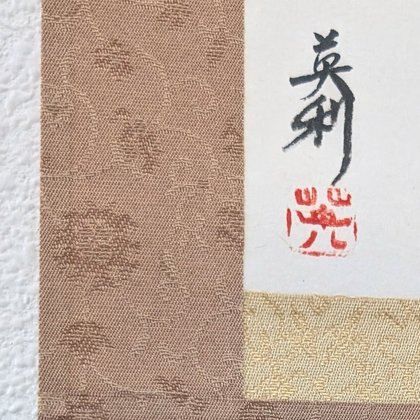


The scrolls are 12 1/4" W × 43" H (31 × 109 cm), with woven damask borders and layered Japanese paper, designed to last generations. The scrolls themselves are made by a scroll maker in Gifu, Japan, and we have worked with them for over two decades.
Eri Takase was born and raised in Osaka, Japan, and holds the rank of Shihan, the highest rank in Japanese calligraphy, from the Bokuteki-kai and the Bunka-shodo. About Master Takase


