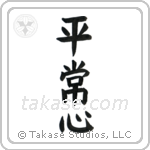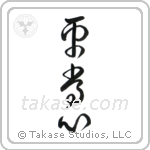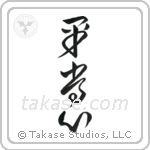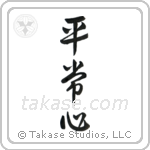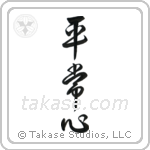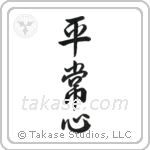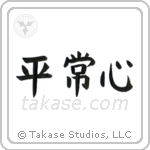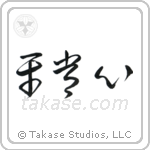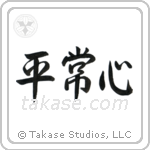

平常心, read
heijōshin: the ordinary mind, the composure one keeps under pressure. In a dojo the word means the mind that stays as it always is when attacked, and
presence of mind is the dictionary's gloss of that sense. Under it is one of the few texts in this catalogue whose source is the Zen canon itself. The Tang master Mazu taught that the Way needs no cultivation, that any contriving or aiming defiles it, and that
the ordinary mind is the Way; his heir Nanquan gave the same three characters as his answer when the young Zhaozhou asked what the Way was, and told him that to aim at it is to miss it; and that exchange is the nineteenth case of the
Gateless Barrier, with the verse that has carried it since: spring has its flowers, autumn its moon, summer its cool wind, winter its snow, and if nothing useless hangs on the mind, that is a good season in the human world. Dōgen built on the word and Keizan awoke on it. It came to the sword by name when Yagyū Munenori, the shogun's fencing master, quoted the koan and turned it into plain Japanese for the archer and the swordsman: do everything with the ordinary mind, and everything goes without difficulty; Musashi said the same in his own words. The modern sense, composure, is a novelist's of 1891 and kendo's since 1923. The Zen reading keeps its own pronunciation,
byōjōshin, and both are right: presence of mind for the dojo, and the ordinary mind is the Way for what the characters have said for twelve centuries. The Japanese word 平常心 meaning "Presence of Mind" is composed of the
kanji 平 (read hei) meaning "peaceful; even",
常 (read jō) meaning "normal, ordinary" and
心 (read shin) meaning "mind, heart, spirit".