

道場で泣き戦場で笑う · 押忍の精神 · 黙って稽古 · dōjō de naki senjō de warau · osu no seishin · damatte keiko · Weep in the dojo, laugh on the battlefield · The spirit of osu · Train in silence
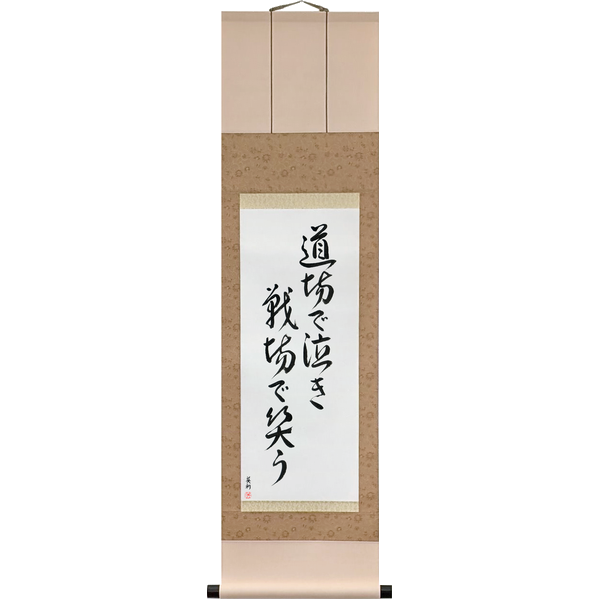
Sold as three scrolls, Cry in the Dojo, Laugh on the Battlefield, Spirit of Perseverance and Shut Up and Train · Read dōjō de naki senjō de warau, osu no seishin, damatte keiko · Oldest witness none: no dictionary, no book to 1946 and no canon carries any of the three phrases; the one word with a dictionary entry, 押忍, has no dated origin · Sense what a dojo says to itself: hard training now for the sake of the real thing later; endurance under pressure; practice without complaint. Modern Japanese, plain and correct, and without a history in print.
The words
Three phrases, all plain modern Japanese, and the words in them are ordinary. 道場, dōjō, is the training hall; 戦場, senjō, the battlefield; 泣き, naki, the continuative of naku, to weep, and 笑う, warau, to laugh, so the first phrase is a balanced couplet, weep in the dojo, laugh on the battlefield. 押忍, osu, is the greeting shouted in karate and other halls, and the one word here with a dictionary entry: デジタル大辞泉 heads it as the interjection おす, 若い男性どうしが出会ったときに使うあいさつ語。親しい間柄で使われる。おっす, a greeting used when young men meet; used between familiars; ossu, and adds 「押忍」とも当てて書く, also written with the characters 押忍, which is to say the two characters, push and endure, are ateji fitted to a spoken word, not its source. 精神, seishin, is spirit in the ordinary sense. 黙って, damatte, is in silence, the て form of damaru, to be silent, and 稽古, keiko, is practice, the same word for the tea room, the theater and the martial hall; as a slogan the phrase is a fragment, in silence, practice, and that is the shape slogans take. The romaji on the catalogue, doujou and senjou, are keyboard spellings of dōjō and senjō.
A history, from the earliest witness
None, in print. The three phrases were searched in the National Diet Library's full-text corpus of digitized books to 1946, on the modern spellings and the prewar ones (道場で泣き, 道場で泣いて, 戦場で笑 and 戰場で笑, 黙って稽古, 黙つて稽古 and 默つて稽古, 押して忍ぶ), and in the two Japanese dictionary sites: nothing. 道場で泣き returns no book; 黙って稽古 returns no book in the modern spelling and two in the old, a novel of 1910 and a translated autobiography of 1911, both using the ordinary words in an ordinary sentence, the novel's being あの長い針が一等天項の所を指すまで、默つて稽古する, practice in silence until the long hand points to the very top, which is a child told to practice, not a motto. 戰場で笑 returns one book, a 1942 prefectural reader whose sentence, 戰場で笑が出るやうになつたら、もう勝です, once you can laugh on the battlefield, you have already won, is a coincidence of words in a wartime schoolbook, not the couplet. 押忍 returns 124 books, every one of them a hit on the two characters in some other word, 押 and 忍 side by side in a Buddhist ritual text of 1321, a Nichiren letter, a place name. kotobank has no entry for 道場で泣き戦場で笑う or 黙って稽古. [lab.ndl.go.jp/dl/api/book/search?keyword=道場で泣き (0) · 黙つて稽古 (2: pid 885552 koma as listed, 1910; pid 824854, 1911) · 戰場で笑 (1: pid 1120725, 1942) · 押忍 (124); run 2026-09-06; text. kotobank.jp/word/道場で泣き戦場で笑う and /word/黙って稽古 return 404]
The word 押忍, and where it is said to come from. デジタル大辞泉 gives the word, the ateji and no origin. The Japanese Wikipedia article, which carries a banner that its sourcing is thin, lists the tellings and calls them 諸説, various theories: that it is おはようございます clipped in the old navy; that it arose among students of the 大日本武徳会's 武道専門学校 in prewar Kyoto, for which it cites 『月刊剣道日本』 of December 1981, page 48; that おはようございます shrank by stages, おはよーっす, おわーす, おす, and the characters 押して忍ぶ, push and endure, were fitted afterward, of which the article says 自我を抑え我慢する、の意か, perhaps in the sense of suppressing the self and enduring; and 大森敏範's claim, in his 2016 book 『押忍とは何か?』, that it began at 拓殖大学 before the war from a sumo word for withstanding a push. The tellings disagree on the place and the decade, which is what a legend looks like; neither print source was opened, and the article's dates are the article's. What is safe to say on a page is that 押忍 is a spoken greeting of the training halls, that its characters are ateji, and that push and endure is how the characters are usually explained, not where the word came from. [2]
Today. The phrases live in the halls and on the walls, and on the web only as the house's own listings and one other calligraphy vendor's; no school's own page naming any of the three as its motto was found. The standard five-line 道場訓 that karate organizations post, 人格完成に努むること and its four fellows, does not contain them. [the account, § 出典; web search 2026-09-05, nothing to cite]
The sense across time
There is no across time to report. Each phrase means what it says, and a reader who trains will hear the sense at once: the first is the soldier's and the athlete's rule that the hard work is done in the hall so that the real contest is easy, and the Japanese puts it with tears and laughter; the second is endurance, the hall's greeting turned into a creed; the third is the instructor's rebuke to talk, do the work. None of them is old, none is scripture, and none carries a quotation from anyone.
What is not a source
The 1942 reader's laugh on the battlefield and the 1910 novel's practice in silence are the ordinary words in ordinary use, not the couplet or the slogan, and are named here so a reader who runs the same search does not take them for witnesses. The four origin tellings of 押忍 are tellings, not attestations; the account does not choose among them. The famous 極真 association of 押忍 was looked for and not found in anything opened. Whether 道場で泣き戦場で笑う and 黙って稽古 are Japanese sayings that reached English, or English gym slogans that reached Japanese, the sources cannot say; the direction is not established.
The phrases in English
No Meiji bilingual dictionary and no printed English book carries any of the three. The English on the three pages is the house's.
Today. Cry in the Dojo, Laugh on the Battlefield is a fair rendering; weep is closer to 泣く than cry, which in English can mean shout. Spirit of Perseverance is the page's gloss of what the spirit of osu is, and a rendering should say so, since 押忍 itself is a greeting and perseverance is an explanation of its characters. Shut Up and Train carries 黙って稽古's bluntness and is the register the phrase has in a hall. The romaji to store are dōjō de naki senjō de warau, osu no seishin and damatte keiko.
A reading
Three scrolls of what a dojo says, and a dojo's sayings mostly live in the air rather than in books, so the honest history of these is short and says that. The phrases are good Japanese and mean exactly what the pages say they mean; what the pages may not claim, and do not, is an origin, an author or an age. The one thing I would change is on the 押忍 page: push and endure is how the characters are usually explained, and the page should say usually explained as rather than present the ateji as the word's meaning, because the dictionary presents it the other way round, a spoken greeting with characters fitted to it. A buyer who trains will not need more than that; a buyer who wants a line with a history should look at the sutra line the house also sells for the same wall, 直心是道場, which has fifteen centuries of it. Signed, 典, 2026-09-06.
How this was read
By text at the address: the kotobank entry for 押忍 and the two 404s; the Japanese Wikipedia article on 押忍; the National Diet Library full-text search on ten spellings, run own-hand 2026-09-06; the three catalogue rows. By OCR: the 1910, 1911 and 1942 books at the search's own snippet, none opened at the leaf, since none is a witness. Not opened: 『月刊剣道日本』 December 1981 and 大森 2016, the two print sources for the origin tellings; any dojo's own motto page; the live product pages. A book cited as pid P resolves at dl.ndl.go.jp/pid/P, and its text at lab.ndl.go.jp/dl/api/page/P_<koma>. The full apparatus, with every address, is in the account.
References
- The three scrolls (ours) (—) — M1024 · M1026 · M1090
- デジタル大辞泉, 押忍 (current) — kotobank 1996120 ↩
- ja.wikipedia, 押忍 (current) — TEXT
- NDL corpus (to 1946) — lab.ndl.go.jp search
- a peer calligraphy vendor (current) — not opened