

苦は楽の種 · ku wa raku no tane · Hardship is the seed of ease
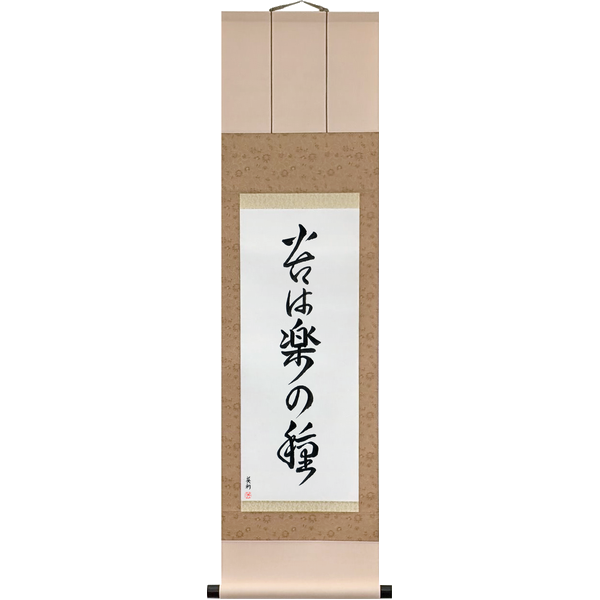
Sold as No Pain, No Gain · Read ku wa raku no tane · Oldest witness a comic novel of 1774, where it is already half of a pair; from the 1840s it heads a list of nine household precepts credited, by most who copied them, to Tokugawa Mitsukuni · Sense present hardship is what future ease grows from; the pair says the reverse is true too.
The words
苦 (ku) is hardship, toil, suffering; the dictionaries paraphrase it 苦労. 楽 (raku) is ease, comfort, 安楽; the same character read tanoshimi is pleasure, and one early witness has that word instead. 種 (tane) is a seed, and the seed is the whole figure: hardship is not a price paid for ease but the thing ease grows from. The proverb lives as a pair, 楽は苦の種、苦は楽の種, ease is the seed of hardship, hardship the seed of ease, and 精選版日本国語大辞典 says under the shorter headword that it is used 「楽は苦の種、苦は楽の種」と続けて, continued into the pair. The scroll carries the second half, the half that consoles. The old printed form is 樂 for 楽 and the witnesses below keep it.
A history, from the earliest witness
1774. 『笑談医者気質』, a comic novel of doctors' manners (Osaka, preface dated 安永三年), book five. The dictionaries' earliest citation for the pair, and the earliest witness opened. The chapter is about a doctor's wife delighted by her neighbors' talk, and it opens on a sermon: 樂は苦の種苦は樂の種。惡人程うるさき者はあらねど。善人を見出すの種なれば善惡は水波の如しと, ease is the seed of hardship, hardship the seed of ease; nothing is so tiresome as a bad man, but since he is the seed by which the good one is found, good and bad are like water and its waves. Read in the 1895 collected edition of the kishō novels, where the book's preface is dated 安永三きのへ午の春, spring of 1774. [NDL pid 1882651, koma 437 (『校訂気質全集』1895, pp. 362–363); read by eye at width 3600; text at lab.ndl.go.jp/dl/api/page/1882651_437; the 1774 printing itself not digitized at the NDL. Cited for the pair by 精選版日国 at kotobank.jp/word/楽は苦の種苦は楽の種-655824, 初出の実例 浮世草子・笑談医者気質(1774)五]
1793. 並木五瓶's kabuki play 『五大力恋緘』, final act. The dictionaries' citation for the short form, in other words: これ、小万さん、其やうにくよくよと、もし、苦は楽みの元といふぞえ, now, Koman, don't fret so; they say hardship is the source of pleasure, you know. That is 精選版日国 quoting the 評釈江戸文学叢書 edition. The 1928 『日本戯曲全集』 typeset of the play prints the speech differently: コレ、小万さん、其やうにクヨ〳〵と……併し、苦は樂しみの元ぢやなア, … but hardship is the source of pleasure, isn't it. The kotobank page that dates the citation 1793 also gives the play's premiere as 1794 (寛政6) at the Naka theater in Osaka. Either way the play is later than the novel and says it in different words. [4]
Undated, Edo. 『故花菴備忘録』, a manuscript miscellany (三木維清 comp.). The proverb as the second of nine precepts, and the earliest form found of the list that the later witnesses attach to Mitsukuni, here under another name: 有徳大君より長福君へ進せられし御譬書 一欲と酒と色とは敵と知るへし 一苦は楽の種楽は苦の種と知るへし 一主と親とは無理なるものと思ふへし 一下人は足らぬものと知るへし … 右九ヶ条, the admonitory writing presented by the shogun Yoshimune (有徳院) to his heir Ieshige (長福丸): know that desire, drink and lust are enemies; know that hardship is the seed of ease and ease of hardship; think of master and parent as unreasonable; know that servants fall short … the above, nine articles. [NDL pid 11446267, koma 36; OCR; the manuscript's date is not given by the catalogue]
1843. 『農家心得種』, a farmers' reader (手塚敬義). 賢君の御壁書の御教に ○苦は樂の種樂は苦の種と知るべし ○主と親とはむりなるものと思へ下人は足らぬものと知べし ○子ほどに親を思へ子なきものは身にたくらべて近き手本にすべし ○掟におぢよ火におぢよ … ○欲と色と酒とは敵と知べし ○朝寝すべからず … ○分別は堪忍にありと知べし, from the teaching of a wise lord's wall-writing: know that hardship is the seed of ease …. The lord is 賢君, a wise lord, and not named. The proverb heads the list. The OCR layer of this cursive leaf reads 楽 for its 樂, 足武らぬものを for 足らぬものと, おちよ for おぢよ and 朝發 for 朝寝; the glyphs are read here from the print and its furigana (らく, あさね). [NDL pid 2536178, koma 36; read by eye at width 3600 and on a crop; text at lab.ndl.go.jp/dl/api/page/2536178_36]
1841. 『役者舞台扇』, a book on kabuki actors (四文舎我笑・百文舎外笑, 河内屋太助), the opening. The pair as a commonplace one can string with others: 楽は苦の種苦は楽の種早牛も淀遅牛もよどまぬ水の流るゝごとく (the OCR's reading; the cursive was not read glyph by glyph), ease the seed of hardship, hardship the seed of ease; fast ox or slow, like water that never stands still. [3]
1880. 『諸家随筆ぬきがき』, a manuscript of extracts (白井光太郎), fascicle 5, leaf 43. 水戸黄門光國卿御作のよし世に云傳ふ書あり 苦ハ楽のたね楽ハ苦の種と知るべし 主人と親とハ無理成ものと知べし 恩を忘るへからず 子ほど親を思へ …, there is a writing the world hands down as said to be by Lord Mitsukuni of Mito: know that hardship is the seed of ease …. The name arrives with a hedge, 御作のよし世に云傳ふ, said to be his, so the world passes it on. The OCR layer reads 光国, 云伝ふ and 苦は楽のたね楽は苦の種 for the manuscript's 光國, 云傳ふ and its katakana ハ. [NDL pid 2576028, koma 45; read by eye at width 3600 and on a crop]
1893. 『善悪合鏡』, a Shingaku lecture (蕉雨逸人, 心学 series), first fascicle. The nine articles again, credited to Mitsukuni's own hand: 又同卿自筆九ケ條の寫に云く 一苦は樂の種樂は苦の種としるべし 一主と親とは無理成物と思へ …, and a copy of the same lord's autograph nine articles says …; the 同卿 is 水戶黄門光圀卿, named a few lines on. [NDL pid 758805, koma 24; OCR]
1894. 『明治節用大全』, a household encyclopedia (博文館), the section of maxims. ○苦は樂の種樂は苦の種と知るべし(以下九則水戶西山公の遺訓) ○主と親とは無理なるものと思ひ下人は足らぬものと知るべし … ○分別は堪忍にありと知るべし, … (the following nine rules are the testament of Lord Nishiyama of Mito). 西山公 is Mitsukuni's name in retirement. [NDL pid 898143, koma 278; OCR]
1896. 岡谷繁実『名将言行録』(牧野書房 ed.), book 46, Tokugawa Mitsukuni, pp. 280–281. The great Meiji compendium of the lives of commanders: 光圀の家訓に曰く、苦は樂の種、樂は苦の種と知るべし。主人と親とは無理なるものと思へ、下人は足らぬものと思へ。子程に親を思へ、子なき者は身に校べて近き手本とすべし。掟に恐れよ、火に恐ぢよ、無分別者に恐ぢよ。欲と色と酒とは敵と知るべし。朝寐すべからず。物言すべからず。被官は家を定めよ、主人は被官に慈悲をせよ。分別は堪忍にありと知るべし。九分は善し十分は必ずこぼるゝと知るべし, Mitsukuni's house precepts say: know that hardship is the seed of ease and ease of hardship; think master and parent unreasonable, servants wanting; love your parents as you would a child, and if you have no child measure by your own body and take a near example; fear the law, fear fire, fear the thoughtless; know desire, lust and drink for enemies; do not sleep late; do not talk idly; a retainer should settle his house and a master be kind to his retainers; know that judgment lies in patience; nine parts is good and ten will surely spill. The same book's own first edition (玉山堂, 1869) is digitized only through book 30 and was not opened. [NDL pid 778868, koma 151; read by eye at width 3600; text at lab.ndl.go.jp/dl/api/page/778868_151]
Between 1890 and 1900, a commonplace. A rakugo-style sermon of 1894 plays on the pair (鍬樂の種, a hoe is the seed of ease, a pun on 苦は); a Kanazawa savings bank's advertisement in an 1894 city guide prints 苦は樂の種 beside 塵も積もれば山となる; two haiku anthologies of 1893 use it in verses (苦は樂の種と畑打つ主哉, "hardship the seed of ease," says the master, tilling). The proverb is in some 730 digitized books in the short form and 490 in the pair. [NDL pids 818471, koma 58; 764578, koma 64; 875160, komas 35 and 69; OCR; counts at the NDL Lab full-text search, 2026-09-06]
Today. デジタル大辞泉: 現在の苦労は、将来の幸福のもとになるということ. 精選版日国 for the pair: 楽をすると、あとで苦を味わわなくてはならないし、苦を忍べばあとで楽ができる, take it easy and you will taste hardship later; bear hardship and ease comes after. ことわざを知る辞典: 苦労しておけば、後々楽になる, with the note for the pair that 苦楽は相伴うもので、どちらか一方だけということはない, ease and hardship go together; you never get just one. [4]
The sense across time
One sense from 1774 to today: sow hardship now, reap ease later, and the pair adds that ease sown now is hardship later. What the record adds is a pedigree. From the 1840s the proverb heads a list of nine household precepts, the same nine in nearly the same order in every copy, and the copies disagree about whose they are: an Edo manuscript gives them to the shogun Yoshimune for his heir; the 1843 farmers' reader gives them to a wise lord; from 1880 on they are Mitsukuni's, first with a hedge (so the world says), then as his autograph, his testament, his house precepts. Another manuscript of the 1890s prints a different list under Hideyoshi's name and notes in the margin that it agrees with 西山公's writing. The precept list is real and old; the name on it is a tradition that settled on Mitsukuni in the Meiji decades, and the proverb is older than any version of the list that was opened. A Buddhist tract, undated, gives the pair a third life as the doctrine of a sect (尼乾子経) that taught ease now means suffering hereafter, which is the pair read as karma.
What is not a source
Galef pairs the proverb with 禍福はあざなえる縄の如し, good and bad luck are twisted together like rope strands; Buchanan pairs it with 楽あれば苦あり. Both are kin, not sources. The nine-precept list is a use of the proverb, not its origin, since the novel of 1774 has the pair as a sermon commonplace already; and the 1793 play's 苦は楽みの元 is the same thought in other words, not the proverb's first form.
The saying in English
Hepburn's 1872 dictionary does not head it, and no Meiji bilingual equation was found. The English begins with the postwar proverb books.
1965. Daniel Crump Buchanan, Japanese Proverbs and Sayings (University of Oklahoma Press), p. 169. Raku wa ku no tane, ku wa raku no tane: "Pleasure is the seed of pain, pain is the seed of pleasure." English parallel: Rest comes from unrest, and unrest from rest. The entry above it, Raku areba ku ari, gets No pains, no gains. Buchanan keeps the seed and gives the pair whole. [the shelf's text layer; Library of Congress catalog number and ASIN not collected]
2000. David Galef, Even a Stone Buddha Can Talk (Tuttle), no. 21; 2012, Japanese Proverbs (Tuttle), no. 121. Raku wa ku no tane, ku wa raku no tane. Pleasure is the source of pain; pain is the source of pleasure. [You have to take the rough with the smooth.] The 2012 note: The idea behind this maxim is both Buddhist—things of this world that delight also cause sorrow—and psychological—true joy comes only after some hardship is overcome. Galef trades the seed for a source and adds the Buddhist reading the undated tract above actually holds. [the shelf's text layers; ISBNs and ASINs not collected]
Today. ことわざを知る辞典 gives There is no pleasure without pain. EDRDG at jisho: one cannot have pleasure without pain; no pain, no gain. The house title, No Pain, No Gain, is the English proverb the Japanese sits nearest, and it loses the seed; the house explanation's literal line, pain is the seed of comfort, keeps it. A rendering must keep the seed, and should give the pair once, since the scroll's half is the consoling half of a saying that cuts both ways.
A reading
A proverb with a seed in it, and the seed is what to keep: not that pain buys gain, but that ease grows from hardship, and hardship from ease. The scroll carries the half people want on a wall. The pedigree the Meiji books gave it, first of Mitsukuni's nine precepts, is worth telling as what it is, a tradition with three names on it and the proverb older than all three, because the buyer who meets it on the internet will meet it as Mitsukuni's without the hedge. No Pain, No Gain is the right title to be found by; the page's literal line is the honest gloss and should stand beside it. Romaji ku wa raku no tane, no macron. Signed, 典, 2026-09-06.
How this was read
By eye, at the National Diet Library page images at width 3600: the 1774 novel in its 1895 typeset, the 1928 typeset of the play, the 1843 farmers' reader (in part), the 1880 manuscript, and the 1896 名将言行録; the 1841 actors' book opened and the run located. By OCR at the page API: the Edo manuscript of nine articles, the 1893 lecture, the 1894 encyclopedia, the 1890s commonplaces, the Buddhist tract. By text at the address: the two kotobank pages, EDRDG at jisho, and the three English books at their text layers. Not opened: the 1774 novel in its own printing; the play in the 評釈江戸文学叢書 edition the dictionary cites; the first proverb collections (毛吹草 1638, 世話尽 1656); the 1869 first edition of 名将言行録 beyond book 30; any autograph or early copy of the nine precepts under any name; the printed pages of Buchanan and Galef. A leaf cited as pid P, koma N resolves as text at lab.ndl.go.jp/dl/api/page/P_N and as an image at dl.ndl.go.jp/api/iiif/P/R<N, seven digits>/full/3600,/0/default.jpg. The full apparatus, with every address, is in the account.
References
- The scroll (ours) (—) — M6047SSVB4A; cultural_works 600
- 並木五瓶『五大力恋緘』大切, as 日国 quotes it (1793) — kotobank 482032, 初出の実例; the play not opened at that line
- 『役者舞台扇』3巻 (天保12 (1841)) — NDL pid 2554748 koma 4, page API, OCR ↩
- デジタル大辞泉 · 精選版日国 · ことわざを知る辞典 (current) — kotobank 482032 ↩
- EDRDG (current) — jisho.org