

雨降って地固まる · ame futte ji katamaru · After rain, the ground sets firm
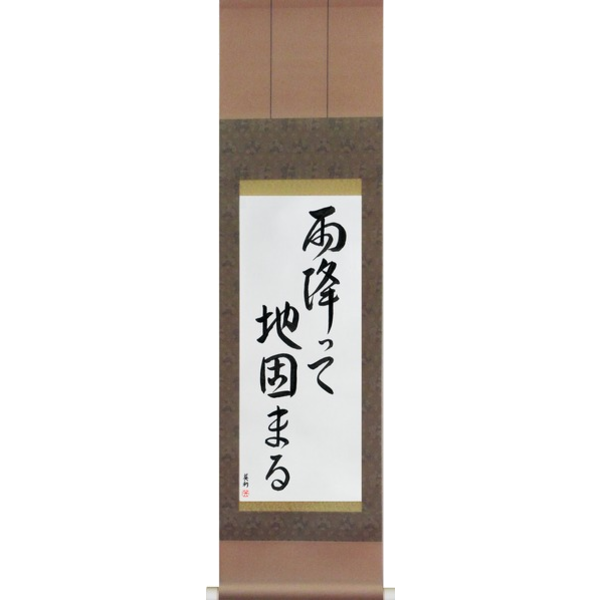
Sold as The Ground Becomes Firm After Rain · Read ame futte ji katamaru · Oldest witness a poets' quarrel of the 1640s that remembers the proverb being turned into a verse at a reconciliation party twenty years earlier; the dictionaries name a notebook of the 1570s that was not opened · Sense after a quarrel or an upheaval, things settle firmer than before.
The words
雨降って, ame futte, is rain having fallen; the て-form links cause to result, and the Edo books write the older inflection 雨ふりて for the same verb. 地, ji, is the ground, read じ in every dictionary and ぢ in a book of 1667. 固まる, katamaru, is to set, to become firm. The 精選版日本国語大辞典 glosses the figure: 変事の後は、かえって事態が落ち着いて、基礎がかたまる, after an upset, things settle and the foundation sets. Every dictionary from 1901 to today uses a word for disturbance to say what comes before the settling: もめごと, 変事, 騒擾, 紛擾, 小いさかひ, 乱, a quarrel, an upset, a disorder, a lovers' spat, a war. What firms afterward is a foundation: a household, a friendship, a realm.
A history, from the earliest witness
The 1570s to 90s. 月菴酔醒記, a notebook. The 日国 names this as the oldest witness and quotes nothing from it; it is not in the digital library and was not opened. [kotobank.jp/word/雨降つて地固まる-3206810; text]
The 1620s, as told in 1646. 安原貞室, 氷室守, a polemic against a rival's poetry collection. 貞室 takes the hokku 雨降て地をかためたる氷かな, rain has fallen and set the ground: ice, from the rival collection and says his master 松永貞徳 made it on the spot at a 中直しの座, a reconciliation party, in the last years of 元和, which is about 1622 to 1624, and made it as 雨ふりて地かたまりたる氷かな, 此も吹草より遥に以前のこと也, long before the 毛吹草. He praises the master's form for setting the proverb's words in the verse whole and at ease, 雨ふりて地かたまるといふこと葉を。やつさすして。やすらかにをかれたり, and calls the collection's 地をかためたる a labored making, 世話をくたきたるさま也. He adds a second such verse, made after rain at a kickball gathering in early 寛永. So the proverb was current by the 1620s, and already the thing one said when friends made up. [5]
1638. 毛吹草, the first printed proverb collection, by 松江重頼. 雨ふりて地かたまる, in a list ordered by association, immediately after 思ふ中のつゝりいさかひ, the small quarrels of a couple in love. The company a proverb keeps in this list is its meaning to the man who compiled it. [藤井乙男's 1929 reprint of the list, 諺の研究, pid 1452761, scan 157, by eye; text at lab.ndl.go.jp/dl/api/page/1452761_157]
1643. 松永貞徳's annotated 犬筑波集. A linked verse about the ground setting to the sound of a mortar carries the note 世俗に雨降て地かたまるといふあり, the common people say: rain falls and the ground sets. [2]
1656. 世話尽, the second proverb collection. 雨降て地かたまる, listed. [6]
1667. 吉原すずめ, a guide to the pleasure quarter. おもふ中の小いさかひ、雨ふりてぢかたまるなどと、おさだまりのあいさつにて, a little quarrel between lovers, and "rain falls and the ground sets" as the usual thing to say. The 日国's first quotation: the proverb as the stock consolation after a lovers' spat. [the 日国 at the address above; the book not opened at its page]
1688. 井原西鶴, 日本永代蔵, book six. 雨ふつて地かたまると, of a household that has come through hard years. [9]
1739. 湯浅常山, 常山紀談, a collection of warrior anecdotes. After the battle of 関ヶ原: 東照宮、石田が亂は雨降りて地固まるといふに同じ。此より靜謐ならん, Ieyasu said: Ishida's rebellion is like rain falling and the ground setting; from here on there will be peace. The lords congratulated him, and 加藤清正 answered that the weather of a realm can cloud over as suddenly as a clear sky, and that the hard thing to read is the human heart; 常山 adds that he does not know where the exchange took place. [12]
Early 1800s. 小山田与清, 松屋筆記, a scholar's notebook. Item 三七, 雨降て地かたまると云諺: he cites the 常山紀談 passage and sets beside it a Chinese parallel from the Book of Changes, the hexagram 睽, estrangement: 天地睽而其事同也 男女睽而其志通也, heaven and earth are estranged yet their work is one; man and woman are estranged yet their wills meet, and its last line, 遇雨則吉, meeting rain is auspicious. A parallel, offered as one. [13]
1891 to 1933. The Meiji and Shōwa dictionaries. 国民の品位 (1891) applies the proverb to the 西南 war and the army it produced; 俗諺辞林 (1901) glosses it 騒擾一たび鎭靜に歸すれば、その後は無事を保つべし, once a disturbance has settled, peace should hold, and retells Ieyasu; 俚諺辞典 (1906): 何事か紛擾を極めたる後、却て能く事の治まるをいふ, after some great confusion, matters settle the better. 藤井乙男's 諺語大辞典 (1910) generalizes, わろしと見ゆることの、却て善き結果を來すをいふ, what looked bad brings a good result, quotes the hokku, and pairs it with two English proverbs, Good comes out of evil and After rain comes fair weather. [14]
Today. デジタル大辞泉: もめごとなど悪いことが起こったあとは、かえって基盤がしっかりしてよい状態になることのたとえ. The ことわざを知る辞典 reads it as a proverb that values a quarrel coming into the open rather than festering, a kind of 験直し, a clearing of the air, with 川端康成's 山の音 (1949 to 1954) as an example, and gives the English After a storm comes a calm. [kotobank.jp/word/雨降つて地固まる-3206810; text]
The sense across time
One sense from the 1620s to today: something goes wrong between people or in a realm, and afterward the ground is firmer than before. The witnesses differ only in the size of the disturbance. For the poets and the pleasure quarter it is a lovers' quarrel; for 西鶴 a household's hard years; for 常山's Ieyasu a war; for the Meiji dictionaries a disturbance of any size; and for 藤井 in 1910, at the widest, anything that looked bad and came out well. The modern dictionaries keep the quarrel at the center and add that the proverb approves of the quarrel's coming out.
What is not a source
The Book of Changes hexagram that 与清 set beside the proverb is a parallel, and he offers it as one; no source opened, Japanese or Chinese, claims a Chinese origin for the sentence, and the Korean proverb the modern dictionary lists is the same image in another language. And a reading. The house page says the proverb means adversity builds character and that it strongly disagrees with calm after a storm and an argument clears away bad feelings. No source opened, from the 1570s notebook's title to today's dictionaries, glosses the proverb as building character; the two equations the page rejects are the tradition's own, and the quarrel is where the proverb began. The one footing for the page's reading is late and English: an American guide of 2004, below, glosses the rain as human beings become stronger as they meet and overcome the challenges of life.
The text in English
Hepburn's dictionary of 1872 lists the proverb under ame and gives no English. From 1897 the Meiji dictionaries render it three ways, and all three are what the page rejects. 1897, イーストレーキ, 英和実用会話独修: After rain the ground gets hard; Good comes out of evil; Peace comes after contest. 1898, 井上十吉, 英語学講義録, page 56: After a rain, the soil hardens, the literal and nothing else. 1902, イーストレーキ, 和英会話辞書: Better friends than ever after a quarrel, and After a quarrel, friendship grows deeper. 1907, ロイド, 和英新辞典: After the storm, a calm; After rain comes sunshine. 1918, 斎藤秀三郎: Good comes out of evil. 1929, 研究社 新英和中辞典: After the storm comes a calm. [pids 871361 scan 173, 869647 koma 31, 870192 scans 24 and 314, 903157 scan 27, 1681530 scans 102 and 259, 1904907 scan 64; OCR, 井上 by eye] 1996. Guy Zona, Even Withered Trees Give Prosperity to the Mountain, Simon and Schuster, page 39. After rain, the earth gets firm. The literal. 2004. Edward Trimnell, Tigers, Devils, and Fools, Beechmont Crest, page 11. Rain hardens the ground. Rain can be unpleasant. However, rain causes the loose soil to coalesce, which in turn makes the surface of the earth harder. In the same way, human beings become stronger as they meet and overcome the challenges of life. The nearest thing to the house page's reading in any source opened, and it is a 2004 English guide's gloss. Not in Galef (1987, 2000). [the text layers; printed books, checkable by a reader who holds them] Today. JMdict: adversity strengthens the foundations; after a storm comes a calm; what doesn't kill you makes you stronger; the ground hardens after it rains. The first of these is where the page's adversity comes from, and it keeps the 日国's noun, foundations, which the page's character does not. The house title is exactly right. What a rendering must keep is that something went wrong first, between people, and that the ground that sets is theirs.
A reading
The design and the romaji are sound, and the page's literal, the ground becomes firm after rain, is exactly right. The rest of the page argues in print against the whole tradition and does so without a source. From the reconciliation party of the 1620s to the stock consolation of 1667 to Ieyasu after 関ヶ原 to every dictionary opened, the proverb is about a disturbance, a quarrel, a crisis, a war, after which the ground is firmer than before. After a storm comes a calm is a fair English for the Ieyasu use, and an argument clears the air is the original use; the page rejects both and offers adversity builds character, which no Japanese witness carries and one American guide of 2004 half supports. The page should say what the proverb says, with 西鶴's household or Ieyasu's sentence under it, and drop the paragraph that disagrees with the dictionaries. If the disagreement came from an ear that hears the proverb used today of hardship in general, which the 1938 and 1949 quotations support, then the page should say hardship and foundation, not character, and say it as a use rather than as a correction. Signed, 典, 2026-09-05.
How this was read
By eye: 貞室's 1646 leaf, re-read on the day of writing; the 1929 毛吹草 list; 与清's notebook; 常山 in the 1912 edition; four Meiji dictionaries and 藤井's 1910 entry; Hepburn; 井上's 1898 leaf. By text at the address: the kotobank entry with its three dictionaries; the ten leaves above at the National Diet Library's page API; 貞徳's 1643 note, 世話尽, 西鶴 and the later Edo witnesses by OCR; eight further proverb dictionaries and twelve bilingual dictionaries by OCR; the four English proverb books in their text layers. Not opened: the 1570s notebook and the 1667 guide at their pages; 毛吹草's own leaf, where the hokku was looked for in the winter section and not found; the Book of Changes at its text; Buchanan 1965, whose file is locked; whatever unnamed sources the page's paragraph disagrees with. Every address in this history is a text address except the two English paperbacks, which a reader checks by holding the book. The full apparatus, with every address, is in the account.
References
- 月菴酔醒記 (1573–92) — reported
- 犬筑波集 with 貞徳's notes (新増犬筑波集) (1643 (the couplet older, date not determined)) — pid 2541201 koma 22, leaf opened, by OCR ↩
- 毛吹草 巻二 世話付合 (重頼 編) (1638) — 藤井 1929 by eye; 皇国俚諺叢 1901 by eye; the leaf not hunted
- 毛吹草 巻五 冬 氷, a hokku (1638) — reported; the 氷 leaf read in strips, verse not found
- 氷室守 (貞室) (1646) — pid 2553219 koma 25, by eye ↩
- 世話尽 (皆虚) 世話二 (1656) — pid 2554768 koma 26, leaf opened, by OCR ↩
- 小町躍 (1665) — by OCR
- 吉原すずめ 上 (1667) — the 日国, reported
- 日本永代蔵 巻六 (西鶴) (1688) — pid 2554356 koma 38, leaf opened, by OCR ↩
- やふにまくは 巻二 (1718) — by OCR
- 忠孝寿門松 (自笑) (1738) — by OCR
- 常山紀談 (湯浅常山) (1739; read in the 1912 typeset) — pid 1078984 koma 257, by eye ↩
- 松屋筆記 (小山田与清) (early 19th c., manuscript) — pid 2574523 koma 106, by eye ↩
- 諺語大辞典 (1910) — pid 862766 scan 37, by eye ↩
- The catalogue and both live pages (2026) — cultural_works.csv:360