

さびしさのうれしくも有秋の暮 · sabishisa no ureshiku mo ari aki no kure · Loneliness, and there is gladness in it too. Autumn dusk
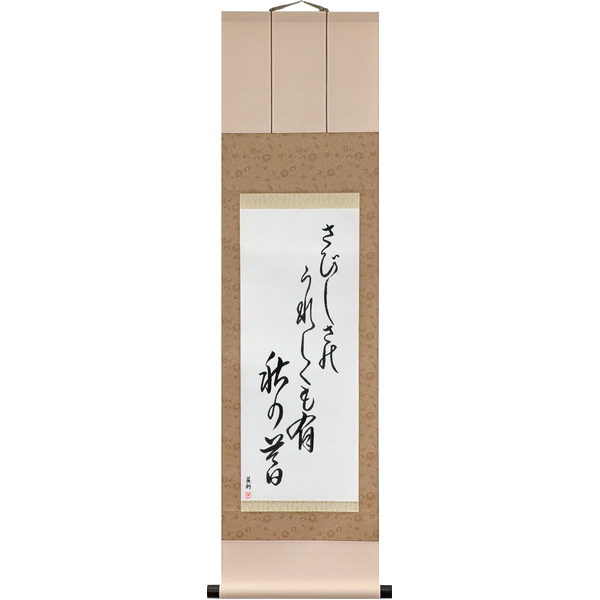
Sold as In loneliness / there is joy too / An autumn eve, under Buson's name and no translator's · Read sabishisa no ureshiku mo ari aki no kure · Oldest witness the poet's posthumous papers, the 蕪村遺稿, by the tags of his 1925 editor; the earliest print on the desk is 1902 · Sense an autumn dusk is a lonely thing, and the verse says plainly that the loneliness is also a joy. The Japanese critics of 1904 to 1940 disagree about whether that plainness is sublime or blunt, and the disagreement is the verse's history.
The text as brushed, and its variants
The scroll carries さびしさのうれしくも有秋の暮, with 有 in kanji where every edition prints あり. Otherwise the witnesses differ only in writing. The Buson editions of 1902, 1906, 1921, 1925 and 1935 and the two commentaries of 1904 and 1926 print さびしさのうれしくもあり秋の暮; the 1906 aesthetics and the 1921 annotated edition write 淋しさ; 鳴雪's 1909 manual writes 淋しさの嬉しくもあり; the 1934 anthology of commentaries writes 秋のくれ. 有 and あり, 淋しさ and さびしさ, 嬉しく and うれしく, 暮 and くれ are one word each, and the calligrapher's 有 is a kanji the editions leave in kana. No witness varies a word. The meter is five, seven, five: さ・び・し・さ・の, う・れ・し・く・も・あ・り, あ・き・の・く・れ.
The attribution, as a dated thread
Buson's, at every witness, and in every edition of Buson opened. Its source is not the 蕪村句集 of 1784 but the posthumous 遺稿, and the record says so in one place, by a tag read by eye: 半田良平's dated edition of 1925 arranges the 秋の暮 verses in two groups, closes the first eight with 右八句、句集, opens the second with this verse, and closes those eight with 右八句、遺稿. The 蕪村三千句 of the same year prints the same run in the same order without the tags. An earlier reading had taken the first tag for this verse's and made the 句集 its source; the leaf shows the verse heads the 遺稿 group. No witness dates the composition. Blyth in 1952 is the only English translator on the shelf who carries it.
The words
さびしさの is loneliness, with の making it the subject of the clause that follows. うれしくも有 is is glad, too, and the も is the whole poem: also, the gladness inside the loneliness and not instead of it. 長谷川零余子's 1921 gloss is the plainest: 秋の暮は淋しいものであるが、その淋しさがまた嬉しい場合もあると云ふ意味の句, autumn dusk is a lonely thing, but the verse means there are times when that loneliness is also a joy. 秋の暮 is autumn dusk or the end of autumn; the phrase carries both, and the tradition has argued it since Bashō's crow. Blyth hears an autumn eve; the 1934 critic hears the season's end, an old man's autumn. As words the line says: Loneliness, and there is gladness in it too: autumn dusk.
A history, from the earliest witness
1902. 山田三子, 蕪村俳句全集, a collected edition. The verse in the 秋の暮 run: 弓取に歌とはれけり秋のくれ, さびしさのうれしくもあり秋の暮, かぎりある命のひまや秋のくれ. [NDL pid 875715, koma 72, OCR; text at lab.ndl.go.jp/dl/api/page/875715_72]
1904. 佐藤紅緑, 蕪村俳句評釈, a commentary. The verse is printed with 一人來て一人を訪ふや秋のくれ and the two are read together: この種の句の妙は全く天籟にして絕て斧鑿の痕なきにあり、然れども若し誤て其句字より之れを求むれば興會全く沒して、所謂月並調とならずんば則ち一つの平弱の句たるに終らん, the wonder of this kind of verse lies wholly in its natural music, without a trace of the chisel; but seek it wrongly through its letter and its life vanishes, and it ends as a hackneyed verse if not a merely feeble one. Then he turns to a Chinese poet: 我王摩詰の七古を愛す、王の詩一種淡白の致あり, I love Wang Wei's old-style verse; his poetry has a certain plainness, and quotes a poem he says Wang sent to 五弟 from his retreat, 終南有茅屋 前對終南山 終年無客長閉關 終日無心長自閒 不妨飮酒復垂釣 君但能來相往還, in my rendering I have a thatched hut in the Zhongnan hills, facing the mountain; all year no visitors, the gate long shut; all day no cares, long at ease; nothing stops me drinking or dropping a line; if only you could come and go with me, and says of it, と小小の文字、字字生命あり、勿謂讀過淡々として、白湯を喫するが如しと、この水由來宇治第三橋に得たり, small words, and every word alive; do not say that read through it is flat, like drinking plain hot water: this water was drawn at the third bridge of Uji. [NDL pid 875716, koma 99, printed pages 188–189, read by eye; text at lab.ndl.go.jp/dl/api/page/875716_99]
1906. 中川四明, 俳諧美学, an aesthetics of haikai. The verse as an instance of 嵩高, the sublime: 要するに、嵩高は總て一たび打擊を受け、壓抑せられて而して後に生ずる〓揚怡悅の感覺なり, in sum, the sublime is always the feeling of elation and delight that arises only after a blow has been received and a pressing-down endured, and beside it a line of Goethe's Faust in German, which the OCR garbles past quotation; the account gives it as In jenem seligen Augenblick, ich fühle mich so klein, so gross, a repair, not the leaf. [NDL pid 875470, koma 98, OCR; text at lab.ndl.go.jp/dl/api/page/875470_98]
1906. 岩本梓石, 蕪村俳句全集 標註, an annotated edition. The same run, with notes on the neighbors and none on this verse. [NDL pid 875714, koma 72, OCR; text at lab.ndl.go.jp/dl/api/page/875714_72]
1909. 内藤鳴雪, 俳句作法, a manual. 淋しさの嬉しくもあり秋の暮, twice: among the 抒情の句, the lyric verses, and among those 主觀に屬するもの, belonging to the subjective. [NDL pid 875595, komas 74 and 124, OCR; text at lab.ndl.go.jp/dl/api/page/875595_74 and 875595_124]
1921. 長谷川零余子, 蕪村俳句全集 校註解釈, an annotated edition. The gloss quoted above. [NDL pid 968346, koma 59, OCR; text at lab.ndl.go.jp/dl/api/page/968346_59]
1925. 蕪村三千句, and 半田良平, 蕪村俳句全集 季題別. The 三千句 prints the 秋の暮 run whole: 我がてに我をまねくや秋の暮, 門を出れば我も行く人秋の暮, 弓取に歌とはれけり秋のくれ, 淋し身に杖わすれたり秋の暮, 秋のくれ辻の地藏に油さす, さびしさのうれしくもあり秋の暮, 人は何に化るかもしらじ秋の暮, 訓讀の經をよすがや秋のくれ, 一人來て一人を訪ふや秋の暮, かぎりある命のひまや秋の暮, 門を出て故人にあひぬ秋の暮, 燈ともせといひつゝ出るや秋の暮, 鳥さしの西へ過けり秋の暮. 半田 prints the same run with his source tags, 右八句、句集 before this verse and 右八句、遺稿 after the eighth from it. [NDL pid 924926, koma 47, printed page 88, and pid 964212, koma 31, printed page 48, both read by eye; text at lab.ndl.go.jp/dl/api/page/924926_47 and 964212_31]
1926. 野口米次郎, 蕪村俳句選評, a poet's selection with comments. The verse among those that show that Buson never drives desolation to its bottom but tastes it with a human warmth that leaves room, and that his Kyoto sensibility cannot be reconciled with the Zen monk's desolation; the account carries the sense and the OCR the words. [NDL pid 1019055, koma 28, OCR; text at lab.ndl.go.jp/dl/api/page/1019055_28]
1934. 俳句評釈選集, an anthology of commentaries, the 蕪村名句評釈. The 秋の暮 run read as one set, 去年より又た淋しいぞ秋の暮, 父母のことのみ思ふ秋のくれ, さびし身に杖わすれたり, and the judgment that it presses its old man's loneliness on us in quick succession, a little too openly, so that the true flavor of age does not come through. [NDL pid 1148254, koma 105, OCR; text at lab.ndl.go.jp/dl/api/page/1148254_105]
1935. 半田良平, 蕪村俳句全集 季題別年代附. The 1925 arrangement and tags reprinted. [NDL pid 1090303, koma 29, OCR; text at lab.ndl.go.jp/dl/api/page/1090303_29]
1940. 日野草城, 展望車, a modern poet's essays. The verse's paradox こころもちの逆說的な一面が率直に詠はれてある, sung straight out, set against さびしさに花咲きぬめり山櫻, where the loneliness is not said but shown. [NDL pid 1114982, komas 116–117, OCR; text at lab.ndl.go.jp/dl/api/page/1114982_116 and 1114982_117]
Today. The Nipponica entry on kotobank gives the poet's dates 1716–1783 and does not mention the verse. The archive's index lists twelve books carrying the verse before 1945, all opened. [kotobank 蕪村, read as text; harvest_index.py lookup --id 273 --year-to 1945, re-derived 2026-09-05]
The sense, across a century
Everyone agrees what the verse says, and the argument is about whether it should have said it. 長谷川 in 1921 gives the plain gloss and stops. 紅緑 in 1904 says the plainness is the art, a natural music without chisel marks, and warns that a reader who looks for the poem in the words will find a hackneyed one; his Wang Wei is there to show what plain words can hold. 中川 in 1906 raises the stakes to the sublime, a joy that comes only after a blow, and hears Faust in it. 鳴雪 in 1909 files it as lyric and subjective, a verse of feeling. 野口 in 1926 makes it the mark of Buson's temperament, a desolation tasted with warmth and never driven to the bottom. The 1934 anthology hears the whole 秋の暮 run as an old man's loneliness pressed too openly, so that the true flavor does not come through. 日野 in 1940 says what the 1934 critic implied: the paradox is stated, not shown, and the better Buson verse shows it. Blyth in 1952 hears the rare moment when the loneliness is welcome, sometimes, rarely, we feel like the bird. The tradition, then, holds two positions: that the verse is beautiful because it is plain, and that it is a little too plain to be beautiful. Both are readings of the same も.
What is not a source
Wang Wei's poem to his friend, which 紅緑 quotes at length, is the commentator's parallel for a kind of plainness, not a source Buson names; it has not been opened at its Chinese address. Goethe's Faust, in 中川, is likewise the critic's instrument. The other 秋の暮 verses of the run, 門を出れば我も行く人, 淋し身に杖わすれたり, かぎりある命のひまや, 一人來て一人を訪ふや, are the verse's neighbors in Buson's editors' ordering and the set the 1934 critic reads as one; they are its company, not its kin. 日野's 山櫻 verse is the contrast he sets against it. None of these is a source for the verse.
The verse in English
The bilingual dictionaries of the Meiji shelf were not checked for this verse. Miyamori, Henderson, Hass, Fitzsimons and Buchanan were searched on the shelf and carry other loneliness verses, not this one.
1952. R. H. Blyth, Haiku, volume 3, Summer–Autumn, Hokuseido Press, Tokyo, under AUTUMN, THE SEASON, page 345 (s43 cited 245–246). An autumn eve; / There is a joy too, / In loneliness, with the sentence on the bird quoted above. Blyth puts the season word first, where the Japanese puts it last. [docs/research/papers, Blyth 1952 vol. 3, page 345 (s43 cited 245–246) by the account's reading of the text layer, read as text; no ASIN collected]
Today. The house English, In loneliness / there is joy too / An autumn eve, is Blyth's three lines in the Japanese order rather than his, with his punctuation dropped, under the poet's name alone. The reordering is an improvement on his English, since it puts 秋の暮 last where the verse does; it is still his words. A rendering of this line has to keep the も, the too, because the verse is nothing without it, and it should keep the season word last, which the page already does.
A reading
I take 紅緑's side and 日野's warning together. The verse says a plain thing, and the plainness is the point: there is no image, no scene, only a feeling named and then qualified by one syllable, も, and then the hour. Read for its letter it is nothing, as 紅緑 says, and read as a statement it is a little too open, as the 1934 critic and 日野 say; read as a moment, the instant at dusk when the loneliness one has been dreading turns out to be welcome, it is exact. The critics' quarrel over whether it is sublime or blunt is the record's gift and belongs in the account; what the page could carry is 長谷川's gloss and 紅緑's warning in one breath. The source is the 遺稿, not the 句集, on 半田's tags read by eye. Text, attribution and romaji stand, and the scroll needs no change. The page's English is Blyth's rearranged and should say so or become a house rendering, which is easy here, since the Japanese order is the natural one and the page has already found it. Signed, 典, 2026-09-05.
How this was read
By eye at width 3600: the 1904 評釈 at the verse and its commentary, pages 188–189; the 蕪村三千句 at the 秋の暮 run, page 88; 半田's 1925 edition at the same run with its source tags, page 48. By OCR from the archive's text layer: the 1902, 1906, 1921 and 1935 editions, the 1906 aesthetics, the 1909 manual at both places, the 1926 selection, the 1934 anthology, the 1940 essays. By text layer from the shelf: Blyth; the kotobank entry. Not opened: the 蕪村遺稿 itself at the 秋の暮 run, which would show the verse in its source and the run's order; Wang Wei's poem and Goethe's line at their own addresses; the 中川 leaf as an image, where the German would be read; Blyth's pages as images, where the columns the OCR interleaved would read. A bracket of the form pid P, koma N resolves as text at lab.ndl.go.jp/dl/api/page/P_N and as an image at dl.ndl.go.jp/api/iiif/P/R<N, seven digits>/full/3600,/0/default.jpg; the three leaves read by eye were fetched at that address. The full apparatus, with every address, is in the account.
Supersession 2026-09-14 (s92)
A read-only worker resolved this account's addresses (citation_checks_2026-09-14/history_sabishisa_273_2026-09-05.check.md): 20 claims; all twelve NDL komas and Blyth's quotation resolve. Corrected above: Blyth's vol. 3 passage is on page 345 by the marker before it in the text layer (Hokuseido numbers at the page head), not 245–246. The house title matches no shelf rendering, as the account says. Not yet read by a person.
References
Each witness is cited in the account above, at the frame or entry where it was read. A linked list follows when the record for this text is completed.