

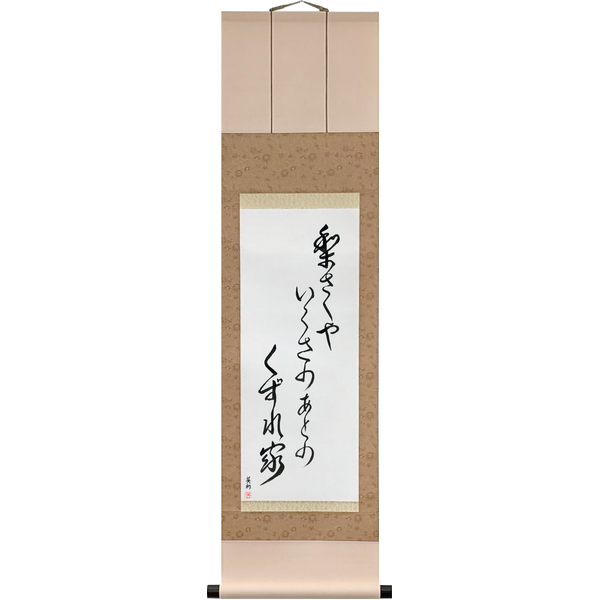
梨さくや戦のあとの崩れ家 · nashi saku ya ikusa no ato no kuzure ie · Pear trees in bloom, and a house fallen in, where the battle was
Sold as Shiki's, with the English A pear tree is blooming, / By a collapsed house, / on an old battlefield · Read nashi saku ya ikusa no ato no kuzure ie · Oldest witness the poet's own hand: the fourth book of his manuscript 寒山落木, under the headnote 金州二句, 梨咲くやいくさのあとの崩れ家, read by eye · Sense pear trees blooming: a house fallen in, after the battle. 金州 on the Liaodong peninsula, April 1895, a war correspondent's spring.
The text as brushed, and its variants
The scroll carries 梨さくや戦のあとの崩れ家, and the record carries one text in three writings. The autograph writes 梨咲くやいくさのあとの崩れ家: 咲 in kanji, いくさ in kana. The 1915 typeset from the same manuscript writes 梨さくや, kana for the verb, and so do Blyth's two books and most of the Meiji and Taishō printings; the scroll follows them and writes 戦 for the kana いくさ, as Blyth's later reprint writes 後 for あと. One real misquotation: the 1929 railway guide to South Manchuria prints 梨咲くや戰のあと崩れ家, dropping the second の and a syllable with it, on a page that sets the verse under 乃木希典's Chinese quatrain on the same battlefield. The sense holds across all of them. The meter is five, seven, five: な・し・さ・く・や, い・く・さ・の・あ・と・の, く・ず・れ・い・え. The three designs served for this text do not all brush the catalogue's form: two write いくさ in kana, as the autograph does, and one writes 戦.
The attribution, as a dated thread
Shiki's, in his own hand, and dated by the manuscript's arrangement and by his own headnote. 寒山落木 is Shiki's fair copy of his verses by year and season; the fourth book is Meiji 28, 1895. On the 梨花 leaf, read by eye: 鞦韆の影静かなり梨花の月 (the OCR layer reads 梨花の影静かなり), then the headnote 金州二句 (OCR 金州二白), two verses at 金州, then 梨咲くやいくさのあとの崩れ家 and 梨老いて花まばらなり韮畠 (OCR 利木老いて花まはらなり), each with Shiki's own selection circle and the second with 碧梧桐's red 碧 beside it; the facing page carries Chinese poems. 金州 is Jinzhou near Dairen, which Shiki reached as a correspondent for 日本 in April 1895, the month the Sino-Japanese War ended (Watson's note; the account's kotobank line, 日清戦争に記者として従軍). The 1915 typeset dates both pear verses 二八. So the verse is spring 1895, written on the ground where the battle of the previous November had been fought, by a man who arrived after it.
The words
梨 is the pear, its white bloom a spring season word; さくや, blooms, and, the cut. いくさ is battle, war; のあとの, of after the, so the after-battle, and the second の binds it to the house. 崩れ家 is a house fallen in, kuzure-ie, a compound the poet makes. As words the line says: Pears in bloom: the fallen house of after the battle. Nothing in the Japanese says old; あと is after, and the after was five months.
A history, from the earliest witness
1895, spring. Shiki at 金州, in his own hand. [寒山落木 巻四, NDL pid 2546168, koma 44, read by eye; text at lab.ndl.go.jp/dl/api/page/2546168_44]
1902–1908. The first printed collections. 虚子's 1902 selection, 瀬川's 子規句集 (1908, 1909), 鼠骨's 明治四大家俳句集 (1906) and 碧梧桐's 新俳句研究談 (1907), which reads the 金州 verses as calm, graceful, tolerant, with nothing pressing in them, and, though they are scenes after a war, not a trace of exaggeration, no pointless tragic diction, no bluster. [NDL pids 875080, 1081716, 875813, 875170, OCR, per the account]
1915. 寒川鼠骨 (ed.), 寒山落木より 子規句集, 俳書堂. Under 梨花: 梨老て花まばらなり韮畑 二八 / 金州二句 / 梨さくやいくさのあとの崩れ家 二八 / 梨花白し此頃美女を見る小家 三〇, the two 金州 verses in the reverse of the manuscript's order and the headnote between them. [NDL pid 954209, koma 69, printed pages 72–73, read by eye — the OCR layer at this koma is column-scrambled and carries neither the headnote nor the verses whole; text at lab.ndl.go.jp/dl/api/page/954209_69]
1918–1925. 子規名句集; 子規全集. The verse in the 1918 selection and in the 1925 アルス 全集's printing of the manuscript. [NDL pids 933037, 978836, OCR, per the account]
1929. 南満洲鉄道 (ed.), 南満洲鉄道旅行案内, the 金州 pages. Under 玉皇廟と鐵牛, 乃木希典's 山川草木轉荒凉。十里風腥新戰場。征馬不レ前人不レ語。金州城外立二斜陽一。, with the kaeriten as the guidebook prints them and 凉 for the received 涼, then, as 正岡子規's, 城壁の上に見えけり春の山 / 梨咲くや戰のあと崩れ家 / 古城や菫花咲く石の門, then 沼波瓊音's verses. The railway's guidebook quotes the verse a syllable short and gives it a company. [NDL pid 1915520, koma 39, printed pages 18–19, read by eye; text at lab.ndl.go.jp/dl/api/page/1915520_39]
1942. 厚生研究会 (ed.), 文学入門, the chapter on war haiku. 戰ひのあと少き燕哉 子規 / なき人のむくろを隱せ春の草 同 / 梨咲くやいくさのあとの崩れ家 同 / 古城やいくさのあとの朧月 同 / 行く春の酒をたまはる陣屋哉 同 / これらは、日露戰爭の折、正岡子規が從軍し金州で作つた句でありますが、ほとんど戰蹟俳句とも見られるやうな、戰爭の只中にあるなま〳〵しい息吹は… (the iteration mark as printed; the OCR layer reads 〓〓), these are verses Shiki made at 金州 as a correspondent in the Russo-Japanese War, almost battlefield-site haiku, without the raw breath of being in the midst of war. The wrong war by ten years, and the right observation. [NDL pid 1127096, koma 69, printed pages 128–129, read by eye; text at lab.ndl.go.jp/dl/api/page/1127096_69]
Today. The archive lists fifteen books carrying the verse; the NDL full-text search returns three for 梨さくや and ten for 梨咲くや. [harvest_index.py lookup --id 266 --year-to 1945; lab.ndl.go.jp/dl/api/book/search, three keywords, 2026-09-05]
The sense, across three centuries
碧梧桐, who nursed the poet at Kobe on his way home, read the 金州 verses in 1907 as calm and without bluster; he is the verse's first critic and its best. The 1942 textbook, wanting war poetry, found in them no war. Blyth in 1949 set the verse in his chapter on Zen as the first example of the loneliness of haiku, not that of the poet as a recluse, not that of desolate places and forgotten men, though it may be induced by them; in 1950 he gave it a picture: the house has fallen down for no apparent reason, from disuse and lack of repair perhaps. Near it, thousands of human beings gouged one another's eyes out … But this too time can change into something of pathos and faint splendour. A pear-tree stands there, its white blossoms quite still. What has it to do with battles long ago, or this tumble-down hut? Watson in 1997 gives the place and the month and no reading.
What is not a source
On an old battlefield is the page's; the Japanese has あと, and the battle was five months old. The railway guide's 戰のあと崩れ家 is a misquotation, not a variant. The 1942 textbook's 日露戰爭 is wrong; the manuscript's own book is Meiji 28. The account's cites block carried three small slips against the OCR (a kana, two glyph forms), noted there by the reader.
The verse in English
The bilingual dictionaries of the Meiji shelf were not checked. Miyamori, Henderson, Hass and Shirane do not carry it on the shelf (their only hits are Bashō's 古戦場 prose); Higginson 1985 and Sato 2018 do, and are below, added s92.
1949. R. H. Blyth, Haiku, volume 1, Eastern Culture, Hokuseido Press, Tokyo, page 177, in the chapter on Zen. 梨さくやいくさのあとの崩れ家 子規; By a house collapsed, / A pear tree is blooming; / Here a battle was fought. [docs/research/book_originals, Blyth 1949, page 177 read by eye from the PDF; no ASIN collected]
1950. R. H. Blyth, Haiku, volume 2, Spring, Hokuseido Press, Tokyo, pages 323–324, PEAR-BLOSSOMS. 梨さくやいくさのあとの崩れ家 子規; Nashi saku ya ikusa no ato no kuzure-ie; By a house collapsed, / A pear-tree is blooming; / Here a battle was fought. With the paragraph quoted above. Again in his Poetry and Zen, in the 2022 reprint on the shelf as text. [docs/research/book_originals, Blyth 1950, pages 323–324 read by eye from the PDF; no ASIN collected]
1985. William J. Higginson, The Haiku Handbook, McGraw-Hill. In the account of Shiki as war correspondent: the pear blossoming / after the battle this / ruined house, interlinear with the romaji. [docs/research/papers, Higginson 1985, page 22 by the text layer's marker, read as text]
1997. Burton Watson, Masaoka Shiki: Selected Poems, Columbia, page 34, no. 36, Chin-chou. Pears in bloom— / a wrecked house / left from the battle; 1895 SPRING; the footnote on the city and the month. [docs/research/book_originals, Watson 1997, page 34 read by eye from the PDF; no ASIN collected]
2018. Hiroaki Sato, On Haiku, New Directions. Pear blooms: after a battle a collapsed house, one line, with the Japanese and the romaji. [docs/research/papers, Sato 2018, read as text; the text layer carries no page number at the verse]
Today. The house page's A pear tree is blooming, / By a collapsed house, / on an old battlefield is a house rendering with Blyth's first two lines reordered and a third line of its own; it needs no credit, and it should lose old.
A reading
I read the verse as its first critic did: a scene after a war, with nothing pressed. The pear blooms because it is spring; the house has fallen because a battle passed; the verse holds them side by side and says nothing about either, and the second の, which the railway guide dropped, is what keeps the house the battle's and the pear its own. Blyth's battles long ago is his, not the poem's; the battle was that winter. The scroll's 戦 for いくさ is a kanji for the manuscript's kana and reads well on a scroll. What the page should say is where and when: 金州, spring 1895, the correspondent's month after the war, in the poet's own hand, with its pair 梨老いて花まばらなり韮畠 on the same leaf; and on an old battlefield should become where the battle was. Signed, 典, 2026-09-05, s42.
Eri
Nothing to ask. She brushed 戦 on one design and the autograph's いくさ on two, as the page's own note on kana and kanji allows.
How this was read
By eye at width 2400 from NDL: Shiki's autograph 寒山落木 at koma 44; the 1915 typeset at koma 69; the 1929 railway guide at koma 39; the 1942 textbook at koma 69; and from the shelf's PDFs Blyth's 1949 page 177 and 1950 pages 323–324 and Watson's page 34. By OCR from the archive's text layer, per the account and the reader: the 1902–1925 printings. By text layer from the shelf: Blyth's Poetry and Zen reprint. As text: kotobank, the NDL full-text search. Not opened: the NDL's second digitization of the autograph (pid 2606034); 子規歌集 (1928) for the apricot tanka the account names; Shiki's dispatches from 金州 in 日本. A bracket of the form pid P, koma N resolves as text at lab.ndl.go.jp/dl/api/page/P_N and as an image at dl.ndl.go.jp/api/iiif/P/R<N, seven digits>/full/3600,/0/default.jpg. The full apparatus, with every address, is in the account.
Supersession 2026-09-14 (s92)
A read-only worker resolved this account's addresses (citation_checks_2026-09-14/history_nashi_saku_266_2026-09-05.check.md): 23 claims, 11 at the address, 7 it could not open (undelivered komas, the Blyth CJK layer, the store row). Corrected above, each re-opened by me: Higginson 1985 (page 22) and Sato 2018 carry the verse and were not in § The verse in English; the three by-eye readings from the autograph leaf now carry the OCR layer's differing forms beside them, and the 1915 typeset's bracket says its OCR is column-scrambled, so the by-eye reading stands alone there. The four books the account says do not carry it still do not (their hits are Bashō's 古戦場 prose). Not yet read by a person.
References
Each witness is cited in the account above, at the frame or entry where it was read. A linked list follows when the record for this text is completed.