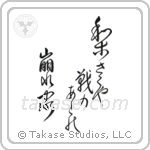
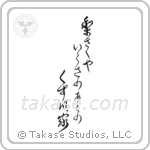
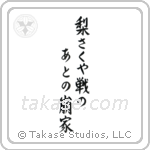
Pear trees in bloom, and a house fallen in, after the battle.
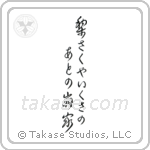
| A pear tree is blooming, By a collapsed house, on an old battlefield | nashi saku ya ikusa no ato no kuzure ie | 梨さくや 戦のあとの 崩れ家 |
| Shiki | shiki | 子規 |
梨さくや戦のあとの崩れ家 (nashi saku ya ikusa no ato no kuzure ie): pear trees in bloom, and a house fallen in, after the battle. 梨 is the pear, whose white blossom is a spring season word; さくや, blooms, and, is the cut; いくさ is battle, and the second の binds after the battle to 崩れ家, a house fallen in. Nothing in the Japanese says old: あと is after, and the after was five months. The word also means the trace of a thing, the ground where it stood; prints of 1908 and 1910 write it 趾 and 跡, as in Bashō's 夢の跡. At Jinzhou (金州), on the Liaodong peninsula, Shiki stood where the battle of the previous November had been fought. The verse stands in his manuscript collection Kanzan Rakuboku under the headnote two verses at Jinzhou. Beside it is its pair, an old pear tree sparse in flower by a leek field. Hekigotō, commenting on the selection Shiki made himself, granted that a real battlefield might have borne grieving words. Then he praised these for their calm: scenes after a war, with nothing pressed. On two of the designs Master Takase brushes いくさ in kana, as Shiki's manuscript does; the words are the same. On two designs she writes 崩家 without the れ, an artistic choice; it reads the same. The English follows R. H. Blyth's, from his Haiku of 1949.
Couldn't add to cart. Please try again.