



Jiun · 自運 · VD6B
Jiun (自運) is the calligrapher's word for writing from one's own invention. As a Shihan, Master Takase has a hand of her own, and these designs are that hand: she draws freely on the classic scripts to create exactly the look she wants.
梨さくや
戦のあとの
崩れ家
nashi saku ya
ikusa no ato no
kuzure ie
shiki 子規
A pear tree is blooming,
By a collapsed house,
on an old battlefield
Pear trees in bloom, and a house fallen in, after the battle.
Master Takase creates this beautiful scroll when your order is placed, personally preparing the ink and brushing your art, which proudly bears her signature and seal. This is an original work of art.
Description
A pear tree is blooming,
By a collapsed house,
on an old battlefield [1]
|
nashi saku ya ikusa no ato no kuzure ie |
梨さくや 戦のあとの 崩れ家 |
| shiki | 子規 |
梨さくや戦のあとの崩れ家 (nashi saku ya ikusa no ato no kuzure ie): pear trees in bloom, and a house fallen in, after the battle.
Masaoka Shiki's verse sets two things side by side and says nothing about either. The pear trees bloom because it is spring. The house has fallen in because a battle passed there. Readers have praised its calm: a scene after a war, with no grief pressed on it. The battle was not long ago. It had been fought five months before.
In the Japanese, 梨, the pear, is the season word, for its white spring blossom, and さくや, blooms, is the cut. あと is after, and it can also mean the traces of a thing, the ground where it stood. The second の ties the house to the battle. Some of the hands write いくさ, battle, in kana, and one writes くずれ in kana too. Some write 崩家 without the れ, an artistic choice that reads the same.
In reading this poem I always think of the landmarks in central Virginia indicating important battles from the civil war. Each time the landscape before me is breathtakingly beautiful. And it is so hard to imagine what had happened there in the past.
People are this way too. Everyone has had difficulties even though the scars don't always show. Many times we only see the person as they are now, a pear tree in bloom, and we forget that each person has fought their share of battles.
Calligraphy Notes:
1) ikusa is commonly written in kanji as 戦 and in hiragana as いくさ. I have used both in the designs.
2) Similarly I have used kuzure in both kanji as 崩れ and in hiragana as くずれ.
Translation Notes:
1) 梨 (nashi) means "pear" and, specifically, "pear tree".
2) さく (saku) in this case means "to bloom".
3) 戦のあと (ikusa no ato) meaning "ruins (remains) of a battle". 戦 (ikusa) means "war; battle; campaign; fight". あと (ato) in this case means "ruins; remains".
4) 崩れ (kuzure) meaning "crumbling; collapse; ruin".
5) 家 (ie) meaning "house; dwelling".
References:
[1] After R. H. Blyth, Haiku, vol. 1 (Hokuseido Press, 1949), p. 177.
The verse is Shiki's own, written in his own hand at 金州 in the spring of 1895, where he had gone as a war correspondent as the Sino-Japanese War was ending, and first printed in 1902 in the selection of his verses he made himself.
We want you to be as happy with the meaning as you are with Master Takase's art. To learn more, visit Philology of 梨さくや戦のあとの崩れ家.
Delivery
Your scroll is brushed when you order it and completed within 1 to 3 business days. It ships by USPS Priority Mail from Master Takase's studio in Washington State, boxed and ready to hang, with a printed page giving the art's English, romaji and Japanese.
Sending it as a gift? Add your message at checkout and we will include it.
Shipping is calculated at checkout from your address; within the United States it is $13 to $23. We ship worldwide, and any import charges for your country are shown at checkout before you pay.
Every order is covered by our 30-day money-back guarantee. If your scroll arrives damaged, or we made an error, we replace it or refund you in full, including shipping. Refund policy
About Our Scrolls
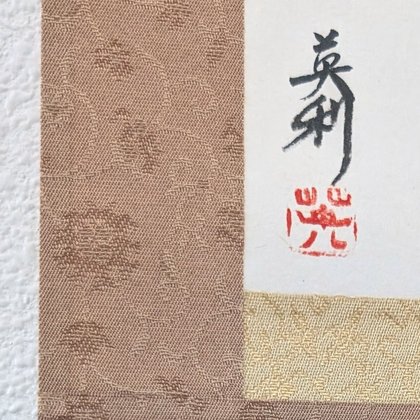
Master Japanese Calligrapher Eri Takase brushes your scroll by hand when you order it. Each scroll bears her red seal, 英利, and her signature.
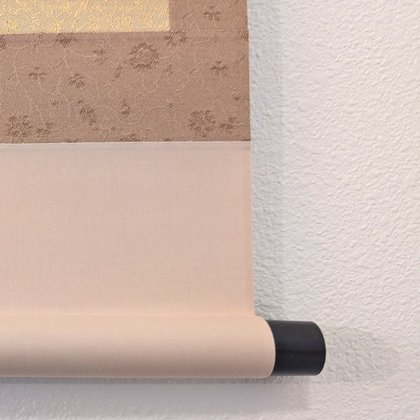
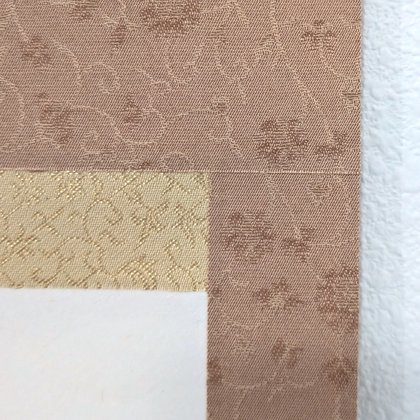
The scrolls are 12 1/4" W × 43" H (31 × 109 cm), with woven damask borders and layered Japanese paper, designed to last generations. The scrolls themselves are made by a scroll maker in Gifu, Japan, and we have worked with them for over two decades.
Eri Takase was born and raised in Osaka, Japan, and holds the rank of Shihan, the highest rank in Japanese calligraphy, from the Bokuteki-kai and the Bunka-shodo. About Master Takase
Related products

Shiki - As I eat a persimmon, a bell rings: Hōryūji柿食えば鐘が鳴るなり法隆寺kaki kueba kane ga naru nari hōryūji

Shiki - Lifting up the hatchet, To cut it down, It was budding鉈あげてきらんとすれば木の芽かなnata agete kiran to sureba konome kana

Shiki - Three thousand, Haiku to examine, Two persimmons三千の俳句を閲し柿二つsanzen no haiku o kemishi kaki futatsu
