

ものいはず客と亭主と白菊と · mono iwazu kyaku to teishu to shiragiku to · Saying nothing, the guest, the host, and the white chrysanthemum
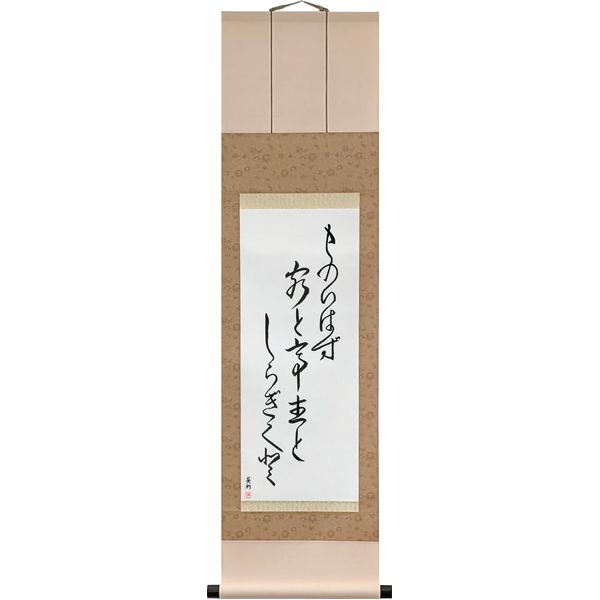
Sold as They spoke no words, / The visitor the host, / And the white chrysanthemum, under Ryōta's name and no translator's · Read mono iwazu kyaku to teishu to shiragiku to · Oldest witness the poet's own collection, 蓼太句集, named as the source by two hands; the earliest witness opened is Shiki's manuscript compilation of 1889 · Sense three who say nothing, joined by the same particle: a guest, a host, and a white chrysanthemum. The flower is the third guest, and the poem is its grammar.
The text as brushed, and its variants
The scroll carries ものいはず客と亭主と白菊と. The witnesses write the first word three ways and mean one: ものいはず in the 1927 大系 and the 1934 encyclopedia, 物いはず and 物言はず in Shiki's manuscript at its two places, ものいはす in Miyamori with the voicing mark dropped, ものいわず in Blyth in modern kana. No witness varies a word. The meter is five, seven, five, with the last と falling on the seventeenth syllable: も・の・い・わ・ず, きゃ・く・と・て・い・しゅ・と, し・ら・ぎ・く・と.
The attribution, as a dated thread
大島蓼太's, and the record is short but it is his own book. Shiki's manuscript compilation of hokku by topic, written in 1889, enters the verse twice, once under 白菊 and once under the grammatical topic と止, verses ending in と, and both times writes the poet and his source in the cell after the verse: 蓼太(蓼太句集). The OCR had rendered the second cell 蓼太刀集也 and the account carried it so, with the garble marked; the leaf, read by eye, is clear. The 1927 日本俳書大系 prints the verse inside its 蓼太句集 section, which is the same book typeset, and the kotobank entry for the poet names 蓼太句集 among his works. So the attribution rests on the poet's own collection, seen through two later hands and not yet at an Edo leaf. Miyamori in 1932, Blyth from 1949, and Haldane in 2006 all give it to Ryōta. Nobody has given it to anyone else.
The words
ものいはず is saying nothing, the verb 言ふ negated with ず, and it is the only verb in the poem; it governs everything after it. 客と亭主と is the guest and the host, joined by と, and the third と after 白菊, the white chrysanthemum, puts the flower in the same list on the same terms: three who say nothing. 白菊 is an autumn season word. Miyamori's note has the grammar exactly: "white chrysanthemums" are imagined to be silent as well as "host and guest." The verse is a list with no verb but the first, and that verb is a negative. As words the line says: Saying nothing: the guest, and the host, and the white chrysanthemum.
A history, from the earliest witness
Before 1787. 大島蓼太, 蓼太句集, the poet's own collection. Not opened at any Edo print; named as the verse's source by Shiki's manuscript and reproduced by the 1927 大系. The poet, by the kotobank entry: 1718–1787, 雪中庵, born in Shinano, pupil of 桜井吏登, a power in the Edo haikai world who preached a return to Bashō and is said to have had three thousand pupils. No witness dates the verse. [kotobank 大島蓼太, read as text]
1889. 正岡子規, 発句類題全集, a manuscript compilation of hokku by topic, in Shiki's hand. Under 白菊, with the topic's headwords 器物, 衣冠, 神人 beside it: 物いはず客と亭主と白菊と 蓼太(蓼太句集), between 白菊や美人の開く十の指 by 曽嵐 and 白菊やあるじの花に暮残る (the OCR layer reads 白菊の), the latter marked 同, the same poet. And under と止, verses ending in と: 物言はず客と亭主と白菊と 蓼太(蓼太句集), between 稲妻や石に入日と出づる日と (the OCR layer reads 稲妻切) by 六阿 and 罌粟蒔くや此月の夜にあやかれと by 流水. Two entries, one source, in the compiler's own hand. [NDL pid 2586429, koma 197, and pid 2586452, koma 240, both read by eye; text at lab.ndl.go.jp/dl/api/page/2586429_197 and 2586452_240]
1927. 勝峰晋風, 日本俳書大系, volume 11, 天明名家句選, the 蓼太句集 section. ものいはず客と亭主と白菊と, in the collection typeset whole. [NDL pid 1194197, koma 148, OCR; text at lab.ndl.go.jp/dl/api/page/1194197_148]
1934. 小原国芳, 児童百科大辞典, an encyclopedia for children. The verse in a list of examples, with 蓼太 after it in the OCR's run, as every verse in the list carries its poet. [NDL pid 1740507, koma 21, OCR; text at lab.ndl.go.jp/dl/api/page/1740507_21]
Today. The archive holds four books that carry the verse before 1945, and the National Diet Library's catalogue names a 1975 集英社 reprint of the 蓼太句集. [harvest_index.py lookup --id 261; ndlsearch.ndl.go.jp opensearch for 蓼太句集, 2026-09-04]
The sense, across two centuries
One reading, and it belongs to the translators, because no Japanese commentary among what was opened stops at this verse. Miyamori in 1932 supplies a scene: host and guest, invited to view the white chrysanthemums, are smitten by their beauty and gazing at them speechless, and the flowers silent with them. Blyth, in the essay collected as Poetry and Zen, makes the verse an illustration of a tendency in Buddhism towards simplicity and non-intellectuality, as against the philosophical one; in Haiku vol. 4 he prints it under chrysanthemums, page 147, and follows it with a short passage on the flower the Buddha held up, which did not preach; in vol. 1, page 192, it stands beside Zhuangzi on the Way that does not speak. Both readings are of the same grammar: three parties, one silence, and the flower admitted to the company as an equal.
What is not a source
Nothing has been set beside this verse by the sources opened; it travels alone. The only company it keeps is Shiki's, who filed it once for its flower and once for its grammar.
The verse in English
The bilingual dictionaries of the Meiji shelf were not checked for this verse. Henderson, Ueda, Keene, Sato, Shirane, Hass and Reichhold were searched on the shelf and do not carry it.
1932. 宮森麻太郎 Asatarō Miyamori, An Anthology of Haiku Ancient and Modern, Maruzen, Tokyo, entry 502, page 510. The Japanese, ものいはす客と亭主と白菊と, a title, White Chrysanthemums, the rendering, They spoke not: host and guest / And white chrysanthemums, and the note quoted above. His chrysanthemums are plural and his silence is past tense. [docs/research/papers, Miyamori 1932, page 510 by the file's page marker, read as text; no ASIN collected]
1949 and 1952. R. H. Blyth, Haiku, volume 1 and volume 4, Hokuseido Press, Tokyo. In the first volume: They spoke no word, / The visitor, the host, / And the white chrysanthemum. In the fourth, under chrysanthemums, the middle line reordered: They spoke no word, / The host, the guest, / And the white chrysanthemum. No word, singular, is the absolute the Japanese ず has. [docs/research/papers, Blyth 1949 vol. 1 and 1952 vol. 4, read as text; no ASIN collected]
1967. Silent Flowers, a Hallmark gift anthology of haiku. Blyth's 1949 lines with the commas changed, and no translator named. The house page is not the first to borrow him. [docs/research/papers, as the account records from the shelf; read as text]
2006, collected 2022. Michael Haldane, in Bashō and the Haikuists, Delphi Classics. not speaking a word, / the guest, the host, / and the white chrysanthemum, with the romaji line by line. The one modern rendering on the shelf, and the one that keeps the Japanese present tense. [docs/research/papers, Delphi Classics 2022, read as text; not cited by the account and found on the shelf this session; no ASIN collected]
2022. R. H. Blyth, Poetry and Zen, Shambhala, a posthumous collection of his essays. The 1949 rendering again, with the passage on Buddhist simplicity quoted above. [docs/research/papers, Blyth 2022, read as text]
Today. The house English, They spoke no words, / The visitor the host, / And the white chrysanthemum, is Blyth's 1949 rendering with words for word and a comma dropped, under the poet's name alone. A rendering of this line has to keep the three と as one list, so that the flower is a party and not a setting, and it has to keep the silence absolute; Blyth's no word does, and the page's no words very slightly does not. Haldane's present tense is the one thing later English has added.
A reading
The poem is its grammar, and I read it as a poem about equality. Three nouns are joined by the same particle and governed by the same negative verb, and the effect is that the chrysanthemum is not looked at but sat with; it is one of three who have nothing to say. Miyamori's scene, in which the two people are struck dumb by the flower's beauty, puts the flower back on a pedestal that the grammar has taken away, and Blyth's sermon on non-intellectuality is true but larger than the verse. The verse is smaller and better than either: an autumn afternoon, a visit, and a silence that is comfortable because the third party in it is a flower. The account is thin for want of an Edo leaf of the 蓼太句集, not for any doubt; the attribution stands on the poet's own book through two hands, and text and romaji stand. The page's English is Blyth's and should say so or become a house rendering; if the house renders it, no word is the word. Signed, 典, 2026-09-05.
How this was read
By eye at width 3600: Shiki's manuscript at both its leaves, the 白菊 topic and the と止 topic, where 蓼太(蓼太句集) was read in the compiler's hand. By OCR from the archive's text layer: the 1927 大系 and the 1934 encyclopedia. By text layer from the shelf: Miyamori at his page; Blyth in three books; Haldane; the 1967 anthology as the account records it; the kotobank entry; the catalogue search. Not opened: the 蓼太句集 in any Edo print or in the 1975 reprint, which would show the verse in the poet's own ordering with any headnote and its neighbors; any Japanese commentary, none being among the four witnesses; the 1927 and 1934 leaves as images. A bracket of the form pid P, koma N resolves as text at lab.ndl.go.jp/dl/api/page/P_N and as an image at dl.ndl.go.jp/api/iiif/P/R<N, seven digits>/full/3600,/0/default.jpg; the two manuscript leaves were fetched at that address, and being manuscript they check by eye alone. The full apparatus, with every address, is in the account.
Supersession 2026-09-14 (s92)
A read-only worker resolved this account's addresses (citation_checks_2026-09-14/history_mono_iwazu_261_2026-09-05.check.md): 22 claims, 13 at the address, 4 it could not open (the by-eye attribution cells, kotobank, the catalogue). Corrected above, each re-opened by me: the 1934 encyclopedia's OCR run carries 蓼太 after the verse (pid 1740507 koma 21), so the verse is attributed there, not unattributed; Blyth's vol. 4 does not leave the verse without comment — a passage on the Buddha's flower that did not preach follows it on page 147 — and his vol. 1 occurrence (page 192, They spoke no word. with a full stop) is in a Zhuangzi passage, not a chrysanthemum listing; two neighboring verses quoted from the by-eye reading now carry the OCR layer's differing particles beside them. Not yet read by a person.
References
Each witness is cited in the account above, at the frame or entry where it was read. A linked list follows when the record for this text is completed.