


Jiun · 自運 · VD6B
Jiun (自運) is the calligrapher's word for writing from one's own invention. As a Shihan, Master Takase has a hand of her own, and these designs are that hand: she draws freely on the classic scripts to create exactly the look she wants.
ものいはず
客と亭主と
白菊と
mono iwazu
kyaku to teishu to
shiragiku to
ryōta 蓼太
They spoke no words.
The visitor, the host,
And the white chrysanthemum.
Saying nothing, the guest, and the host, and the white chrysanthemum.
Master Takase creates this beautiful scroll when your order is placed, personally preparing the ink and brushing your art, which proudly bears her signature and seal. This is an original work of art.
Description
They spoke no words.
The visitor, the host,
And the white chrysanthemum. [1]
|
mono iwazu kyaku to teishu to shiragiku to |
ものいはず 客と亭主と 白菊と |
| ryōta | 蓼太 |
ものいはず客と亭主と白菊と (mono iwazu kyaku to teishu to shiragiku to): saying nothing, the guest, and the host, and the white chrysanthemum.
Ōshima Ryōta's verse is a visit where three share a silence. The white chrysanthemum is one of the company, and it says nothing, like the guest and the host. With a flower as the third, the silence is a comfortable one.
In the Japanese, the verse has one verb, and it is a negative: ものいはず, saying nothing. The small word と, which means and, comes three times, so the guest, the host and the white chrysanthemum make one list. The flower, 白菊, marks the season as autumn. Some designs spell a word another way, writing 言はず with the kanji 言, or the flower's name in kana, しらぎく. The words are the same.
One can imagine this as a setting for a tea ceremony - the host and the guest appreciate the white chrysanthemums in its place of honor.
Calligraphy Notes:
1) Students of Japanese know that when the hiragana は (ha) is used as a grammatical particle it is read "wa". So, for example, the sentence これはペンです is read "kore wa pen desu" and not "kore ha pen desu".
Prior to hiragana being codified in modern times, the hiragana は was also used in words to represent the sound "wa". In these designs, we use the convention at the time of the poet so instead of the modern いわず (iwazu), we use the now archaic いはず (iwazu). And to emphasize, the reading is the same, only the characters are different.
Translation Notes:
ものいはず
客と亭主と
白菊と1) もの (mono) - meaning "things; something; anything; everything; nothing;".
2) いはず (iwazu) - not spoken. Negative of the verb 言う (iu) meaning "to say; to speak"
ものいはず thus becomes "nothing was spoken".
3) 客 (kyaku) - meaning "visitor; guest".
4) と (to) - meaning "and".
5) 亭主 (teishu) - meaning "master; lord; host".
6) と (to) - see (4) above.
7) 白菊 (shiragiku) - meaning "white chrysanthemum".
8) と (to) - see (4) above.
References:
[1] After R. H. Blyth, Haiku, vol. 1 (Hokuseido Press, 1949), p. 192.
The verse is Ōshima Ryōta's, first printed in 1769 among the chrysanthemum verses in the autumn book of his own collection, 蓼太句集 (Ryōta kushū), published in Edo in his lifetime.
We want you to be as happy with the meaning as you are with Master Takase's art. To learn more, visit Philology of ものいはず客と亭主と白菊と.
Delivery
Your scroll is brushed when you order it and completed within 1 to 3 business days. It ships by USPS Priority Mail from Master Takase's studio in Washington State, boxed and ready to hang, with a printed page giving the art's English, romaji and Japanese.
Sending it as a gift? Add your message at checkout and we will include it.
Shipping is calculated at checkout from your address; within the United States it is $13 to $23. We ship worldwide, and any import charges for your country are shown at checkout before you pay.
Every order is covered by our 30-day money-back guarantee. If your scroll arrives damaged, or we made an error, we replace it or refund you in full, including shipping. Refund policy
About Our Scrolls
Master Japanese Calligrapher Eri Takase brushes your scroll by hand when you order it. Each scroll bears her red seal, 英利, and her signature.
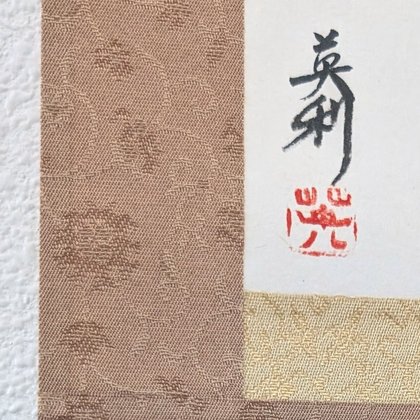
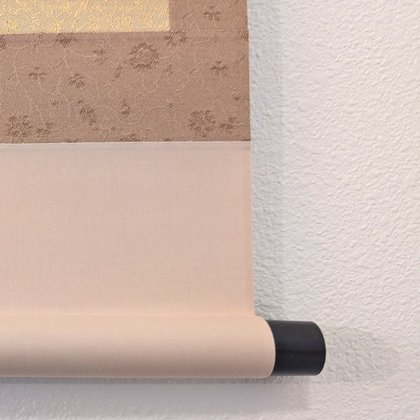
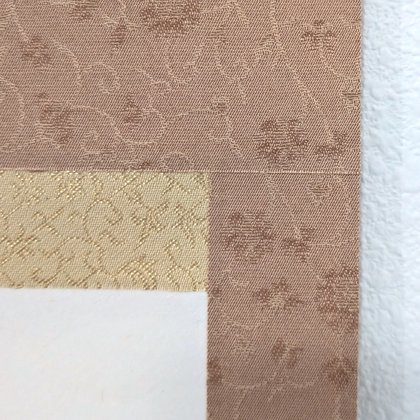
The scrolls are 12 1/4" W × 43" H (31 × 109 cm), with woven damask borders and layered Japanese paper, designed to last generations. The scrolls themselves are made by a scroll maker in Gifu, Japan, and we have worked with them for over two decades.
Eri Takase was born and raised in Osaka, Japan, and holds the rank of Shihan, the highest rank in Japanese calligraphy, from the Bokuteki-kai and the Bunka-shodo. About Master Takase
Related products

Issa - This dewdrop world, is a dewdrop world, and yet露の世は露の世ながらさりながらtsuyu no yo wa tsuyu no yo nagara sari nagara

Issa - Snail, ever so slowly climb, Mt Fuji蝸牛そろそろ登れ富士の山katatsuburi sorosoro nobore fuji no yama

Bashō - How admirable, to see lightning, and not think life is fleeting稲妻にさとらぬ人の貴さよinazuma ni satoranu hito no tattosa yo
