

苦の娑婆や桜が咲けば咲いたとて · ku no shaba ya sakura ga sakeba saita tote · This world of suffering; and the cherry blooms, and so it has bloomed
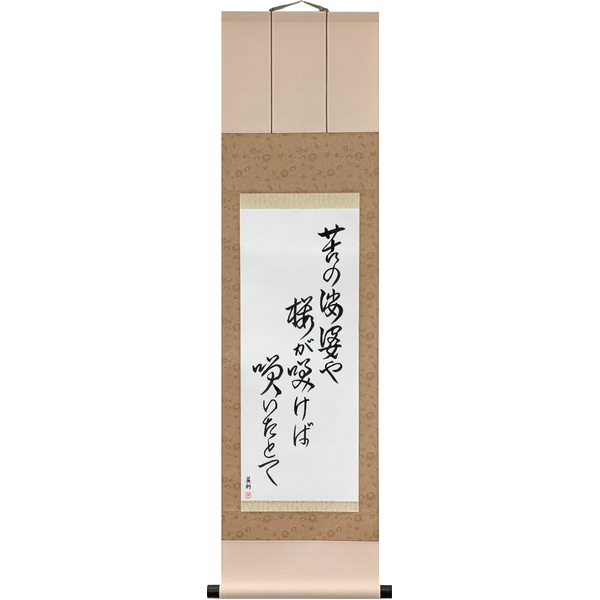
Sold as Hamill's This suffering world: / the flowers will blossom, but / even at that . . ., credited, under Issa's name, with the occasion written upon the death of his child · Read ku no shaba ya sakura ga sakeba saita tote · Oldest witness Issa's own verse diary だん袋, where the verse sits between entries dated the twelfth and fifteenth of the second month of 1823, read at the leaf in the 1930 typeset · Sense this world is a place of suffering; the cherry has bloomed, and what of it. The verse we brush is the English tradition's text of it; Issa's own editions read a plainer line, the flower opens, so it opens, and the history says so.
The text as brushed, and its variants
The scroll carries 苦の娑婆や桜が咲けば咲いたとて, and the second and third phrases are two texts. Every Japanese edition of Issa opened reads 花が開けばひらく迚 or its equivalents, if the flower opens, it opens, and so: 大塚's 1902 全集, read by eye, 苦の娑婆や花が開けば開くとて; 藤井乙男's 1906 essay; 勝峰's 1921 全集 twice; 島田's 1925 selection; 勝峯's 1926 発句集; 藤井紫影's 1935 edition; 半田's 1935 dated edition, read by eye, 花が開けば開くとて; and the 1930 一茶叢書, printed from the poet's own diaries, read by eye, 苦の娑婆や花が開ばひらく迚. One Japanese witness reads the form we brush. The 1928 index of the 日本俳書大系, read by eye, files クノシ (選抄) 苦の娑婆や櫻が咲ばさいたとて, with the tag 選抄, which on that page marks the verses drawn from the 大系's own selection of Issa. That is the form Miyamori prints second, beside the editions' form, in 1932; the form Blyth prints alone from 1949; the form Hamill prints alone in 1997; and the form the house brushes. Miyamori, the one editor who names the fork, calls the two readings one verse with exactly the same meaning. He is right about the sense. Which Issa wrote is in his manuscripts and in the 選抄's source, neither opened, and the weight of the Japanese editions, including the one set from his own hand, is on 花が開けば. The first phrase is one text everywhere. The meter of the brushed form is five, seven, five: く・の・しゃ・ば・や, さ・く・ら・が・さ・け・ば, さ・い・た・と・て; the editions' form runs five, seven, five: は・な・が・ひ・ら・け・ば, ひ・ら・く・と・て.
The attribution, as a dated thread
Issa's, at every witness that names a poet, and in his own verse diary. The 1930 一茶叢書, which prints Issa's diaries from the manuscripts, carries the verse in the section だん袋 in a dated run, read by eye: an entry headed 田中河原 文政六、二月十二日, then a handful of verses, then 苦の娑婆や花が開ばひらく迚, then 齒ももたぬ口に咥へてつぎ穗哉, and then the next date, 二月十五日. So the verse was written between the twelfth and the fifteenth of the second month of 文政6, 1823, in the poet's sixty-first year by the old count. The account written before this history had found the dated run and said no date sat adjacent; the leaf shows the two dates three verses apart with ours between them. 半田's dated edition of 1935, which tags each verse with its era where the manuscripts allow, leaves this one untagged, and the account had taken that for silence; the diary is not silent. 藤井乙男 in 1906 made the verse the type of Issa's proverb-flavored haiku, 市島謙吉 in 1929 listed it among his verses that lodge a truth, and the English translators from Miyamori to Hamill all name Issa. The page's occasion, written upon the death of his child, stands on nothing opened: no witness gives one, and the diary's date is a date, not a cause. Whether a death of Issa's stands near the second month of 1823 is a question for his chronology, which has not been opened here.
The words
苦の娑婆 is the world as a place of suffering. 娑婆 is the Buddhist word for this world, from Sanskrit sahā, the land to be endured; Miyamori gives the derivation at the page and adds that in ordinary use it simply means the world. The phrase is Issa's stock, not a coinage for this verse: the 1908 全集 carries 苦の娑婆やヤレ花見ソレ月見とて, this suffering world: now flower-viewing, now moon-viewing, and 苦の娑婆と艸さへ伏すか秋の暮 on the same words. 桜が咲けば咲いたとて is if the cherry blooms, well, it has bloomed, and, with とて the concessive shrug at the end, even granting that; the editions' 花が開けばひらく迚 says the same with flower and open, in the plainer words 藤井乙男 praised Issa for, 俗語を愛す, he loved the common word. The page's two readings, pessimistic and optimistic, are both in the とて: the particle carries a resignation that can be heard either way, and that is the verse's mechanism rather than a translator's choice. As words the brushed line says: This world of suffering; and if the cherry blooms, so it has bloomed.
A history, from the earliest witness
1823, the second month. 小林一茶, だん袋, the verse diary, as the 1930 一茶叢書 prints it. 田中河原 / 文政六、二月十二日 / 畠打や通してくれる寺參り … then 苦の娑婆や花が開ばひらく迚, then 齒ももたぬ口に咥へてつぎ穗哉, then 二月十五日 and せうばんに我らもごろり涅槃哉. The verse in the poet's own run, between two dates three days apart. [NDL pid 1186739, koma 58, printed pages 528–529, read by eye; text at lab.ndl.go.jp/dl/api/page/1186739_58]
1902. 大塚甲山, 一茶俳句全集. 苦の娑婆や花が開けば開くとて, between 今の世や猫も杓子も花見笠 and さる人は病氣を遣ふ花見かな (the OCR layer reads 遺ふ, and the leaf at this resolution does not settle the one stroke between them); on the same page 刈萱堂 花の世は地藏菩薩も親子かな and 有やうは我も花より團子かな (the OCR layer reads 圓子). The earliest print on the desk. [NDL pid 874848, koma 37, printed pages 68–69, read by eye; text at lab.ndl.go.jp/dl/api/page/874848_37]
1906. 藤井乙男, 俗諺論, an essay on proverbs. 近世の俳人にして巧に諺を用ひしは俳諧寺一茶なり。一茶は滑稽を好み、俗語を愛す, of the poets of the recent age, the one who used proverbs skillfully was Issa; he loved humor and loved the common word, and this verse among his examples. [NDL pid 902816, komas 166–167, OCR; text at lab.ndl.go.jp/dl/api/page/902816_167]
1921 to 1935. 勝峰晋風's 新選一茶全集 and 一茶発句集; 島田青峰's 一茶選集; 藤井紫影's 名家俳句集; 半田良平's 季題別年代附. Six printings of 花が開けばひらく迚 or 開けば開くとて, 半田's without an era tag among tagged neighbors, read by eye. [NDL pids 970100 komas 24 and 244; 1019188 komas 17 and 74; 977663 koma 52; 1259717 koma 432; 1034501 koma 18, printed pages 22–23, read by eye; text at lab.ndl.go.jp/dl/api/page/1034501_18 and the others]
1928. 勝峰晋風, 日本俳書大系, the index volume. クノシ (選抄) 苦の娑婆や櫻が咲ばさいたとて, the one Japanese witness to the brushed form, tagged as from the 大系's own selection. [NDL pid 1179400, koma 266, printed pages 200–201, read by eye; text at lab.ndl.go.jp/dl/api/page/1179400_266]
1929. 市島謙吉, 春城漫筆. The verse among Issa's that carry 含蓄 and 諷刺 and of themselves lodge a deep truth, beside 露の世を押しあひへし合萩の花; 以上一茶. [NDL pid 1174229, komas 212–213, OCR; text at lab.ndl.go.jp/dl/api/page/1174229_212]
Today. The kotobank entry for the poet gives his dates, 1763–1828. The archive lists thirty-one books carrying the verse before 1945; twelve were opened and two of those carry other verses on the same phrase, not this one. [kotobank 小林一茶, read as text; harvest_index.py lookup --id 251 --year-to 1945 --located-only]
The sense, across a century
One sense and two tempers. 藤井乙男 in 1906 hears a proverb in haiku, the common word doing the work; 市島 in 1929 hears a truth with satire in it; Miyamori in 1932 gives the Sanskrit and the plain meaning and says the two Japanese forms mean the same; Blyth from 1949 makes it a statement of the relation between pain and beauty, the major problem, not only of poets, but of all men, and says in the insolubility of the problem lies the meaning; Hamill in 1997 renders it three ways in one book and hears resignation, a shrug and a wry laugh by turns. The page's own paragraph on the two readings is the best sentence on the page, and it is right: the とて allows both, and the verse does not tell you which. What the page adds, that beauty's audacity to exist made Issa's pain the greater, is not Blyth's and not in the record.
What is not a source
The occasion the page gives, the death of a child, stands on nothing opened; the diary gives a date and not a cause. The page's Blyth, beauty had the audacity to be in the same world made Issa's pain all the greater, is a paraphrase in quotation's clothing: the word audacity occurs nowhere in any Blyth file on the shelf, and the passage it paraphrases says the problem is insoluble, not that the flowers add to the pain. Lanoue's rendering and Rev. Kodani's gloss of 娑婆, both linked by the page, were not opened; Miyamori's gloss is on the shelf and says the same thing in fewer words. The other 苦の娑婆 verses are the phrase's company in Issa, not sources for this one.
The verse in English
The bilingual dictionaries of the Meiji shelf were not checked for this verse. Henderson, Hass, Ueda, Keene, Sato, Shirane and Reichhold were searched on the shelf and do not carry it.
1932. 宮森麻太郎 Asatarō Miyamori, An Anthology of Haiku Ancient and Modern, Maruzen, Tokyo, page 538. Both Japanese forms printed side by side, 苦の娑婆 花が開けば ひらくとて and 苦の娑婆 櫻が咲けば さいたとて, then Ours is a world of suffering, / Even if cherry-flowers bloom, the Sanskrit derivation, and the judgment that the two forms have exactly the same meaning. [docs/research/papers, Miyamori 1932, printed page 538 by the running heads of the file's page-marked layer, read as text; no ASIN collected]
1949 to 1981. R. H. Blyth, Haiku, volume 1 and later printings; and Poetry and Zen, Shambhala, 2022. A world of grief and pain, / Even when cherry-blossoms / Have bloomed, with the sentences on pain and beauty quoted above; and in the essays, A world of grief and pain: / Flowers bloom: / Even then…., with the remark that the loneliness of Issa is that of Bashō, but with less of nature and more of man. Blyth prints the Japanese as 桜が咲けばさいたとて. [docs/research/papers, Blyth 1949 and the 1981 printing, and Blyth 2022, read as text; no ASIN collected]
1997. Sam Hamill, The Spring of My Life and Selected Haiku, Shambhala. Three renderings in one book: This suffering world: / the flowers will blossom, but / even at that . . .; A world of trials, / and if the cherry blossoms, / it simply blossoms; Pain and suffering— / even if the old cherry / had somehow blossomed. The first is the house page's, quoted to the word and credited. [docs/research/papers, Hamill 1997, read as text; no ASIN collected]
Today. The house page quotes Hamill correctly and credits him, which is right. A rendering of this line has to keep the shrug of とて, and the page's own two-readings paragraph shows it knows that. What the page should not carry is a paraphrase dressed as Blyth's words, or an occasion no witness gives.
A reading
The attribution is sound and the text we brush is Issa's verse in the form the English tradition carries; one Japanese index carries it too, so it is not a translator's invention, and Miyamori is right that the two forms mean one thing. But the poet's editions, and the one printed from his own diary, read the plainer line, and a page that sells the verse as Issa's should say so in a sentence: the editions print the flower opens, and the cherry blooms is the form the English took up. I would not change the design; a scroll is not an edition. I would cut written upon the death of his child until a witness carries it, and I would quote Blyth or drop him. The diary gives what the page wanted and could not find: a date, the second month of 1823, three days wide, in the poet's own hand as the 1930 editors set it. Whether a grief stands behind that month is a question the chronology can answer and the verse cannot; the verse, read as words, is a man looking at a cherry in bloom and refusing to be consoled by it, which needs no death to be true. Signed, 典, 2026-09-05, with the fork recorded and the diary's date the new footing.
How this was read
By eye at width 3600: the 1930 叢書 at the だん袋 run with its two dates, pages 528–529; the 1902 全集 at the verse, pages 68–69; the 1928 index at クノシ, pages 200–201; 半田's 1935 edition at the 花 run, pages 22–23. By OCR from the archive's text layer: 藤井乙男 1906, the 1908 全集 at three komas where the verse is absent and its kin present, the 1916 index likewise, 勝峰 1921 and 1926, 島田 1925, 市島 1929, 藤井紫影 1935. By text layer from the shelf: Miyamori, Blyth in four books, Hamill. Not opened: Issa's diary in manuscript or facsimile at the 1823 run, and his chronology for that year, which together would settle the occasion; the source of the 大系's 選抄 text with 櫻が咲ば; Lanoue's page and Kodani's essay, both linked by the page; the 1926 発句集's 善光寺 note at koma 17 as an image; nineteen books the archive lists. A bracket of the form pid P, koma N resolves as text at lab.ndl.go.jp/dl/api/page/P_N and as an image at dl.ndl.go.jp/api/iiif/P/R<N, seven digits>/full/3600,/0/default.jpg; the four leaves read by eye were fetched at that address. The full apparatus, with every address, is in the account.
Supersession 2026-09-14 (s92)
A read-only worker resolved this account's addresses (citation_checks_2026-09-14/history_ku_no_shaba_251_2026-09-05.check.md): 16 claims, 8 at the address, 6 it could not open. Corrected above: the brushed form's meter is five, seven, five (さ・く・ら・が・さ・け・ば is seven, さ・い・た・と・て five), where s39 had split it five, eight, five against its own kana; Miyamori's entry is on printed page 538 by the running heads; the 1935 藤井 citation narrows to koma 432. Re-opened by me where the worker lacked the koma: all six Taishō and early-Shōwa printings cited for 花が開けばひらく迚 carry it at the koma given (970100 komas 24 and 244, 1019188 komas 17 and 74, 977663 koma 52, 1259717 koma 432). Standing from the s91 answer to 照: the house title is Blyth's, Haiku vol. 1 page 177, and Hamill's book carries the verse three times. Not yet read by a person.
References
Each witness is cited in the account above, at the frame or entry where it was read. A linked list follows when the record for this text is completed.