

春の海終日のたりのたり哉 · haru no umi hinemosu notari notari kana · The spring sea, all day long, swelling and falling, swelling and falling
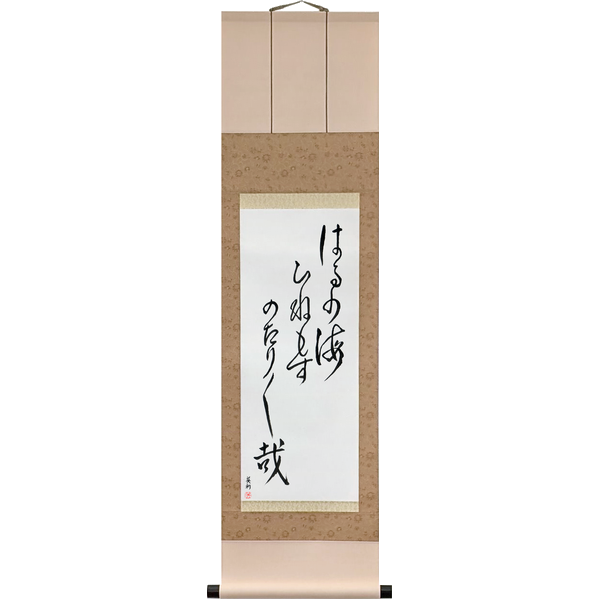
Sold as The spring sea / all day ebb and flow / ebb and flow, a house rendering, under Buson's name · Read haru no umi hinemosu notari notari kana · Oldest witness 嘯山's anthology 俳諧古選 of 1763, the verse's first print by 潁原's account and Miyamori's, not opened; the earliest witness on the desk is a picture-book of 1797 with the verse inscribed on its view of Edo bay · Sense the spring sea heaving slowly all day, in place. Every Japanese reader and every translator hears a swell; the page's ebb and flow is the tide, a different motion on a different clock.
The text as brushed, and its variants
The scroll carries 春の海終日のたりのたり哉, and the witnesses write one text four ways. 終日 and ひねもす are one word, the kanji read hinemosu, as the page's own explanation says: 終日 in the 1797 picture-book, the 1906 annotated edition, 岡野 in 1924, the 1935 edition of the 句集 and 潁原 in 1943; ひねもす in the manuscript miscellany, 鳴雪 in 1906, 沼波 in 1909, the 三千句 of 1925 and the 1919 dictionary. 哉 and かな are one particle: 哉 in the 1935 edition, 潁原, the miscellany and the 三千句; かな in the 1797 book, the 1906 edition, 岡野 and the dictionary. In nine witnesses the text layer renders the repeated のたり as 〓〓, which is the OCR's rendering of the iteration mark 〳〵 the printers used and the 1919 dictionary spells out. The design's writing, 終日 with 哉, is the 1935 名家俳句集's and 潁原's. No witness varies a word. The meter is five, seven, five: は・る・の・う・み, ひ・ね・も・す・の・た・り, の・た・り・か・な.
The attribution, as a dated thread
Buson's, at every witness, and from the start. 潁原退蔵's 1943 biography, read by eye, places the verse among the two or three of Buson's in print in the years after his return to Kyoto: 同年刊行の『俳諧古選』(嘯山編)に、「柳ちり」の舊作と共に 春の海終日のたりのたり哉 蕪村 等の二三句が收められて居るのみである (the OCR layer reads 「柳らり」 at both mentions; 「柳ちり」 is the by-eye reading), in the 俳諧古選 published the same year, edited by 嘯山, together with the older "柳ちり" verse, two or three verses such as "the spring sea, all day, notari notari" are all that are collected; the year is 寶暦十三年, 1763, named in his previous sentence. Miyamori in 1932 says the anthology was edited in 1763 and the verse written in that period; Shirane in two books says the poem was published in 1762. The difference is one year and one calendar, and the anthology has not been opened. From 1763 the attribution never wavers: the 1797 東海道名所図会 inscribes the verse with 蕪村's name on its picture of the teahouses at 高縄 with Edo bay before them; the manuscript 鶏[ソウ]録 (the second character unresolved in the catalogue) sets it beside a painted screen of the same bay; the 1919 大日本国語辞典 cites it as its example for the word のたりのたり with the source 蕪村句集; and every edition of Buson prints it. In English, Miyamori, Yasuda, Blyth, Buchanan, Hass and Shirane give it to Buson without a doubt.
The words
春の海 is the spring sea, the season word; Shirane calls it a relatively calm, open surface. 終日, hinemosu, is all day long; Shirane hears in it a sense of time stretching out forever, and Blyth notices that the sounds of hinemosu almost reverse the sounds of haru no umi. のたりのたり is the verse, and the 1919 dictionary defines it from the verse: のたり-のたり〔前條の重言〕のたるさま、うねり行くさまにいふ語, the doubling of のたり: a word for the manner of a slow heave, of going in swells, with this line as its citation. 鳴雪 in 1906 says what kind of sea it is: neither violent waves nor none, 波も徒然らしい樣, a sea whose waves look somewhat idle. 哉 closes it. As words the line says: The spring sea; all day long, swelling and falling, swelling and falling. The page's own gloss, undulating; rolling slowly; gently swelling, is the dictionary's sense exactly. The page's English line, ebb and flow, is the tide's word: the sea going out and coming in twice a day, not the sea heaving in place all day, which is the poem.
A history, from the earliest witness
1763. 嘯山, 俳諧古選, an anthology. The first print, by 潁原 and Miyamori, with the editor's judgment on the verse, 平淡而逸, plain, calm, and free, which 潁原 quotes. Not opened; the year is 潁原's. [潁原 1943, below]
1797. 秋里籬島, 東海道名所図会, the illustrated gazetteer of the Tōkaidō. A double-page picture, signed 政美, of the teahouses at 高縄 on the road out of Edo with the bay before them, boats moored and under sail; and in the sky of the left-hand page, in a cursive hand, the verse with the poet's name, 春の海終日のたり〳〵かな 蕪村, the repeat mark 〳〵 rendered 十一 by the OCR layer. The verse inscribed on the view. [NDL pid 2559319, koma 69, read by eye; text at lab.ndl.go.jp/dl/api/page/2559319_69]
Undated. 駒井乗邨, 鶯宿雑記; 山口済, 鶏[ソウ]録; two manuscript miscellanies. The first carries the verse with the note 悠々無涯; the second, in its entry for 御殿山, sets it beside a picture of the bay and a screen. [NDL pid 10303817, komas 93–95; pid 2579217, komas 87–89; OCR; text at lab.ndl.go.jp/dl/api/page/10303817_94 and 2579217_88]
1906. 内藤鳴雪, 蕪村七部集俳句評釈; 岩本梓石, 蕪村俳句全集 標註. 鳴雪's reading: 春の海を見て居ると朝から晩迄一日のたり〳〵と波が打つてゐる (the OCR layer prints 〓〓 for the repeat mark), watching the spring sea, from morning to night all day the waves beat notari notari, neither fierce nor absent, the calm around them felt through them, 我と海と同化してしまふやう, until I and the sea become one, and it makes no difference whether one looks from a boat, the shore or a hill. 岩本 prints the verse under 春の海 without a gloss. [NDL pid 875711, komas 19–21; pid 875714, koma 18; OCR; text at lab.ndl.go.jp/dl/api/page/875711_20 and 875714_18]
1909. 沼波瓊音, 俳句の作り方, a manual. The verse as the example of thought and sound in harmony, 其想に、其調に, so that the reader is brought by both to a slow and spacious feeling. [NDL pid 994608, koma 62, OCR; text at lab.ndl.go.jp/dl/api/page/994608_62]
1919. 上田万年 and 松井簡治, 大日本国語辞典. The entry quoted above, under のたり-のたり, with the source 蕪村句集 and the verse spelled out, ひねもすのたりのたりかな. [NDL pid 954648, koma 67, printed pages 128–129, read by eye; text at lab.ndl.go.jp/dl/api/page/954648_67]
1924. 岡野知十, 蕪村 その他 俳諧一家言. 彼の『春の海終日のたり〳〵かな』もいかにも春の氣分かも知れないが、土佐繪の海を見る, his "spring sea" may indeed be a spring mood, but one sees the sea of a Tosa-school painting, not of 文晁's brush: the verse as evidence that Buson's sensibility was Kyoto's, not Edo's. [NDL pid 925072, koma 135, OCR; text at lab.ndl.go.jp/dl/api/page/925072_135]
1925 and 1935. 蕪村三千句; 藤井紫影, 名家俳句集. The verse in place in both, ひねもす in the one and 終日 in the other. [NDL pid 924926, koma 11; pid 1259717, koma 222; OCR; text at lab.ndl.go.jp/dl/api/page/924926_11 and 1259717_222]
1943. 潁原退蔵, 蕪村, a biography. The passage quoted above, and the judgment: 嘯山は「平淡而逸」と評して居るが、誠に平明の中によく俗を脱して高いものがある, 嘯山 called it "plain, calm and free", and truly in its plainness there is something that well escapes the common and stands high; and the frame, that in these years Buson's work was painting and haikai was his 餘技, a side art, and that the 俳諧古選's editor listed 太祇 and 蕪村 as Kyoto men not yet recognized as a school. [NDL pid 1128419, komas 72–74, koma 73 read by eye, printed pages 128–129; text at lab.ndl.go.jp/dl/api/page/1128419_73]
Today. The archive lists two hundred and eighty-two books carrying the verse before 1945, twelve opened. The kotobank entry for the poet was not reached. [harvest_index.py lookup --id 259 --year-to 1945]
The sense, across two centuries
Everyone praises the verse and, as Blyth noticed, there is a surprising disagreement as to what the verse particularly refers to: Shiki read it as the light waves on the sand, 鳴雪 as the idle swell seen from anywhere, 岡野 as a painted sea. But the disagreement is about the picture, not the motion. Every reader from 嘯山 in 1763 to Shirane in 2016 hears the same slow vertical heave, and praises the same two things in it, its plainness and its sound: 嘯山's 平淡而逸, 沼波's 想 and 調 in harmony, Miyamori's the merit is the rhythm of notari-notari, which cannot adequately be reproduced in a translation, Shirane's the musical quality that marks Buson's hokku. Buchanan in 1973 adds a moral, ups and downs and monotony as in a life or a nation, which no Japanese reader opened supplies. The one thing nobody in two centuries has heard in the verse is a tide.
What is not a source
The picture of 1797 and the manuscript screen show where Edo readers set the verse, the bay off 高縄 and 御殿山 at Shinagawa; they do not say where Buson wrote it, and no witness does. 岡野's Tosa-school sea and 文晁's brush are a critic's comparison. Buchanan's nation is his own. None is a source; the source is the 1763 anthology, unopened.
The verse in English
The bilingual dictionaries of the Meiji shelf were not checked for this verse. Henderson, Ueda, Keene, Sato and Reichhold were searched on the shelf and do not carry it. Every translator who does renders のたりのたり as a swell.
1932. 宮森麻太郎 Asatarō Miyamori, An Anthology of Haiku Ancient and Modern, Maruzen, Tokyo, printed pages 460–461. Behold! the spring sea undulates, / And undulates the whole day long, with the note on rhythm quoted above and the judgment Quite a masterpiece; and beside his own, 西村茂's The spring sea swells and falls, and swells— / Until the bell of tardy evening knells. [docs/research/papers, Miyamori 1932, printed pages 460–461 by the running heads of the file's page-marked layer, read as text (s39 cited 588, the PDF index); no ASIN collected]
1949 and 1950. R. H. Blyth, Haiku, volume 1, Eastern Culture, and volume 2, Spring, Hokuseido Press, Tokyo. In the first, under TECHNIQUE: The spring sea, / Gently rising and falling, / The whole day long, with the note on the sounds of hinemosu. In the second: The sea of spring, / Rising and falling, / All the day long, with the remark on the disagreement quoted above. [docs/research/papers, Blyth 1949 vol. 1, and vol. 2 in the 1950 Hokuseido text at printed page 135, read as text; the shelf file labeled Volume 1, 1981 is a reprint of vol. 2 and carries the same passage; no ASIN collected]
1947. Kenneth Yasuda, A Pepper-Pod, Tuttle. All day long the spring / Ocean is undulating / And undulating, under the heading IN SPRING, with the romaji and the poet's name. [docs/research/papers, Yasuda 1947, read as text; s39 said the text layer captured only the romaji and the name, which was wrong]
1973. Daniel C. Buchanan, One Hundred Famous Haiku, Japan Publications, numbers 22–23. The sea at springtime. / All day it rises and falls, / Yes, rises and falls. [docs/research/papers, Buchanan 1973, read as text; no ASIN collected]
1994. Robert Hass, The Essential Haiku, Ecco Press. The spring sea rising …, the rest of his three lines not captured by the shelf's text layer, and his note, this poem is admired for its sound. [docs/research/papers, Hass 1994, read as text; his page 86 not opened as an image]
2002 and 2016. Haruo Shirane, Early Modern Japanese Literature, Columbia University Press, and The Cambridge History of Japanese Literature. The spring sea— / all day long the waves / rising and falling, rising and falling, with the notes on the calm surface, the stretched time and the music. [docs/research/papers, Shirane 2002 and 2016, read as text; no ASIN collected]
Today. The house English, The spring sea / all day ebb and flow / ebb and flow, is a house rendering, verbatim to no one, and needs no credit. It needs one change. A rendering of this line has to keep the motion the word names, the slow heave of a swell, and the doubling that is the verse's sound; ebb and flow names the tide and loses the swell. Swelling and falling, swelling and falling or rising and falling, rising and falling keeps both, and is what Blyth, Buchanan and Shirane all wrote.
A reading
The verse is about one thing, the motion of a calm sea, and it gets that motion into the language by saying it twice. That is the whole of its art and 嘯山 saw it in 1763: plain, calm, free. I read it with 鳴雪, from no fixed point, because the verse gives none; there is no shore, no boat, no hill, only the sea and the day and the word for the swell said over. What I would add to the tradition is only that the doubling is not decoration but mimesis: のたりのたり takes as long to say as a swell takes to pass, and 終日 tells you it will not stop. The page's explanation understands this and its English line does not. Ebb and flow is the one word on the page the Japanese does not say, and the fix is three words. Text, attribution and romaji stand; the scroll needs no change; the story for the page is short and sourced, printed in 1763 with the judgment 平淡而逸, inscribed in 1797 on a picture of Edo bay. Signed, 典, 2026-09-05.
How this was read
By eye at width 3600: the 1797 picture-book at the 高縄茶店 spread, where the inscription was read; the 1919 dictionary at the のたり entries, pages 128–129; 潁原's 1943 biography at the verse, pages 128–129. By OCR from the archive's text layer: the two manuscript miscellanies, the undated ことばのいづみ, 鳴雪, 岩本, 沼波, 岡野, the 1925 and 1935 editions. By text layer from the shelf: Miyamori, Blyth in two volumes, Yasuda, Buchanan, Hass and Shirane in two books. Not opened: the 俳諧古選 of 1763, the first print, where the verse's writing, 嘯山's judgment in place and the colophon's year would be read; Hass's three lines at his page; the kotobank entry for the poet; two hundred and seventy books the archive lists. A bracket of the form pid P, koma N resolves as text at lab.ndl.go.jp/dl/api/page/P_N and as an image at dl.ndl.go.jp/api/iiif/P/R<N, seven digits>/full/3600,/0/default.jpg; the three leaves read by eye were fetched at that address. The full apparatus, with every address, is in the account.
Supersession 2026-09-14 (s92)
A read-only worker resolved every address in this account against the koma text files and the shelf (citation_checks_2026-09-14/history_haru_no_umi_259_2026-09-05.check.md); each difference was re-opened by me the same turn. Corrected above: Miyamori's entry is on printed pages 460–461, not 588 (the PDF index; the running heads of the page-marked layer, and the couplet Quite a masterpiece on the same pages); Yasuda's A Pepper-Pod carries an English rendering the s39 reading missed, now quoted; Blyth's vol. 2 passage cited at the 1950 text's page 135, with the mis-shelved 1981 file named for what it is; the 潁原 quotation marked where the OCR layer reads 柳らり against the by-eye 柳ちり. Not opened by the worker and standing on the s39 reading: the 1763 first print (no koma cited), the 鶯宿雑記 and 鶏𣏰録 komas and the 鳴雪 1906 komas (not delivered to it), the 1919 dictionary's printed page (read from the image), the harvest count (a tool run), and Hass's page 86 with the note on page 273, which I re-checked in the Hass file this turn (the Page 86 heading in the notes, the page marker 272 before it). Not yet read by a person.
References
Each witness is cited in the account above, at the frame or entry where it was read. A linked list follows when the record for this text is completed.