


Font Design · VD5B
Font Designs are Master Takase's unique designs. Often she will use her own style or a combination of fonts and, without a classification limit, create exactly the look she wants.
春の海
終日のたり
のたり哉
haru no umi
hinemosu notari
notari kana
buson 蕪村
The spring sea
all day rising and falling
rising and falling
The spring sea, all day long, swelling and falling, swelling and falling.
Master Takase creates this beautiful scroll when your order is placed. Personally preparing the ink and brushing your art that proudly bears her signature and seal. This is an original work of art.
Description
The spring sea
all day rising and falling
rising and falling [1]
|
haru no umi hinemosu notari notari kana |
春の海 終日のたり のたり哉 |
| buson | 蕪村 |
春の海終日のたりのたり哉 (haru no umi hinemosu notari notari kana): the spring sea, all day long, swelling and falling, swelling and falling.
Yosa Buson's verse puts the slow motion of a calm sea into its sound. The doubled word のたりのたり takes as long to say as a swell takes to pass, and the sea keeps at it all day. Readers have praised it as plain and calm. They have not agreed where to look: at waves on the shore, farther out, or across the whole face of the sea.
In the Japanese, 春の海 is the spring sea, the season word. 終日, hinemosu, is all day long. のたりのたり is a slow heave of the water, moving at ease, and 哉 closes the line. Some of the hands write words in kana: one gives 終日 as ひねもす, and another ends on かな for 哉.
Translation Notes:
This haiku by Buson consists of the words 春 (read haru) meaning "spring", 海 (read umi) meaning "sea; ocean", 終日 (read hinemosu) meaning "all day long; the whole day", and のたりのたり (read notarinotari) meaning "undulating; rolling slowly; gently swelling". Also notice that the final 哉 (read kana) is often written in either hiragana or kanji and this does not change the meaning.
References:
[1] After Haruo Shirane, The Cambridge History of Japanese Literature (Cambridge University Press, 2016), p. 412.
The verse is Buson's, from the Hōreki years that ended in 1764, and it was first printed in 1763 in the appendix of Shōzan's anthology 俳諧古選.
We want you to be as happy with the meaning as you are with Master Takase's art. To learn more, visit Philology of 春の海終日のたりのたり哉.
Delivery
Your scroll is brushed when you order it and completed within 1 to 3 business days. It ships by USPS Priority Mail from Master Takase's studio in Washington State, boxed and ready to hang, with a printed page giving the art's English, romaji and Japanese.
Sending it as a gift? Add your message at checkout and we will include it.
Shipping is calculated at checkout from your address; within the United States it is $13 to $23. We ship worldwide, and any import charges for your country are shown at checkout before you pay.
Every order is covered by our 30-day money-back guarantee. If your scroll arrives damaged, or we made an error, we replace it or refund you in full, including shipping. Refund policy
About Our Scrolls
Master Japanese Calligrapher Eri Takase brushes your scroll by hand when you order it. Each scroll bears her red seal, 英利, and her signature.
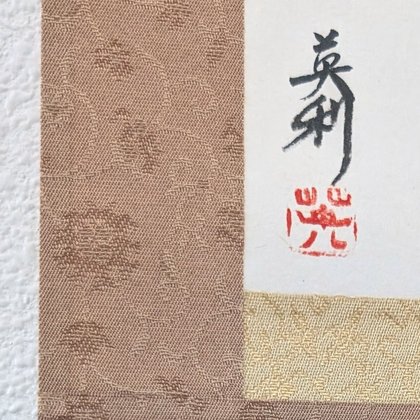
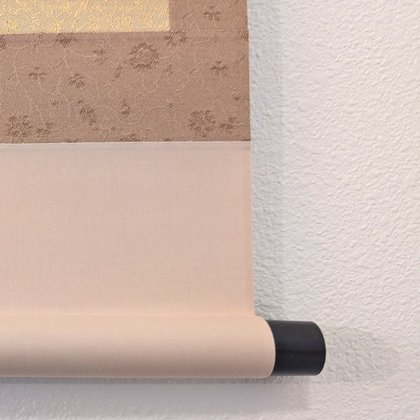
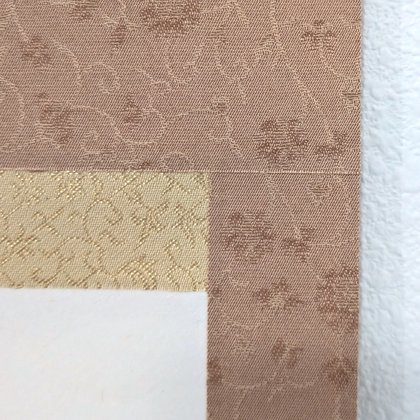
The scrolls are 12 1/4" W × 43" H (31 × 109 cm) with woven damask borders and Japanese paper that are layered so the scroll hangs straight and will not warp over time. The scrolls themselves are made by a scroll maker in Gifu, Japan, and we have worked with them for over two decades.
Eri Takase was born and raised in Osaka, Japan, and holds the rank of Shihan, the highest rank in Japanese calligraphy, from the Bokuteki-kai and the Bunka-shodo. About Master Takase
Related products

Bashō - A rough sea: lying toward Sado, the Milky Way荒海や佐渡によこたふ天河araumi ya sado ni yokotau amanogawa

Bashō - As the temple bell fades, The ringing lingers in the blossom scent, Evening鐘消えて花の香は撞く夕べ哉kane kiete hana no ka wa tsuku yūbe kana

Bashō - Gathering the early-summer rains, swift: the Mogami River五月雨をあつめて早し最上川samidare o atsumete hayashi mogamigawa
